

Microsoft has quietly moved Azure Copilot out of the sidebar and into the engine room: at Ignite 2025 Microsoft unveiled an agentic Azure Copilot — a managed orchestration layer and a family of purpose-built AI agents designed to plan, reason, and (with guardrails) act across the cloud application lifecycle.
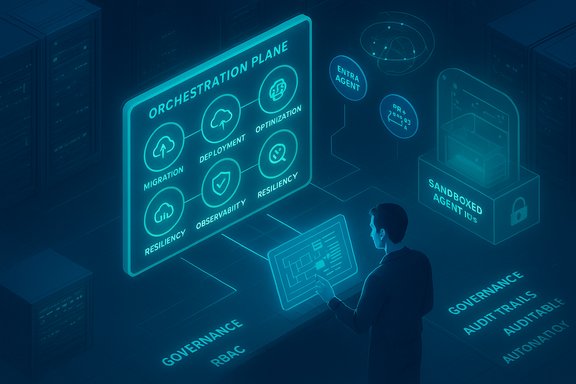
Azure Copilot’s evolution is important context: the original Copilot in Azure (and the GitHub Copilot agent work in VS Code) focused on natural-language assistance and code suggestions. The new offering reframes Copilot as an orchestration plane that binds together agent authoring, runtime, model choice and tenant-level governance into a single operational story. Microsoft describes this shift as agentic cloud ops — an architecture where specialized agents (Migration, Deployment, Optimization, Observability, Resiliency and Troubleshooting) are orchestrated by a central pipeline that enforces identity, policy, and approvals. This is not a UI tweak. It’s a systems-level strategy: Copilot Studio and Azure AI Foundry supply the model and agent lifecycle tooling; the Model Context Protocol (MCP) and agent-to-agent conventions enable safe tool access and inter-agent cooperation; Agent 365 and Entra integrations tie agents into identity and policy; and an Operations Center plus an Agent Mode UX give operators a plan‑first, auditable view of what agents propose and do.
The new Azure Copilot is best approached with pragmatic optimism: it delivers a coherent vision and useful early capabilities, but the enterprise payoff depends on disciplined pilots, careful policy design, and independent validation of performance and cost assumptions. The announcements are a foundation — converting them into reliable production value will be the work of the next 12–24 months.
Source: InfoWorld Agentic cloud ops with the new Azure Copilot
 Background / Overview
Azure Copilot’s evolution is important context: the original Copilot in Azure (and the GitHub Copilot agent work in VS Code) focused on natural-language assistance and code suggestions. The new offering reframes Copilot as an orchestration plane that binds together agent authoring, runtime, model choice and tenant-level governance into a single operational story. Microsoft describes this shift as agentic cloud ops — an architecture where specialized agents (Migration, Deployment, Optimization, Observability, Resiliency and Troubleshooting) are orchestrated by a central pipeline that enforces identity, policy, and approvals. This is not a UI tweak. It’s a systems-level strategy: Copilot Studio and Azure AI Foundry supply the model and agent lifecycle tooling; the Model Context Protocol (MCP) and agent-to-agent conventions enable safe tool access and inter-agent cooperation; Agent 365 and Entra integrations tie agents into identity and policy; and an Operations Center plus an Agent Mode UX give operators a plan‑first, auditable view of what agents propose and do. What Microsoft actually announced
The agent family and orchestration model
Microsoft’s public materials and Ignite roll-ups spell out a clear initial lineup: six purpose-built Azure Copilot agents for the cloud lifecycle — Migration, Deployment, Optimization, Observability, Resiliency, and Troubleshooting. These agents can be combined into multi-step plans by an orchestrator that reasons over the tenant’s context, applies RBAC/Azure Policy checks, and either proposes a plan for approval or executes (with tenant-configured gates). Key operational primitives:- Agent Mode: a plan-first UI where agents show intended steps, intermediate artifacts, and approval points before any change to production.
- Operations Center: a single-pane operational view aggregating agent findings, telemetry, optimization suggestions and remediation history.
- Agent identity: agents are represented as first-class principals (Entra Agent IDs / managed identities) so every action is attributable and controllable through existing identity workflows.
Deployment Agent: from intent to Infrastructure-as-Code
The Deployment Agent is the most tangible example for many teams: it accepts natural-language intent, conducts multi-turn clarification, proposes an architecture aligned to the Azure Well‑Architected Framework, and then generates Terraform configurations you can review or push to GitHub as a draft pull request. Microsoft’s documentation explicitly notes that the current preview produces Terraform artifacts only, and that the feature is focused on greenfield deployments rather than importing or modifying unknown existing estates. This plan→code flow is designed to accelerate time-to-value by removing repetitive scaffolding work, but it also introduces integration considerations (for example, organizations that standardize on ARM templates or Bicep will need conversion workflows or interim processes).Ecosystem pieces: Copilot Studio, Azure AI Foundry, MCP, and Foundry Agent Service
Azure Copilot doesn’t stand alone. Microsoft ties agents into broader platform tooling:- Copilot Studio: low-code/no-code authoring for agents and connectors, with runtime testing and governance controls.
- Azure AI Foundry / Foundry Agent Service: model cataloging, model routing, and operational controls that let tenants pick models (including vendor/third‑party choices) and manage model lifecycle.
- Model Context Protocol (MCP): a protocol and server model for secure discovery and invocation of tools/connectors so agents can call APIs and services in a controlled way.
Where agents run: Cloud PCs, Windows 365 for Agents, and sandboxing
Microsoft previewed Windows 365 for Agents, a Cloud PC runtime tuned for agent work, paired with an Agent Workspace sandbox to host agent processes under constrained identities and ephemeral credentials. This design is meant to isolate agent activity from user endpoints and to centralize scaling, billing, and audit trails.Why it matters: immediate benefits
Azure Copilot’s agentic approach promises several practical advantages for teams running and modernizing cloud estates:- Faster provisioning and modernization: by translating intent to Terraform artifacts and CI/CD-ready pull requests, teams can compress the time from architecture to deployed environment.
- Consistency and best-practice encoding: agents apply the Well‑Architected Framework to surface tradeoffs and default guardrails, reducing ad‑hoc misconfigurations.
- Observable automation: Agent Mode and the Operations Center aim to make automation auditable and reversible rather than opaque.
- Cross-domain workflows: composition of Migration→Deployment→Observability agents can produce end-to-end plans that span discovery, conversion, deployment, and post‑deploy validation.
- Platform-level governance: agent identities, RBAC integration, Azure Policy enforcement and BYOS (bring‑your‑own‑storage) options give CIOs administrative levers to control data residency, retention, and who may allow agent actions.
Risks, limitations, and the hard realities
No industrial shift is frictionless. The agentic cloud ops model introduces new failure modes and governance burdens that teams must confront.1) Governance and identity complexity
Agents expand the automation attack surface. Treating agents as principals helps trace actions, but it also demands disciplined lifecycle workflows (provisioning, access reviews, conditional access, deprovisioning) and careful policy scopes. Poorly scoped agents can make high‑impact changes quickly.2) Policy design becomes the new plumbing
Azure Policy and RBAC must now do heavy lifting to constrain agent behavior. Designing policy templates that both enable agent productivity and limit blast radius is non-trivial; it requires testing for corner cases and managing exceptions. Expect approval workflows to become operational bottlenecks if not thoughtfully implemented.3) Hallucination, incorrect assumptions, and data quality
Agents reason using models and tenant data. If data is mislabeled, incomplete, or not purged of sensitive content, agent decisions will be flawed or risky. Agents can propose inaccurate remediation scripts or incomplete designs — making human review essential, especially for production changes. This is a general LLM risk amplified when the output can be executed on infrastructure.4) Toolchain and IaC mismatch
The Deployment Agent currently generates Terraform-only artifacts and is greenfield-focused. Organizations that use ARM, Bicep, or tightly integrated IaC pipelines will need migration paths or change control to adopt the generated code. The Terraform-only limitation is explicit in Microsoft’s docs and is a practical blocker for some governance models.5) Cost and hidden consumption
Agentic workloads — especially those that leverage GPU-backed model inference, cross-region AI WAN traffic, or Windows 365 for Agents Cloud PC compute — can generate non-obvious operating costs. Teams must model cost-per-result and monitor agent-driven actions (retries, large-scale scans, or simulation runs) that can spike bills quickly. Microsoft’s messages about new datacenter silicon and offload hardware are strategic; independent verification is required for procurement decisions.6) Vendor concentration and lock-in risk
Agent authoring, grounding, model routing, and governance are tightly integrated into Microsoft’s stack (Copilot Studio, Foundry, Fabric, OneLake). While multi-model support is advertised, long-term operational and data gravity effects may increase vendor lock‑in unless teams design explicit portability layers.Verification and what’s been independently corroborated
Multiple Microsoft pages and independent coverage confirm the core facts: the six agents exist in preview, Deployment Agent generates Terraform-only artifacts, preview access is gated, and agent identity/governance controls are emphasized. See Microsoft’s Azure blog and Learn documentation for the technical specifics and the Azure Infrastructure blog/TechCommunity updates for operational detail. Independent trade press and technical blogs mirrored the announcement and raised similar cautions about governance and cost. A few claims require caution:- Microsoft’s hardware and datacenter improvements (Fairwater, GB300 NVL72 racks, Cobalt silicon) were described as strategic direction at Ignite. Published performance and power numbers for new silicon are promotional until formal product datasheets and independent benchmarks are released; treat those numeric claims as provisional until validated.
- Industry forecasts (for example, an IDC snapshot Microsoft referenced about 1.3 billion AI agents by 2028) are market projections and should be treated as forecasts, not operational facts. Use them to inform planning urgency, not deterministic roadmaps.
Practical checklist: how to pilot Azure Copilot agents safely
- Inventory: map business-critical apps, data locations, and compliance boundaries. Tag what must never be modified by automation without human sign-off.
- Policy Templates: create scoped RBAC roles and Azure Policy definitions specifically for agent identities; default to deny for high-impact actions.
- Approval Flows: require human approvals for any plan that touches production or cross-account resources; test approval UX under load.
- Small Representational Pilots: pick a single non-critical environment (sandbox or dev subscription) and run end-to-end Deployment→Observability workflows. Measure time saved and failure modes.
- Artifact Review Controls: enforce PR workflows for generated IaC, with mandatory linting, static security checks, and a plan-only CI job before merge.
- Telemetry and Auditing: integrate logs to SIEM (Sentinel/other), monitor run histories, and create dashboards for agent actions and costs.
- Recovery Playbooks: simulate rollback scenarios for agent-driven changes; validate the “reversible” story the Agent Mode UX promises.
- Cost Modeling: run consumption simulations for agent workloads that use Cloud PCs, GPU inference, and cross-region transfers. Negotiate pricing or set consumption alerts.
- Data Governance: ensure Purview/labeling and OneLake/Fabric policies are accurate so agents reason over correct data.
- Vendor/Portability Plan: decide how much to rely on Copilot Studio/Foundry primitives vs. building portability layers (e.g., storing canonical artifacts, using model-agnostic tooling).
Governance patterns that scale
- Agent as product: assign owners, SLAs, and a lifecycle policy for each agent (versioning, testing, decommissioning). Treat agents as operational products.
- Least-Privilege composition: split agent duties across narrow roles (e.g., a Deployment Agent role that can create resource groups but not touch identity stores).
- Approval co-pilot: design an “approver” agent or an automated checklist that validates generated plans against corporate best practices before human sign-off.
- Observability-first design: route all mutable actions through a single audit plane and wire agent telemetry to change management systems.
Implications for teams and the market
- For SRE and DevOps teams, agentic automation promises faster scaffolding and repeatable modernization paths — if teams accept IaC artifacts produced by the agent and place robust review gates in CI.
- For SecOps, the agent model creates both an opportunity (automated, consistent remediation) and risk (agents that hold credentials or that can make sweeping changes). Security teams must be early pilots and gatekeepers.
- For platform and cloud architects, the value is in composition: mapping migration, deployment, observability and optimization into a coherent, automated flow that reduces human error. Platform teams must also own the lifecycle of agents and the fitness tests for their outputs.
- For MSPs and partners, a new market of packaged, outcome‑oriented agents will emerge — companies that deliver prebuilt agent blueprints, hardened connectors, and certified automation patterns will be valuable to customers hesitant to build their own.
Technical constraints and unanswered questions
- Terraform-only output for Deployment Agent is a gating constraint for many orgs; Microsoft’s docs state this explicitly, and there is no ARM/Bicep export yet. Teams that standardize on other IaC formats need conversion or governance that accepts Terraform artifacts.
- The preview is gated and capacity-limited; administrators must request tenant-level access and the Agent Mode toggle appears only after approval. This rollout cadence affects planning and pilot timelines.
- Performance and cost claims around new datacenter silicon and offload hardware (Fairwater, GB300, Cobalt) are strategic; independent benchmarks and product datasheets will be necessary for procurement decisions. Treat early claims as directional.
- Interoperability between agents from different vendors and tenant boundaries relies on MCP and agent-to-agent conventions. The maturity and security model for cross-vendor agent cooperation will be a key operational determinant as third‑party agents proliferate.
A pragmatic next-steps roadmap (30/60/90 days)
- Day 0–30
- Request preview access and read the Deployment Agent docs. Enable a sandbox tenant.
- Build a governance checklist and narrow agent RBAC roles.
- Day 31–60
- Run a greenfield Deployment Agent pilot: generate Terraform for a non-critical app, route through PR and CI checks, measure time and error rates.
- Integrate agent telemetry into existing SIEM/observability.
- Day 61–90
- Expand pilot to include an Observability/Optimization proof-of-concept and validate remediation loops. Simulate rollback scenarios.
- Conduct a cost impact study for agent-driven operations and Cloud PC usage.
Conclusion
Azure Copilot’s agentic pivot is a meaningful strategic move: Microsoft is packaging agent authoring, runtime, model choice, identity, and governance into a platform designed to let agents operate across the cloud lifecycle. For engineering teams, the potential productivity wins are real — plan-to-code pipelines, guided modernization, and auditable automation could shave weeks off routine work and reduce configuration errors. At the same time, agentic cloud ops amplifies governance, policy, and cost challenges. Identity-first agent principals, approval flows, careful policy scoping, rigorous telemetry, and controlled pilots are non-negotiable prerequisites before granting agents operational privileges. Treat agents as operational products with owners, SLAs, and staged rollouts.The new Azure Copilot is best approached with pragmatic optimism: it delivers a coherent vision and useful early capabilities, but the enterprise payoff depends on disciplined pilots, careful policy design, and independent validation of performance and cost assumptions. The announcements are a foundation — converting them into reliable production value will be the work of the next 12–24 months.
Source: InfoWorld Agentic cloud ops with the new Azure Copilot
