

Azure Custom Commands retires on September 19, 2026, and Windows automation teams should not treat the deadline as a hunt for a drop-in SDK. The right replacement depends on the workload: use speech-to-text plus an explicit command layer for deterministic automation, CLU or Microsoft Foundry for structured intent extraction, and Foundry models only when the product genuinely needs an open-ended assistant.
Microsoft’s 2026 lifecycle list confirms the retirement date. That leaves administrators and developers roughly two months to locate production dependencies, separate speech recognition from command execution, and decide how much nondeterminism each workflow can safely tolerate.
The key distinction is architectural. Azure Custom Commands bundled capabilities that replacement designs may need to divide among transcription, language interpretation, policy enforcement, and Windows-side execution. Migrating without making those boundaries explicit risks turning a predictable voice command into a loosely controlled AI action.
The first task is not selecting a Microsoft Foundry model. It is identifying every application, service, script, kiosk, help-desk tool, accessibility workflow, or line-of-business client that still assumes Custom Commands will translate speech into an executable action.
Search application source, infrastructure definitions, deployment documentation, Azure resource inventories, configuration files, secrets, and operational runbooks for references to Custom Commands and associated Speech resources. Do not stop at the team that originally created the Azure component; Windows automation often survives through scheduled tasks, PowerShell scripts, desktop utilities, service accounts, and undocumented launchers long after the front-end project changes ownership.
For each dependency, record five things:
Conversely, a support assistant expected to interpret broad troubleshooting requests, ask follow-up questions, and synthesize guidance is not merely a command parser. Rebuilding that experience as a rigid phrase table would preserve predictability at the cost of the product’s purpose.
This is similar to the lesson behind WindowsForum’s coverage of the PowerShell 2.0 retirement: locating the legacy component is only the beginning. Administrators must also discover which operational assumptions grew around it and whether those assumptions still belong in the replacement.
That design preserves a critical separation: recognizing what the user said does not automatically authorize what the computer should do. The dispatcher can reject unknown commands, validate arguments, require confirmation, check user identity, enforce role restrictions, and write an audit record before invoking PowerShell, a Windows service API, or another automation endpoint.
A second path uses Conversational Language Understanding, or CLU, when commands vary naturally but still need structured output. Microsoft documents a command-and-control pattern in which speech-to-text transcribes an utterance and CLU identifies its intent and extracts entities for the client application.
For example, an application might need to distinguish an intent such as restarting a service from another intent such as checking its status, while extracting the requested service name. CLU supplies the interpretation; application code must still decide whether the extracted service is permitted, whether the caller has authority, and whether confirmation is required.
CLU is therefore a bridge rather than a permanent destination. Microsoft now advises customers to direct new projects and migrate existing workloads toward Microsoft Foundry, while CLU itself is scheduled to retire on March 31, 2029. Moving from Custom Commands to CLU can reduce immediate migration work for an existing intent-and-entity design, but it also creates another dated transition.
The third path is a Foundry-based assistant designed for open-ended language. This makes sense when users expect the system to interpret unfamiliar requests, maintain conversational context, produce explanations, or propose multi-step plans. It is a redesign, not a mechanical port of a command-and-control application.
A generative assistant can still invoke tools, but its model output should not become an unrestricted command line. High-consequence actions need a constrained tool catalog, validated arguments, an authorization boundary, and an execution policy outside the model.
This matrix points to a conservative default for administrators: if the application controls Windows configuration, accounts, services, devices, files, or business records, start with the deterministic design. Add language intelligence only where simpler matching cannot handle the required phrasing.
A voice-operated media controller and a voice-operated privileged administration console may both use the word “command,” but they do not have the same failure cost. The latter needs stronger identity checks, narrower parameters, explicit confirmation, and a reliable record of who authorized the action.
A robust flow looks like this:
Confirmation also needs to reflect consequence rather than inconvenience. Reading service status may proceed immediately, while stopping a service, deleting data, changing a firewall rule, or disabling an account should require stronger approval. The parser can propose an action, but policy determines whether it runs.
This control remains necessary regardless of which Microsoft language technology supplies the intent. It also makes future migrations less disruptive because speech recognition and natural-language understanding can change without rewriting the execution boundary.
CLU is the closer conceptual fit for structured intent and entity extraction, but its March 31, 2029 retirement means teams should evaluate the cost of a two-stage migration now. A short-lived or difficult-to-redesign application may justify CLU as an interim step. A new strategic platform should account for Microsoft’s stated direction toward Foundry models from the outset.
That does not mean every new project should become generative. A Foundry-based implementation can still present model capabilities through a constrained intent or tool interface. The important decision is whether the model is interpreting a request, composing a response, or being allowed to initiate an operation—and where deterministic policy takes control.
The broader pattern will be familiar to readers following Microsoft’s other retirement cycles, including WindowsForum’s reporting on PowerShell 2.0 and the movement of older SQL and monitoring tooling toward newer platforms. Lifecycle notices expose technical debt, but replacing the named component without reviewing the surrounding architecture merely reschedules the problem.
The immediate milestone is a complete dependency inventory and a classification of each workflow into deterministic commands, structured intent extraction, or open-ended assistance. Teams should then test ambiguous speech, invalid entities, unauthorized requests, transcription failures, network loss, repeated commands, and rejected confirmations.
Operational documentation must also show how administrators can disable voice execution without disabling the underlying Windows management path. A conventional interface or manual recovery procedure matters when speech, connectivity, or language interpretation fails.
Finally, preserve the abstraction between interpretation and execution. Custom Commands retires on September 19, 2026; CLU follows on March 31, 2029; and LUIS is already gone. The durable investment is not another tightly coupled language endpoint, but a Windows automation layer that can change parsers without changing what the system is permitted to do.
Microsoft’s 2026 lifecycle list confirms the retirement date. That leaves administrators and developers roughly two months to locate production dependencies, separate speech recognition from command execution, and decide how much nondeterminism each workflow can safely tolerate.
The key distinction is architectural. Azure Custom Commands bundled capabilities that replacement designs may need to divide among transcription, language interpretation, policy enforcement, and Windows-side execution. Migrating without making those boundaries explicit risks turning a predictable voice command into a loosely controlled AI action.
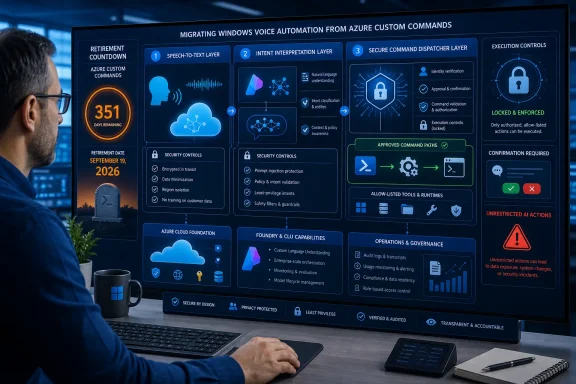 Find the Dependency Before Choosing the Replacement
The first task is not selecting a Microsoft Foundry model. It is identifying every application, service, script, kiosk, help-desk tool, accessibility workflow, or line-of-business client that still assumes Custom Commands will translate speech into an executable action.Search application source, infrastructure definitions, deployment documentation, Azure resource inventories, configuration files, secrets, and operational runbooks for references to Custom Commands and associated Speech resources. Do not stop at the team that originally created the Azure component; Windows automation often survives through scheduled tasks, PowerShell scripts, desktop utilities, service accounts, and undocumented launchers long after the front-end project changes ownership.
For each dependency, record five things:
- Capture the spoken phrases or phrase families the application accepts today.
- Document the Windows action triggered by each recognized command.
- Identify whether the action changes data, security state, device configuration, or service availability.
- Record the acceptable response time and whether the workflow must function without a cloud connection.
- Determine what logs, approvals, and confirmation prompts operators need for an audit.
Conversely, a support assistant expected to interpret broad troubleshooting requests, ask follow-up questions, and synthesize guidance is not merely a command parser. Rebuilding that experience as a rigid phrase table would preserve predictability at the cost of the product’s purpose.
This is similar to the lesson behind WindowsForum’s coverage of the PowerShell 2.0 retirement: locating the legacy component is only the beginning. Administrators must also discover which operational assumptions grew around it and whether those assumptions still belong in the replacement.
Three Migration Paths, Not One Successor
The safest replacement for tightly bounded Windows automation is a speech-to-text component feeding an allow-listed command dispatcher. The transcription layer produces text, while application code maps approved phrases or parameters to specific operations.That design preserves a critical separation: recognizing what the user said does not automatically authorize what the computer should do. The dispatcher can reject unknown commands, validate arguments, require confirmation, check user identity, enforce role restrictions, and write an audit record before invoking PowerShell, a Windows service API, or another automation endpoint.
A second path uses Conversational Language Understanding, or CLU, when commands vary naturally but still need structured output. Microsoft documents a command-and-control pattern in which speech-to-text transcribes an utterance and CLU identifies its intent and extracts entities for the client application.
For example, an application might need to distinguish an intent such as restarting a service from another intent such as checking its status, while extracting the requested service name. CLU supplies the interpretation; application code must still decide whether the extracted service is permitted, whether the caller has authority, and whether confirmation is required.
CLU is therefore a bridge rather than a permanent destination. Microsoft now advises customers to direct new projects and migrate existing workloads toward Microsoft Foundry, while CLU itself is scheduled to retire on March 31, 2029. Moving from Custom Commands to CLU can reduce immediate migration work for an existing intent-and-entity design, but it also creates another dated transition.
The third path is a Foundry-based assistant designed for open-ended language. This makes sense when users expect the system to interpret unfamiliar requests, maintain conversational context, produce explanations, or propose multi-step plans. It is a redesign, not a mechanical port of a command-and-control application.
A generative assistant can still invoke tools, but its model output should not become an unrestricted command line. High-consequence actions need a constrained tool catalog, validated arguments, an authorization boundary, and an execution policy outside the model.
Match the Architecture to the Risk
The practical choice can be reduced to the operating characteristics of the workload.| Requirement | Speech-to-text plus explicit commands | CLU or Foundry intent extraction | Open-ended Foundry assistant |
|---|---|---|---|
| Safety for high-consequence actions | Best fit when every operation and parameter is allow-listed. | Suitable when intent output is validated before execution. | Requires the strongest tool restrictions and confirmation controls. |
| Predictable latency | Usually the simplest processing path after transcription. | Adds an intent-classification stage. | May require more processing and conversational turns. |
| Strict offline operation | Requires a locally available transcription and command stack rather than a cloud dependency. | A cloud-dependent design does not satisfy strict offline requirements. | A cloud-dependent assistant does not satisfy strict offline requirements. |
| Auditability | Commands, arguments, policy decisions, and results can be recorded directly. | Intent scores, extracted entities, validation, and execution should be logged. | Prompts alone are insufficient; tool requests and policy decisions need separate records. |
| Tolerance for generative output | None is required. | Low when the system returns predefined intents and entities. | High, although executable actions must remain constrained. |
| Best workload shape | Small, stable command vocabulary. | Variable phrasing mapped to known intents. | Broad requests, dialogue, explanations, and planning. |
A voice-operated media controller and a voice-operated privileged administration console may both use the word “command,” but they do not have the same failure cost. The latter needs stronger identity checks, narrower parameters, explicit confirmation, and a reliable record of who authorized the action.
The Command Layer Is the Security Boundary
Neither CLU nor a generative model should decide directly that an arbitrary string is safe to execute. For high-consequence Windows automation, the authoritative layer should accept a structured request and map it to a predefined operation.A robust flow looks like this:
- Speech is transcribed into text.
- A deterministic parser, CLU project, or Foundry model interprets the request.
- The application converts that interpretation into a known command identifier and validated parameters.
- A policy layer checks identity, authorization, resource scope, and confirmation requirements.
- The dispatcher invokes only the corresponding approved operation.
- The application records the request, policy decision, command, result, and failure state.
Confirmation also needs to reflect consequence rather than inconvenience. Reading service status may proceed immediately, while stopping a service, deleting data, changing a firewall rule, or disabling an account should require stronger approval. The parser can propose an action, but policy determines whether it runs.
This control remains necessary regardless of which Microsoft language technology supplies the intent. It also makes future migrations less disruptive because speech recognition and natural-language understanding can change without rewriting the execution boundary.
Do Not Retreat to LUIS
LUIS is not an escape route for teams seeking a familiar intent model. It retired on October 1, 2025, so rebuilding a Custom Commands workload around LUIS would exchange one unsupported dependency for another.CLU is the closer conceptual fit for structured intent and entity extraction, but its March 31, 2029 retirement means teams should evaluate the cost of a two-stage migration now. A short-lived or difficult-to-redesign application may justify CLU as an interim step. A new strategic platform should account for Microsoft’s stated direction toward Foundry models from the outset.
That does not mean every new project should become generative. A Foundry-based implementation can still present model capabilities through a constrained intent or tool interface. The important decision is whether the model is interpreting a request, composing a response, or being allowed to initiate an operation—and where deterministic policy takes control.
The broader pattern will be familiar to readers following Microsoft’s other retirement cycles, including WindowsForum’s reporting on PowerShell 2.0 and the movement of older SQL and monitoring tooling toward newer platforms. Lifecycle notices expose technical debt, but replacing the named component without reviewing the surrounding architecture merely reschedules the problem.
What Teams Should Complete Before September 19
By the retirement date, organizations need more than a proof of concept. They need a tested production path that no longer depends on Custom Commands.The immediate milestone is a complete dependency inventory and a classification of each workflow into deterministic commands, structured intent extraction, or open-ended assistance. Teams should then test ambiguous speech, invalid entities, unauthorized requests, transcription failures, network loss, repeated commands, and rejected confirmations.
Operational documentation must also show how administrators can disable voice execution without disabling the underlying Windows management path. A conventional interface or manual recovery procedure matters when speech, connectivity, or language interpretation fails.
Finally, preserve the abstraction between interpretation and execution. Custom Commands retires on September 19, 2026; CLU follows on March 31, 2029; and LUIS is already gone. The durable investment is not another tightly coupled language endpoint, but a Windows automation layer that can change parsers without changing what the system is permitted to do.
References
- Primary source: learn.microsoft.com
Azure Blueprints retirement - Azure Blueprints | Microsoft Learn
Learn when Azure Blueprints is retired, the phased retirement timeline, what changes in each phase, and how to migrate to Azure Deployment Stacks and template specs.learn.microsoft.com - Independent coverage: mc.merill.net
MC1422061 - Microsoft Entra ID: Retirement of Custom Controls in Conditional Access and migration to External MFA | Microsoft 365 Message Center Archive
Microsoft Entra ID is retiring Custom Controls in Conditional Access by May 2027, replacing them with External MFA for standardized third-party MFA integration. Administrators…mc.merill.net - Independent coverage: techcommunity.microsoft.com
- Independent coverage: support.microsoft.com
Windows Speech Recognition commands | Microsoft Support
Learn how to control your PC by voice using Windows Speech Recognition commands for dictation, keyboard shortcuts, punctuation, apps, and more.support.microsoft.com - Primary source: WindowsForum
Microsoft Retires PowerShell 2.0: Embrace the Future of Windows Automation and Security | Windows Forum
A seismic but well-signposted shift has arrived for system administrators, IT departments, and Windows power users worldwide: Microsoft is finally retiring...windowsforum.com