

Microsoft’s claim that algorithms are worthless without data has quietly become the operating principle for organizations trying to scale AI beyond pilots, and nowhere is that maxim more tangible than in the company’s Azure Data Analytics stack — a stitched-together ecosystem of ingestion, storage, processing, governance and consumption that aims to turn fragmented data estates into reliable, production-ready data foundations for AI. The components that matter — Azure Data Factory, Azure Synapse Analytics, Azure Databricks, Azure Machine Learning, Power BI, Microsoft Fabric / OneLake, and Microsoft Purview — are no longer separate point tools; they’re the rails on which enterprise AI maturity runs. This article verifies those claims, tests the technical specifics against public documentation and independent reporting, and lays out practical advantages, trade-offs and a staged roadmap for organizations that intend to become truly AI-driven.
Modern AI programs fail more often from poor data than from poor models. Data fragmentation, inconsistent quality, dispersed systems and manual reporting create the single largest barrier to scaling AI. A “data‑first” approach — where teams treat data as a product with owners, lineage, and access controls — is the practical pivot away from model‑first band‑aids.
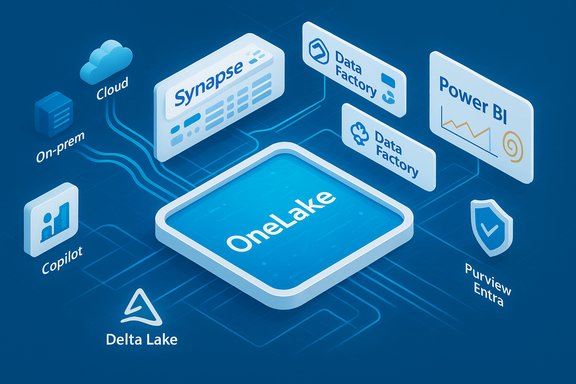
Microsoft’s strategy is to minimize that friction by offering a tightly integrated analytics stack that emphasizes a unified storage layer, end‑to‑end pipelines, real‑time processing, and baked‑in governance. Recent product moves center on Microsoft Fabric and its tenant‑level lake called OneLake as the “one copy of the truth” design point, supplemented by the familiar Azure services (Synapse, Data Factory, Databricks, Azure ML, Purview, Power BI). This integrated stance is echoed across Microsoft materials and community analyses, which describe the platform as a data-first backbone for production AI.
Why that matters: AI systems only scale when the data they consume is discoverable, trusted, accessible, and governed. Without that, pilots degenerate into point solutions that can’t be audited, repeated or operationalized.
At the same time, success is not automatic. The platform’s power amplifies good process and people — and magnifies poor governance, cost control failures, and skill gaps. Procurement teams should insist on verifiable evidence for throughput numbers and SLA claims; architects should design for data portability and cost controls; and security/compliance owners must be engaged from day one.
In short: Azure Data Analytics provides a complete, integrated toolbox for building AI‑driven organizations — but the return on that toolbox is realized only when disciplined data operations, responsible AI practices and cost governance are enforced alongside the technology.
Conclusion
Becoming an AI‑driven organization starts with turning raw, messy data into trustworthy, governed data products that models and business processes can reliably consume. Microsoft’s Azure Data Analytics portfolio — anchored by Fabric/OneLake, Synapse, Data Factory, Databricks, Azure Machine Learning, Purview and Power BI — supplies a practical path for that transformation. The technical claims behind the stack are well supported by product documentation and real‑world migrations, but they come with operational trade‑offs: vendor coupling, licensing complexity, governance workloads and the need for skilled cross‑functional teams. Organizations that pair the platform with clear data ownership, staged governance, and careful cost planning will get durable value; those that treat these tools as a silver bullet will find themselves managing brittle systems instead of production AI.
Source: Analytics Insight The Role of Azure Data Analytics in Building AI-Driven Organizations
 Background / Overview
Modern AI programs fail more often from poor data than from poor models. Data fragmentation, inconsistent quality, dispersed systems and manual reporting create the single largest barrier to scaling AI. A “data‑first” approach — where teams treat data as a product with owners, lineage, and access controls — is the practical pivot away from model‑first band‑aids.Microsoft’s strategy is to minimize that friction by offering a tightly integrated analytics stack that emphasizes a unified storage layer, end‑to‑end pipelines, real‑time processing, and baked‑in governance. Recent product moves center on Microsoft Fabric and its tenant‑level lake called OneLake as the “one copy of the truth” design point, supplemented by the familiar Azure services (Synapse, Data Factory, Databricks, Azure ML, Purview, Power BI). This integrated stance is echoed across Microsoft materials and community analyses, which describe the platform as a data-first backbone for production AI.
Why that matters: AI systems only scale when the data they consume is discoverable, trusted, accessible, and governed. Without that, pilots degenerate into point solutions that can’t be audited, repeated or operationalized.
Anatomy of Azure Data Analytics
Below is a verified, component‑by‑component look at what each major Azure capability provides, and which technical claims hold up under scrutiny.Azure Data Factory — centralized ingestion and orchestration
- What it does: A fully managed data integration service for creating ETL/ELT pipelines that move and transform data from source to destination.
- Verified capabilities:
- Broad connector catalog for many SaaS, on‑prem and cloud data stores: Microsoft documents a comprehensive connector overview for Azure Data Factory and Synapse pipelines, covering a wide range of sources and formats (Parquet, Delta, Iceberg, JSON, Excel, relational stores, SaaS apps).
- Extensible options (ODBC, REST, custom activities) where native connectors aren’t available.
- Common claim checked: “100+ native connectors.” Microsoft’s connector catalog is the authoritative source and lists a large, evolving set of connectors; independent practitioner writeups and consulting guides repeatedly reference “over 100 connectors” as an accurate description for planning purposes. Where exact counts matter for procurement, validate against the live connector overview because Microsoft updates this list frequently.
Azure Synapse Analytics — warehouse + lake + real‑time SQL
- What it does: Blends enterprise data warehousing with big‑data analytics under a unified studio, offering both provisioned (dedicated) and serverless SQL, Spark pools, and pipelines.
- Verified capabilities:
- Designed for large‑scale analytics and MPP query workloads; Microsoft positions Synapse as a system capable of petabyte‑scale analytics and the ability to run TPC‑H queries at petabyte scale. Public Microsoft articles and technical pages document serverless SQL, dedicated SQL pools, Spark integration and lake database semantics.
- Serverless SQL pool enables pay‑per‑query exploration over data lakes, reducing infrastructure overhead for ad‑hoc queries.
- Practical note: Synapse serves both as a high‑throughput warehouse and as a query surface for lake data, making it a natural integration point with Power BI and Azure ML.
Azure Databricks — Spark, Delta Lake and MLflow
- What it does: Managed Apache Spark platform with a lakehouse architecture (Delta Lake), collaborative notebooks, and integrated tooling for feature stores and model lifecycle.
- Verified capabilities:
- Delta Lake brings ACID transactions, schema enforcement and time travel to lake storage; Databricks’ managed MLflow supports experiment tracking, model registry and model serving workflows. Microsoft and Databricks documentation confirm tight integration between Databricks, Delta Lake and MLflow footprints on Azure.
- Databricks on Azure is commonly used as the compute layer for large‑scale ETL and model training in production telco, retail and financial workloads (independent migrations report tens of billions of daily records in some cases). These claims often come from vendor case studies and industry press; treat customer throughput numbers as vendor‑reported unless independently audited.
Azure Machine Learning — MLOps, automated ML, and operationalization
- What it does: Model training, experiment tracking, model registry, managed endpoints, and MLOps tooling to move models from experiment to production with monitoring and governance.
- Verified capabilities:
- Azure ML supports AutoML (no‑code/low‑code AutoML flows for tabular, text and image tasks), model registries and managed endpoints for real‑time/batch scoring. Documentation and Microsoft guidance show CI/CD integration, model monitoring, bias/fairness tooling and telemetry for governance.
- Integration with MLflow and Databricks is well documented; teams commonly use MLflow on Databricks for experiment tracking and push models into Azure ML for production hosting or use Azure ML’s MLOps pipelines. Databricks and Microsoft explain common patterns for integrating MLflow and Azure ML serving.
- Responsible AI: Azure ML includes explainability and fairness toolkits and a Responsible AI dashboard, but some UI features and AutoML integrations evolve rapidly — organizations should verify current UI and API surfaces before assuming parity with older documentation.
Power BI (and Copilot) — business consumption and augmented analytics
- What it does: Interactive dashboards, embedded analytics, natural‑language query and now Copilot capabilities that enable conversational access to governed datasets.
- Verified capabilities:
- Copilot in Power BI is available and being rolled out as both an in‑pane assistant and a full‑screen “Chat with your data” experience; Microsoft docs outline prerequisites, capacity requirements (Premium/Fabric capacities) and tenant settings for enabling Copilot.
- Copilot is dependent on capacity choices (Power BI Premium / Fabric Copilot capacity), and some premium features may require dedicated billable capacity. Administrators must enable tenant settings and ensure workspace licensing aligns with Copilot consumption.
Microsoft Fabric and OneLake — the unifying layer
- What it does: Fabric is Microsoft’s SaaS analytics plane that includes a managed cross‑workload lake called OneLake, intended to reduce data movement by providing a single, tenant‑level lake that maps to ADLS Gen2 under the covers.
- Verified capabilities:
- Microsoft documentation describes OneLake as a unified logical data lake automatically provisioned for Fabric tenants, supporting Delta/Parquet/Iceberg formats and integration with existing Azure services (Databricks, Synapse). OneLake acts as the canonical store for Fabric workloads.
- Fabric’s design intent is to allow multiple analytics engines to operate on one copy of data, minimizing duplication and simplifying governance. Industry writeups and community discussion confirm this vision, though real‑world migrations still require careful transition planning.
Microsoft Purview / Entra — governance, classification, and secure access
- What it does: Cataloging, lineage, classification and policy enforcement across the data estate; integrates with Fabric, Synapse, and other Azure services for DLP and access control.
- Verified capabilities:
- Purview provides data discovery, lineage tracking and classification; integration guides and product pages show how Purview supports governance for AI workloads and ensures data used by Copilot/agents can be constrained by policy.
How Azure Data Analytics Powers AI‑Driven Business Models
Once the pieces above are wired correctly, Azure becomes the platform for four high‑value capabilities that shift organizations toward AI maturity.- Predictive decision‑making at scale. Organizations can combine Synapse serverless queries, Databricks training pipelines and Azure ML models to forecast demand, detect anomalies and predict churn with operational scoring. These patterns are reinforced by product integrations and customer migrations.
- Intelligent automation. Data Factory, Synapse, and Azure ML integrated with Power Automate and Copilot enable end‑to‑end automation: from an anomaly detected in streaming telemetry to automated ticket creation and human review workflows. Microsoft positions Copilot + Fabric as low‑friction endpoints for business users to consume AI outputs.
- A single source of truth. OneLake / ADLS Gen2 plus Delta/Iceberg table formats let teams curate governed lakehouse layers that multiple compute engines can share, reducing duplication and accelerating time to insight. Fabric’s OneLake is explicitly built to be that canonical store.
- Governance and compliance by design. Purview, Entra ID, private VNet options and DLP help enterprises track lineage, secure sensitive data and restrict agent or Copilot access to approved data surfaces. These are central features for regulated industries.
Real‑world signals: who’s driving this at scale?
Public and partner case studies provide practical signals that the architecture can work in production:- MTN’s migration to a Databricks‑on‑Azure lakehouse (EVA 3.0) is a high‑visibility telco example where Databricks + ADLS + Delta + Azure networking/security were used to consolidate telemetry and OSS/BSS signals at very high scale. The company reported very large daily record volumes and hundreds of analytic workflows — a vendor‑reported scale that independent reporting has amplified. Treat customer numbers as company statements to be validated during procurement.
- Academic and public sector pilots (Xavier College, Georgia Tech, Oregon State University) highlight practical benefits when organizations pair scoped problems, governed data and human oversight; results cited show faster insights and workflow automation when governance was applied up front. These examples illustrate the practical value of a governed platform.
Strengths: what Azure Data Analytics actually buys you
- Integrated, end‑to‑end tooling reduces friction between data engineers, data scientists and business teams, shortening time to production.
- Scalability and scale economics — from serverless SQL that charges per query to provisioned Synapse pools and Databricks clusters, the platform can handle large batch and streaming workloads. Microsoft documentation and product pages confirm serverless options and scale claims.
- Governance baked into the stack through Purview/Entra and Fabric capabilities — audit trails, lineage and classification reduce regulatory risk relative to ad‑hoc models.
- Democratization of insights via Power BI + Copilot, enabling non‑technical users to ask questions in natural language and embed AI insights into operational flows.
Risks, limitations, and practical cautions
No platform is a magic bullet. These trade‑offs are real and must be planned for.- Vendor lock‑in. Deep investment in Fabric/OneLake and platform‑specific services increases migration cost and operational coupling. Teams requiring multi‑cloud portability should design abstractions and use open table formats (Iceberg/Delta) to mitigate this risk. Microsoft is making interoperability improvements but lock‑in remains a non‑trivial business risk.
- Cost complexity. The pay‑as‑you‑go model can create unpredictable spend across streaming, compute spikes (Databricks/Synapse), and Copilot premium capacities. Accurate capacity planning, cost tagging and reserved capacity commitments are essential. Copilot experiences in Power BI and Fabric may require Premium/Fabric capacity to be cost‑effective for broader rollouts.
- Governance is organizational, not just technical. Tools help; people and process are required. Data stewards, clear SLA playbooks, red‑team exercises for prompt injection and model governance are operational necessities. Community playbooks repeatedly stress governance-first sequencing for Copilot/agent rollouts.
- Model safety and hallucination risks. Integrating LLMs with enterprise data requires retrieval quality controls, provenance on RAG results, and careful policy mechanics to prevent misleading outputs. These are technical problems with policy and people elements — not purely engineering fixes.
- Marketing vs. verifiable claims. Statements like “market leadership among tech giants” are vendor positioning and must be validated against independent market research (Gartner, Forrester) when used in procurement or RFP responses. Treat such claims cautiously and ask vendors for verifiable metrics and named references.
A practical roadmap to AI maturity on Azure
Community playbooks and vendor guidance converge on a staged approach that balances quick wins with governance essentials.- Immediate (0–3 months)
- Run a rapid data‑health sprint on the 2–3 datasets that feed critical KPIs.
- Establish identity baseline (Microsoft Entra ID), MFA and conditional access.
- Create a minimal Purview catalog and assign owners for prioritized data products.
- Launch a limited Copilot pilot behind human review to measure output quality and risk.
- Platform & governance (3–9 months)
- Consolidate critical workloads into a governed Fabric tenant or Synapse workspace with OneLake as canonical store.
- Implement MLOps pipelines in Azure ML (testing, validation, bias checks, deployment gates).
- Enable Purview policies and DLP for any surfaces Copilot and agents can access.
- Rightsize and commit to reserved capacity where predictable traffic exists.
- Scale & assurance (9–18 months)
- Expand Copilot/agent use only after governance and audit checklists are satisfied.
- Automate data quality checks and run periodic adversarial/red-team exercises (prompt injection, exfiltration scenarios).
- Measure operational KPIs: time‑to‑insight, data‑quality index, model‑drift metrics, MTTD/MTTR for incidents, and cost per analytic query.
Technical verification: claims and citations you can use in procurement
Below are the most load‑bearing technical claims often cited in vendor writeups, and where to verify them:- Azure Data Factory connectors: Microsoft’s connector overview is the authoritative source for supported connectors and formats; use it as the baseline for “connector parity” checks when validating vendor claims about source support.
- Synapse petabyte‑scale analytics: Microsoft product material and launch posts describe Synapse as capable of petabyte‑scale analytics and as having run TPC‑H queries at that scale; use these pages plus Synapse feature docs for performance expectations.
- Databricks + MLflow integration: Databricks’ own documentation details managed MLflow, experiment tracking and the model registry, and shows common integration patterns with Azure ML for serving. Use Databricks docs for model lifecycle behaviors.
- Azure Machine Learning MLOps & AutoML: Microsoft Learn and Azure ML docs describe AutoML capabilities, MLOps pipelines, model registry and monitoring; confirm which AutoML visualizations or Responsible AI dashboards are currently available because features evolve rapidly.
- Power BI Copilot: Microsoft’s Power BI blog and Learn articles document Copilot availability, tenancy and capacity prerequisites; administrators must validate license and capacity requirements before enterprise rollouts.
Final assessment: who should bet on Azure Data Analytics?
For enterprises that can commit to a disciplined, governance‑first transformation — and who value a single vendor experience that integrates identity, security, governance and BI — Azure Data Analytics (Fabric + OneLake + Synapse + Data Factory + Databricks + Azure ML + Purview + Power BI) is a practical, production‑grade platform that noticeably reduces friction between data engineering and AI operations. Industry migrations and Microsoft’s product evolution corroborate the approach: shared lakehouse semantics, built‑in cataloging, serverless query surfaces, and managed MLOps tooling together materially shorten time‑to‑value for AI initiatives.At the same time, success is not automatic. The platform’s power amplifies good process and people — and magnifies poor governance, cost control failures, and skill gaps. Procurement teams should insist on verifiable evidence for throughput numbers and SLA claims; architects should design for data portability and cost controls; and security/compliance owners must be engaged from day one.
In short: Azure Data Analytics provides a complete, integrated toolbox for building AI‑driven organizations — but the return on that toolbox is realized only when disciplined data operations, responsible AI practices and cost governance are enforced alongside the technology.
Conclusion
Becoming an AI‑driven organization starts with turning raw, messy data into trustworthy, governed data products that models and business processes can reliably consume. Microsoft’s Azure Data Analytics portfolio — anchored by Fabric/OneLake, Synapse, Data Factory, Databricks, Azure Machine Learning, Purview and Power BI — supplies a practical path for that transformation. The technical claims behind the stack are well supported by product documentation and real‑world migrations, but they come with operational trade‑offs: vendor coupling, licensing complexity, governance workloads and the need for skilled cross‑functional teams. Organizations that pair the platform with clear data ownership, staged governance, and careful cost planning will get durable value; those that treat these tools as a silver bullet will find themselves managing brittle systems instead of production AI.
Source: Analytics Insight The Role of Azure Data Analytics in Building AI-Driven Organizations
