

Microsoft’s argument that “algorithms are worthless without data” has become a de facto maxim for every organization attempting to move from pilot projects to enterprise-grade, AI-driven operations, and nowhere is that truth more practical than in the Azure Data Analytics stack. The cloud, tooling, and governance layers Microsoft has stitched together—now centered around products such as Microsoft Fabric/OneLake, Azure Synapse Analytics, Azure Data Factory, Azure Databricks on Azure, Microsoft Purview, Azure Machine Learning, Power BI, and streaming engines—are designed to convert fragmented, low-trust data estates into governed, high-velocity data foundations that feed reliable models and intelligent applications. This piece synthesizes the claims made in recent industry commentary, validates technical points against independent documentation, critiques strengths and risks, and lays out a pragmatic adoption roadmap for organizations that intend to become truly AI-driven.
The core premise behind any AI transformation is simple: models produce value only when they run on trustworthy, accessible, and well-engineered data. Microsoft’s modern Azure data story shifts attention away from isolated algorithmic experiments toward an integrated data platform that prioritizes:
Azure’s data analytics vision reframes AI maturity as a function of disciplined data operations: trustworthy inputs, governed distribution, real-time pipelines where required, and reliable model lifecycle management. For organizations with the appetite to invest in people and process alongside platform adoption, Azure offers a practical set of technologies to build, run, and govern AI at scale. Community migrations and Microsoft’s product roadmap indicate the approach is broadly viable—what remains is the hard work of sequencing adoption, policing quality, and measuring business outcomes.
Source: Analytics Insight The Role of Azure Data Analytics in Building AI-Driven Organizations
 Background / Overview
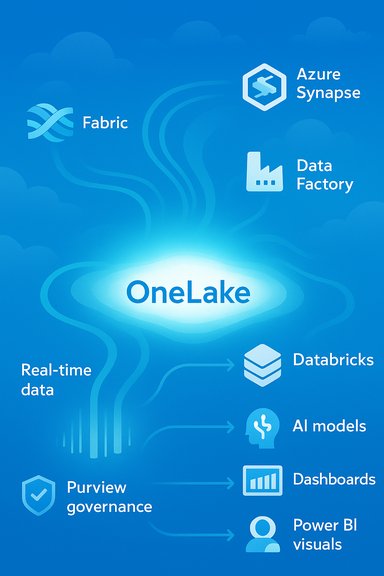
The core premise behind any AI transformation is simple: models produce value only when they run on trustworthy, accessible, and well-engineered data. Microsoft’s modern Azure data story shifts attention away from isolated algorithmic experiments toward an integrated data platform that prioritizes:- Unified storage and semantics (OneLake / ADLS Gen2 integrations)
- End-to-end data pipelines and orchestration (Azure Data Factory, Fabric SQL/ELT)
- Real-time ingestion and processing (Azure Stream Analytics, Fabric Real-Time)
- Model lifecycle and operationalization (Azure Machine Learning, MLOps pipelines)
- Enterprise-grade governance and protection (Microsoft Purview, DLP, Entra ID)
- Business consumption and augmentation (Power BI, Copilot integration)
Why data-first (not model-first)
The difference between model-first and data-first approaches is operational. Models are repeatable; poor data pipelines are not. Organizations that have seen durable success with AI invested first in:- Data discovery and cataloging (to know what exists)
- Lineage and quality (to trust the inputs)
- Access controls and policy enforcement (to comply and secure)
- Standardized runtime surfaces for models (to scale safely)
Anatomy of Azure Data Analytics: the components that matter
This section breaks down the major Azure components, explains what they do, and verifies key claims with independent documentation.Microsoft Fabric and OneLake: the new unifying layer
- What it is: Fabric is Microsoft’s unified analytics SaaS that bundles lakehouse, data engineering, data science, real-time, and Power BI workloads under a single tenant with a managed data lake called OneLake. OneLake is presented as a cross-workload, tenant-level data layer that maps to ADLS Gen2 under the covers.
- Why it matters: Fabric reduces data movement and duplication by letting workloads share the same physical data surface. That simplifies governance, lineage, and discovery while accelerating time-to-insight.
- Validation: Microsoft’s Fabric messaging and third-party writeups describe OneLake as an abstraction over ADLS Gen2, with built-in indexing and discovery features. Independent coverage confirms Fabric’s intent to centralize data while integrating existing ADLS ecosystems.
Azure Synapse Analytics and Fabric SQL: query, integrate, and serve
- Role: Synapse provides integrated warehousing and big-data capabilities (serverless SQL, dedicated SQL pools, Spark). Fabric extends the query and database story with Fabric Databases and native T-SQL compatibility for lakehouse-style tables.
- Verification: Synapse documentation remains the reference for large-scale data warehouse and Spark integration on Azure; Fabric extends those patterns with additional SaaS management. Both are complementary for hybrid analytic workloads.
Azure Data Factory / Fabric Dataflows: orchestration and ELT
- Role: Managed ELT/ETL orchestration for batch and streaming ingestion, connectors to SaaS and on-prem sources.
- Why it’s relevant: Proper pipeline orchestration and lineage are prerequisites to reliable AI usage—Data Factory (and Fabric’s SQL ELT/Enhancements) give teams production-ready orchestration and monitoring.
- Evidence: Microsoft and partner docs highlight ELT features and growing Fabric-native SQL ELT tooling for no-code/low-code pipeline definitions.
Azure Databricks (on Azure) and lakehouse patterns
- Role: Spark-based data engineering, feature engineering, and model training on Delta Lake. Databricks remains a favored compute layer for scalable ETL and model training.
- Real-world usage: Large telco and retail migrations demonstrate the lakehouse pattern (ADLS + Delta + Databricks) on Azure for high-throughput, near-real-time analytics at scale. These cases report tens of billions of daily records in production scenarios. Community reports corroborate these patterns.
Azure Stream Analytics and Real-Time Intelligence
- Role: Serverless streaming processing with SQL-like semantics for subsecond analytics, in-cloud and at-the-edge deployments.
- Verification: The Azure Stream Analytics product page details serverless scaling, subsecond latencies, and production SLAs; Microsoft has also promoted Stream Analytics as Fabric-integrated for real-time workloads.
Microsoft Purview: governance, catalog, and data protection
- Role: Unified data governance—asset cataloging, lineage, classification, and access policy enforcement across cloud and on-prem data.
- Verified claims: Microsoft published Purview’s push into governance and its GA milestones; Purview’s integration with Fabric and tenant-level governance is documented. Microsoft has framed Purview releases as central to governance for AI use, including DLP and Copilot embeddability.
Azure Machine Learning and MLOps
- Role: Model training, registry, CI/CD, and deployment targets for inference—integrates with Fabrics and Databricks pipelines for end-to-end operationalization.
- Why it’s needed: Without repeatable deployment and monitoring, model drift and reproducibility issues make production AI brittle; Azure ML is Microsoft’s MLOps offering to close that gap.
- Validation: The ecosystem guidance from Microsoft and partners consistently places Azure ML at the center of production model lifecycle management alongside Databricks and Fabric.
Power BI and Copilot: business consumption and augmented analytics
- Role: Presentation and conversational interfaces—Power BI remains the primary BI surface on Azure, now enhanced with Copilot capabilities to generate narratives and queries via natural language.
- Evidence: Microsoft continues to embed Copilot into Power BI and Fabric workflows to reduce friction for business users, and third-party coverage shows enterprises using Copilot to accelerate narrative generation and analysis.
How Azure Data Analytics fuels AI maturity — the mechanics
Turning data capabilities into real business outcomes requires more than individual products; it demands architecture, process, and measurable KPIs. Here’s how Azure enables the transition:- From siloed datasets to shareable data products: OneLake and Purview enable teams to curate discoverable data products with clear owners and lineage—reducing the time analysts spend looking for trustworthy inputs. This is the precondition for scalable model training and RAG (retrieval-augmented generation) scenarios where models fetch context instead of hallucinating.
- Streaming-first decisioning: Azure Stream Analytics and Fabric Real-Time workloads let organizations embed near-real-time insights (anomalies, telemetry) into business flows and agents, converting analytics outputs into automated actions.
- Integrated MLOps: With Azure ML, Databricks, and Fabric pipelines, teams can enforce testing, validation, bias checks, and rollout gates—meaning models deployed to serve applications are auditable and monitorable.
- Governance baked into the platform: Purview’s cataloging, classification, and DLP integrations create guardrails so Copilot and agentic AI systems interact only with approved data surfaces under controlled policies. Microsoft’s announcements around Purview and wider integrations emphasize this direction.
Strategic advantages: what organizations actually get
- Faster time-to-insight — reduction in data preparation time and improved reuse of datasets through shared lakehouse semantics and cataloging.
- Operationalized intelligence — models and streaming analytics can be deployed into production with MLOps patterns and serverless real-time primitives.
- Centralized governance — single-pane lineage, classification, and DLP reduce regulatory and compliance risk when scaled across an enterprise.
- Lower friction for business users — Copilot and Power BI democratize query and insight generation via natural language and templates.
- Hybrid and multi-cloud interoperability — OneLake and ADLS integrations accept hybrid inputs and established partners (Databricks, Snowflake) support multi-cloud patterns, easing heterogeneous estates.
Real-world signals and independent confirmations
Vendor materials are necessary but insufficient; real-world migrations and independent reporting confirm key patterns:- Telecom and large retail migrations to lakehouse architectures on Azure (Databricks + ADLS + Delta) report massive ingestion scales (tens of billions of daily records) and measurable operational wins—shorter time-to-detection and more automated remediation. Industry community threads documenting MTN and similar projects provide operational context for these architectures.
- Product reporting and third-party analysis validate that Microsoft has focused on unifying governance (Purview) and the integrated SaaS experience (Fabric/OneLake) to shrink time-to-production for AI projects. Multiple Microsoft product pages and independent writeups (blogs, tech press) corroborate the product directions and technical claims.
Limitations, risks, and cautions
Every platform decision carries trade-offs. The Azure Data Analytics offering is powerful, but these realistic risks must be managed:- Vendor lock-in: Deep investment into Fabric, OneLake, and platform-specific integrations increases the migration cost to other clouds or on-prem solutions. Where multi-cloud flexibility is required, design for data portability (standard table formats such as Iceberg/Delta) and abstractions. Recent announcements around Iceberg and interoperability address this, but the risk remains operational.
- Cost complexity: Pay-as-you-go can scale unpredictably—streaming, stored data volumes, compute spikes (Databricks, Fabric compute), and premium capacities for Copilot/Power BI add up. Accurate capacity planning and tagging are essential.
- Governance gaps require people/process: Tools help, but governance requires staffed roles—data stewards, catalog owners, and audit processes. Several community playbooks emphasize sequencing governance before broad Copilot rollout to avoid “garbage in, garbage out.”
- Talent and operational maturity: Lakehouse and MLOps require cross-functional teams (data engineering, ML engineers, security, compliance). Many organizations underestimate the people and governance investment.
- Model safety and hallucination risk: Integration of LLMs with enterprise data demands strict controls. Retrieval quality, prompt engineering, and traceability to sources are required to prevent misleading outputs.
- Regulatory and data residency exposure: Enterprises in regulated sectors must ensure Purview policies, DLP, and tenant isolation meet regional requirements—especially for cross-border inference and multimodal datasets. Microsoft has introduced features and partnerships to mitigate these exposures, but legal validation remains necessary.
Implementation roadmap: practical steps to AI maturity on Azure
Below is a sequence that teams can follow to move from experimentation to production-grade AI using Azure Data Analytics.- Immediate (0–3 months)
- Run a targeted data-health sprint on the top 2–3 datasets that feed critical KPIs (finance, sales, operations).
- Establish identity baseline (Microsoft Entra ID), MFA, and conditional access.
- Create a minimal Purview catalog and tag owners for prioritized data products.
- Deploy a gated Copilot pilot with human review for outputs to measure quality and risk.
- Platform and governance (3–9 months)
- Consolidate critical workloads into a governed Fabric tenant or Synapse workspace with OneLake as the canonical store.
- Implement MLOps pipelines in Azure ML for test, validation, bias checks, and deployment gates.
- Enable Purview policies and DLP for any surfaces Copilot and agents access.
- Rightsize and commit to reserved capacities or cost controls for predictable workloads.
- Scale and assurance (9–18 months)
- Expand Copilot/agent use only after governance and audit checklists are satisfied.
- Automate data quality checks and run periodic “red-team” exercises for prompt injection and data exfiltration scenarios.
- Measure and report operational KPIs: time-to-insight, data-quality index, model drift metrics, MTTD/MTTR for incidents, and cost per analytic query. Community playbooks suggest this staged approach to avoid premature, risky rollouts.
Practical architecture patterns
- Lakehouse (Recommended): ADLS Gen2 (or OneLake) + Delta/Iceberg tables + Databricks/Spark/Fabric SQL compute. Use Delta/Iceberg for transactional semantics, time travel, and schema enforcement.
- Streaming + Enrichment: Event Hubs / IoT Hub → Stream Analytics / Databricks Structured Streaming → Curated lakehouse layers → Real-time dashboards (Power BI / Fabric Real-Time).
- RAG for LLMs: Curate high-quality context sets from governed lakehouse, index with vector stores, and control access via Purview policies—ensuring provenance on every retrieval.
- Agentic systems: Use Azure AI Foundry / Agent runtime with strict tool catalogs and audit trails; bind agent access to Purview-governed data products. Community integrations (Informatica, Neudesic) show enterprise orchestration layers built on Foundry for lifecycle, safety, and observability.
Cost, governance and compliance—concrete controls
- Implement Purview at the outset to enable a single source for glossary, lineage, and classification.
- Use tagging and cost attribution to allocate expenses and enforce budgets.
- Adopt capacity planning for Power BI Premium or Fabric compute; many enterprise Copilot features require premium capacities for performance and governance.
- Deploy Defender for cloud and data protection to get workload-level security telemetry and automated remediation.
- Document audit and retention policies—especially for agent and Copilot logs—to satisfy regulators. Microsoft’s Purview enhancements and integration milestones indicate continued investment here; nevertheless, legal teams must validate compliance for specific industries.
Final assessment: strengths vs. weaknesses
- Strengths
- Integrated, end-to-end platform reduces friction between data engineering, governance, and analytics.
- Enterprise-grade governance and security primitives make production AI less risky compared with ad-hoc setups.
- SaaS-first Fabric approach accelerates time-to-value for many workloads and reduces management overhead.
- Weaknesses / Risks
- Potential vendor lock-in and licensing complexity require architectural countermeasures and careful cost modeling.
- Operational maturity demands are non-trivial; tool adoption without process and staffing yields brittle AI.
- Unverifiable leadership claims (for example, statements like “market leadership among tech giants” are marketing positions and should be validated against independent market research when needed).
Azure’s data analytics vision reframes AI maturity as a function of disciplined data operations: trustworthy inputs, governed distribution, real-time pipelines where required, and reliable model lifecycle management. For organizations with the appetite to invest in people and process alongside platform adoption, Azure offers a practical set of technologies to build, run, and govern AI at scale. Community migrations and Microsoft’s product roadmap indicate the approach is broadly viable—what remains is the hard work of sequencing adoption, policing quality, and measuring business outcomes.
Source: Analytics Insight The Role of Azure Data Analytics in Building AI-Driven Organizations
