

Eastman Chemical’s sales teams are spending a fraction of the time they used to on call preparation and reporting after the company unified its customer data in Microsoft Fabric and layered a voice‑first, Azure OpenAI–powered sales copilot on top of it, according to the vendor case study—an outcome built on OneLake mirroring, dbt transformations, SQL in Fabric, and a hybrid vector/SQL retrieval design that aims to deliver hyper‑precise answers to sellers in seconds.
Eastman is a global chemical company whose products touch consumer goods, medical devices, and industrial applications. Its commercial teams historically relied on a monolithic, on‑premises data warehouse and a mix of spreadsheets, CRM notes, and siloed documents to prepare for customer engagements—processes that introduced friction, hidden facts, and long preparation times. Facing large volumes of semi‑structured and rapidly changing data, the company moved to a cloud data platform to scale analytics and enable modern, AI‑first applications.
Source: Microsoft Eastman unifies data and builds an AI-powered future with Microsoft Fabric | Microsoft Customer Stories
 Background
Eastman is a global chemical company whose products touch consumer goods, medical devices, and industrial applications. Its commercial teams historically relied on a monolithic, on‑premises data warehouse and a mix of spreadsheets, CRM notes, and siloed documents to prepare for customer engagements—processes that introduced friction, hidden facts, and long preparation times. Facing large volumes of semi‑structured and rapidly changing data, the company moved to a cloud data platform to scale analytics and enable modern, AI‑first applications. Why Fabric — and why now
Microsoft positions Fabric as a unified analytics platform built around OneLake (a tenant‑wide logical lake) with workloads for data engineering, warehousing, real‑time intelligence, and operational databases. Eastman’s story highlights three Fabric strengths that drove its selection:- Near‑real‑time mirroring (ingest without complex ETL), enabling operational workloads to be replicated into OneLake;
- Integrated SQL database in Fabric, which provides OLTP‑style capabilities and creates queryable artifacts in OneLake; and
- AI integration, where vector embeddings, Azure OpenAI, and retrieval patterns coexist with traditional SQL queries to support precise, actionable answers.
What Eastman built: Architecture and mechanics
The data plane: mirroring, dbt, and OneLake sharing
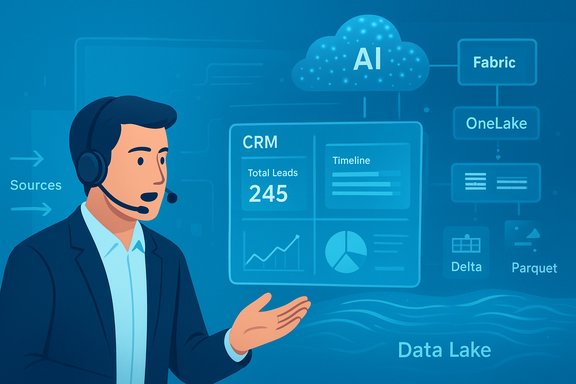
Eastman replicates production systems into Fabric using mirroring and open mirroring for laboratory and LIMS data. Mirrored data is converted into analytics‑ready Delta/Parquet files in OneLake; transformations are then performed with dbt to produce curated, consumable models. Teams expose those models via OneLake shortcuts to avoid needless copies while keeping governance and lineage intact. The company reports ingesting roughly a billion rows from eight systems with hourly updates—data volumes and update cadence the team says were impractical on the legacy SQL Server ETL warehouse. Mirroring and shortcut approaches map cleanly to Fabric’s documented patterns: mirroring can replicate entire databases and metadata, while shortcuts let workspaces reference external data without duplication. This reduces copy sprawl and makes governance easier because the authoritative data lineage lives in OneLake. Fabric’s mirroring design is intended to cut the friction of manual ETL and provide near‑real‑time analytics access to operational data.The AI layer: embeddings, vector stores, and SQL
Eastman’s sales copilot is a voice‑first assistant embedded in CRM via Azure Web Apps and Azure OpenAI. The copilot uses a blended RAG (retrieval‑augmented generation) approach: vector embeddings surface candidate documents or notes (semantic retrieval), while SQL queries deliver hyper‑precise counts and structured answers (analytical retrieval). Fabric processes data and generates embeddings, which Eastman stores in a Fabric SQL database; GraphQL sits above the SQL layer to provide flexible, consumer‑friendly endpoints for the copilot to pull exactly the fields the UI needs. This hybrid approach is intentional: vector search finds the where and SQL gives the what with rigor. Key implementation components Eastman cites:- Azure OpenAI for model inference and natural‑language generation.
- SQL database in Fabric for transactional queries and to host embeddings metadata.
- GraphQL to simplify data access for GenAI developers and to shape payloads for the copilot UI.
- Voice input converted to SQL queries to produce dynamic dashboards and iterative, conversation‑driven filtering.
Workflow: how a seller uses the copilot
- A seller speaks a preparation prompt (voice‑first).
- Copilot uses vector search to locate relevant notes or call transcripts.
- A generated SQL filter or direct SQL query runs against Fabric’s SQL database or warehouse to produce counts, timelines, and structured fields.
- Results are presented in a dynamic dashboard (text, charts, visuals).
- The seller refines the dashboard conversationally (e.g., “show sustainability discussions from last two meetings”), and the copilot iterates.
- Final summaries and extracted structured data are written back to the CRM and into Fabric for the next user.
The business outcomes Eastman reports
The most striking operational metric in the case study: sellers who once spent up to four hours preparing for calls now complete that work in approximately 40 minutes, enabled by the copilot’s rapid retrieval and report generation. Eastman also cites scalability improvements—near‑infinite scale for warehousing workloads on Fabric—and improved cross‑domain workflows because teams can mirror and shortcut data from finance, supply chain, or lab systems without extra ETL. These are company‑reported results published in a Microsoft customer story and, while they are compelling, they should be interpreted as vendor‑aligned claims unless independently audited or benchmarked. Independent reporting on the same Eastman deployment is limited in the public record; much of the corroborating technical detail about mirroring, SQL in Fabric, and GraphQL integration comes from Microsoft documentation and third‑party coverage of Fabric features.Why the architecture matters: technical strengths
1. Unified data estate with governed sharing
OneLake shortcuts and mirroring let teams publish curated datasets without copying terabytes of files—this reduces duplication, simplifies access control, and centralizes lineage. For regulated industries such as chemicals and pharmaceuticals, reducing copy sprawl and preserving governance is a big win.2. Hybrid retrieval model
Combining vector retrieval for discovery with SQL for precise aggregations prevents many of the false positives that pure‑vector RAG systems can generate. Eastman’s emphasis on SQL for exact numeric queries recognizes that analytics and LLMs solve complementary problems: SQL offers deterministic answers; vectors provide semantic context.3. Platform productivity
SQL databases in Fabric integrate with familiar developer tools (SSMS, VS Code) and connect directly to OneLake; GraphQL APIs simplify front‑end development. That lowers the barrier for GenAI engineers to iterate quickly and deliver production copilot features with CI/CD pipelines.4. Faster time to insight and process automation
By embedding a copilot into CRM and automating report generation and data writes back to Fabric, Eastman turns preparation overhead into structured data that benefits the next user—creating a virtuous feedback loop for knowledge capture.Risks, gaps, and operational caveats
No single vendor story captures the full set of long‑term tradeoffs. The Eastman example exposes several areas enterprises must consider carefully.Data quality and lineage
The value of RAG and copilots depends on trustworthy retrieval. Mirroring and dbt transformations help, but organizations must maintain robust data‑quality checks, unit tests, and lineage visibility. Without strict controls, copilot outputs may cite stale or incorrectly transformed records—issues that can damage customer relationships if acted upon. Microsoft’s mirroring design reduces ETL complexity, but lineage and validation remain the organization’s responsibility.Hallucination and over‑reliance on generative outputs
Generative models can hallucinate facts, especially when asked to summarize sparse or contradictory notes. Eastman mitigates this by anchoring hard metrics to SQL queries, yet narrative summaries still need human review and auditable evidence trails. Enterprises should log model prompts, retrieval hits, and returned source snippets to support traceability and dispute resolution.Access controls and IP boundary
Eastman uses Microsoft Entra for role‑level policies; this is necessary but not sufficient. For chemical and materials companies, trade secrets and regulated data require fine‑grained object‑level security, network isolation, and careful consideration of model telemetry and logging (what is sent to model endpoints, how long inputs are retained). Fabric supports OneLake security constructs, but architects must validate data residency and exposure for any Azure OpenAI traffic.Cost and vendor dependency
Running high‑frequency mirroring, continuous embedding generation, and real‑time Azure OpenAI inference can be expensive. Fabric provides capacity‑based economics and some free mirroring storage per capacity unit, but costs scale with usage. The combined dependency on Fabric, OneLake, and Azure OpenAI creates vendor lock‑in risks that require contractual and architectural mitigations (e.g., exportable embeddings, portable data formats, and multi‑cloud escape plans).Operational maturity: monitoring, retraining, and freshness
Embedding pipelines must be monitored for drift, and embeddings should be refreshed on a cadence tied to data update frequency. Eastman’s hourly mirroring helps, but teams must build observability: query latency SLAs, index/embedding refresh metrics, and automated tests that validate summarization accuracy over time. These operational controls are often the harder engineering work after an initial pilot.Best practices and recommendations for enterprises considering a similar path
- Adopt a hybrid retrieval pattern: use vector search for discovery and SQL for deterministic metrics; avoid relying on a single retrieval mechanism for both discovery and precise counts.
- Design for auditable retrieval: log which documents and table rows were used to produce each copilot answer so humans can validate and correct outputs.
- Use open, portable formats: Delta/Parquet (what Fabric uses) keeps data portable and simplifies exports if you change platforms.
- Automate data quality: integrate dbt tests, schema checks, and statistical monitors as part of the ingestion pipeline to catch corruption early.
- Control model exposure: restrict what information is passed to model endpoints, anonymize PII where possible, and enforce retention policies for prompts and generations.
- Measure business impact with A/B tests: validate claimed outcomes (like the 4‑hour to 40‑minute reduction) using controlled rollouts and objective metrics—time saved, deal conversion lift, and error rates. If a vendor story provides a headline outcome, aim to replicate it with internal measurement.
Cross‑checking the technical claims
The most load‑bearing technical claims in Eastman’s story—mirroring into OneLake, SQL database in Fabric, hourly updates, and GraphQL integration—are supported by Microsoft’s technical documentation for Fabric (mirroring and SQL database features). Independent coverage of Fabric’s capabilities and the vendor ecosystem also corroborates Fabric’s design intent (OneLake, shortcuts, mirroring, integrated analytics). Industry blogs and community posts discuss OneLake shortcuts and mirroring tradeoffs, and third‑party analysis highlights Fabric’s direction toward unified data + AI workloads. These secondary sources underline that Eastman’s architecture follows widely‑recommended patterns for modern RAG and analytics systems. However, specific outcome numbers reported by Eastman—“roughly a billion rows from eight systems” and the preparation‑time reduction from “four hours to approximately 40 minutes”—come from Eastman’s account in the Microsoft customer story and are not widely independently verified in public reporting at the time of publication. Treat those numbers as customer‑reported results that are useful for benchmarking but that benefit from independent validation in other deployments or internal A/B testing.The strategic takeaway for Windows‑centric and Azure‑centric enterprises
Eastman’s deployment is an instructive blueprint for companies that need to combine governed, enterprise data estates with operational AI assistants. The architecture demonstrates several reproducible patterns:- Use mirroring and OneLake to bring operational data into an analytics‑ready lake without heavy ETL overhead.
- Combine SQL and vector retrievals to get deterministic numbers and semantic discovery in one flow.
- Expose thin GraphQL layers over SQL to simplify developer and copilot integration.
Conclusion
Eastman’s Microsoft Fabric deployment illustrates how a unified data platform and a hybrid SQL/vector architecture can convert sprawling, siloed customer information into an actionable, AI‑driven assistant that materially reduces seller preparation time and improves knowledge reuse. The technical building blocks—mirroring into OneLake, dbt transformations, SQL databases in Fabric, vector embeddings, and GraphQL—are grounded in Microsoft’s documented Fabric capabilities and in broader industry adoption patterns. That said, the most eye‑catching metrics are company‑reported and should be benchmarked internally before being accepted as universal outcomes. Organizations pursuing similar projects must budget for governance, observability, security, and continuous model maintenance to avoid common pitfalls—hallucination, stale embeddings, uncontrolled cost, and data‑leak risk. When those operational disciplines are in place, the combination of a governed lake (OneLake), mirrored operational data, and a hybrid retrieval copilot can move sales and support teams from data hunting to insight‑driven conversations—exactly the outcome Eastman reports and a model any enterprise should evaluate carefully.Source: Microsoft Eastman unifies data and builds an AI-powered future with Microsoft Fabric | Microsoft Customer Stories
