

Microsoft’s Azure Data Factory (ADF) has become a default choice for many Azure-centric teams building ETL/ELT for machine learning pipelines because it combines a visual, drag-and-drop authoring surface with a broad connector ecosystem, flexible integration runtimes, and built-in hooks to Azure Machine Learning and Azure AI services—making it particularly well suited for data ingestion, feature engineering, and model scoring at scale.
The modern AI and machine learning lifecycle depends on high-quality, well-orchestrated data pipelines. Data ingestion, cleaning, feature engineering, and model scoring must move from ad-hoc notebooks to repeatable, monitored pipelines before models are production-ready. That shift has pushed tooling beyond traditional ETL suites into a broader ecosystem where orchestration, cloud-native ELT, data transformation, and governance intersect with MLOps needs.
Across clouds and open source, vendors are embedding AI-assisted authoring, automated schema handling, and managed connectors to reduce engineering friction. At the same time, organizations must balance speed with governance, cost predictability, and model explainability—constraints that shape tool selection for AI/ML projects.
Practical adoption starts with a focused POC that measures cost and operational needs, followed by a migration plan that preserves raw data, enforces data quality testing, and stages pipelines into production with robust monitoring. Wherever AI-assisted tooling is used to accelerate pipeline authoring, include human verification and versioned tests to protect model integrity and compliance. The modern stack gives teams the flexibility to support growing ML workloads—but success depends on thoughtful integration, cost-aware design, and continuous observability.
Source: Analytics Insight Top ETL Tools for AI & Machine Learning Projects
 Background
The modern AI and machine learning lifecycle depends on high-quality, well-orchestrated data pipelines. Data ingestion, cleaning, feature engineering, and model scoring must move from ad-hoc notebooks to repeatable, monitored pipelines before models are production-ready. That shift has pushed tooling beyond traditional ETL suites into a broader ecosystem where orchestration, cloud-native ELT, data transformation, and governance intersect with MLOps needs.Across clouds and open source, vendors are embedding AI-assisted authoring, automated schema handling, and managed connectors to reduce engineering friction. At the same time, organizations must balance speed with governance, cost predictability, and model explainability—constraints that shape tool selection for AI/ML projects.
Overview: What AI & ML Projects need from ETL/ELT tools
AI and ML workloads impose a specific set of requirements on data pipelines:- Repeatability and orchestration: Pipelines must run on schedule, trigger on events, and integrate with model training/serving pipelines.
- Data quality and lineage: Accurate feature computation requires observability and dataset lineage to debug model drift and ensure regulatory compliance.
- Scalability and performance: Feature engineering often processes large volumes; tools must scale horizontally or push computation into data warehouses.
- Flexibility for experimentation: Data scientists need ad-hoc access to explore and spin up experiments without blocking engineering teams.
- Model integration: The ability to score data and trigger retraining from ETL/ELT pipelines keeps production ML current.
- Security & governance: Sensitive data must be masked, cataloged, and audited across the pipeline.
Microsoft Azure Data Factory — Why it matters for ML projects
What ADF brings to the table
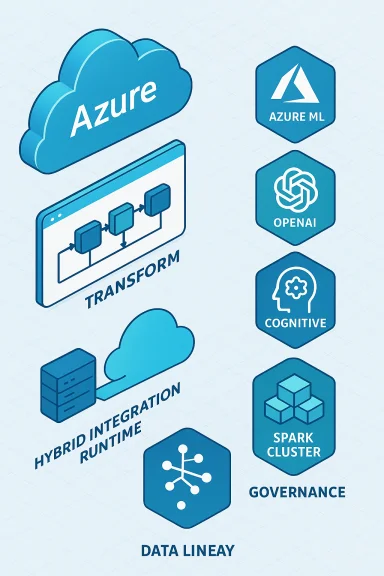
Azure Data Factory is a cloud-native, serverless data integration service with three core strengths for ML teams:- Visual, code-free mapping data flows for drag-and-drop transformation authoring that runs on managed Spark clusters—useful for teams that want a GUI-driven path from raw data to analysis-ready tables.
- Wide connectivity and hybrid integration via multiple Integration Runtimes (Azure-hosted, self-hosted, Azure-SSIS) so teams can ingest cloud data, on-prem systems, and lift-and-shift legacy SSIS workloads.
- Native hooks into ML and AI services, including an Execute Azure Machine Learning pipeline activity and connectors for Azure OpenAI/Cognitive Services, enabling pipelines that trigger training, batch scoring, or embed data for LLM retrieval.
Strengths for AI/ML workflows
- Operationalized feature pipelines: Mapping data flows + pipeline orchestration lets teams create deterministic feature-generation jobs that can be debugged, monitored, and re-run reliably. The visual debug mode is especially useful during iteration.
- Tight Azure integration: If your model training and serving live in Azure (Azure ML, Fabric, Databricks, Synapse), ADF reduces friction between ingestion, transformation, and model orchestration.
- Event-driven triggers and automation: You can trigger pipelines on blob arrival, schedule retraining, or chain ADF pipelines to model-serving steps—critical for near-real-time model refresh patterns.
Limitations and operational risks
- Cost complexity: ADF pricing is multi-dimensional—pipeline runs, data movement DIU-hours, data flow compute, and managed VNet options—so cost forecasting can be non-trivial for large or spiky workloads. Teams should model expected DIU-hours and data flow activity to avoid surprises.
- Ecosystem lock-in: The most frictionless experience is within Azure; cross-cloud portability requires extra design effort or abstraction layers.
- Performance tuning: Mapping data flows execute on Spark clusters; for very large transformations, engineers must tune performance or pushdown logic into warehouses for lower latency.
How ADF compares to other ETL/ELT options for ML
Cloud-native ELT: Fivetran and similar automated connectors
- Fivetran provides a fully managed connector layer with automated schema drift handling and CDC (change data capture), designed to move source data into warehouses with minimal ops overhead—useful when you want to centralize raw data for downstream feature engineering. Fivetran uses a consumption model (Monthly Active Rows), which simplifies quick onboarding but can become costly at scale.
- Rapid onboarding and consistent ingestion.
- Offloads connector maintenance, enabling data scientists to focus on modeling.
- Limited in-pipeline heavy transformations; typically paired with dbt or warehouse transformations for feature engineering.
Orchestration-first approach: Apache Airflow
- Apache Airflow is the de facto open-source orchestrator for ML pipelines. It defines workflows as code (DAGs) and is widely used to manage ingestion → transform → training → deployment cycles. Managed Airflow offerings (MWAA, Cloud Composer) make it easier to operate in cloud environments. Airflow excels at complex dependency management and long-running ML jobs, but it’s not an ingestion/ELT engine by itself.
- Fine-grained control, reproducibility, scheduling, and easy integration with experiments (MLFlow, SageMaker Pipelines, Kubeflow).
- Strong community and operator ecosystem.
- Requires DevOps maturity to run reliably in production.
Transformation-first approach: dbt for ELT and analytics engineering
- dbt (Data Build Tool) focuses exclusively on transformations inside the warehouse: SQL-based models, testing, documentation, and version control. It’s the standard transformation layer in ELT stacks, enabling software-engineering practices around feature generation. dbt is often combined with managed ingestion (Fivetran) and orchestration (Airflow/ADF).
- Versioned, testable transformations and clear lineage—essential for feature reproducibility.
- Works well with modern warehouses for compute-efficient transforms.
- dbt assumes data is already in the warehouse; ingestion and real-time streaming need separate solutions.
Serverless Spark-based ETL: AWS Glue
- AWS Glue is a serverless ETL platform that provides crawlers, a Data Catalog, Glue Studio (drag-and-drop authoring) and support for Spark, Ray, and Python. Glue integrates with AWS ML tooling and includes generative AI-assisted features for job authoring. It is a strong fit for AWS-first ML ecosystems.
- Serverless scaling, native AWS integration, and visual tooling for ETL authoring.
- Built-in schema discovery and metadata cataloging for data discovery.
- Glue jobs are Spark-based; for teams wanting non-Spark engines, different services will be needed.
Selecting a tool: practical decision criteria for ML teams
When evaluating ETL/ELT tooling for AI and ML projects, weigh these factors deliberately:- Platform alignment: Which cloud(s) host your compute, model registry, and feature store? Choose a tool that minimizes cross-cloud data movement.
- Latency needs: Do you need batch, micro-batch, or streaming ingestion? Tools like Fivetran (batch/near-real-time) or Glue (streaming) may be better for continuous features.
- Transformation placement: Prefer ELT (warehouse-based transforms with dbt) for scale and experimentation, but use ETL/ADF-style transforms for pre-processing before landing data if your warehouse is not the canonical compute engine.
- Governance and observability: Look for data lineage, profiling, schema drift detection, and audit logging—critical for model explanations and regulatory compliance.
- Team skills: SQL-first teams benefit from dbt; Python-driven ML teams may want Airflow + custom operators; citizen-data teams may prefer GUI-based ADF or Glue Studio.
- Cost model transparency: Consumption pricing (MAR, DIUs, run-hours) must be modeled using expected volumes and transformation complexity.
Security, governance, and compliance — non-functional musts
AI projects frequently touch private or regulated data. Make sure your ETL choice supports:- Role-based access control and identity integration (e.g., Entra/AD, IAM).
- Encryption in transit and at rest.
- Data masking, tokenization, and PII detection in ingestion and transformation layers.
- Cataloging and lineage so data scientists can trace features back to source systems for audits.
- Many vendors now add ML-assisted observability (data trust scores, anomaly detection) to surface upstream issues before models break; these are valuable but should be validated against known baselines.
Practical implementation patterns for ML pipelines
- Ingest raw data with a managed connector (Fivetran, Airbyte) into a central data lake or warehouse.
- Use dbt (or warehouse-native SQL) for deterministic feature generation with unit tests and documentation.
- Orchestrate end-to-end runs (ingest → transform → train → score) using Airflow or a cloud orchestrator (ADF, MWAA, Composer) depending on platform fit.
- Embed model scoring and retraining steps via native ML activities (e.g., ADF Execute Azure ML Pipeline, Glue integration with SageMaker), and add event triggers for near-real-time refresh.
- Add governance: data catalog, lineage, automated data quality checks, and alerting to catch drift early. Consider platforms with built-in AI copilot features to accelerate building and documenting pipelines, but validate generated logic before production use.
Vendor highlights: strengths & caveats at a glance
- Azure Data Factory
- Strengths: Visual data flows, hybrid runtimes, Azure ML/OpenAI hooks, event triggers.
- Caveats: Complex pricing, Azure-centric.
- Fivetran
- Strengths: Managed connectors, CDC, low maintenance, excellent for ingestion to warehouses.
- Caveats: Can be costly at scale; limited heavy transformation in-flight.
- dbt
- Strengths: Transformations-as-code, testing, lineage, documentation—ideal for feature engineering in warehouses.
- Caveats: Not an ingestion tool.
- Apache Airflow
- Strengths: Flexible orchestration, DAGs-as-code, broad operator ecosystem—widely used in MLOps.
- Caveats: Operational overhead, requires DevOps skills to run at scale.
- AWS Glue
- Strengths: Serverless Spark jobs, Glue Studio visual authoring, tight AWS integration, and AI-assisted features.
- Caveats: Engine is Spark-centric; pricing model requires careful planning.
- Talend
- Strengths: Strong data quality/governance features and Trust Score for data health—good for regulated ML use cases.
- Caveats: Higher licensing costs and learning curve for complex use cases.
- Informatica IDMC
- Strengths: Enterprise-grade governance and CLAIRE AI copilot capabilities for automating pipeline generation and metadata insights—targeted at large enterprises building agentic AI experiences.
- Caveats: Enterprise pricing; complexity for small teams.
- Airbyte
- Strengths: Open-source, extensible connectors and growing managed offerings—appealing to engineering-led teams.
- Caveats: Self-hosting requires DevOps; managed service reduces control.
Integration patterns for LLM/embeddings workflows
Modern LLM use cases require repeating data preparation and embedding generation. Practical patterns:- Use ETL to normalize and sanitize documents and metadata (ADF or Glue) before creating embeddings. Ensure chunking, deduplication, and PII removal occur pre-embedding.
- Store raw and processed data separately to enable retraining and explainability.
- Automate embedding generation in the pipeline and push vectors to a vector DB or search index with proper observability for drift and freshness.
- Where available, leverage native connectors to Azure OpenAI, Azure Cognitive Search, or equivalent services to reduce glue code.
Migration and production checklist (recommended)
- Inventory data sources and label sensitive fields needing masking or redaction.
- Run a proof-of-concept integrating one representative source into a simulated ML pipeline (ingest → transform → train → score).
- Measure DIU-hours, MAR, or equivalent compute/ingest metrics for cost forecasting across peak loads.
- Implement automated tests for data quality and dbt-style unit checks for features.
- Configure observability: pipeline logs, dataset freshness metrics, drift alerts, and lineage tracing.
- Add role-based access, encryption, and data cataloging.
- Validate AI-generated or auto-suggested pipeline code before running production jobs. Vendors’ copilots can accelerate development but require human verification.
Final analysis — strengths, risks, and recommended approach
The ecosystem has matured into complementary building blocks rather than one-size-fits-all suites. For AI and ML projects:- Best overall fit if you’re Azure-first: Azure Data Factory combined with Azure Machine Learning and Fabric offers a streamlined path from ingestion to model orchestration with mapped data flows and native AI hooks—great for teams that value integrated security, event-driven triggers, and GUI-driven transformation. However, plan for cost modelling and acknowledge the Microsoft-centric stack lock-in.
- Best for rapid ingestion: Fivetran shines when teams want low-maintenance, reliable connectors to centralize raw data quickly into warehouses, accelerating feature availability for modeling. Pair Fivetran with dbt for testable feature engineering to achieve reproducible ML artifacts.
- Best for orchestration & complex MLOps: Apache Airflow remains the most flexible orchestration option. Use it when you need custom dependency graphs, third-party integrations, or source-level orchestration across clouds. Managed Airflow reduces ops burden but not the need for engineering expertise.
- Best for enterprise governance and AI copilot acceleration: Platforms like Informatica and Talend now embed AI to automate pipeline generation, trust scoring, and governance—appealing for regulated industries or large-scale deployments but at enterprise pricing and complexity. Validate AI-driven outputs thoroughly.
- Cost surprises from consumption billing and runtime compute.
- Overreliance on AI copilot-generated logic without human verification.
- Vendor lock-in when platform-native features (e.g., Azure OpenAI, managed runtimes) are heavily used.
Conclusion
Selecting the right ETL/ELT tool for AI and machine learning projects is a balance between speed-to-value and long-term operational control. Azure Data Factory provides a compelling, integrated path for Azure-first organizations—offering drag-and-drop ETL, hybrid connectivity, and direct ML orchestration features that shorten the route from raw data to production models. For multi-cloud or open-source-first shops, the best results come from combining specialized tools—managed ingestion (Fivetran/Airbyte), transformation-as-code (dbt), and orchestration (Airflow or cloud-native services)—while layering governance and observability across every step.Practical adoption starts with a focused POC that measures cost and operational needs, followed by a migration plan that preserves raw data, enforces data quality testing, and stages pipelines into production with robust monitoring. Wherever AI-assisted tooling is used to accelerate pipeline authoring, include human verification and versioned tests to protect model integrity and compliance. The modern stack gives teams the flexibility to support growing ML workloads—but success depends on thoughtful integration, cost-aware design, and continuous observability.
Source: Analytics Insight Top ETL Tools for AI & Machine Learning Projects
