

Microsoft’s Azure platform suffered a high‑impact outage on October 29, 2025, after an inadvertent configuration change to Azure Front Door triggered DNS‑related failures that left thousands of businesses, games, productivity tools and consumer services intermittently unreachable — a stark reminder of how concentrated modern internet infrastructure has become.
Azure Front Door, DNS and the architecture that routes the web
Azure Front Door (AFD) is Microsoft’s global application delivery and edge routing service. It sits between end users and origin services, performing traffic routing, caching, TLS termination and global failover. The service plays the same role for many Azure‑hosted apps as a content delivery network (CDN) or global load balancer, and it is a critical piece of Microsoft’s control plane and delivery topology.
The Domain Name System (DNS) is the internet’s phonebook: it translates human‑readable names (like example.com) into IP addresses that routers and clients use to connect. A failure in DNS resolution — whether caused by configuration changes, withdrawal of route advertisements, or any other failure mode — can make services unreachable even if the backend systems themselves remain healthy.
Border Gateway Protocol (BGP) governs the exchange of routing information across the internet. While DNS resolves names to addresses, BGP is responsible for telling the world how to reach those addresses. Problems in either DNS or BGP can produce similar outward symptoms: traffic that previously flowed smoothly now times out or lands in the wrong place. Misconfigurations in one can also make issues in the other more visible.
Why this mattered on October 29
On October 29, a configuration change affecting Azure Front Door produced DNS failures and connectivity issues across multiple Microsoft‑managed services and customer platforms that relied on AFD for global routing. The outage manifested as failed web requests, timeouts, authentication errors and degraded portal access for customers. High‑profile consumer services such as Xbox and Minecraft, and enterprise‑facing software like Microsoft 365, were affected. Retailers and hospitality brands that rely on Microsoft’s cloud for parts of their operations reported disruptions to websites and customer‑facing systems.
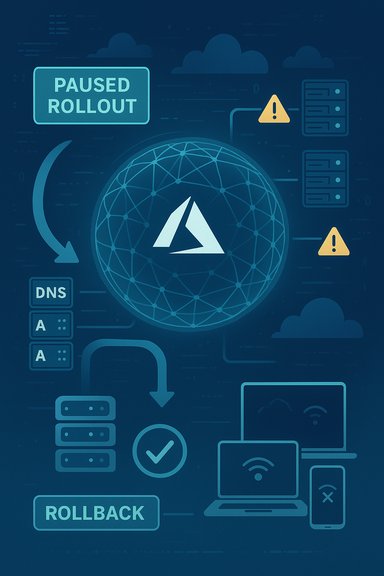
Several outage trackers reported spikes of tens of thousands of complaints during the incident, and major news organizations described broad commercial impacts. Microsoft moved quickly to halt the configuration roll‑out, deploy a rollback to a known‑good state, and reroute traffic away from the affected infrastructure while recovery continued.
Key mechanisms by which changes cause outages:
The response from Microsoft — stopping changes, rolling back to a known‑good configuration, and rerouting traffic — highlights both the maturity of cloud operations and the limits of automation when configuration mistakes slip through. For enterprises and product teams, the lesson is blunt: design for provider failure, diversify critical paths, and require failover and recovery exercises as part of standard operational hygiene.
As cloud platforms continue to consolidate much of the internet’s plumbing, the industry must balance the efficiency gains of centralization with stronger guardrails, transparency and coordination that prevent a single configuration blunder from cascading into widespread disruption. The engineering fixes and policy conversations that follow this outage will determine whether the next incident is smaller — or simply the next headline.
Source: Business Plus Microsoft meltdown leaves ‘half the world’without the internet
 Background
Azure Front Door, DNS and the architecture that routes the webAzure Front Door (AFD) is Microsoft’s global application delivery and edge routing service. It sits between end users and origin services, performing traffic routing, caching, TLS termination and global failover. The service plays the same role for many Azure‑hosted apps as a content delivery network (CDN) or global load balancer, and it is a critical piece of Microsoft’s control plane and delivery topology.
The Domain Name System (DNS) is the internet’s phonebook: it translates human‑readable names (like example.com) into IP addresses that routers and clients use to connect. A failure in DNS resolution — whether caused by configuration changes, withdrawal of route advertisements, or any other failure mode — can make services unreachable even if the backend systems themselves remain healthy.
Border Gateway Protocol (BGP) governs the exchange of routing information across the internet. While DNS resolves names to addresses, BGP is responsible for telling the world how to reach those addresses. Problems in either DNS or BGP can produce similar outward symptoms: traffic that previously flowed smoothly now times out or lands in the wrong place. Misconfigurations in one can also make issues in the other more visible.
Why this mattered on October 29
On October 29, a configuration change affecting Azure Front Door produced DNS failures and connectivity issues across multiple Microsoft‑managed services and customer platforms that relied on AFD for global routing. The outage manifested as failed web requests, timeouts, authentication errors and degraded portal access for customers. High‑profile consumer services such as Xbox and Minecraft, and enterprise‑facing software like Microsoft 365, were affected. Retailers and hospitality brands that rely on Microsoft’s cloud for parts of their operations reported disruptions to websites and customer‑facing systems.
Several outage trackers reported spikes of tens of thousands of complaints during the incident, and major news organizations described broad commercial impacts. Microsoft moved quickly to halt the configuration roll‑out, deploy a rollback to a known‑good state, and reroute traffic away from the affected infrastructure while recovery continued.
What happened: a concise timeline
The trigger event
- Around mid‑afternoon UTC on October 29, 2025, reports began to surface of Azure Portal access issues and intermittent request failures for applications fronted by Azure Front Door.
- Microsoft’s operational status updates identified an inadvertent configuration change as the initiating event and explicitly named Azure Front Door as the affected service. The initial mitigation actions included blocking further configuration changes and rerouting traffic away from impacted Front Door nodes.
Escalation and impact
- The disruption propagated downstream to services that depend on AFD for routing and termination: Microsoft 365 consoles and authentication flows saw delays; Xbox and Minecraft users reported login and multiplayer interruptions; several corporate websites and payment systems reported degraded access.
- Outage‑tracking services recorded tens of thousands of user reports at the peak of the incident, reflecting both consumer and enterprise symptoms.
- Companies that rely on Azure for parts of their customer journey — from retail checkout pages to airline check‑in systems — reported intermittent outages, illustrating the scope of modern cloud dependency.
Containment and remediation
- Microsoft halted the rollout of the problematic configuration, initiated a rollback to the last known good configuration, and performed targeted reroutes to healthy Front Door nodes while monitoring stability.
- The company implemented additional mitigations and recovery steps to restore service availability and then released staged updates to bring more of the platform back to normal operation.
- As services recovered, Microsoft continued to block configuration changes to reduce the chance of recurrence during the immediate recovery window.
Why a configuration change can become an outage
Configuration changes are a normal part of cloud operations: routing tables, access controls, TLS bindings and service topologies must evolve. However, when a configuration change touches globally distributed control systems — route advertisements, anycast prefixes, or DNS records — the potential blast radius grows dramatically.Key mechanisms by which changes cause outages:
- Control‑plane inconsistency: If new configuration is partially applied — some front‑end nodes get a change while others do not — clients may receive inconsistent answers about where to reach services, producing timeouts or authentication failures.
- Anycast and prefix advertisement errors: Global edge networks often use anycast IPs to direct clients to the nearest POP (point of presence). Misconfiguring which POPs advertise which prefixes can cause sudden withdrawals or misdirection of traffic.
- DNS‑hosted dependencies: Many systems are configured with hard references (IP addresses, CNAMEs tied to provider infrastructure). If those DNS mappings are modified or a resolver can’t reach the authoritative records, clients can’t find services even if backend servers are healthy.
- Cascading failure paths: Cloud services are layered: identity/authentication (Entra ID/AD), gateway (AFD), application (App Services), data (SQL, storage). A failure in one foundational layer can cascade to many dependent layers.
Separating myth from reality: “half the world” and customer counts
Sensational headlines claim that outages of major cloud providers can take “half the internet” or “half the world” offline. Those phrases are dramatic and useful for clicks, but they rarely reflect measured reality.- The October 29 incident produced thousands to tens of thousands of outage reports across monitoring services — significant and disruptive, but not equivalent to half the world’s internet connectivity. Outage tracking spikes reflect user complaints and telemetry concentrated on affected services and regions; they are real, but they do not equate to a majority of global internet users being offline.
- Claims that “more than 550,000 companies use Azure” are repeated in some commentary but are not an independently verified, Microsoft‑published total for the platform’s active corporate customers. Microsoft does not publish a simple, single figure that corresponds to “companies using Azure” in a way that validates that number. Vendor or partner press releases sometimes cite a customer base for specific products or partner integrations that may use figures in the hundreds of thousands — but these are product‑specific and not the same as a verified global Azure tenancy count.
The technical anatomy: DNS, AFD and BGP explained
How Azure Front Door interacts with DNS and clients
- Many organizations front their web and API traffic with Azure Front Door. Client requests are resolved by DNS to Front Door’s anycast addresses or to a CNAME that points to Microsoft’s edge routing plane.
- When front door nodes or their routing policies are misconfigured, DNS entries may still resolve but point to nodes that are not accepting or correctly forwarding requests, producing timeouts or HTTP 5xx errors.
- Azure Front Door also integrates with authentication and identity services; when the delivery layer fails, dependent auth flows can time out, preventing users from logging into downstream services.
DNS versus BGP — different layers, similar symptoms
- DNS failures make names unresolvable. A misconfigured DNS zone or problems in the authoritative name servers create immediate symptoms: “could not find host” errors.
- BGP routing problems change the path that packets take or remove a prefix advertisement entirely. If a network withdraws announcements for the IP space used by a service, the rest of the internet cannot reach that IP.
- Often, incidents involve features of both: a control‑plane configuration triggers route withdrawals or causes a set of IP prefixes to be unreachable, and DNS resolvers then fail to obtain records or caches expire — the practical end result is users can’t reach services.
- Historical outages illustrate both pathways: a 2021 global outage of a large social platform was driven by BGP withdrawals of route announcements that hosted DNS infrastructure; a 2025 outage of a major public DNS resolver was caused by an internal configuration error that changed route announcements and service topology.
Why these are hard to isolate quickly
- Large cloud providers run highly automated, distributed systems. When something goes wrong, the automated processes that normally accelerate deployment can amplify a bad change.
- Partial rollbacks are risky: reversing a global configuration without fully understanding dependencies can inadvertently prolong or worsen impact. That’s why providers often stop all changes first, then methodically roll back and monitor.
Critical analysis: strengths, failures and systemic risks
Strengths demonstrated
- Rapid detection and response: Large cloud operators maintain extensive telemetry and incident response playbooks. Microsoft identified a configuration change quickly and halted further changes to stop amplification.
- Existing mitigation tooling: The ability to reroute traffic, failover to alternative entry points, and deploy “last known good” configurations enabled staged recovery without requiring wholesale rebuilds.
- Transparency of incident notices: Public status updates and frequent follow‑ups — while not complete post‑mortem detail — helped customers understand immediate mitigation steps and temporary workarounds.
Notable weaknesses and risks exposed
- Concentration of risk: A relatively small set of global cloud providers hosts a very large share of customer applications and core services. When they fail, impacts cascade beyond single tenants to entire industries.
- Complex dependency chains: Modern applications depend on identity, API gateways, storage, networking and observability — many of which are provided by the same cloud vendor. A fault in one foundational service can disable many seemingly unrelated systems.
- Overreliance on edge/control‑plane primitives: Services that depend directly on provider‑managed routing or anycast prefixes are exposed to provider control‑plane errors in ways that are difficult for tenants to mitigate independently.
- Operational opacity for customers: Many tenants lack visibility into provider internals. Status pages provide high‑level updates, but granular root cause data and precise impact windows are often delayed or incomplete.
- Media amplification and public misunderstanding: Hyperbolic framing of outages as “half the internet” can obscure measured risk assessment and lead to poorly informed regulatory or customer backlash.
Practical resilience checklist for businesses
Companies that depend on cloud providers — whether for critical customer flows, internal productivity or public websites — can take concrete steps to harden themselves against provider incidents.- Implement multi‑region deployment patterns
- Deploy critical services across multiple geographic regions to reduce the risk of single‑region failures.
- Use health checks and automated failover mechanisms that test end‑to‑end flows.
- Decouple control plane from user traffic where possible
- Avoid single points that require portal access for emergency management. Maintain programmatic access (CLI, PowerShell, APIs) and ensure they are routed independently when possible.
- Diversify DNS and CDN strategies
- Use multiple authoritative DNS providers and configure short TTLs for critical records, combined with automated health checks and failover routing.
- Consider multi‑CDN setups for public web assets, with smart DNS failover.
- Harden identity and authentication resilience
- Keep emergency admin accounts and out‑of‑band authentication pathways that do not depend on a single provider’s identity service.
- Test SSO and authentication failover in disaster recovery drills.
- Maintain robust incident runbooks and drills
- Run tabletop exercises that simulate cloud provider outages and ensure staff can execute failover playbooks under pressure.
- Document fallback modes for degraded operations (e.g., manual checkins, local payment processing).
- Monitor independent signals
- Use external monitoring (global synthetic transactions, third‑party uptime monitors) that can detect provider outages from multiple vantage points.
- Contractual and financial protections
- Negotiate clearer SLAs, incident reporting commitments, and remediation pathways in vendor contracts.
- Evaluate insurance or financial contingency plans for outage‑driven revenue loss.
Policy and industry implications
These recurring high‑profile outages are prompting broader conversations about internet resilience and the role of large cloud vendors in national infrastructure.- Regulatory scrutiny: Governments are increasingly attentive to the systemic risk posed by a handful of cloud providers controlling large parts of the critical internet stack. Expect heightened regulatory dialogues about transparency, minimum resilience standards and mandatory incident reporting.
- Industry standards: Best‑practice frameworks for DNS resilience, multi‑cloud failover and incident logging are likely to accelerate. Independent audits of routing and failover designs may become more common.
- Market responses: Enterprises may shift toward hybrid architectures, combining cloud, edge and on‑premises capabilities to maintain control over the most critical customer paths.
- Service design evolution: Architects will need to assume provider outages as a design constraint — designing for graceful degradation, local caching and temporary offline modes rather than expecting instant access to all cloud services.
Lessons learned and concrete takeaways
- The outage reaffirms a core truth of modern internet operations: control‑plane errors, not just hardware failures or attacks, are a major operational risk. Automated, global configuration systems are powerful but demand rigorous safeguards.
- For cloud providers, the imperative is clear: stronger change management, staged rollouts with conservative blast radiuses, and improved in‑service testing can dramatically reduce the likelihood that a single misstep affects broad classes of customers.
- For customers, the practical reality is the same as it has been for years: assume failure, design for failure, and test for failure. Multi‑layered resilience (DNS, CDN, identity, compute) reduces exposure and gives businesses time to restore essential operations without panic.
Unverifiable or exaggerated claims to treat with caution
- Statements that a single outage caused “half the world” to lose internet access are hyperbolic and unsupported by measured outage telemetry and network observability data from independent trackers. While outages of major cloud services are disruptive, the global internet is vast and composed of many independent networks and services.
- Specific tallies of “how many companies use Azure” are often cited in marketing or partner materials in ways that are not directly comparable; an asserted figure of “550,000 companies” should be treated as unverified unless supported by Microsoft’s own published metrics or a robust third‑party audit.
Conclusion
The October 29 Azure outage — driven by a configuration change affecting Azure Front Door and manifesting as DNS‑related disruptions — was a material incident with real commercial and consumer impacts. It exposed old vulnerabilities in new packaging: the internet’s resilience depends not only on physical fiber and compute capacity but also on the correctness of distributed control systems and the processes that change them.The response from Microsoft — stopping changes, rolling back to a known‑good configuration, and rerouting traffic — highlights both the maturity of cloud operations and the limits of automation when configuration mistakes slip through. For enterprises and product teams, the lesson is blunt: design for provider failure, diversify critical paths, and require failover and recovery exercises as part of standard operational hygiene.
As cloud platforms continue to consolidate much of the internet’s plumbing, the industry must balance the efficiency gains of centralization with stronger guardrails, transparency and coordination that prevent a single configuration blunder from cascading into widespread disruption. The engineering fixes and policy conversations that follow this outage will determine whether the next incident is smaller — or simply the next headline.
Source: Business Plus Microsoft meltdown leaves ‘half the world’without the internet
