Azure Front Door Outage 2025: Lessons for Cloud Resilience in Australia

  • Thread Author
Microsoft’s cloud fabric suffered a major disruption beginning on October 29, 2025 (UTC) when an inadvertent configuration change to Azure Front Door (AFD) triggered DNS, routing and authentication failures that cascaded across Microsoft 365, Azure management surfaces, Xbox services and thousands of customer sites worldwide — an outage that reached Australian hours on October 30, 2025 (AEDT) and renewed urgent conversations about cloud resiliency, vendor risk and incident readiness.

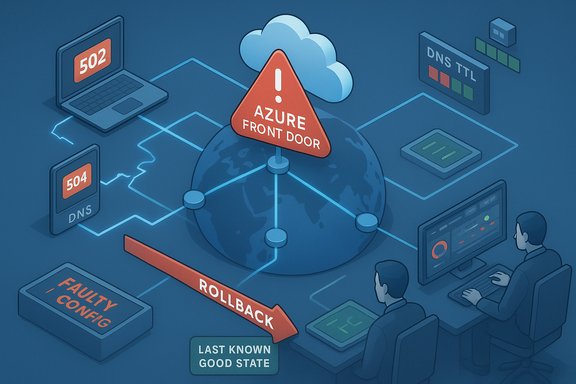
Global cloud fabric failure depicted by a cracked globe, glowing networks, and operators monitoring the outage.Background / Overview​

Azure Front Door is Microsoft’s global Layer‑7 edge and application delivery fabric. It performs TLS termination, global HTTP(S) load balancing, Web Application Firewall (WAF) enforcement and DNS-level routing for Microsoft-owned endpoints and many third‑party customer front ends. Because it sits at the public ingress for large numbers of services and is often used together with Microsoft Entra ID (Azure AD) for authentication, control‑plane or routing faults in AFD can produce broad, immediate symptoms — from failed sign‑ins to blank administration blades and 502/504 gateway errors. Microsoft’s operational messages stated the proximate trigger was an inadvertent configuration change that affected AFD behavior. The company immediately blocked further AFD configuration rollouts, deployed a rollback to a validated “last known good” state, rerouted Azure Portal traffic away from affected AFD paths and began recovering nodes and rebalancing traffic to healthy Points‑of‑Presence (PoPs). Those actions produced progressive recovery over several hours for most customers.

What happened — concise, verifiable timeline​

  • Detection: Public monitoring systems and customer reports first spiked in the mid‑afternoon UTC window on October 29, 2025, with observability feeds showing elevated latencies, DNS anomalies and a surge of 502/504 errors.
  • Attribution: Microsoft identified a configuration change affecting Azure Front Door as the likely trigger and published active incident notices describing mitigation steps and an internal incident identifier for impacted Microsoft 365 services.
  • Containment: Engineers halted all AFD configuration rollouts to prevent further drift, deployed the rollback, and failed the Azure Portal away from AFD to restore management‑plane access where possible.
  • Recovery: Microsoft recovered affected nodes and progressively re‑homed traffic to healthy PoPs; public trackers and status feeds showed a sharp decline in complaints as the rollback and routing fixes took effect. Full convergence and tenant‑specific residuals took additional hours.
The outage began at roughly 16:00 UTC on October 29, 2025 — which is approximately 03:00 AEDT on October 30, 2025 — and the pattern of detection, rollback and gradual recovery unfolded over the following hours. Where internal change automation and staged rollouts interact with a global edge fabric, a single erroneous change can amplify rapidly; this incident is a textbook example.

The technical anatomy: why Azure Front Door failures cascade​

Azure Front Door is not merely a content delivery network; it is a globally distributed control plane that handles three critical responsibilities:
  • DNS and global routing: mapping domain names to edge PoPs and selecting the correct origin.
  • TLS termination and host header handling: offloading TLS at the edge and enforcing certificate/hostname relationships.
  • Layer‑7 application logic and security: WAF rules, rate limits, origin failover and integration with DDoS and bot protections.
When an automated configuration change or roll‑out touches the AFD control plane and alters DNS or routing rules, the outward symptoms are immediate: clients can’t find the correct PoP, TLS/host header mismatches surface, and authentication token exchanges (often tied to Entra ID flows) time out or fail. Because many Microsoft first‑party services and thousands of customer sites front their public surface with AFD, what appears externally as “site down” is often a routing/TLS/authentication failure rather than an origin compute outage.
Key vectors that amplified this incident:
  • Centralization of identity (Entra ID) and management portals behind the same global fabric. This meant routing errors and DNS anomalies could simultaneously impact both user sign‑ins and admin console access.
  • Automated, global configuration rollouts. Modern deployment systems push small changes quickly across many nodes; a bad rule or misapplied route can be applied far and wide before human operators can intercept it.
  • Public caching and DNS TTL behaviors. Transient resolution failures can be amplified by resolver caches and uneven TTLs, producing regionally inconsistent availability during recovery.
Independent reporting and Microsoft’s own status messages both point to these mechanisms as central to the observable impact. Reuters and the Associated Press documented customer disruptions — including Alaska Airlines’ site and app outages — while Microsoft’s incident page described the AFD configuration rollback approach and the decision to fail portal traffic away from AFD.

Who was affected — scope and real‑world consequences​

The outage’s visible impact spanned Microsoft’s first‑party services and numerous customer applications:
  • Microsoft 365 admin center and Office web apps: sign‑in failures, blank admin blades and delayed mail delivery.
  • Azure Portal / management plane: blank or stalled resource blades and intermittent portal access, prompting Microsoft to route management traffic off AFD.
  • Xbox/Xbox Store/Minecraft: authentication and store access failures for gamers.
  • Airline check‑in and customer‑facing systems: high‑profile carriers — notably Alaska Airlines — reported website and app outages related to the Azure disruption, with real‑world friction at airports and check‑in desks.
  • Thousands of third‑party customer sites fronted by AFD: many presented 502/504 gateway errors or timeouts, affecting retail, transport, and public service portals.
In Australia, reporting shows that many organisations likely experienced degraded services, intermittent access, or slower workflows rather than widespread, total outages. That regional picture — limited or degraded local impact but possible customer‑facing interruptions — is consistent with the outage being global and edge‑routing driven rather than a localized data‑center collapse. Where an Australian service relied on AFD for its public surface or used Microsoft 365 identity for critical flows, operational exposure was real even if whole systems did not go fully offline. This pattern should be treated as typical rather than exceptional.

Why Australian organisations should pay attention​

Australian enterprises and government bodies are among the world’s heaviest users of Microsoft cloud services. The practical implications of the October 29 outage for Australian IT leaders include:
  • Operational exposure: mission‑critical public portals, APIs and customer‑facing workflows can degrade or fail when an upstream provider’s edge fabric misbehaves. Even if back‑end compute is healthy, the public ingress is the critical path.
  • Incident readiness beyond cyberattacks: response plans often focus on ransomware or intrusions, but vendor outages are a different class of incident that requires vendor‑centric playbooks and multi‑disciplinary coordination across IT, communications and legal.
  • Reputational and regulatory risk: service interruptions affecting public services, transport or banking invite scrutiny from regulators and the public — especially where alternate access routes or fallback procedures are absent. The timing of this outage coincides with regulatory activity in Australia (see ACCC proceedings below), increasing the visibility of vendor‑risk governance.

Practical resilience measures: what to do now​

Long‑term architectural resilience against provider control‑plane failures requires planning, testing and selective investment. The following are pragmatic steps Australian IT leaders can implement immediately and over the next 3–12 months.

1. Map and reduce single points of failure​

  • Inventory which public endpoints and control flows transit Azure Front Door, Azure CDN, or other upstream edge services.
  • Document dependencies on Microsoft Entra ID for authentication and plan for identity fallbacks or temporary workarounds.
  • Prioritise business‑critical flows (payments, check‑in, emergency services) for immediate mitigation planning.

2. Implement layered ingress and origin‑direct fallbacks​

  • Deploy an origin‑direct DNS record or alternate CDN/Traffic Manager path that can be switched to quickly if AFD is unavailable.
  • Configure short, tested runbooks that use Azure Traffic Manager or equivalent to fail traffic away from AFD to origin servers or an alternate provider.
  • Maintain validated origin TLS certs and host headers so origin‑direct access will function when required.

3. Harden authentication and admin access​

  • Ensure programmatic management methods (Azure CLI, PowerShell, REST API) are usable and that admin accounts have non‑AFD paths for emergency management.
  • Maintain break‑glass accounts and out‑of‑band authentication methods that do not rely on a single cloud provider’s management portal.

4. Exercise incident communications and SLA contracts​

  • Rehearse multi‑team incident response that includes communications, customer support, and legal as first‑class participants.
  • Review vendor SLAs and contractual obligations, and clarify escalation paths for incidents that have systemic cross‑tenant impact. Document the expected support response and contact chain for emergency RCA requests.

5. Consider multi‑cloud or hybrid strategies (practical, not ideological)​

  • For top‑tier critical functions, maintain a viable runbook to switch public surfaces to an alternate cloud provider or a managed CDN.
  • Where multi‑cloud is economically or technically impractical, focus on multi‑path (alternate DNS/CDN/origin routes) and robust caching to reduce immediate dependency.

6. Improve observability of upstream health​

  • Integrate vendor status feeds, external observability (third‑party latency and DNS monitors), and synthetic transactions that validate login flows and API health from multiple geographic vantage points.
  • Trigger automated playbooks when upstream metrics cross thresholds, so runbooks can be invoked earlier in the blast‑radius window.

Tactical runbook: the first 90 minutes after an AFD‑style failure​

  • Confirm the scope with external telemetry (Downdetector, vendor status page) and internal SRE dashboards.
  • Activate the communications cell and prepare an initial customer message acknowledging impact and expected actions.
  • Switch management access to alternate portals or programmatic paths; escalate to break‑glass accounts if necessary.
  • If AFD‑fronted public endpoints are impacted, trigger DNS failover to origin or an alternate CDN (preconfigured low-TTL records are essential).
  • Monitor for certificate/TLS host‑header mismatches when failing to origin and be prepared to issue emergency cert updates if needed.
  • Post‑incident: preserve logs, sign into vendor‑provided incident rooms, and demand a formal RCA with timeline and mitigation actions.

Regulatory and legal context: the ACCC case and vendor scrutiny​

The outage happens in a moment of heightened regulatory focus on large cloud providers in Australia. The Australian Competition and Consumer Commission (ACCC) recently commenced proceedings against Microsoft Australia and Microsoft Corporation alleging misleading conduct around Microsoft’s integration of its AI assistant (Copilot) into Microsoft 365 subscription plans — specifically that millions of Australian consumers may not have been clearly informed of subscription options and pricing changes. That action has already increased regulatory attention on Microsoft’s consumer transparency and, by extension, its corporate controls and governance in Australia. Regulators and courts will likely consider systemic vendor‑risk and customer disclosure practices when assessing broader market harms. Public reaction to an outage that disrupts essential services — transport check‑ins, government portals or banking flows — will increase political and regulatory scrutiny. Australian organisations in regulated sectors (banking, critical infrastructure, transport) should expect closer questions from auditors and regulators about vendor due diligence and contingency readiness.

What to expect from Microsoft’s forthcoming root‑cause analysis (RCA)​

Microsoft has signalled that it will publish a detailed RCA. Effective RCAs for incidents like this typically include:
  • A precise timeline of the configuration change and the automation pipelines that pushed it.
  • The human and/or automation triggers that allowed the change to roll out at scale.
  • Canary and pre‑deployment testing gaps that failed to catch the error.
  • Short‑ and mid‑term mitigation steps and engineering changes to prevent recurrence (for example, guardrails on AFD configuration rollouts, improved canaries, safer rollback tooling).
  • Recommendations to customers for operational mitigations and suggested architecture changes.
Organisations should scrutinise the RCA for facts that affect contractual liability, for systemic weaknesses in Microsoft’s deployment safety practices, and for recommended mitigation controls that can be operationalised locally. If the RCA omits actionable detail about internal automation, demand clarification — incomplete RCAs are a common gap after major hyperscaler incidents. Treat any vendor assertions that cannot be independently corroborated as provisional until documented evidence is provided.

Strengths and weaknesses revealed by the incident​

Notable strengths demonstrated​

  • Microsoft’s operational posture executed classic control‑plane containment playbooks promptly: freezing changes, rolling back to a known‑good configuration, and rerouting management traffic away from AFD to restore admin access. Those are the correct initial containment steps and they materially reduced the blast radius.
  • Visible, public status updates and estimated mitigation timelines helped customers coordinate immediate mitigations, reducing confusion in the early hours.

Key risks and structural weaknesses exposed​

  • Centralization risk: placing identity, portal management and vast swaths of public ingress onto a single global fabric makes inadvertent control‑plane changes disproportionately dangerous.
  • Automation and rollout safety: automated staged rollouts that lack sufficiently conservative canaries or easy-cutoff points can propagate errors at scale before operators detect them.
  • Downstream unpredictability: customers who assume upstream robustness without tested fallbacks are operationally exposed; the cost of that assumption was made visible in airline check‑in queues and consumer payment failures.
Any long‑term remediation must address these structural issues at both the hyperscaler and customer architecture levels.

Executive checklist for boards and CIOs (short)​

  • Confirm whether the organisation’s public surfaces are fronted by AFD or equivalent and map criticality.
  • Validate existing incident runbooks include vendor outage scenarios and cross‑functional communications.
  • Ensure legal and procurement teams have visibility on SLA remediation paths and escalation contacts at the vendor level.
  • Commission a resilience audit that focuses on identity dependencies, DNS/TLS posture and failover capability for external endpoints.

Conclusion​

The October 29, 2025 Azure outage is an important, avoidable lesson in modern cloud risk: scale and centralization buy efficiency but concentrate blast radius. Microsoft’s fast rollback and routing changes contained the immediate crisis, but the event highlights persistent, structural fragilities — especially where a single global edge fabric carries both identity and public ingress. Australian organisations should use the incident as a prompt to map dependencies, rehearse vendor‑outage runbooks, and invest in pragmatic fallbacks — not to reflexively abandon the cloud, but to demand and design for measured resilience that matches the strategic importance of cloud‑hosted services. The final, detailed RCA from Microsoft will matter. Organisations should read it closely, validate its claims against their own telemetry, and — where necessary — escalate contractual and regulatory questions through legal and risk channels. Meanwhile, the immediate operational advice is straightforward: map dependencies, test fallbacks, harden identity and management paths, and be ready to switch public ingress when the upstream fabric falters.
Source: Australian Cyber Security Magazine Microsoft Azure Outage Hits Globally - Australian Cyber Security Magazine
 

Microsoft's cloud and productivity services were restored after a widespread outage on October 29–30, 2025, that began with a failure in Azure Front Door and cascaded into Microsoft 365, Xbox Live, and multiple customer-facing systems worldwide, forcing rollbacks, emergency mitigations, and renewed scrutiny of cloud resilience across industries.

Azure Front Door outage warning with DNS errors and rollback to last known good state.Background​

On October 29, 2025, at approximately 16:00 UTC (12:00 p.m. Eastern Time), Microsoft’s monitoring and external outage trackers began registering elevated error rates, timeouts, and DNS anomalies across services that rely on Azure Front Door (AFD) — the company’s global content- and application-delivery control plane. The incident rapidly affected a wide range of Microsoft first‑party products and thousands of third‑party customer applications fronted by AFD, producing authentication failures, blank admin consoles, HTTP 502/504 gateway errors, and intermittent portal access.
Microsoft identified the immediate trigger as an inadvertent configuration change in the AFD control plane and initiated a controlled rollback to a “last known good” configuration while simultaneously blocking further changes to AFD. The recovery process involved staged rollbacks, failing portal traffic away from AFD where possible, re-routing traffic through healthy Points of Presence (PoPs), and recovering impacted edge nodes. Telemetry showed user-reported outage reports spiking into the tens of thousands on public trackers before receding as mitigations were applied. Microsoft subsequently reported that error rates and latency had returned to pre-incident levels, although a small number of customers reported lingering issues during the tail of recovery.
This outage landed amid heightened sensitivity to hyperscaler availability after a major outage at another large cloud provider earlier that month. The timing — close to Microsoft’s scheduled quarterly results announcement — intensified attention on operational controls and the real-world consequences of cloud control‑plane regressions.

What failed and why: Azure Front Door at the centre​

What is Azure Front Door?​

Azure Front Door (AFD) is a global, distributed service that provides HTTP-based load balancing, web application firewall capabilities, TLS termination, and edge-level routing for Microsoft’s cloud services and customer applications. Critically, AFD is frequently used not only for content delivery but also as a fronting layer for management and identity endpoints (including sign‑in flows), making it part of the control path for a large number of services.

The proximate cause​

Microsoft attributed the incident to an inadvertent configuration change in the AFD control plane. That single change had an outsized effect because AFD sits in front of many control and data paths: a misconfiguration at the control plane can deny access to identity and management endpoints, causing authentication failures and preventing administrators from logging in to management consoles.
The remedial actions Microsoft took were standard for control‑plane regressions:
  • Block further configuration changes to AFD to prevent re-introduction of the faulty state.
  • Deploy a rollback of the AFD control‑plane configuration to the company’s previously validated “last known good” state.
  • Fail the Azure management portal away from AFD where possible to restore administrative access.
  • Recover edge nodes, re-balance traffic across healthy PoPs, and monitor DNS/TTL effects as caches and ISPs converge on corrected entries.
Those mitigations restored broad service availability over the course of several hours, but recovery was not instantaneous due to caching, DNS propagation, and the distributed nature of internet routing.

Why a single configuration change cascaded​

Several systemic properties explain why a control‑plane misconfiguration produced such a large blast radius:
  • AFD is a foundational layer used by many services; when it fails, downstream services that rely on it lose connectivity or authentication capability.
  • Identity systems (Entra ID / Azure AD) and management portals are often proxied through the same front door fabric; when the fabric’s control plane is impacted, authentication and administrative control lose availability.
  • Global CDN and network caches (DNS TTLs, ISP caches) create a recovery tail that can extend impact for affected tenants beyond the time of the internal fix.
  • Protective safeguards that slow or block automated rollbacks (implemented to protect the fabric) can extend remediation time when they interact with operational rollback procedures.

Timeline of the outage (concise)​

  • 16:00 UTC, Oct 29 – Elevated packet loss, DNS anomalies, and HTTP gateway failures begin to surface for services fronted by AFD. User reports spike on public outage trackers.
  • Soon after detection – Microsoft posts incident updates identifying AFD issues and suspects an inadvertent configuration change as the trigger.
  • Containment actions – Engineers implement a change freeze on AFD, fail the Azure portal away from Front Door where feasible, and initiate deployment of a last‑known‑good configuration.
  • Rollback and recovery – The rollback is applied in stages; healthy PoPs are brought back into service and traffic re‑routed. Some mitigations take longer due to protective blocks and validation checks.
  • Late evening Oct 29 / early Oct 30 – Error rates and latency return to pre‑incident levels for the vast majority of customers; a small tail of tenant-specific issues persists as DNS caches and regional PoPs converge.
  • Post-incident actions announced – Microsoft states that safeguards and additional validation/rollback controls will be implemented and commits to publishing a Post Incident Review (PIR) with a preliminary update followed by a final review.

Scope and impact​

Services affected​

The outage impacted both Microsoft first‑party services and a broad set of customer applications that rely on Azure infrastructure. Reported disruptions included:
  • Microsoft 365 sign‑in and access to services such as Outlook, Teams, SharePoint, and the Microsoft 365 admin center.
  • Azure control‑plane components that depend on AFD for traffic routing and identity endpoints.
  • Gaming services including Xbox Live and Minecraft, which experienced connectivity issues and temporary disruptions.
  • Customer applications across industries — airline systems, retail checkouts, payment flows, and public sector sites — that use AFD for content delivery or application fronting.
  • Third‑party businesses whose public sites and portals are fronted by Azure Front Door, leading to incidents at well‑known brands and public infrastructure providers.

Quantifying the incident​

Public outage trackers recorded a rapid surge of user reports during the outage, with peaks in the tens of thousands for Microsoft-branded services. Those numbers reflect user-submitted incident reports and are not direct measures of the total number of impacted users or transactions, but they are a useful proxy for scope and timing.
The outage duration is measured from the first significant telemetry spike to the point where error rates and latency returned to baseline across most regions — roughly eight hours from detection to broad recovery, followed by a residual tail of tenant‑specific impacts during stabilization.

Real‑world consequences​

Enterprises and public services reported operational disruptions including:
  • Airline check‑in and boarding APIs temporarily failing.
  • Retail and loyalty systems experiencing transactional interruptions.
  • Government and healthcare portals showing intermittent downtime.
  • Game launches and online services encountering reduced availability.
  • Internal administrative access blocked for IT admins while consoles were inaccessible.
The event highlighted potential regulatory and contractual exposure for cloud consumers as well as financial and reputational risk for companies that rely on cloud‑fronted infrastructure.

Technical analysis: control plane, cascading failures, and mitigations​

The control-plane problem​

Cloud architectures separate data plane (user traffic) and control plane (management and configuration). AFD’s control plane orchestrates edge configuration, routing, and policies. When the control plane contains an invalid or unexpected configuration change, the edge fabric can enter an inconsistent state where traffic is incorrectly routed, authentication endpoints are unreachable, or edge gateways return errors.
Because identity and management endpoints often depend on AFD for fronting, the most visible effects are authentication failures and inaccessible admin consoles — exactly what many users observed.

Protective safeguards interacting with recovery​

Large cloud providers implement safeguards to prevent accidental or automated rollbacks from re-applying problematic configurations. These protections are sensible but can prolong recovery when rollback itself becomes part of the remediation. Engineers had to navigate and temporarily disable or work around protective blocks while ensuring they did not re‑introduce the faulty state.

DNS and caching as recovery tail factors​

Even after Microsoft deployed a fix, DNS TTLs, CDN caches, and ISP routing meant that some clients continued to see errors until caches expired or routing tables converged. This is an expected side-effect of a globally distributed content-delivery network and explains why some tenants saw lingering issues even after internal telemetry showed recovery.

Lessons about dependencies​

This outage illustrates how a single, centralised control point — albeit powerful and efficient — can amplify risk. Systems that appear loosely coupled at the application level often share common cloud infrastructure primitives: authentication endpoints, CDN fabrics, and configuration management. That shared use can turn localized failures into systemic outages.

Enterprise risk assessment and practical recommendations​

The outage underscores several key risks for enterprises that depend on hyperscale cloud services:
  • Single points of control: Dependence on a single global control plane can create systemic exposure.
  • Downstream cascading failures: Identity and management endpoints are high‑value targets for accidental disruption.
  • Operational visibility gaps: Customers may lack immediate visibility into provider control‑plane failures and be constrained while waiting for provider remediation.
  • Contract and regulatory exposure: Downtime can trigger SLA thresholds, compliance incidents, or contractual liability, particularly for regulated industries.
To reduce exposure and improve resilience, organizations should consider the following pragmatic measures:
  • Implement a multi-cloud or multi-region architecture for critical services:
  • Use active/passive failover between different cloud providers for mission‑critical workloads.
  • Maintain independent identity paths where possible to avoid a single front door for authentication.
  • Harden application architecture for degraded modes:
  • Design services with graceful degradation so that limited failures do not cascade into wholesale outages.
  • Cache authentication tokens with safe expiry to tolerate short-lived identity outages.
  • Prepare operational runbooks for cloud-provider outages:
  • Trigger incident playbooks that include provider status checks, mitigation steps, and communications templates.
  • Define manual bypasses for admin access (out‑of‑band consoles, bastion hosts).
  • Maintain contact paths with provider incident response teams for escalation.
  • Validate business continuity plans (BCP) and disaster recovery (DR) using realistic chaos testing:
  • Periodically simulate control‑plane failures and measure recovery time objectives (RTOs) and recovery point objectives (RPOs).
  • Revisit contractual SLAs and insurance:
  • Clarify performance metrics, credits, and remediation responsibilities in cloud contracts.
  • Evaluate cyber insurance and business interruption coverage for cloud‑dependent failures.
  • Invest in observability that correlates provider status with application metrics:
  • Instrument client-side and server-side telemetry to detect provider-side faults early.
  • Incorporate provider status feeds into incident dashboards.

Operational and regulatory implications​

For cloud providers​

The event will likely accelerate internal reviews at major cloud vendors on operational guardrails — especially around change management, configuration validation, and rollback procedures. Expect providers to:
  • Tighten automated validation rules for control-plane changes.
  • Enhance staged deployment practices and canarying for global fabric changes.
  • Improve communication APIs and status channels to give faster, more machine-readable signals to customers during incidents.
Microsoft has indicated it will revise safeguards, add validation and rollback controls, and publish a Post Incident Review that details root causes and corrective measures. Providers typically follow a two‑stage PIR cadence: a preliminary review within days and a deeper, final review within a few weeks.

For enterprise customers and regulators​

Regulators and watchdogs will take note of repeated hyperscaler disruptions. The systemic importance of cloud infrastructure may prompt more detailed guidance on resilience, transparency, and market concentration. Enterprises may face increased pressure to demonstrate continuity preparedness for critical public services and to hold cloud providers accountable to contractual SLAs.
In regulated sectors (financial services, healthcare, aviation), documented evidence of contingency testing and cloud‑risk mitigation will likely become part of compliance checklists and audit frameworks.

Microsoft’s response and follow-up commitments​

Microsoft’s immediate incident response included public status updates, a rollback to last known good configuration, a change freeze on the AFD control plane, and targeted mitigation to restore portal access. The company acknowledged the inadvertent configuration change and communicated steps taken to prevent recurrence, including reviewing safeguards and adding additional validation and rollback controls.
Microsoft also committed to performing a post-incident retrospective and to publishing a Post Incident Review (PIR), typically delivered in an initial preliminary form followed by a comprehensive final PIR. Those reviews commonly include:
  • A detailed timeline of events.
  • The root cause analysis and contributing factors.
  • Short- and long-term remediation actions.
  • Affected service lists and impact quantification where possible.
Customers should expect provider PIRs to include limited technical detail where revealing operational specifics could affect security, but they should contain actionable steps for customers and product teams.

Practical advice for administrators during provider outages​

When a major cloud provider outage occurs, IT admins should follow a clear checklist:
  • Confirm scope:
  • Check provider status pages and public outage trackers to establish whether issues are provider-wide or local.
  • Activate incident response:
  • Run the organization’s cloud outage playbook and assemble the incident team.
  • Communicate quickly and transparently:
  • Notify impacted stakeholders with status, expected impacts, and recommended next steps.
  • Perform safe mitigations:
  • Switch to backup identity providers or keep-time-limited tokens to preserve access to critical systems.
  • Escalate with the provider:
  • Use enterprise support channels for priority visibility when business-critical systems are at risk.
  • Preserve evidence:
  • Collect logs, timestamps, transaction failures, and customer-impact proofs to support SLA claims or insurance.
  • After the incident:
  • Execute a post-mortem that maps internal impacts to provider timelines and determines gaps in resilience.

Broader lessons: systemic concentration and resilience engineering​

This outage is part of a pattern where a handful of hyperscalers power enormous portions of the internet and enterprise systems. When those platforms experience failures — whether by human error, code regressions, or software bugs — the consequences ripple across industries.
Key takeaways for the broader ecosystem:
  • Concentration risk matters: Market concentration in a few cloud providers increases systemic fragility. Enterprises and public-interest entities need to assess concentration risk in procurement and continuity planning.
  • Resilience engineering must be prioritized: Building systems that tolerate partial failures, have multi-path identity flows, and can fail over across zones and providers is no longer optional for mission-critical services.
  • Transparency and measurable SLAs: Customers need clearer metrics and guarantees for control‑plane robustness and communications during incidents.
  • Regulatory and industry standards: There may be a growing case for industry-wide standards on operational transparency and incident reporting for hyperscalers.

Critical appraisal: strengths and weak points in the response​

Notable strengths​

  • Rapid detection and acknowledgement: Microsoft’s monitoring and public status updates provided timely detection and an identified trigger.
  • Standard, conservative mitigations: Deploying the last known good configuration and blocking further configuration changes are appropriate containment strategies for control‑plane regressions.
  • Commitment to PIR: A formal post-incident review offers an opportunity for systemic fixes and improved practices.

Risks and weaknesses​

  • Blast radius from centralised control plane: The architecture that makes AFD powerful also creates systemic exposure; a single misconfiguration affected a broad swath of dependent services.
  • Recovery tail due to caching and DNS: Even when internal fixes are applied, external caching and routing effects can extend the impact beyond the mitigation window.
  • Operational complexity in rollback interactions: Protective safeguards that normally prevent accidental rollbacks can interfere with recovery when they collide with emergency rollback needs.
  • Customer visibility and control: Many customers lack out‑of‑band mechanisms to manage identity or administrative access when the provider’s fronting layer is compromised.
Where Microsoft moves from here — in tightening change validation, improving rollback ergonomics, and increasing customer‑facing transparency — will be pivotal in restoring confidence among large enterprise and regulated customers.

Conclusion​

The October 29–30, 2025 Azure Front Door incident was a stark reminder that the convenience and scale of hyperscale cloud platforms come with concentrated operational risk. Microsoft’s incident response — a controlled rollback, change freeze, and staged recovery — restored broad service availability within hours, but the outage exposed how a single control‑plane change can quickly cascade into wide‑ranging outages across productivity, gaming, and enterprise services.
For organizations that rely on cloud providers, the practical response is clear: treat cloud dependency like any other operational dependency. Build multi-path identity and management routes, validate failover capabilities under realistic conditions, codify incident runbooks, and ensure contractual and insurance protections are in place. For cloud providers, the imperative is equally clear: strengthen safe change controls and rollback procedures, reduce single points of system-wide failure, and provide faster, clearer signals to customers during incidents.
When the final Post Incident Review is published, it should become required reading for IT leaders and CIOs who must translate the incident’s hard lessons into durable improvements in architecture, procurement, and operational readiness. The era of cloud‑native systems demands that resilience engineering evolve as quickly as the platforms it depends on.

Source: Computing UK https://www.computing.co.uk/news/2025/cloud/microsoft-services-restored-after-outage/
 

Back
Top