

Microsoft announced the Azure Functions serverless agents runtime in public preview at Build 2026, adding a markdown-first way to define, deploy, and run AI agents on the same event-driven Azure Functions infrastructure developers already use for HTTP APIs, queues, timers, databases, and enterprise connectors. The move is less about inventing another agent framework than about pulling agents into an operations model Azure teams already understand. Microsoft is betting that the winning enterprise agent platform will look less like a chatbot demo and more like scheduled jobs, managed identity, telemetry, connectors, and boring deployment plumbing. That is exactly why this preview matters.
Azure Functions has always been a small-unit-of-compute product: a blob changes, a queue message arrives, an HTTP request lands, a timer fires, and code wakes up just long enough to do the work. The serverless agents runtime keeps that shape but changes the payload. Instead of a handler merely transforming data or calling an API, the function can now launch an agent that reasons over instructions, calls tools, invokes MCP servers, and reaches into enterprise systems.
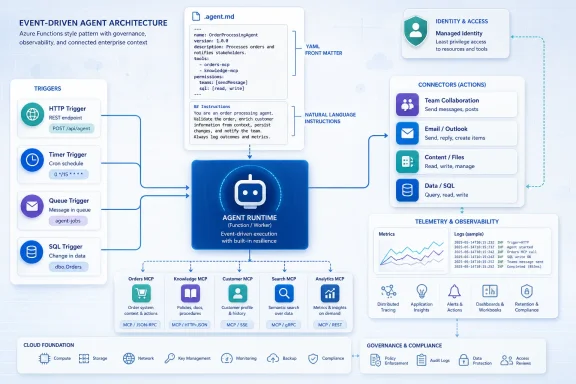
That may sound like branding until you look at the trigger model. Microsoft is not asking developers to host an always-on agent service and then bolt serverless concepts onto it. The agent is itself an Azure Functions workload, started by the same triggers that already anchor a large chunk of cloud automation: HTTP, Timer, Service Bus, Event Hubs, SQL, Cosmos DB, storage events, and now connection-backed triggers for services such as Teams, Outlook, calendar events, and SharePoint items.
The architectural point is subtle but important. Many agent frameworks start from the conversation and then discover they need scheduling, retries, secrets, identity, observability, and integration. Azure Functions starts from those operational realities and says the thing being executed can now be an agent.
That is a very Microsoft answer to the agent boom. The company is not trying to persuade enterprise developers that their infrastructure should become more magical. It is trying to persuade them that agents can be made less magical by pinning them to known cloud primitives.
This is not merely syntactic sugar. Microsoft is making a bet about who will read and govern agent behavior. If the agent’s purpose, trigger, and instructions are buried across TypeScript classes or Python orchestration code, review belongs mainly to developers. If those details are in a structured markdown file, architects, security reviewers, operations leads, and product owners have a fighting chance of understanding what the agent is supposed to do.
There is a trade-off. Markdown-first programming can look deceptively simple, and simplicity is dangerous when the system behind it can send mail, query business data, summarize private records, or trigger downstream workflows. A readable prompt is not the same as a safe system. But readability is still a prerequisite for governance, and
The format also acknowledges how agent development actually works. Instructions change frequently. Tool boundaries shift. Prompts need review and iteration. Treating the agent definition as a first-class file, rather than a string literal inside application code, makes that churn more visible.
That does not mean agent workloads will be cheap or fast. It means the serverless wrapper is not supposed to be the expensive part. Latency will come from model invocation, tool calls, prompt size, retrieval, and whatever remote systems the agent touches. Cost will come from model tokens, connector activity, storage, observability, sandbox execution, and execution duration. The cloud function is only the chassis.
This distinction matters for WindowsForum’s sysadmin and IT pro audience because serverless sticker shock often appears where abstraction hides work. Microsoft is saying the runtime preserves the Flex Consumption economics: scale-to-zero, per-second billing, managed identity, and familiar monitoring through Application Insights. The hard part is now estimating how much reasoning the agent performs once it wakes up.
That is the right boundary. Platform teams can reason about function execution. AI teams must reason about prompt complexity and tool behavior. The runtime’s job is to avoid adding a mysterious platform premium on top.
Microsoft’s MCP extension now supports hosting MCP servers on Azure Functions with tool, resource, and prompt triggers across .NET, Java, Python, TypeScript, and JavaScript. Built-in On-Behalf-Of authentication means a Functions-hosted MCP server can inherit the caller’s identity rather than collapsing every action into a single backend service account. That is exactly the kind of distinction enterprises care about once a prototype turns into a system with audit logs and compliance requirements.
The more interesting long-term play is discoverability. Microsoft says integration with Foundry Toolbox is planned so that MCP servers published from Functions can become discoverable to Foundry agents. If that lands cleanly, Azure Functions becomes not just a place to run agents, but a factory for creating governed tools that other agents can consume.
This is where Microsoft’s platform instincts show. Agent frameworks multiply quickly. Tool catalogs become messy even faster. By tying MCP hosting to Functions and discovery to Foundry, Microsoft is trying to turn scattered automation into an inventory.
That is why the connection-backed triggers matter. They move agents closer to the stream of everyday business activity. A new email, a calendar event, a Teams message, or a SharePoint update can become the event that starts reasoning and action.
For Microsoft, this is familiar territory. Logic Apps has long sold the value of connectors and low-code orchestration. Power Platform has done the same for business users. Azure Functions now gets an agentic version of that story for code-first developers who want the integration surface without giving up source control, custom tools, testability, and deployment discipline.
But connector abundance cuts both ways. The more systems an agent can reach, the more important permission boundaries become. A function app with managed identity and connector access is not a toy; it is a principal with operational consequences. Enterprises will need to treat
That example works because it is not a chatbot. It is scheduled governance. It wakes up, inspects a defined surface area, reasons over policy-sensitive signals, and reports. It costs nothing between runs under Flex Consumption, which is exactly the sort of workload serverless was designed to host before the industry started using the word “agent” for everything.
This is likely where many serious deployments will begin. Not autonomous agents that roam the enterprise making decisions, but constrained agents that perform recurring review, triage, summarization, reconciliation, or escalation. They will have clear triggers, bounded tool access, and measurable outputs.
That is also where administrators will be most willing to experiment. A security posture agent that drafts findings is easier to approve than an agent that remediates production settings. A daily operations digest is less risky than an autonomous incident commander. The runtime’s event-driven model encourages these bounded patterns.
On-demand Sandboxes, currently in private preview, push the story further. Each orchestration step can run in a clean, microVM-backed sandbox, opening the door for isolated execution of native toolchains, CPU-heavy preprocessing, cross-runtime activities, customer plugins, or LLM-generated code. That is not a marginal feature. It is an admission that serious AI systems will need places to do messy work safely.
The agent runtime handles event-driven reasoning. Durable Task Scheduler handles long-running process reliability. Sandboxes handle risky or heavyweight execution. Together, they sketch a platform for agentic systems that look much more like distributed applications than chat windows.
The Windows angle is not desktop Windows, of course, but operational Windows estates. IT teams already live with scheduled maintenance, log analysis, email triage, compliance scans, ticket routing, and SharePoint sprawl. The more Microsoft can connect those worlds to managed agents without requiring a new always-on service tier, the more plausible adoption becomes.
That division is sensible, but it is also a warning. Microsoft is not delivering a single agent product. It is building a stack. Developers, integration specialists, platform engineers, and security teams will each see a different layer, and successful deployments will require agreement about where responsibilities begin and end.
Functions developers will care about source control, triggers, cold start, logging, and tool code. Logic Apps users will care about connector flows and business process automation. API Management owners will care about policy, metering, routing, and safety. Security teams will care about identity propagation, connector permissions, audit trails, and the blast radius of tool access.
The agent runtime’s success depends on whether those layers feel integrated rather than adjacent. Microsoft has enough pieces to make a credible enterprise agent platform. The risk is that customers experience it as another Azure jigsaw puzzle unless templates, defaults, and governance patterns mature quickly.
The safest early use cases are internal, bounded, and observable. Scheduled digests, compliance checks, ticket summaries, repository audits, and non-destructive triage agents fit the model well. Workloads that mutate production systems, make customer-facing decisions, or execute broad connector actions should wait for stronger governance patterns and more field experience.
There is also the question of language support. The agent runtime’s current project anatomy is Python-centric, even as the broader Functions and MCP story spans several languages. That is not fatal, but it matters for shops standardized on .NET or TypeScript. Microsoft’s agent strategy will feel more complete when the markdown programming model is equally natural across the languages Azure Functions developers already use.
Finally, observability must grow beyond “the function ran.” Agent execution needs traces that explain model calls, tool invocations, connector actions, prompt versions, identity context, and failure points. Application Insights gives Microsoft a starting point, but AI systems require more semantic telemetry than traditional request logs.
 Microsoft Turns the Function Into the Agent
Azure Functions has always been a small-unit-of-compute product: a blob changes, a queue message arrives, an HTTP request lands, a timer fires, and code wakes up just long enough to do the work. The serverless agents runtime keeps that shape but changes the payload. Instead of a handler merely transforming data or calling an API, the function can now launch an agent that reasons over instructions, calls tools, invokes MCP servers, and reaches into enterprise systems.That may sound like branding until you look at the trigger model. Microsoft is not asking developers to host an always-on agent service and then bolt serverless concepts onto it. The agent is itself an Azure Functions workload, started by the same triggers that already anchor a large chunk of cloud automation: HTTP, Timer, Service Bus, Event Hubs, SQL, Cosmos DB, storage events, and now connection-backed triggers for services such as Teams, Outlook, calendar events, and SharePoint items.
The architectural point is subtle but important. Many agent frameworks start from the conversation and then discover they need scheduling, retries, secrets, identity, observability, and integration. Azure Functions starts from those operational realities and says the thing being executed can now be an agent.
That is a very Microsoft answer to the agent boom. The company is not trying to persuade enterprise developers that their infrastructure should become more magical. It is trying to persuade them that agents can be made less magical by pinning them to known cloud primitives.
Markdown Becomes the New Deployment Artifact
The most distinctive part of the announcement is the.agent.md file. An agent is declared in a markdown document with YAML front matter for metadata and trigger configuration, followed by natural-language instructions that become the agent’s operating brief. The supporting pieces — app-wide defaults, MCP server definitions, custom tools, skills, and sandbox configuration — live beside it in conventional project files.This is not merely syntactic sugar. Microsoft is making a bet about who will read and govern agent behavior. If the agent’s purpose, trigger, and instructions are buried across TypeScript classes or Python orchestration code, review belongs mainly to developers. If those details are in a structured markdown file, architects, security reviewers, operations leads, and product owners have a fighting chance of understanding what the agent is supposed to do.
There is a trade-off. Markdown-first programming can look deceptively simple, and simplicity is dangerous when the system behind it can send mail, query business data, summarize private records, or trigger downstream workflows. A readable prompt is not the same as a safe system. But readability is still a prerequisite for governance, and
.agent.md gives Microsoft a human-scale artifact to put into pull requests, change reviews, and policy checks.The format also acknowledges how agent development actually works. Instructions change frequently. Tool boundaries shift. Prompts need review and iteration. Treating the agent definition as a first-class file, rather than a string literal inside application code, makes that churn more visible.
The Boring Runtime Is the Product
InfoQ’s most practical questions went straight to cold start and cost, because those are the questions that decide whether a preview survives contact with real workloads. Microsoft’s answer was deliberately unglamorous: the agents runtime does not add extra cold start beyond a regular HTTP trigger on Flex Consumption, and there is no separate “agents tax.” It is billed like a standard function execution.That does not mean agent workloads will be cheap or fast. It means the serverless wrapper is not supposed to be the expensive part. Latency will come from model invocation, tool calls, prompt size, retrieval, and whatever remote systems the agent touches. Cost will come from model tokens, connector activity, storage, observability, sandbox execution, and execution duration. The cloud function is only the chassis.
This distinction matters for WindowsForum’s sysadmin and IT pro audience because serverless sticker shock often appears where abstraction hides work. Microsoft is saying the runtime preserves the Flex Consumption economics: scale-to-zero, per-second billing, managed identity, and familiar monitoring through Application Insights. The hard part is now estimating how much reasoning the agent performs once it wakes up.
That is the right boundary. Platform teams can reason about function execution. AI teams must reason about prompt complexity and tool behavior. The runtime’s job is to avoid adding a mysterious platform premium on top.
MCP Moves From Demo Protocol to Azure Plumbing
The agents runtime arrives alongside the general availability of the Azure Functions MCP extension, and that pairing is not accidental. The Model Context Protocol has quickly become the lingua franca for exposing tools to agents, but enterprise adoption depends on boring questions: who authenticates, what identity is forwarded, which tools are exposed, how traffic is monitored, and where governance lives.Microsoft’s MCP extension now supports hosting MCP servers on Azure Functions with tool, resource, and prompt triggers across .NET, Java, Python, TypeScript, and JavaScript. Built-in On-Behalf-Of authentication means a Functions-hosted MCP server can inherit the caller’s identity rather than collapsing every action into a single backend service account. That is exactly the kind of distinction enterprises care about once a prototype turns into a system with audit logs and compliance requirements.
The more interesting long-term play is discoverability. Microsoft says integration with Foundry Toolbox is planned so that MCP servers published from Functions can become discoverable to Foundry agents. If that lands cleanly, Azure Functions becomes not just a place to run agents, but a factory for creating governed tools that other agents can consume.
This is where Microsoft’s platform instincts show. Agent frameworks multiply quickly. Tool catalogs become messy even faster. By tying MCP hosting to Functions and discovery to Foundry, Microsoft is trying to turn scattered automation into an inventory.
Connectors Are the Enterprise Moat
The 1,400-plus connector catalog is the quiet heavyweight in this announcement. An agent that can reason but cannot touch business systems is a demo. An agent that can react to a Teams message, inspect a SharePoint item, send Outlook mail, update Salesforce, create a ServiceNow ticket, or query SQL is a workflow engine with a model attached.That is why the connection-backed triggers matter. They move agents closer to the stream of everyday business activity. A new email, a calendar event, a Teams message, or a SharePoint update can become the event that starts reasoning and action.
For Microsoft, this is familiar territory. Logic Apps has long sold the value of connectors and low-code orchestration. Power Platform has done the same for business users. Azure Functions now gets an agentic version of that story for code-first developers who want the integration surface without giving up source control, custom tools, testability, and deployment discipline.
But connector abundance cuts both ways. The more systems an agent can reach, the more important permission boundaries become. A function app with managed identity and connector access is not a toy; it is a principal with operational consequences. Enterprises will need to treat
.agent.md, mcp.json, and connector namespaces as sensitive infrastructure definitions, not prompt experiments.Microsoft’s Own Security Agent Is the Real Sales Pitch
Microsoft’s internal dogfooding example is telling. The Azure Functions team reportedly built a timer-triggered.agent.md agent that continuously audits security posture across GitHub organizations and repositories, reasoning over branch protection, secret scanning, and workflow permissions before reporting findings through the same connector and MCP machinery available to external users.That example works because it is not a chatbot. It is scheduled governance. It wakes up, inspects a defined surface area, reasons over policy-sensitive signals, and reports. It costs nothing between runs under Flex Consumption, which is exactly the sort of workload serverless was designed to host before the industry started using the word “agent” for everything.
This is likely where many serious deployments will begin. Not autonomous agents that roam the enterprise making decisions, but constrained agents that perform recurring review, triage, summarization, reconciliation, or escalation. They will have clear triggers, bounded tool access, and measurable outputs.
That is also where administrators will be most willing to experiment. A security posture agent that drafts findings is easier to approve than an agent that remediates production settings. A daily operations digest is less risky than an autonomous incident commander. The runtime’s event-driven model encourages these bounded patterns.
Durable Workflows Show Where Simple Agents Stop
The Build 2026 update also included Durable Task Scheduler news, and that matters because agents often turn into workflows the moment they become useful. Microsoft says Durable Task Scheduler is now used at significant internal scale, including Copilot scenarios involving complex, long-running AI workflows. The message is obvious: when reasoning becomes multi-step, stateful, and failure-prone, you need orchestration, not just invocation.On-demand Sandboxes, currently in private preview, push the story further. Each orchestration step can run in a clean, microVM-backed sandbox, opening the door for isolated execution of native toolchains, CPU-heavy preprocessing, cross-runtime activities, customer plugins, or LLM-generated code. That is not a marginal feature. It is an admission that serious AI systems will need places to do messy work safely.
The agent runtime handles event-driven reasoning. Durable Task Scheduler handles long-running process reliability. Sandboxes handle risky or heavyweight execution. Together, they sketch a platform for agentic systems that look much more like distributed applications than chat windows.
The Windows angle is not desktop Windows, of course, but operational Windows estates. IT teams already live with scheduled maintenance, log analysis, email triage, compliance scans, ticket routing, and SharePoint sprawl. The more Microsoft can connect those worlds to managed agents without requiring a new always-on service tier, the more plausible adoption becomes.
The Three-Layer Agent Stack Comes Into Focus
Microsoft’s positioning is now fairly clear. Azure Functions is for code-first developers building event-driven agents and tool servers. Logic Apps is for low-code integration workflows with a visual canvas and AI assistance. Azure API Management is the governance layer across both, covering model routing, content safety for MCP and A2A traffic, and enterprise token metrics.That division is sensible, but it is also a warning. Microsoft is not delivering a single agent product. It is building a stack. Developers, integration specialists, platform engineers, and security teams will each see a different layer, and successful deployments will require agreement about where responsibilities begin and end.
Functions developers will care about source control, triggers, cold start, logging, and tool code. Logic Apps users will care about connector flows and business process automation. API Management owners will care about policy, metering, routing, and safety. Security teams will care about identity propagation, connector permissions, audit trails, and the blast radius of tool access.
The agent runtime’s success depends on whether those layers feel integrated rather than adjacent. Microsoft has enough pieces to make a credible enterprise agent platform. The risk is that customers experience it as another Azure jigsaw puzzle unless templates, defaults, and governance patterns mature quickly.
Preview Means the Sharp Edges Still Matter
The serverless agents runtime is in public preview, and Microsoft’s own documentation warns that features, configuration names, and supported connectors can change before general availability. That caveat is not boilerplate. It should shape how teams adopt the preview.The safest early use cases are internal, bounded, and observable. Scheduled digests, compliance checks, ticket summaries, repository audits, and non-destructive triage agents fit the model well. Workloads that mutate production systems, make customer-facing decisions, or execute broad connector actions should wait for stronger governance patterns and more field experience.
There is also the question of language support. The agent runtime’s current project anatomy is Python-centric, even as the broader Functions and MCP story spans several languages. That is not fatal, but it matters for shops standardized on .NET or TypeScript. Microsoft’s agent strategy will feel more complete when the markdown programming model is equally natural across the languages Azure Functions developers already use.
Finally, observability must grow beyond “the function ran.” Agent execution needs traces that explain model calls, tool invocations, connector actions, prompt versions, identity context, and failure points. Application Insights gives Microsoft a starting point, but AI systems require more semantic telemetry than traditional request logs.
The Useful Agent Is the One That Looks Like a Job
The concrete lesson from this announcement is that Microsoft is trying to domesticate agents by making them resemble the automation units enterprises already run. That does not remove the risks of LLM behavior, but it gives administrators and developers familiar places to apply controls.- Azure Functions can now host preview serverless agents defined in
.agent.mdfiles, with triggers and instructions living in a readable markdown-first artifact. - The runtime preserves the familiar Functions operational model, including Flex Consumption, scale-to-zero, managed identity, and Application Insights.
- Microsoft says the runtime does not add extra cold-start overhead beyond a regular Flex Consumption function, leaving model calls and prompt complexity as the main latency drivers.
- MCP support is becoming a first-class Azure Functions capability, with Functions able to host MCP servers and agents able to consume MCP tools.
- The biggest enterprise value may come from connector-backed agents that react to Teams, Outlook, SharePoint, databases, queues, and SaaS systems under governed identities.
- The public preview is best suited to bounded internal automation before teams trust agents with broad production write access.
References
- Primary source: infoq.com
Published: Fri, 19 Jun 2026 08:57:07 GMT
Azure Functions Ships Serverless Agents Runtime at Build 2026 - InfoQ
Azure Functions shipped a serverless agents runtime in public preview at Build 2026. Agents are defined in .agent.md markdown files with YAML triggers, MCP server access, 1,400+ connectors, and sandbowww.infoq.com
