

On June 5, 2026, Microsoft published a customer story describing how Uniklinik RWTH Aachen in Germany is using Azure to support Genolator, an AI system for natural-language exploration of genomic data. The project matters because it reframes cloud computing not as generic infrastructure, but as an interface layer between biological complexity and human scientific reasoning. The bet is that researchers should not need to be cloud engineers, model wranglers, and molecular biologists at once just to ask better questions of the genome. If the approach works, it hints at a more practical future for genomic medicine: one where discovery is accelerated by making the data easier to interrogate, not merely larger.
The most interesting part of the Aachen project is not that a hospital research team is using the cloud. That stopped being surprising years ago. The more important shift is that Azure is being positioned as part of the scientific instrument itself: a computational layer that helps researchers build, train, store, and operate AI systems that interpret biological data.
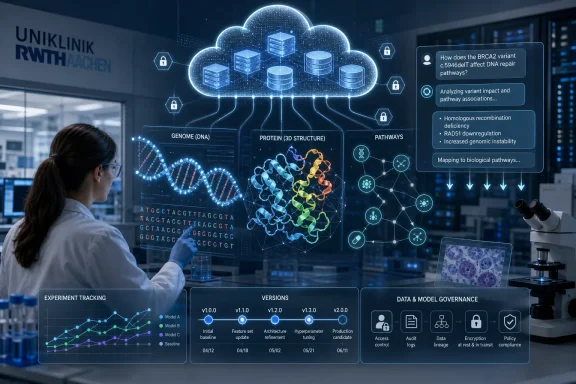
Uniklinik RWTH Aachen’s team is working on Genolator, a multimodal AI system designed to connect genomic sequences, protein structure information, and natural language models. In plain terms, the researchers are trying to let scientists ask questions about coding sequences in ordinary language and receive useful associations with biological processes, molecular functions, and cellular roles. That is a different kind of research workflow from the traditional pipeline-heavy world of bioinformatics, where insight often depends on moving between specialized tools, data formats, and statistical outputs.
Microsoft’s customer story frames Azure as the enabling substrate for that work: storage for large training datasets, compute for model training, and support across the full MLOps lifecycle. That last phrase can sound like enterprise software boilerplate, but in a research setting it has teeth. Reproducibility, versioning, experiment tracking, and controlled deployment are not optional when models are being used to reason about biology.
This is where the cloud story becomes more than a marketing vignette. Genomics is not just a “big data” problem; it is a problem of layered meaning. DNA sequences, amino acid chains, protein structures, biological pathways, clinical observations, and disease phenotypes do not naturally live in the same explanatory space. The Aachen project is an attempt to build a bridge across those spaces.
The classic challenge in genomics has been that identifying a genetic variant is not the same as understanding what it does. Sequencing can generate data at scale, but interpretation remains stubbornly difficult. Researchers may find a change in a coding region, a suspicious regulatory signal, or a correlation with disease, only to face the harder question: does this matter, and if so, how?
That is why the phrase “natural-language genomic exploration” deserves attention. It implies a shift from asking computers only to process biological data toward asking them to mediate biological reasoning. The scientist’s query becomes part of the workflow, not merely the final step after a pipeline has completed.
Genolator’s current focus on coding regions is a sensible place to start. Protein-coding sequences are better studied than many other parts of the genome, and protein structure information gives AI systems a richer set of relationships to model. But even there, the space is vast enough to defeat manual inspection. The value of the system is not that it magically understands disease; it is that it may help researchers navigate a dense map of possible biological meaning.
The cloud role here is mundane in the best sense. Large-scale model training needs compute. Genomic datasets need storage. Research teams need environments that can be scaled without disrupting clinical systems. On-premises infrastructure in hospitals is often reserved for clinical workloads, governed by reliability, compliance, and operational constraints that make experimental AI development difficult to wedge in.
That division matters. A university hospital cannot simply treat its production clinical systems as a playground for model training. By moving the experimental burden to Azure, the Aachen team gets room to build without consuming capacity intended for patient-facing operations. The cloud becomes a pressure valve for research ambition.
But the story also exposes the hard boundary between vendor promise and scientific outcome. Azure can supply elastic infrastructure, identity controls, data services, and machine learning tooling. It cannot, by itself, validate whether a model’s associations are biologically meaningful, clinically relevant, or safe to use beyond research. That distinction should stay bright.
Natural-language interfaces are powerful because they lower the cost of exploration. A researcher can ask broader, more iterative questions without constantly translating those questions into code or tool-specific syntax. In a field where insight may come from connecting distant biological layers, a more fluid interface can change the rhythm of research.
The danger is that fluency can masquerade as certainty. A model that produces a plausible explanation for a sequence may be useful for hypothesis generation, but plausibility is not proof. In genomics, where the consequences of interpretation can eventually touch diagnosis, counseling, and treatment, the system’s role must be carefully framed.
Genolator, as described, appears to sit on the research side of that line. That is the right place for it. The more immediate value is helping scientists generate leads, identify relationships, and prioritize further work. The leap from research assistant to clinical decision support is much larger, and it carries a different regulatory and ethical burden.
That makes cloud architecture choices more consequential than raw performance figures. Where data is stored, who can access it, how models are trained, how outputs are logged, and how experiments are reproduced are not merely administrative details. They are part of the scientific and ethical design of the system.
Azure’s appeal to institutions like Uniklinik RWTH Aachen is that it can offer a mature enterprise platform rather than a loose collection of rented servers. Identity management, policy controls, monitoring, encryption, and lifecycle management are essential when research data and AI tooling begin to converge. The same features that sysadmins care about in conventional enterprise deployments become foundational in biomedical research.
Still, cloud governance is not automatic governance. A well-configured environment can reduce risk; a poorly configured one can concentrate it. The lesson for IT pros is familiar: the cloud gives teams more capability and more responsibility at the same time.
That emphasis is important. A research model that cannot be reproduced is a demo, not an instrument. A pipeline that cannot track which data, parameters, and model versions produced a result is a liability. A natural-language system that cannot be audited may be impressive in a presentation and useless in a serious lab.
For WindowsForum readers who live in the world of infrastructure, this is the part of the story that should feel most familiar. AI does not abolish systems administration; it makes the consequences of systems administration more visible. Storage tiers, permissions, compute quotas, network design, monitoring, and deployment hygiene all shape whether a project like Genolator can survive contact with real research use.
The irony of modern AI is that its most futuristic interfaces depend on deeply conventional engineering discipline. Scientists may experience Genolator as a conversational gateway into genomic data, but behind that gateway is a stack that must behave predictably. In medicine and research, the magic trick only matters if the apparatus is trustworthy.
But the team’s longer-term ambition points toward the more mysterious parts of the genome. Much of the human genome does not directly code for proteins, yet non-coding regions can influence regulation, expression, timing, and disease risk. For genomic medicine, the difficult cases often live in that gap between what can be sequenced and what can be explained.
That is why Jeremias Krause’s comment about future research into less understood parts of the genome is more than an aside. If Genolator can provide a framework for linking multiple biological layers in coding regions, the next question is whether similar approaches can help make sense of regulatory and non-coding complexity. That is where the promise becomes much larger — and the uncertainty grows with it.
The patient connection is also crucial. Martin Danner’s point that many patients have genetic disorders whose causal changes remain unclear captures the human reason for doing this work. The goal is not an elegant interface for its own sake. The goal is to reduce the number of cases where medicine can observe suffering, sequence DNA, and still fail to explain what happened.
A project like Genolator requires more than a principal investigator and a cloud subscription. It needs clinicians who understand patient problems, geneticists who understand biological mechanisms, data scientists who understand model behavior, and engineers who can make the platform reliable. The Aachen team described by Microsoft has exactly that multidisciplinary shape.
This is the likely template for serious healthcare AI. The strongest projects will not come from dropping a generic model into a hospital and waiting for transformation. They will come from teams that combine domain expertise with infrastructure maturity. In that sense, the cloud is less a replacement for institutional capability than a multiplier of it.
For administrators, this raises uncomfortable but necessary questions. Who owns the model lifecycle? Who approves data movement? Who reviews model outputs? Who decides when a research tool is ready for broader use? These are governance questions, but they are also organizational design questions.
If a hospital builds its datasets, model workflows, security policies, and research operations around Azure, the platform becomes more than a vendor line item. It becomes embedded in the way the institution does science. That is exactly the kind of cloud adoption Microsoft wants: not opportunistic burst compute, but workflow gravity.
The Aachen story also gives Microsoft a cleaner healthcare AI narrative than many chatbot-centric announcements. It is not about replacing doctors or automating bedside decisions. It is about giving researchers better tools for exploring complex data. That is a safer and more credible claim.
The risk for Microsoft is overextension of the narrative. A customer story can imply momentum, but it is not a clinical validation study. Genolator’s promise will ultimately depend on scientific results, researcher adoption, and the quality of the hypotheses it helps generate. Azure can be necessary without being sufficient.
The same admins who manage Windows fleets are often the people asked to secure access to cloud research environments, enforce identity policies, integrate devices, and support collaboration across departments. Healthcare AI may be developed in notebooks and pipelines, but it is accessed by humans sitting at managed endpoints. The boring perimeter still matters.
That means projects like Genolator are part of a broader shift in Microsoft’s center of gravity. Windows remains important, but the action is often in the systems connected to it: Entra ID, Azure storage, machine learning workspaces, compliance tooling, and data governance. The PC is one node in a larger institutional machine.
For IT pros, the practical lesson is that AI adoption will not arrive as a single product. It will arrive as a series of specialized workloads that stretch existing governance models. A genomics lab today, an imaging department tomorrow, a clinical documentation pilot after that. Each one will ask whether the organization’s cloud controls are mature enough for sensitive AI.
In an AI market full of inflated timelines, modest specificity is refreshing. The project has named researchers, a defined institution, a described technical goal, and a concrete platform role. It is still a customer story, and therefore promotional by design, but it gives readers enough substance to evaluate the shape of the work.
There is also a useful asymmetry in the stakes. If Genolator improves research exploration, even incrementally, the payoff could be meaningful. If it fails to generalize or produces only modest gains, the lesson is still valuable: scientific AI systems need better interfaces, better infrastructure, and better evaluation. Either outcome advances the conversation more than another generic “AI will transform healthcare” slogan.
That is why this story deserves attention beyond Microsoft’s marketing channel. It is a glimpse of how AI may enter biomedical research not as a single disruptive event, but as a set of new instruments layered onto existing scientific practice. The transformation, if it comes, will look less like a robot doctor and more like a better workbench.
 Azure Moves From Back Office to Lab Bench
The most interesting part of the Aachen project is not that a hospital research team is using the cloud. That stopped being surprising years ago. The more important shift is that Azure is being positioned as part of the scientific instrument itself: a computational layer that helps researchers build, train, store, and operate AI systems that interpret biological data.Uniklinik RWTH Aachen’s team is working on Genolator, a multimodal AI system designed to connect genomic sequences, protein structure information, and natural language models. In plain terms, the researchers are trying to let scientists ask questions about coding sequences in ordinary language and receive useful associations with biological processes, molecular functions, and cellular roles. That is a different kind of research workflow from the traditional pipeline-heavy world of bioinformatics, where insight often depends on moving between specialized tools, data formats, and statistical outputs.
Microsoft’s customer story frames Azure as the enabling substrate for that work: storage for large training datasets, compute for model training, and support across the full MLOps lifecycle. That last phrase can sound like enterprise software boilerplate, but in a research setting it has teeth. Reproducibility, versioning, experiment tracking, and controlled deployment are not optional when models are being used to reason about biology.
This is where the cloud story becomes more than a marketing vignette. Genomics is not just a “big data” problem; it is a problem of layered meaning. DNA sequences, amino acid chains, protein structures, biological pathways, clinical observations, and disease phenotypes do not naturally live in the same explanatory space. The Aachen project is an attempt to build a bridge across those spaces.
The Genome Is Too Large for the Old Interface
The human genome is frequently described as a book, but that metaphor undersells the problem. A book has pages, chapters, and a reading order. The genome has sequences, regulatory regions, coding regions, structural relationships, and effects that depend on context, timing, cell type, and interaction with other systems.The classic challenge in genomics has been that identifying a genetic variant is not the same as understanding what it does. Sequencing can generate data at scale, but interpretation remains stubbornly difficult. Researchers may find a change in a coding region, a suspicious regulatory signal, or a correlation with disease, only to face the harder question: does this matter, and if so, how?
That is why the phrase “natural-language genomic exploration” deserves attention. It implies a shift from asking computers only to process biological data toward asking them to mediate biological reasoning. The scientist’s query becomes part of the workflow, not merely the final step after a pipeline has completed.
Genolator’s current focus on coding regions is a sensible place to start. Protein-coding sequences are better studied than many other parts of the genome, and protein structure information gives AI systems a richer set of relationships to model. But even there, the space is vast enough to defeat manual inspection. The value of the system is not that it magically understands disease; it is that it may help researchers navigate a dense map of possible biological meaning.
Microsoft’s Healthcare AI Pitch Gets More Concrete
Microsoft has spent the last few years talking about AI in healthcare in broad terms: productivity, clinical documentation, imaging, research, security, and patient engagement. The Aachen story is narrower and therefore more useful. It shows where hyperscale cloud platforms can plausibly help without pretending that a general-purpose chatbot is about to solve medicine.The cloud role here is mundane in the best sense. Large-scale model training needs compute. Genomic datasets need storage. Research teams need environments that can be scaled without disrupting clinical systems. On-premises infrastructure in hospitals is often reserved for clinical workloads, governed by reliability, compliance, and operational constraints that make experimental AI development difficult to wedge in.
That division matters. A university hospital cannot simply treat its production clinical systems as a playground for model training. By moving the experimental burden to Azure, the Aachen team gets room to build without consuming capacity intended for patient-facing operations. The cloud becomes a pressure valve for research ambition.
But the story also exposes the hard boundary between vendor promise and scientific outcome. Azure can supply elastic infrastructure, identity controls, data services, and machine learning tooling. It cannot, by itself, validate whether a model’s associations are biologically meaningful, clinically relevant, or safe to use beyond research. That distinction should stay bright.
Natural Language Is a User Interface, Not a Scientific Shortcut
The seductive version of this story is that scientists will “talk to the genome.” The more realistic version is that natural language may become a better front end for querying complex computational representations. That is still a major step, but it should not be confused with replacing scientific judgment.Natural-language interfaces are powerful because they lower the cost of exploration. A researcher can ask broader, more iterative questions without constantly translating those questions into code or tool-specific syntax. In a field where insight may come from connecting distant biological layers, a more fluid interface can change the rhythm of research.
The danger is that fluency can masquerade as certainty. A model that produces a plausible explanation for a sequence may be useful for hypothesis generation, but plausibility is not proof. In genomics, where the consequences of interpretation can eventually touch diagnosis, counseling, and treatment, the system’s role must be carefully framed.
Genolator, as described, appears to sit on the research side of that line. That is the right place for it. The more immediate value is helping scientists generate leads, identify relationships, and prioritize further work. The leap from research assistant to clinical decision support is much larger, and it carries a different regulatory and ethical burden.
The Cloud Solves Scale, Then Creates Governance
Every serious cloud story in healthcare eventually becomes a governance story. Genomic data is among the most sensitive categories of information an institution can handle. It is personal, familial, durable, and difficult to anonymize in any absolute sense. Once generated, it can remain relevant for decades.That makes cloud architecture choices more consequential than raw performance figures. Where data is stored, who can access it, how models are trained, how outputs are logged, and how experiments are reproduced are not merely administrative details. They are part of the scientific and ethical design of the system.
Azure’s appeal to institutions like Uniklinik RWTH Aachen is that it can offer a mature enterprise platform rather than a loose collection of rented servers. Identity management, policy controls, monitoring, encryption, and lifecycle management are essential when research data and AI tooling begin to converge. The same features that sysadmins care about in conventional enterprise deployments become foundational in biomedical research.
Still, cloud governance is not automatic governance. A well-configured environment can reduce risk; a poorly configured one can concentrate it. The lesson for IT pros is familiar: the cloud gives teams more capability and more responsibility at the same time.
The Unfashionable Work Is What Makes AI Useful
The public conversation around AI tends to fixate on models. In scientific computing, the less glamorous work often matters more: datasets, labeling, pipelines, storage design, reproducibility, access control, and evaluation. The Aachen project is notable because Microsoft’s own summary emphasizes the full MLOps lifecycle rather than only the final interface.That emphasis is important. A research model that cannot be reproduced is a demo, not an instrument. A pipeline that cannot track which data, parameters, and model versions produced a result is a liability. A natural-language system that cannot be audited may be impressive in a presentation and useless in a serious lab.
For WindowsForum readers who live in the world of infrastructure, this is the part of the story that should feel most familiar. AI does not abolish systems administration; it makes the consequences of systems administration more visible. Storage tiers, permissions, compute quotas, network design, monitoring, and deployment hygiene all shape whether a project like Genolator can survive contact with real research use.
The irony of modern AI is that its most futuristic interfaces depend on deeply conventional engineering discipline. Scientists may experience Genolator as a conversational gateway into genomic data, but behind that gateway is a stack that must behave predictably. In medicine and research, the magic trick only matters if the apparatus is trustworthy.
Coding Regions Are the Beginning, Not the Destination
Genolator’s current concentration on coding regions gives the project a defined scientific target. Coding regions are where DNA sequences carry instructions for proteins, making them a natural starting point for connecting sequence data to amino acid chains and protein structures. They are also better represented in existing biological knowledge than many other genomic regions.But the team’s longer-term ambition points toward the more mysterious parts of the genome. Much of the human genome does not directly code for proteins, yet non-coding regions can influence regulation, expression, timing, and disease risk. For genomic medicine, the difficult cases often live in that gap between what can be sequenced and what can be explained.
That is why Jeremias Krause’s comment about future research into less understood parts of the genome is more than an aside. If Genolator can provide a framework for linking multiple biological layers in coding regions, the next question is whether similar approaches can help make sense of regulatory and non-coding complexity. That is where the promise becomes much larger — and the uncertainty grows with it.
The patient connection is also crucial. Martin Danner’s point that many patients have genetic disorders whose causal changes remain unclear captures the human reason for doing this work. The goal is not an elegant interface for its own sake. The goal is to reduce the number of cases where medicine can observe suffering, sequence DNA, and still fail to explain what happened.
Hospitals Are Becoming AI Infrastructure Operators
For years, hospitals have been buyers of IT systems. Increasingly, research hospitals are becoming operators of AI infrastructure. That changes what skills they need, what risks they carry, and how they should think about partnerships with cloud vendors.A project like Genolator requires more than a principal investigator and a cloud subscription. It needs clinicians who understand patient problems, geneticists who understand biological mechanisms, data scientists who understand model behavior, and engineers who can make the platform reliable. The Aachen team described by Microsoft has exactly that multidisciplinary shape.
This is the likely template for serious healthcare AI. The strongest projects will not come from dropping a generic model into a hospital and waiting for transformation. They will come from teams that combine domain expertise with infrastructure maturity. In that sense, the cloud is less a replacement for institutional capability than a multiplier of it.
For administrators, this raises uncomfortable but necessary questions. Who owns the model lifecycle? Who approves data movement? Who reviews model outputs? Who decides when a research tool is ready for broader use? These are governance questions, but they are also organizational design questions.
Microsoft Wins When the Workload Becomes the Platform
There is a strategic angle here that should not be ignored. Microsoft wants Azure to be the place where high-value AI workloads live, especially in regulated industries that cannot simply improvise with consumer tools. Genomics research is a prestige workload: computationally demanding, socially meaningful, and institutionally sticky.If a hospital builds its datasets, model workflows, security policies, and research operations around Azure, the platform becomes more than a vendor line item. It becomes embedded in the way the institution does science. That is exactly the kind of cloud adoption Microsoft wants: not opportunistic burst compute, but workflow gravity.
The Aachen story also gives Microsoft a cleaner healthcare AI narrative than many chatbot-centric announcements. It is not about replacing doctors or automating bedside decisions. It is about giving researchers better tools for exploring complex data. That is a safer and more credible claim.
The risk for Microsoft is overextension of the narrative. A customer story can imply momentum, but it is not a clinical validation study. Genolator’s promise will ultimately depend on scientific results, researcher adoption, and the quality of the hypotheses it helps generate. Azure can be necessary without being sufficient.
The Windows Angle Is the Enterprise Angle
At first glance, this story may seem distant from Windows enthusiasts and IT admins. It is not a Windows release, a security patch, or a desktop feature. But for the WindowsForum audience, the relevance is in the enterprise pattern: Microsoft’s platform strategy increasingly connects Windows endpoints, identity, Azure infrastructure, developer workflows, and AI services into one operational universe.The same admins who manage Windows fleets are often the people asked to secure access to cloud research environments, enforce identity policies, integrate devices, and support collaboration across departments. Healthcare AI may be developed in notebooks and pipelines, but it is accessed by humans sitting at managed endpoints. The boring perimeter still matters.
That means projects like Genolator are part of a broader shift in Microsoft’s center of gravity. Windows remains important, but the action is often in the systems connected to it: Entra ID, Azure storage, machine learning workspaces, compliance tooling, and data governance. The PC is one node in a larger institutional machine.
For IT pros, the practical lesson is that AI adoption will not arrive as a single product. It will arrive as a series of specialized workloads that stretch existing governance models. A genomics lab today, an imaging department tomorrow, a clinical documentation pilot after that. Each one will ask whether the organization’s cloud controls are mature enough for sensitive AI.
The Aachen Story Is Small Enough to Be Believable
The best part of Microsoft’s Aachen case study is its restraint. It does not claim that Genolator has cured genetic disease or transformed clinical care. It describes a research system aimed at making genomic data more accessible and meaningful, with future potential for understanding disease. That is the right level of claim.In an AI market full of inflated timelines, modest specificity is refreshing. The project has named researchers, a defined institution, a described technical goal, and a concrete platform role. It is still a customer story, and therefore promotional by design, but it gives readers enough substance to evaluate the shape of the work.
There is also a useful asymmetry in the stakes. If Genolator improves research exploration, even incrementally, the payoff could be meaningful. If it fails to generalize or produces only modest gains, the lesson is still valuable: scientific AI systems need better interfaces, better infrastructure, and better evaluation. Either outcome advances the conversation more than another generic “AI will transform healthcare” slogan.
That is why this story deserves attention beyond Microsoft’s marketing channel. It is a glimpse of how AI may enter biomedical research not as a single disruptive event, but as a set of new instruments layered onto existing scientific practice. The transformation, if it comes, will look less like a robot doctor and more like a better workbench.
Aachen’s Bet Turns on Five Practical Realities
The Aachen project is ambitious, but its near-term importance is practical. It shows how healthcare AI becomes real only when scientific need, cloud capacity, model operations, and governance meet in the same room.- Uniklinik RWTH Aachen is using Azure to support Genolator, an AI system intended to let researchers explore genomic coding sequences through natural-language queries.
- The project combines genomic sequence representations, protein structure information, and language models rather than treating AI as a standalone chatbot.
- Azure’s role is primarily infrastructure and operations: scalable storage, compute for model training, and support for the lifecycle discipline needed to manage machine learning work.
- The current focus on coding regions gives the system a tractable starting point, while future work may extend toward less understood regions of the genome.
- The project’s real test will be whether it helps researchers generate better hypotheses and move closer to explaining genetic disorders that remain unresolved today.
- For IT organizations, the story is a reminder that AI in healthcare depends as much on governance, identity, reproducibility, and secure cloud architecture as it does on model capability.
References
- Primary source: Microsoft
Published: 2026-06-05T08:42:10.836007
Uniklinik RWTH Aachen uses Azure to help innovate genome research | Microsoft Customer Stories
Uniklinik RWTH Aachen uses Azure to build a multimodal AI system that helps researchers explore genomic data and accelerate scientific discovery.www.microsoft.com
- Related coverage: letstalkacademy.com
Human Genome Gene Percentage - CSIR NET LIFE SCIENCE COACHING | NTA NET LIFE SCIENCE | CSIR LIFE SCIENCE
What percentage of genes are found in human genome? 1-2% protein-coding truth vs 25% 30% 40% 45% options for GATE Life Sciences. Human genome composition, exon vs gene confusion, ENCODE findings decoded.www.letstalkacademy.com - Related coverage: genome.gov
Why Mouse Matters
www.genome.gov
- Official source: learn.microsoft.com
Architecture & key concepts (v1) - Azure Machine Learning | Microsoft Learn
This article gives you a high-level understanding of the architecture, terms, and concepts that make up Azure Machine Learning.learn.microsoft.com - Official source: techcommunity.microsoft.com
MLOps Maturity Model with Azure Machine Learning | Microsoft Community Hub
 techcommunity.microsoft.com
- Related coverage: mdwiki.org
