

Microsoft’s decision to deploy AMD’s Helios rack-scale AI platform across Azure is more than another accelerator purchase: it is a calculated attempt to weaken Nvidia’s control over the architecture, economics, and software assumptions of modern AI infrastructure. By committing Helios to production-scale frontier-model inference while also adopting next-generation AMD EPYC processors and Pensando networking, Microsoft is validating AMD as a full-stack supplier and giving the open UALink interconnect ecosystem its most consequential hyperscale endorsement yet.
Microsoft and AMD announced the expanded partnership on July 20, 2026, two days before AMD’s Advancing AI event begins in San Francisco. AMD says it will start shipping Helios systems to customers, including Microsoft, during the second half of 2026, although neither company has disclosed the size, cost, regional footprint, or precise availability schedule of Azure’s deployment.
The distinction between shipping hardware and offering generally available cloud capacity matters. Microsoft must install the racks, integrate them with Azure’s network and management planes, validate reliability, qualify supported software, establish capacity controls, and decide how the hardware will be exposed to customers before organizations can provision it like an ordinary virtual machine.
The new agreement broadens that relationship across four layers:
Performance now depends on the whole rack: memory capacity, memory bandwidth, scale-up links, scale-out networking, CPUs, power delivery, cooling, collective communications, scheduling, and software optimization. Nvidia recognized this transition early and turned NVLink-connected systems into tightly integrated products.
Helios is AMD’s response to that shift. The competitive unit is no longer the GPU card; it is the rack, and increasingly the data center.
AMD is targeting up to approximately 2.9 exaFLOPS of dense FP4 performance and 1.4 exaFLOPS at FP8 across a rack. These figures describe theoretical capabilities under specified data formats, not guaranteed application performance, and independent production benchmarks will be essential.
By placing 72 GPUs inside a coordinated system, AMD can present Helios as a single deployment building block rather than forcing every customer to engineer a rack from separate servers and switches. That makes procurement and installation more predictable, particularly for hyperscalers that want to replicate thousands of similar racks.
The integrated design can also reduce the number of variables that operators must qualify. Firmware versions, cable layouts, thermal characteristics, host processors, network adapters, and management interfaces can be validated together instead of treated as unrelated components.
The approach also changes AMD’s commercial position. Selling accelerators leaves much of the system value to server manufacturers, networking vendors, and integrators; defining a rack-scale platform lets AMD compete for a larger share of infrastructure spending while setting the technical agenda around its silicon.
Microsoft’s involvement makes the design more credible. Azure engineers operate at a scale where minor inefficiencies become major costs, so a commitment to deploy Helios indicates that the platform has progressed beyond a laboratory demonstration—even if final performance and economics remain undisclosed.
Nvidia’s NVLink and NVLink Switch technologies remain formidable advantages. They are mature, deeply integrated with Nvidia’s hardware and software, and proven across successive generations of large AI systems.
This is different from conventional data-center networking. Ethernet historically connected independent computers that could tolerate more variable latency, while a scale-up fabric must make many accelerators behave more like parts of one large machine.
For large models, a weak interconnect can strand expensive compute. A GPU may have extraordinary arithmetic throughput, but that throughput produces little value if the processor waits for data from another accelerator.
An open specification could eventually create several advantages:
Initial Helios configurations are expected to use UALink protocols over Ethernet-oriented infrastructure rather than relying exclusively on purpose-built native UALink switches. That can speed deployment because hyperscalers already understand Ethernet components, but it also creates uncertainty around latency, overhead, congestion behavior, and deterministic performance.
The real test will not be whether Helios can advertise bandwidth comparable to NVLink systems. It will be whether applications can consistently use that bandwidth under demanding production conditions.
Microsoft’s announcement specifically emphasizes production-scale inference rather than positioning the Azure deployment primarily as a training platform. That choice plays to Helios’ apparent strengths.
If a model does not fit comfortably within one rack, operators may have to distribute it across more systems. That adds communication, scheduling complexity, failure exposure, and power consumption.
Higher memory capacity therefore has several possible benefits:
Such workloads can expose the difference between headline aggregate bandwidth and usable application bandwidth. Switch latency, congestion management, collective libraries, and expert placement policies may matter as much as GPU compute.
Helios could benefit from its large memory pool, especially if more experts can remain within a rack. Yet UALink-over-Ethernet must demonstrate that it can handle irregular, latency-sensitive traffic without allowing expensive accelerators to sit idle.
For that reason, prospective Azure customers should resist reducing Helios to its 2.9-exaFLOPS FP4 headline. Useful comparisons must evaluate model quality, latency, throughput, power, memory usage, and cost under the same software and accuracy targets.
This specialization reflects how AI systems actually operate. Accelerators generate the most attention, but a production AI service depends on extensive CPU processing, storage, networking, retrieval, orchestration, security, and observability.
Those details will determine whether ND MI455X v7 becomes broadly useful or remains a scarce specialist service. Customers need to know whether Azure will offer entire rack-scale domains, fractional allocations, managed endpoints, reserved capacity, or some combination of these models.
Microsoft may also consume a meaningful share internally. Copilot services, Azure AI offerings, search systems, and other cloud workloads compete for the same accelerators that Azure could otherwise rent to outside customers.
This category deserves more attention than it normally receives. Agentic applications can generate large volumes of tool calls, retrieval queries, policy checks, serialization work, database operations, and short-lived execution tasks.
A GPU may produce an answer quickly and still deliver a slow user experience if the surrounding system spends too long gathering information or coordinating actions. HDv2 is Microsoft’s attempt to package high-density CPU infrastructure around those less glamorous but increasingly costly tasks.
EDA workloads often value fast individual cores, large caches, substantial memory, and predictable scaling more than raw core count alone. Many stages include serial or lightly threaded work that cannot simply be accelerated by adding thousands of generic cores.
The irony is productive: cloud resources used to design the next generation of processors will themselves run on the latest processor technology. AMD already uses Azure HX infrastructure for elements of its own engineering work, while Synopsys is aligning its software roadmap with the new systems.
This layer is easy to overlook because customers rarely write applications directly for a DPU. Nevertheless, it can materially influence cloud performance, security isolation, and infrastructure efficiency.
A DPU moves many of these tasks to dedicated hardware. That can provide more consistent application performance while allowing Microsoft to enforce cloud policies outside the guest operating system.
The design has several consequences:
This breadth could improve optimization because the companies can coordinate data movement from the network edge through CPU preprocessing and into GPU memory. It also gives Microsoft another supplier capable of providing more than one isolated component.
However, a broader AMD footprint introduces its own concentration risk. Microsoft’s objective is unlikely to be replacing Nvidia lock-in with AMD lock-in; it is creating enough architectural diversity that no single vendor can dictate the entire infrastructure roadmap.
ROCm has improved substantially, particularly for mainstream PyTorch and large-language-model workloads. The challenge is no longer simply whether an application can run, but whether it can run efficiently, reliably, and with manageable engineering effort.
This is the most promising path for AMD. As AI infrastructure becomes more standardized, developers increasingly express workloads through frameworks rather than hand-written accelerator kernels.
Microsoft can strengthen that abstraction through Azure Foundry Managed Compute. If Azure exposes Helios through a managed endpoint, customers may care less about whether ROCm or CUDA executes underneath, provided the service meets its price, latency, reliability, and model-support commitments.
Even when automated tools translate source code, they cannot guarantee equivalent performance. Memory layouts, synchronization behavior, compiler maturity, supported data types, and kernel-fusion opportunities differ between platforms.
Enterprises should therefore classify workloads before planning migration:
Microsoft is unusually well placed to influence this outcome. It controls Azure provisioning, managed AI services, developer tooling, observability, identity, and much of the enterprise application stack. If it treats AMD as a first-class backend across these layers, ROCm’s remaining gaps will become less visible to many customers.
That integration creates excellent performance and reduces deployment uncertainty. It also gives Nvidia significant influence over pricing, supply, upgrade timing, and the technical assumptions customers build into their software.
The company is pursuing several infrastructure paths simultaneously, including Nvidia GPUs, AMD accelerators, internally developed silicon, varied CPU architectures, and specialized networking. This heterogeneous strategy lets Microsoft assign workloads according to cost, availability, power, and software compatibility.
AMD’s role is particularly valuable because it provides a merchant alternative. Unlike Microsoft’s internal silicon, Helios can develop an external ecosystem of manufacturers, software vendors, and other cloud operators.
That credibility can pressure Nvidia in several ways:
The business case will vary by model, software stack, service-level target, and commitment length.
Organizations running their own models will need transparent pricing and performance data. The useful unit is not dollars per accelerator-hour but cost per successful workload outcome, such as cost per million tokens at a specified latency and accuracy.
Procurement teams should request:
This split can reduce costs without forcing an immediate rewrite of the most specialized code. It also lets engineering teams build portability gradually by testing model quality and performance across backends.
The challenge is operational fragmentation. Multiple accelerator platforms require broader monitoring, capacity planning, incident response, performance testing, and skills development. Azure must make that heterogeneity manageable rather than merely making it available.
Lower inference costs or greater capacity could affect how frequently those products invoke sophisticated models and how quickly new capabilities reach users.
If AMD gives Microsoft a less expensive backend for suitable models, the company can choose among several outcomes: improve margins, offer higher usage limits, include AI in lower-priced subscriptions, or run more capable models for the same cost.
None of those results is guaranteed. Savings at the infrastructure level do not automatically reach consumers, and Microsoft has not connected the Helios announcement to specific Windows or Copilot features.
For Windows developers, the broader lesson is that backend portability is becoming strategically valuable. Applications built around model APIs and standard formats are easier to move than software tied to a vendor-specific runtime.
The same principle applies to local AI PCs. Hardware abstraction in Windows, ONNX-based deployment, DirectML, and cross-vendor model tooling can help prevent the client side from reproducing the lock-in now visible in data centers.
Helios is a liquid-cooled rack-scale system, reflecting the growing difficulty of removing heat from dense accelerator installations. Azure must integrate it into facilities designed for unusually high power and thermal loads.
The correct metric is useful work per watt under production conditions. That measurement should include CPUs, memory, interconnect switches, network adapters, cooling overhead, and idle periods—not just accelerator power.
Inference workloads can be especially variable. Demand fluctuates, requests differ in length, and agentic services may alternate between GPU computation and external tool calls. Efficient scheduling and rapid reuse of model state may matter as much as peak silicon efficiency.
Large hyperscalers often secure priority allocation, which can leave smaller clouds and enterprises waiting. Azure may therefore become one of the most practical ways to access MI455X hardware, but early capacity could be restricted to selected regions, internal services, or customers with substantial commitments.
Aggressive pricing would suggest that Microsoft wants to build a broad AMD developer base. Managed-service emphasis would imply that it prefers to absorb ROCm complexity internally, while limited premium availability could indicate constrained supply rather than a direct price war.
Interoperability will matter more than branding. The industry needs to see switches and components from multiple vendors operating reliably under one compliance regime, with diagnostics and management tools capable of supporting hyperscale production.
Microsoft’s Helios deployment does not break Nvidia’s hold on AI infrastructure overnight, and it does not erase CUDA’s enormous advantage. It does something more realistic and potentially more important: it establishes a credible second rack-scale architecture inside one of the world’s largest clouds, backed by an open interconnect effort that Microsoft helped create. If AMD can deliver the hardware on schedule, prove UALink performance, mature ROCm, and convert theoretical memory and efficiency advantages into lower production costs, Azure will gain more than another VM family—it will gain leverage over the technical and commercial foundations of the AI era.
 Background
Microsoft and AMD announced the expanded partnership on July 20, 2026, two days before AMD’s Advancing AI event begins in San Francisco. AMD says it will start shipping Helios systems to customers, including Microsoft, during the second half of 2026, although neither company has disclosed the size, cost, regional footprint, or precise availability schedule of Azure’s deployment.The distinction between shipping hardware and offering generally available cloud capacity matters. Microsoft must install the racks, integrate them with Azure’s network and management planes, validate reliability, qualify supported software, establish capacity controls, and decide how the hardware will be exposed to customers before organizations can provision it like an ordinary virtual machine.
A relationship that extends beyond GPUs
AMD has supplied Microsoft with processors and accelerators for years. Azure already operates EPYC-based virtual machines, offers AMD Instinct GPU infrastructure, and uses Pensando data-processing units in parts of its networking stack.The new agreement broadens that relationship across four layers:
- Instinct MI455X accelerators will provide the primary AI compute inside Helios.
- Sixth-generation EPYC “Venice” processors will power both Helios and two additional Azure VM families.
- Pensando technology will support backend networking and selected Azure services.
- ROCm will serve as the principal software platform connecting applications to AMD accelerators.
From component competition to systems competition
The AI accelerator market was once discussed primarily in terms of individual GPU specifications. That framing became inadequate as models grew large enough to require dozens or thousands of accelerators working as a coordinated system.Performance now depends on the whole rack: memory capacity, memory bandwidth, scale-up links, scale-out networking, CPUs, power delivery, cooling, collective communications, scheduling, and software optimization. Nvidia recognized this transition early and turned NVLink-connected systems into tightly integrated products.
Helios is AMD’s response to that shift. The competitive unit is no longer the GPU card; it is the rack, and increasingly the data center.
Helios Turns AMD Into a Rack-Scale Supplier
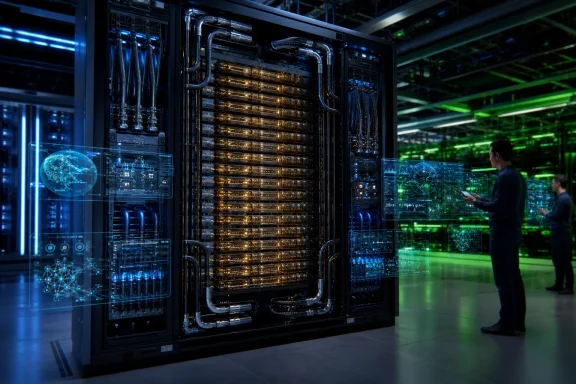
Helios is AMD’s first comprehensive rack-scale AI platform intended to compete with Nvidia’s 72-accelerator systems. It combines 72 Instinct MI455X accelerators, EPYC Venice host processors, Pensando networking, liquid cooling, and the ROCm software stack in an Open Compute Project-oriented design.AMD is targeting up to approximately 2.9 exaFLOPS of dense FP4 performance and 1.4 exaFLOPS at FP8 across a rack. These figures describe theoretical capabilities under specified data formats, not guaranteed application performance, and independent production benchmarks will be essential.
Why 72 accelerators matter
The number 72 is not arbitrary. A rack-scale design must balance accelerator density, memory capacity, interconnect topology, serviceability, cooling, and the physical limits of power distribution.By placing 72 GPUs inside a coordinated system, AMD can present Helios as a single deployment building block rather than forcing every customer to engineer a rack from separate servers and switches. That makes procurement and installation more predictable, particularly for hyperscalers that want to replicate thousands of similar racks.
The integrated design can also reduce the number of variables that operators must qualify. Firmware versions, cable layouts, thermal characteristics, host processors, network adapters, and management interfaces can be validated together instead of treated as unrelated components.
A platform rather than a reference diagram
AMD still depends on manufacturing and systems partners to deliver Helios-based products, but the company is defining more of the architecture than it did with earlier Instinct generations. This gives it greater influence over real-world performance and lets software engineers optimize against a known topology.The approach also changes AMD’s commercial position. Selling accelerators leaves much of the system value to server manufacturers, networking vendors, and integrators; defining a rack-scale platform lets AMD compete for a larger share of infrastructure spending while setting the technical agenda around its silicon.
Microsoft’s involvement makes the design more credible. Azure engineers operate at a scale where minor inefficiencies become major costs, so a commitment to deploy Helios indicates that the platform has progressed beyond a laboratory demonstration—even if final performance and economics remain undisclosed.
UALink Challenges Nvidia at the Most Strategic Layer
The central architectural story is UALink, the open accelerator interconnect specification backed by AMD, Microsoft, and other major technology companies. UALink is intended to connect accelerators coherently and efficiently inside high-density AI systems without requiring customers to buy a proprietary scale-up fabric from a single accelerator supplier.Nvidia’s NVLink and NVLink Switch technologies remain formidable advantages. They are mature, deeply integrated with Nvidia’s hardware and software, and proven across successive generations of large AI systems.
What a scale-up interconnect does
Scale-up networking connects accelerators within a tightly coupled system. It must provide extremely high bandwidth, low latency, predictable behavior, and efficient collective communication because the accelerators frequently exchange model parameters, activations, gradients, routing information, and cache data.This is different from conventional data-center networking. Ethernet historically connected independent computers that could tolerate more variable latency, while a scale-up fabric must make many accelerators behave more like parts of one large machine.
For large models, a weak interconnect can strand expensive compute. A GPU may have extraordinary arithmetic throughput, but that throughput produces little value if the processor waits for data from another accelerator.
Why Microsoft wants an open alternative
Microsoft’s motivation is not difficult to understand. A hyperscaler purchasing enormous numbers of accelerators does not want one supplier to control the GPU, switching silicon, interconnect roadmap, software platform, and upgrade schedule.An open specification could eventually create several advantages:
- Multiple vendors could produce compatible switches, controllers, cables, and supporting components.
- Cloud operators could exert more influence over roadmap priorities and system design.
- Competition at the interconnect layer could reduce component costs and improve supply resilience.
- Future accelerator suppliers could adopt the same fabric instead of creating isolated hardware islands.
- System builders could innovate around cooling, packaging, and topology without depending on one proprietary platform owner.
Openness must be proven operationally
Open specifications do not automatically produce open markets. UALink needs mature switching silicon, interoperable devices, stable firmware, diagnostic tools, cable ecosystems, compliance testing, and long-term support.Initial Helios configurations are expected to use UALink protocols over Ethernet-oriented infrastructure rather than relying exclusively on purpose-built native UALink switches. That can speed deployment because hyperscalers already understand Ethernet components, but it also creates uncertainty around latency, overhead, congestion behavior, and deterministic performance.
The real test will not be whether Helios can advertise bandwidth comparable to NVLink systems. It will be whether applications can consistently use that bandwidth under demanding production conditions.
Memory Capacity Is Helios’ Clearest Hardware Advantage
A Helios rack combines roughly 31 terabytes of HBM4 memory across its 72 MI455X accelerators. That capacity is especially relevant to inference, where fitting model weights and a large key-value cache within one high-bandwidth domain can directly affect cost, latency, and throughput.Microsoft’s announcement specifically emphasizes production-scale inference rather than positioning the Azure deployment primarily as a training platform. That choice plays to Helios’ apparent strengths.
Bigger models create bigger memory problems
A model’s weights consume substantial memory before it processes a single user request. Quantization can reduce that requirement, but serving the model also requires temporary working data and a key-value cache that grows with context length, batch size, and concurrent users.If a model does not fit comfortably within one rack, operators may have to distribute it across more systems. That adds communication, scheduling complexity, failure exposure, and power consumption.
Higher memory capacity therefore has several possible benefits:
- It can accommodate larger models or less aggressive quantization.
- It can support longer contexts and more simultaneous sessions.
- It can give inference engines additional room for batching.
- It can reduce the need to divide a model across multiple rack-scale domains.
- It can improve utilization when workloads have irregular memory demands.
Mixture-of-experts models complicate the comparison
Mixture-of-experts models activate only selected portions of a model for each token. This can reduce arithmetic requirements, but it creates substantial communication as tokens are routed to different experts distributed across accelerators.Such workloads can expose the difference between headline aggregate bandwidth and usable application bandwidth. Switch latency, congestion management, collective libraries, and expert placement policies may matter as much as GPU compute.
Helios could benefit from its large memory pool, especially if more experts can remain within a rack. Yet UALink-over-Ethernet must demonstrate that it can handle irregular, latency-sensitive traffic without allowing expensive accelerators to sit idle.
FP4 helps, but it is not universal
FP4 can dramatically increase quoted inference throughput and reduce memory consumption, but not every model or operation can run entirely at four-bit precision without unacceptable accuracy loss. Production systems often use mixed precision, retaining higher precision for sensitive layers or calculations.For that reason, prospective Azure customers should resist reducing Helios to its 2.9-exaFLOPS FP4 headline. Useful comparisons must evaluate model quality, latency, throughput, power, memory usage, and cost under the same software and accuracy targets.
Azure Is Creating Three Specialized AMD VM Families
Microsoft plans to expose the expanded partnership through three upcoming Azure product families. Each addresses a different infrastructure bottleneck: GPU inference, CPU-heavy AI data processing, and high-performance engineering workloads.This specialization reflects how AI systems actually operate. Accelerators generate the most attention, but a production AI service depends on extensive CPU processing, storage, networking, retrieval, orchestration, security, and observability.
ND MI455X v7 for production inference
The ND MI455X v7 series will use Helios for reasoning, search, agentic applications, Azure AI services, and customer inference workloads. Microsoft has not announced pricing, regional availability, VM sizes, tenancy models, or the number of accelerators allocated to each customer-visible instance.Those details will determine whether ND MI455X v7 becomes broadly useful or remains a scarce specialist service. Customers need to know whether Azure will offer entire rack-scale domains, fractional allocations, managed endpoints, reserved capacity, or some combination of these models.
Microsoft may also consume a meaningful share internally. Copilot services, Azure AI offerings, search systems, and other cloud workloads compete for the same accelerators that Azure could otherwise rent to outside customers.
HDv2 for AI data systems
Azure HDv2 is designed around nearly 500 physical sixth-generation EPYC cores, 4TB of RAM, 32TB of local NVMe storage, and 400Gbps Azure Boost networking. Microsoft is targeting data preparation, search, reinforcement learning, agent coordination, and other CPU-intensive stages of the AI pipeline.This category deserves more attention than it normally receives. Agentic applications can generate large volumes of tool calls, retrieval queries, policy checks, serialization work, database operations, and short-lived execution tasks.
A GPU may produce an answer quickly and still deliver a slow user experience if the surrounding system spends too long gathering information or coordinating actions. HDv2 is Microsoft’s attempt to package high-density CPU infrastructure around those less glamorous but increasingly costly tasks.
HXv2 for chip design and scientific computing
HXv2 will provide 176 EPYC Venice cores at frequencies above 5GHz, 50 percent more addressable cache per core than its predecessor, configurations approaching 2TB or 4TB of RAM, and 800Gbps InfiniBand connectivity. Microsoft is positioning it for electronic design automation, RTL simulation, engineering analysis, and distributed-memory scientific applications.EDA workloads often value fast individual cores, large caches, substantial memory, and predictable scaling more than raw core count alone. Many stages include serial or lightly threaded work that cannot simply be accelerated by adding thousands of generic cores.
The irony is productive: cloud resources used to design the next generation of processors will themselves run on the latest processor technology. AMD already uses Azure HX infrastructure for elements of its own engineering work, while Synopsys is aligning its software roadmap with the new systems.
Pensando and Azure Boost Complete the Full-Stack Strategy
The expanded partnership includes deeper integration between AMD Pensando technology and Azure Boost. Azure Boost offloads networking, storage, and virtualization tasks from host processors so customer workloads can use more of the CPU resources they pay for.This layer is easy to overlook because customers rarely write applications directly for a DPU. Nevertheless, it can materially influence cloud performance, security isolation, and infrastructure efficiency.
Why offload matters
Traditional cloud servers ask their main CPUs to perform both customer computation and infrastructure duties. Packet processing, virtual switching, storage translation, encryption, telemetry, and hypervisor functions all consume cycles and memory bandwidth.A DPU moves many of these tasks to dedicated hardware. That can provide more consistent application performance while allowing Microsoft to enforce cloud policies outside the guest operating system.
The design has several consequences:
- Customer VMs can receive a larger and more predictable share of host CPU resources.
- Networking and storage services can scale independently of the application processor.
- Isolation controls can operate in a hardware domain unavailable to the guest.
- Microsoft can update infrastructure functions without placing all processing on the host.
- Telemetry and connection processing can occur closer to the physical network.
AMD silicon at multiple control points
With Instinct GPUs, EPYC CPUs, and Pensando DPUs, AMD gains a role at three major control points in Azure infrastructure. ROCm provides the software layer for accelerated workloads, while Microsoft’s orchestration and Azure Boost technologies tie the hardware into the broader cloud.This breadth could improve optimization because the companies can coordinate data movement from the network edge through CPU preprocessing and into GPU memory. It also gives Microsoft another supplier capable of providing more than one isolated component.
However, a broader AMD footprint introduces its own concentration risk. Microsoft’s objective is unlikely to be replacing Nvidia lock-in with AMD lock-in; it is creating enough architectural diversity that no single vendor can dictate the entire infrastructure roadmap.
ROCm Remains the Deciding Software Test
Helios can offer strong specifications and an open interconnect, but customers ultimately buy usable application performance. Nvidia’s most durable advantage remains CUDA and the extensive collection of libraries, tools, frameworks, examples, and trained developers surrounding it.ROCm has improved substantially, particularly for mainstream PyTorch and large-language-model workloads. The challenge is no longer simply whether an application can run, but whether it can run efficiently, reliably, and with manageable engineering effort.
Standard frameworks narrow the gap
Organizations using widely supported models through PyTorch, vLLM, composable inference servers, or managed Azure services may encounter relatively little hardware-specific code. Framework maintainers and cloud providers can absorb much of the optimization work beneath stable APIs.This is the most promising path for AMD. As AI infrastructure becomes more standardized, developers increasingly express workloads through frameworks rather than hand-written accelerator kernels.
Microsoft can strengthen that abstraction through Azure Foundry Managed Compute. If Azure exposes Helios through a managed endpoint, customers may care less about whether ROCm or CUDA executes underneath, provided the service meets its price, latency, reliability, and model-support commitments.
Custom CUDA code remains expensive baggage
The migration becomes harder when an organization relies on custom CUDA kernels, Nvidia-specific inference engines, proprietary extensions, or libraries tuned around particular tensor-core behavior. Porting may require code changes, numerical validation, performance tuning, and operational retraining.Even when automated tools translate source code, they cannot guarantee equivalent performance. Memory layouts, synchronization behavior, compiler maturity, supported data types, and kernel-fusion opportunities differ between platforms.
Enterprises should therefore classify workloads before planning migration:
- Managed model APIs are the easiest to move because Azure controls the implementation.
- Standard PyTorch inference is usually the next most portable category if all required operators are supported.
- Framework-based training requires deeper validation because collective communication and checkpointing behavior become critical.
- Custom kernels and Nvidia-specific libraries create the largest migration burden and may erase hardware savings.
- Regulated workloads require additional qualification because numerical changes can affect documented model behavior.
Developer experience can outweigh specifications
A platform that is 15 percent cheaper on paper may become more expensive if engineers spend months porting and maintaining code. Conversely, a managed service that removes most platform-specific work could make AMD economical even if individual kernels trail Nvidia.Microsoft is unusually well placed to influence this outcome. It controls Azure provisioning, managed AI services, developer tooling, observability, identity, and much of the enterprise application stack. If it treats AMD as a first-class backend across these layers, ROCm’s remaining gaps will become less visible to many customers.
The Competitive Target Is Nvidia’s Infrastructure Control
Nvidia is not merely the market leader in accelerators. It has built a vertically coordinated platform combining GPUs, NVLink, NVSwitch, networking, systems, CUDA, optimized libraries, and reference architectures.That integration creates excellent performance and reduces deployment uncertainty. It also gives Nvidia significant influence over pricing, supply, upgrade timing, and the technical assumptions customers build into their software.
Microsoft wants leverage, not a divorce
Azure will continue deploying Nvidia systems because customer demand is enormous and many workloads depend on CUDA. Microsoft is not abandoning Nvidia; it is increasing its negotiating leverage and reducing the risk that one supplier constrains Azure’s growth.The company is pursuing several infrastructure paths simultaneously, including Nvidia GPUs, AMD accelerators, internally developed silicon, varied CPU architectures, and specialized networking. This heterogeneous strategy lets Microsoft assign workloads according to cost, availability, power, and software compatibility.
AMD’s role is particularly valuable because it provides a merchant alternative. Unlike Microsoft’s internal silicon, Helios can develop an external ecosystem of manufacturers, software vendors, and other cloud operators.
Competition moves from chips to ecosystems
AMD does not need to displace Nvidia everywhere to change market behavior. It needs to become credible enough that hyperscalers can move substantial workloads when prices, supply, or architecture favor an alternative.That credibility can pressure Nvidia in several ways:
- It can constrain pricing by giving buyers a viable negotiating option.
- It can force faster improvements in memory capacity and energy efficiency.
- It can encourage more portable software interfaces.
- It can weaken the assumption that CUDA is the only production platform.
- It can attract networking and systems vendors to UALink-compatible products.
- It can reduce the risk of a single roadmap delay affecting the entire AI industry.
Enterprise Impact: More Choice, but Not Yet Simplicity
Enterprise customers should welcome another production-scale accelerator platform, especially those facing capacity shortages or high inference costs. They should not assume, however, that an AMD-backed Azure VM will be a drop-in replacement for every Nvidia deployment.The business case will vary by model, software stack, service-level target, and commitment length.
Inference buyers gain negotiating power
Many enterprises consume AI through managed services rather than directly provisioning large GPU clusters. For them, Helios may appear indirectly as a lower-cost or more available backend inside Azure services.Organizations running their own models will need transparent pricing and performance data. The useful unit is not dollars per accelerator-hour but cost per successful workload outcome, such as cost per million tokens at a specified latency and accuracy.
Procurement teams should request:
- End-to-end throughput under representative context lengths and batch sizes.
- Time-to-first-token and inter-token latency distributions.
- Availability guarantees and regional capacity plans.
- Supported model formats, quantization methods, and inference engines.
- Data residency, security, and compliance coverage.
- Reserved-capacity terms and migration conditions.
- Power or carbon reporting where sustainability obligations apply.
Hybrid strategies become more practical
Businesses do not have to standardize on one accelerator. A sensible strategy may retain Nvidia for CUDA-dependent training while assigning portable inference workloads to AMD.This split can reduce costs without forcing an immediate rewrite of the most specialized code. It also lets engineering teams build portability gradually by testing model quality and performance across backends.
The challenge is operational fragmentation. Multiple accelerator platforms require broader monitoring, capacity planning, incident response, performance testing, and skills development. Azure must make that heterogeneity manageable rather than merely making it available.
Consumer and Windows Implications
Most Windows users will never interact directly with a Helios rack, but they will consume services that run on one. Microsoft’s cloud AI products increasingly influence Windows, Microsoft 365, GitHub, security services, search, gaming, and developer tools.Lower inference costs or greater capacity could affect how frequently those products invoke sophisticated models and how quickly new capabilities reach users.
Cloud economics shape Windows AI features
A Windows feature backed by a cloud model carries an ongoing execution cost. Every summary, generated image, agent action, code suggestion, or semantic search request consumes infrastructure resources.If AMD gives Microsoft a less expensive backend for suitable models, the company can choose among several outcomes: improve margins, offer higher usage limits, include AI in lower-priced subscriptions, or run more capable models for the same cost.
None of those results is guaranteed. Savings at the infrastructure level do not automatically reach consumers, and Microsoft has not connected the Helios announcement to specific Windows or Copilot features.
Portability could improve service resilience
A service that can run across Nvidia, AMD, and Microsoft-designed accelerators is less vulnerable to shortages or failures affecting one platform. That resilience matters when AI features become integrated into everyday workflows rather than offered as optional demonstrations.For Windows developers, the broader lesson is that backend portability is becoming strategically valuable. Applications built around model APIs and standard formats are easier to move than software tied to a vendor-specific runtime.
The same principle applies to local AI PCs. Hardware abstraction in Windows, ONNX-based deployment, DirectML, and cross-vendor model tooling can help prevent the client side from reproducing the lock-in now visible in data centers.
Power, Cooling, and Capacity Could Decide the Winner
AI infrastructure expansion increasingly runs into physical limits. Utilities, substations, generators, water systems, cooling equipment, and construction schedules can constrain deployment before chip supply does.Helios is a liquid-cooled rack-scale system, reflecting the growing difficulty of removing heat from dense accelerator installations. Azure must integrate it into facilities designed for unusually high power and thermal loads.
Efficiency matters more than nameplate power
Published rack power figures are useful only when paired with workload performance. A lower-power system can still be less efficient if it completes fewer useful requests, while a higher-power rack may be economical if it delivers proportionally more throughput.The correct metric is useful work per watt under production conditions. That measurement should include CPUs, memory, interconnect switches, network adapters, cooling overhead, and idle periods—not just accelerator power.
Inference workloads can be especially variable. Demand fluctuates, requests differ in length, and agentic services may alternate between GPU computation and external tool calls. Efficient scheduling and rapid reuse of model state may matter as much as peak silicon efficiency.
Supply constraints remain a threat
HBM4, advanced packaging, leading-edge wafers, optical and electrical networking components, and liquid-cooling equipment all have limited supply chains. Microsoft’s commitment gives AMD a prestigious customer, but it does not prove that AMD can deliver Helios in the quantities the market wants.Large hyperscalers often secure priority allocation, which can leave smaller clouds and enterprises waiting. Azure may therefore become one of the most practical ways to access MI455X hardware, but early capacity could be restricted to selected regions, internal services, or customers with substantial commitments.
Strengths and Opportunities
Microsoft’s endorsement gives Helios several opportunities that specifications alone could not create.- Hyperscale validation reduces adoption risk. Azure’s deployment indicates that Helios is being engineered for production operations rather than positioned solely as a future roadmap concept.
- Large HBM4 capacity fits the inference market. Memory-heavy frontier models, long contexts, and high-concurrency serving could benefit from keeping more state inside one rack-scale domain.
- UALink creates a credible path toward interconnect competition. A multi-vendor ecosystem could reduce dependency on proprietary switching and encourage broader hardware innovation.
- Microsoft can hide software complexity behind managed services. Azure Foundry and other managed platforms can make AMD infrastructure accessible to customers that never interact directly with ROCm.
- The full-stack agreement improves optimization potential. AMD CPUs, GPUs, DPUs, networking, and software can be tuned with Azure Boost and Microsoft’s orchestration systems.
- Specialized EPYC VMs address non-GPU bottlenecks. HDv2 and HXv2 recognize that data processing, agent coordination, simulation, and EDA require different balances of cores, cache, memory, and networking.
- A viable second supplier strengthens customer leverage. Even organizations that remain primarily on Nvidia benefit if AMD forces more competitive pricing, availability, and roadmaps.
- Windows and Microsoft cloud products could gain capacity. More infrastructure options can improve resilience and potentially lower the cost of delivering cloud-backed AI features.
Risks and Concerns
The announcement is strategically significant, but major technical and commercial questions remain unanswered.- Microsoft has not quantified the commitment. “At scale” could describe a substantial deployment, but no rack count, dollar value, wattage, or regional plan has been published.
- Availability may lag hardware shipments. Second-half 2026 deliveries do not mean customers will immediately be able to provision ND MI455X v7 instances.
- UALink-over-Ethernet remains unproven at this scale. Peak aggregate bandwidth does not establish latency, utilization, congestion behavior, or mixture-of-experts performance.
- ROCm still carries migration costs. CUDA-specific libraries and custom kernels can require significant engineering work and may perform differently after porting.
- AMD’s performance claims need independent validation. Theoretical FP4 and FP8 figures cannot substitute for application benchmarks using identical quality and latency targets.
- Supply could restrict practical access. HBM4, packaging, networking equipment, and liquid-cooled rack production may limit the number of systems AMD can deliver.
- Platform diversity adds operational complexity. Supporting multiple accelerator families can increase testing, monitoring, staffing, and incident-response requirements.
- Open standards can fragment. Incomplete interoperability, optional features, and vendor-specific extensions could weaken UALink’s promise if certification is not rigorous.
- Nvidia’s integrated ecosystem remains a powerful advantage. Mature software, proven systems, developer familiarity, and rapid product cadence make it difficult to displace.
- Cost savings are not yet established. Azure pricing and production benchmarks will determine whether Helios delivers a genuine economic advantage.
What to Watch Next
AMD’s Advancing AI event on July 22 and July 23, 2026, should provide the next major opportunity to clarify Helios’ technical and commercial position. Investors will watch for customer names and shipment guidance, but infrastructure buyers need more detailed evidence.The most important disclosures
The following developments would materially improve confidence in the platform:- Independent benchmark results should compare Helios with contemporary Nvidia systems using identical models, precision, accuracy, and latency targets.
- Microsoft should disclose the architecture of ND MI455X v7 instances, including tenancy, GPU allocation, networking, and supported deployment modes.
- Azure should publish regional availability and capacity-reservation timelines.
- AMD and its partners should demonstrate UALink-over-Ethernet under communication-heavy mixture-of-experts and distributed-training workloads.
- ROCm documentation should identify supported frameworks, inference engines, quantization schemes, and migration tools for MI455X.
- System vendors should provide realistic power, cooling, serviceability, and failure-domain data.
- UALink vendors should outline native-switch availability, interoperability testing, and upgrade paths from initial Ethernet-based implementations.
- Customer case studies should report measured cost per token, utilization, and reliability rather than theoretical accelerator throughput.
Azure pricing will reveal the real strategy
Microsoft could price ND MI455X v7 aggressively to stimulate adoption, keep pricing close to Nvidia instances while emphasizing availability, or reserve the systems primarily for managed services. Each path would communicate a different strategic objective.Aggressive pricing would suggest that Microsoft wants to build a broad AMD developer base. Managed-service emphasis would imply that it prefers to absorb ROCm complexity internally, while limited premium availability could indicate constrained supply rather than a direct price war.
Native UALink will be a critical milestone
The initial deployment can validate Helios as an AMD rack platform, but native UALink switching will determine whether the open-standard vision matures into a durable ecosystem. Customers will want a clear migration path that protects early investments rather than dividing Helios into incompatible generations.Interoperability will matter more than branding. The industry needs to see switches and components from multiple vendors operating reliably under one compliance regime, with diagnostics and management tools capable of supporting hyperscale production.
Microsoft’s Helios deployment does not break Nvidia’s hold on AI infrastructure overnight, and it does not erase CUDA’s enormous advantage. It does something more realistic and potentially more important: it establishes a credible second rack-scale architecture inside one of the world’s largest clouds, backed by an open interconnect effort that Microsoft helped create. If AMD can deliver the hardware on schedule, prove UALink performance, mature ROCm, and convert theoretical memory and efficiency advantages into lower production costs, Azure will gain more than another VM family—it will gain leverage over the technical and commercial foundations of the AI era.
References
- Primary source: Tech Times
Published: 2026-07-21T20:10:16+00:00
Azure Bets on AMD Helios Open-Standard Rack to Break Nvidia Infrastructure Lock-In
AMD Helios Azure deployment challenges Nvidia’s NVLink monopoly: Microsoft committed to AMD’s open-standard rack-scale AI system, adding three new VM families for inference, AI pipelines, and chipwww.techtimes.com - Related coverage: tomshardware.com
Microsoft will deploy AMD’s Helios rack-scale AI accelerator ‘at scale’ on Azure – Radeon Instinct MI455X and Epyc Venice power will be available through Redmond’s cloud infrastructure | Tom's Hardware
But it’s not clear just how much AMD AI compute Microsoft is buyingwww.tomshardware.com - Official source: blogs.microsoft.com
Microsoft expands Azure AI and HPC infrastructure with AMD - The Official Microsoft Blog
AI workloads are scaling faster than any single infrastructure approach can support — with more models, new agent-driven workloads and surging compute demand driving the need for greater specialization across the stack. To meet this need, Microsoft continues to evolve Azure’s infrastructure...blogs.microsoft.com - Related coverage: amd.com
Microsoft Azure Expanding AI Infra Choice with AMD Helios™
Microsoft and AMD expand Azure AI infrastructure with AMD Instinct MI455X and Helios, delivering more choice, scale, and efficiency.www.amd.com - Related coverage: simplywall.st
AMD (AMD) Expands Microsoft Azure Partnership With Helios AI Deployment - Simply Wall St News
Microsoft has expanded its partnership with Advanced Micro Devices to deploy AMD Helios AI infrastructure within Microsoft Azure. The agreement brings AMD's next generation Helios AI systems into Azure data centers to support AI services and enterprise workloads. This move highlights...simplywall.st - Related coverage: constellationr.com
AMD launches Helios, lands Microsoft Azure deal | Constellation Research
www.constellationr.com