

Microsoft’s brief MSRC attestation that “Azure Linux includes this open‑source library and is therefore potentially affected” is accurate for the artifacts Microsoft has inspected — but it is not a technical guarantee that no other Microsoft product can ship the same vulnerable component; absence of an attestation is absence of inventory confirmation, not proof of absence.
CVE‑2025‑38487 is a Linux kernel vulnerability in the Aspeed LPC‑snoop driver (soc/aspeed/lpc‑snoop) that can cause a NULL‑pointer dereference when channels that are not enabled are disabled during device removal or similar operations. The bug was publicly disclosed on July 28, 2025, and is tracked by major vulnerability repositories and distribution advisories. The vulnerability is primarily an availability issue (kernel oops, crash or system instability) with a CVSS v3.1 score in the mid‑range (distributions generally list it as medium, CVSS ≈ 5.5). Exploitation requires local or privileged access patterns that exercise the aspeed LPC snoop remove/unbind code paths; it is not a widely wormable remote network vector in typical configurations. Microsoft’s public-facing wording on its CVE pages and VEX/CSAF attestations has a predictable form: a short inventory statement that names the Microsoft product(s) the company has checked and found to include the implicated open‑source component. That is the operating model behind the one‑line Azure Linux note — it is an attestation about inventory status, and Microsoft has said it will add other products to the attestation set if/when they are discovered to ship the same upstream component.
Source: MSRC Security Update Guide - Microsoft Security Response Center
 Background / Overview
CVE‑2025‑38487 is a Linux kernel vulnerability in the Aspeed LPC‑snoop driver (soc/aspeed/lpc‑snoop) that can cause a NULL‑pointer dereference when channels that are not enabled are disabled during device removal or similar operations. The bug was publicly disclosed on July 28, 2025, and is tracked by major vulnerability repositories and distribution advisories. The vulnerability is primarily an availability issue (kernel oops, crash or system instability) with a CVSS v3.1 score in the mid‑range (distributions generally list it as medium, CVSS ≈ 5.5). Exploitation requires local or privileged access patterns that exercise the aspeed LPC snoop remove/unbind code paths; it is not a widely wormable remote network vector in typical configurations. Microsoft’s public-facing wording on its CVE pages and VEX/CSAF attestations has a predictable form: a short inventory statement that names the Microsoft product(s) the company has checked and found to include the implicated open‑source component. That is the operating model behind the one‑line Azure Linux note — it is an attestation about inventory status, and Microsoft has said it will add other products to the attestation set if/when they are discovered to ship the same upstream component. What Microsoft actually said — reading the attestation precisely
- Microsoft’s published CVE/VEX/CSAF entries often include the sentence: “Azure Linux includes this open‑source library and is therefore potentially affected.” This means Microsoft inspected its Azure Linux product family (the Azure Linux distro / Azure‑provided images) and confirmed the upstream kernel component is present in the examined builds.
- Microsoft’s approach to VEX is phased: they started with Azure Linux and promised to expand attestations to other products over time. The VEX files are machine‑readable statements designed to help customers automate triage. The presence of a VEX statement for Azure Linux is therefore authoritative for that product family; it is not a statement that other Microsoft SKUs have been exhaustively checked and found absent.
- In short: the attestation answers “Does Azure Linux include this component?” (Yes. It does not answer “Is Azure Linux the only Microsoft product that includes the component?” (No definitive technical claim.
Technical snapshot of CVE‑2025‑38487
What the bug does
- The bug occurs in the aspeed LPC snooper driver’s removal / disable path. Under some sequences of driver/device state, the code attempts to disable or unbind channels that were never enabled, leading to dereferencing a NULL pointer and a kernel oops.
- Observed failure mode in kernel logs: a NULL pointer dereference at a low virtual address (for example, 0x4), followed by standard kernel oops traces and call traces pointing into aspeed_lpc_snoop_remove and platform removal helpers.
Why it matters operationally
- A kernel oops on devices running the affected driver can crash the device or require a reboot — an availability impact that is especially meaningful for multi‑tenant infrastructure, appliances, or embedded systems that rely on the Aspeed LPC management path.
- Exploitation is generally modeled as local or tenant‑adjacent because it requires access to device nodes or orchestration that triggers the vulnerable remove/unbind path. That said, in managed infrastructures where device nodes are exposed to VMs, containers, or tenant workloads, the risk surface can grow.
Is Azure Linux the only Microsoft product that includes this open‑source library?
Short answer (practical)
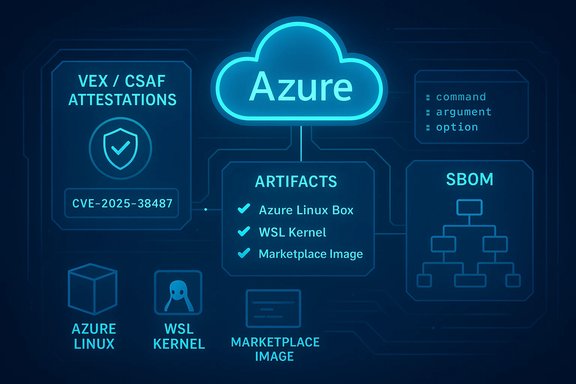
No — Azure Linux is the only Microsoft product Microsoft has publicly attested so far to include the vulnerable upstream component for CVE‑2025‑38487, but that attestation is product‑scoped. It does not logically or technically rule out the possibility that other Microsoft artifacts (WSL kernels, Marketplace images, linux‑azure kernels, custom appliance images, etc. may also contain the same kernel code depending on build choices, kernel versions, and configuration flags. Treat Microsoft’s Azure Linux VEX/CSAF entry as authoritative for Azure Linux only; treat other Microsoft‑supplied artifacts as unverified until Microsoft attests them or you verify them locally.Why this distinction matters
- Inventory statements are binary and scoped. A VEX/CSAF attestation is a machine‑readable statement that a vendor performed an artifact‑level inventory for the named product family. It intentionally omits other products until those product inventories are completed. Microsoft’s phased rollout began with Azure Linux and will expand to other product families over time.
- Kernel presence is an artifact property. Whether a particular Microsoft image ships the vulnerable driver depends on:
- the kernel version and commit range used to build the image,
- kernel configuration flags (CONFIG_*) that determine whether the driver is compiled in or built as a module,
- backports or cherry‑picked fixes applied to that build,
- and packaging/marketplace image composition choices for that SKU. Two Microsoft kernels can diverge dramatically even if they come from the same upstream base.
- Absence of evidence ≠ evidence of absence. If MSRC’s CVE page lists only Azure Linux today, that says Microsoft has completed inventory for Azure Linux and found the component. It does not prove they scanned every Microsoft artifact or that other artifacts are clean — it simply reflects the scope of work completed to date.
Examples of Microsoft artifacts that warrant independent checks
- WSL2 kernel binaries — Microsoft builds and publishes WSL2 kernels; those kernels can include or exclude particular drivers depending on the build configuration. If a given WSL kernel build contains the aspeed LPC snoop driver and the vulnerable commit range, it could be affected. Verify the WSL kernel config or binary on each host.
- Azure Marketplace VM images and partner appliances — Marketplace publishers and partners build images independently; those images must be inventoried individually. Just because Microsoft’s Azure Linux attestation exists does not mean every Marketplace image in Azure is covered by it.
- linux‑azure / kernel images Microsoft builds for cloud hosts or services — Some Azure components use tuned kernel builds for VM hosts, container hosts or service images. They are separate artifacts with discrete build provenance and must be verified on an artifact basis.
- Custom or embedded images Microsoft may ship for appliances or IoT — If Microsoft publishes or supports embedded Linux images, those artifacts should be inventoried separately for the presence of the aspeed code.
How operators should treat Microsoft’s attestation — practical guidance
- Prioritize Azure Linux images: treat the MSRC attestation as authoritative for Azure Linux and act accordingly — deploy vendor‑supplied patched images or kernel updates as Microsoft releases them.
- Inventory other Microsoft‑supplied Linux artifacts in your estate (WSL2, Marketplace images, AKS/VM host images, linux‑azure builds) and verify the kernel contents. Do not assume those artifacts are clean solely because MSRC’s page currently names only Azure Linux.
- Use SBOMs, kernel configs and VEX/CSAF automation where available to map CVEs to artifacts; Microsoft’s new machine‑readable VEX approach is designed to assist this automation, but the rollout is phased and may not yet cover all product families.
- If you run custom images or third‑party Marketplace appliances, require publishers to provide a vulnerability attest or publish the SBOM so you can confirm whether the aspeed driver is present and which kernel commit is used.
- Where in doubt, perform artifact‑level checks directly on running systems or offline images (commands listed below).
Concrete detection and verification steps
The following checks help determine whether a given Linux artifact is carrying the vulnerable aspeed LPC snoop code and whether a vendor backport is present.- On a running host (VM, container host, WSL instance):
- Check kernel version: uname -a
- Inspect loaded modules / drivers: lsmod | grep aspeed
- Search filesystem for aspeed driver and module files:
- find /lib/modules/$(uname -r) -type f -name 'aspeed' -print
- Inspect kernel ring buffer / dmesg for aspeed related traces: dmesg | grep -i aspeed
- If /proc/config.gz or /boot/config-$(uname -r) is available: zgrep ASPEED /proc/config.gz or zgrep LPC_SNOOP /boot/config-$(uname -r)
- Check package changelogs for kernel packages referencing CVE‑2025‑38487 or upstream commit IDs.
- For offline images or vendor binaries:
- Mount the image and inspect /lib/modules/* for the driver or check the kernel build config used to build the image.
- Compare the kernel version/commit to the upstream stable commits that fixed the CVE (upstream commit hashes are recorded in public CVE references and stable tree merges).
- Monitoring and telemetry:
- Hunt for kernel oopses, repeated firmware/driver crashes that mention aspeed_lpc_snoop, or platform remove / misc_deregister call traces in system logs. These signatures appear in the public PoC/trace excerpts posted in distribution advisories.
Mitigation and remediation
- The definitive remediation is to install kernels or vendor images that include the upstream stable fix for the aspeed lpc‑snoop path. Distributions and vendors published backports and package updates; track distribution advisories (Ubuntu, Debian, Amazon Linux, etc. and your cloud provider guidance.
- As a short‑term mitigation on affected platforms, unbind the aspeed lpc‑snoop device driver to prevent the vulnerable code path from executing:
- echo <device-name>.lpc-snoop > /sys/bus/platform/drivers/aspeed-lpc-snoop/unbind
- Note that unbinding may disable management/console features that depend on LPC snooping; evaluate operational impact before applying. Public advisories list unbind as a temporary mitigation example.
- For multi‑tenant or managed hosts where drivers may be exposed via passthrough, restrict access to device nodes and review orchestration workflows that might cause device removal/rebind operations to run under tenant control.
Why VEX/CSAF inventory attestations are a step forward — and their limits
- Benefit: Machine‑readable attestations (VEX/CSAF) reduce noise and accelerate automated triage — if a vendor states “Known Affected” for a product, automation can flag impacted images immediately and speed patch pipelines. Microsoft’s phased VEX rollout, beginning with Azure Linux, reflects this approach.
- Limit: Attestations are only as complete as the inventory work performed. Vendors may start with a subset of product families and expand; in the interim, customers must still perform artifact‑level checks for artifacts not yet attested. Microsoft has been explicit that it will update CVE entries when additional Microsoft products are identified as shipping the component.
Risk analysis — strengths and caveats
Strengths- Microsoft’s VEX/CSAF effort provides a clear, machine‑readable signal for Azure Linux customers to act quickly. That reduces uncertainty and helps automate remediation for a known product family.
- The underlying fix in the Linux kernel is surgical; distributions typically backport these targeted commits quickly, limiting long‑term exposure for mainstream distro customers.
- Inventory incompleteness creates a practical triage gap: customers who run non‑attested Microsoft artifacts must perform their own checks rather than relying solely on the MSRC page.
- Embedded appliances, IoT devices, and custom images that are slow to update or whose vendors do not publish SBOMs represent the longest tail of exposure. These devices should be prioritized for vendor confirmation or isolation if they expose relevant device paths.
Recommended action checklist (immediate to 30 days)
- For Azure Linux customers: follow Microsoft’s published updates and patch Azure Linux images when Microsoft marks the CVE as fixed for that artifact. Treat the VEX/CSAF “Known Affected” as the trigger to act.
- Inventory all Microsoft‑supplied Linux artifacts in use (WSL kernels, AKS/VM host images, Marketplace images) and run the detection checks above.
- For any artifact that contains the driver and an affected kernel version, schedule patching or image replacement, and plan required reboots or maintenance windows.
- If you cannot patch immediately, apply the temporary unbind mitigation on affected systems after assessing functional impact; restrict access to LPC management device nodes where possible.
- Demand SBOMs / attestations from third‑party Marketplace publishers and appliance vendors; refuse to deploy unverified images into production until their patch status is confirmed.
Conclusion
Microsoft’s MSRC attestation that “Azure Linux includes this open‑source library and is therefore potentially affected” is an important, machine‑readable inventory signal that Azure Linux customers should prioritize. However, that attestation is product‑scoped and reflects the inventory work Microsoft has completed so far — it is not a categorical statement that no other Microsoft product can or does include the same vulnerable upstream component. Operators must treat the Azure Linux attestation as authoritative for Azure Linux, and they must perform artifact‑level verification for other Microsoft images (WSL2, Marketplace, linux‑azure, embedded images) until Microsoft extends its VEX/CSAF attestations or vendors provide explicit SBOMs and vulnerability confirmations. For a practical roadmap: prioritize Azure Linux patches first, then inventory and verify the rest of the Microsoft‑supplied Linux artifacts in your environment, and apply mitigations or enforce isolation policies for any unpatched items while you obtain fixed images or kernel updates.Source: MSRC Security Update Guide - Microsoft Security Response Center
