

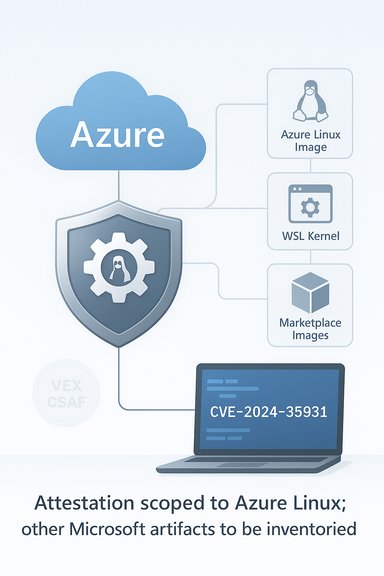
Microsoft’s wording that “Azure Linux includes this open‑source library and is therefore potentially affected” is an important and verifiable product‑scope attestation — but it is not a blanket technical guarantee that no other Microsoft product contains the same vulnerable code.
CVE‑2024‑35931 is a Linux kernel patch/bugfix recorded against the AMDGPU DRM driver that addresses a system‑hang caused by a PCI error slot reset being triggered during RAS (reliability, availability, serviceability) recovery. Upstream descriptions make clear this is an availability/robustness issue tied to driver behavior during multi‑error recovery rather than a confidentiality or integrity exploit. Microsoft’s public note about this CVE (the wording you quoted) performs two functions simultaneously: it informs customers that the Azure Linux distribution contains the implicated open‑source component, and it states Microsoft’s process commitment — that it will expand its machine‑readable VEX/CSAF attestations if additional Microsoft products are later found to ship the same component. That process commitment is real and documented in Microsoft’s transparency blog about VEX/CSAF adoption. This article explains what Microsoft’s statement does and does not mean, verifies the technical facts of the CVE across independent trackers, and provides a practical, defensible posture for operators who consume Microsoft artifacts (Azure Linux images, WSL kernels, Marketplace appliances, and more). The goal is to give readers a clear, evidence‑backed answer to your question plus a pragmatic operational checklist.
Why:
Applying these practical steps will ensure that you treat Microsoft’s Azure Linux attestation as the authoritative signal it is while retaining a defensible posture for other Microsoft artifacts until they are explicitly inventoried and attested.
Source: MSRC Security Update Guide - Microsoft Security Response Center
 Background / Overview
CVE‑2024‑35931 is a Linux kernel patch/bugfix recorded against the AMDGPU DRM driver that addresses a system‑hang caused by a PCI error slot reset being triggered during RAS (reliability, availability, serviceability) recovery. Upstream descriptions make clear this is an availability/robustness issue tied to driver behavior during multi‑error recovery rather than a confidentiality or integrity exploit. Microsoft’s public note about this CVE (the wording you quoted) performs two functions simultaneously: it informs customers that the Azure Linux distribution contains the implicated open‑source component, and it states Microsoft’s process commitment — that it will expand its machine‑readable VEX/CSAF attestations if additional Microsoft products are later found to ship the same component. That process commitment is real and documented in Microsoft’s transparency blog about VEX/CSAF adoption. This article explains what Microsoft’s statement does and does not mean, verifies the technical facts of the CVE across independent trackers, and provides a practical, defensible posture for operators who consume Microsoft artifacts (Azure Linux images, WSL kernels, Marketplace appliances, and more). The goal is to give readers a clear, evidence‑backed answer to your question plus a pragmatic operational checklist.The technical facts: what CVE‑2024‑35931 actually is
- The defect lives in the Linux kernel’s AMDGPU DRM code path and concerns how PCI slot resets can be invoked during RAS recovery when certain error sequences are injected repeatedly. Repeated slot resets in that context could lead to system hangs.
- Multiple public vulnerability trackers (NVD, distribution advisories such as Ubuntu’s security tracker, OSV mirrors and vendor trackers) document the same root cause and remedial intent: the upstream fix ensures the driver avoids triggering a slot reset during the RAS recovery path that could deadlock the platform. These independent records corroborate the technical diagnosis.
- Impact profile: availability only (kernel hang / driver instability). The defect is local in nature — an attacker or unprivileged process would need to access the relevant DRM/device paths or reproduce the RAS error injection sequence to trigger the condition. There is no authoritative public evidence that this bug leads to remote code execution or privilege escalation.
What Microsoft actually said (and why the wording is carefully scoped)
Microsoft’s update guide entry and broader VEX/CSAF rollout use machine‑readable attestations to indicate which Microsoft product artifacts include a particular upstream open‑source component. In practice:- When Microsoft says “Azure Linux includes this open‑source library and is therefore potentially affected,” that is an authoritative attestation for Azure Linux only — it confirms Microsoft has completed the inventory for that product and found the component.
- Microsoft also states it will update CVE mappings (the VEX/CSAF files) if further Microsoft products are later found to include the same component. That is an explicit process commitment, not a technical statement that other products cannot include the code.
Independent verification: cross‑checking the CVE and Microsoft’s attestation
To validate both the technical claim and Microsoft’s product‑scoped statement, I cross‑checked public trackers and Microsoft’s published transparency blog:- The NVD entry for CVE‑2024‑35931 describes the defect in the drm/amdgpu driver and the reason for the upstream change. This confirms the kernel‑level technical description and the availability impact.
- Ubuntu’s security advisory for CVE‑2024‑35931 documents the same description and lists affected kernel packages and the date of publication/updates, which is useful for mapping fixed package versions. Distribution advisories are critical corroborating sources for operators who rely on distro kernels.
- Microsoft’s public transparency blog and VEX rollout announcement explain the phased approach to publishing CSAF/VEX attestations and explicitly note Azure Linux as the starting product family for the VEX implementation. That blog confirms Microsoft’s process rationale and the existence of machine‑readable attestations beginning with Azure Linux.
- Additional mirrors (OSV, Rapid7, vendor trackers) repeat the same technical narrative: the kernel amdgpu fix prevents slot reset-induced hangs during RAS recovery. Those mirrors provide alternate packaging and remediation mappings useful for enterprise patching.
Is Azure Linux the only Microsoft product that includes the library?
Short answer (evidence‑backed): No — not necessarily. Azure Linux is the only Microsoft product Microsoft has publicly attested to include the implicated open‑source component for this CVE at the time of the advisory, but absence of an attestation for other Microsoft products is not proof of absence.Why:
- Microsoft’s attestations are product‑scoped. The VEX/CSAF files are created per product family as Microsoft inventories artifacts; starting with Azure Linux gives customers a deterministic, automatable signal for that product. Microsoft explicitly said it will expand attestations as it completes inventory for other products. That means only the artifacts Microsoft has finished mapping are covered by the published VEX files.
- Microsoft maintains multiple Linux kernel artifacts and images across product lines (Azure Linux distribution images, linux‑azure kernels for cloud instances, WSL2 kernel source and builds, Marketplace publisher images, management agents, appliance images). Each of those artifacts is a separate build/configuration that may or may not include the amdgpu driver depending on build options (CONFIG_* flags), packaging choices, and target hardware. Presence is a per‑artifact property and cannot be universally inferred from a single product attestation.
- Microsoft publishes the WSL2 kernel source publicly; the presence of amdgpu source in a repository or tree does not by itself mean a shipped binary includes the driver — but it does indicate plausible channels for the component to appear in other Microsoft kernels unless intentionally omitted at build time. That makes it reasonable to suspect other Microsoft artifacts could carry the same code until they are explicitly attested or scanned.
Practical implications for enterprises and administrators
Operators should adopt a pragmatic, layered response:- Prioritize Azure Linux updates
- If you run Azure Linux images, treat Microsoft’s VEX/CSAF attestation for that product as the canonical signal: apply the vendor‑supplied kernel updates or image rebuilds Microsoft provides, and validate the fix in staging.
- Inventory other Microsoft artifacts you run
- Do not assume other Microsoft artifacts are unaffected simply because they are not listed in a VEX file. Inventory the specific images and kernels you run:
- WSL kernels installed on developer machines
- Azure Marketplace images (first‑party and third‑party)
- linux‑azure kernels used by specific VM SKUs
- Microsoft management agents and appliances that embed kernel images
- For each artifact, either request an SBOM/VEX attestation from the publisher or unpack and scan the kernel binary / modules for the presence of amdgpu or the specific vulnerable commit signatures.
- Use distro advisories to map fixed package versions
- Cross‑reference your installed kernel package versions against distribution advisories (Ubuntu, Red Hat, SUSE, Debian) that map CVE entries to fixed package releases. This lets you apply the correct vendor patch instead of relying only on upstream commit IDs.
- Apply compensating controls where patching is delayed
- Restrict access to DRM device nodes (/dev/dri/*) via udev rules or group membership.
- Remove /dev/dri from untrusted containers; avoid GPU passthrough into multi‑tenant or CI containers.
- Harden container capabilities and drop unnecessary kernel capabilities to reduce the attack surface for local DoS primitives.
- Monitor for signs of the defect
- Hunt kernel logs (dmesg, journalctl) for amdgpu‑related oops/panic signs, repeated GPU resets, or PCI slot reset messages correlated to GPU activity. Preserve logs for vendor support if you observe crashes.
How to verify whether a Microsoft artifact includes the vulnerable library
- Ask for the VEX/CSAF attestation for that specific product/artifact from Microsoft or the Marketplace publisher. If a VEX entry exists, it is authoritative for that artifact. Microsoft is explicitly rolling out attestations product‑by‑product.
- If no attestation is available:
- Extract the kernel image or module set from the artifact and inspect /lib/modules, drivers/gpu/drm, and similar paths for amdgpu artifacts.
- Search for known commit IDs or code patterns introduced by the upstream patch; vendors typically reference the stable commit hashes in advisories, and those can be grepped in source trees or binary module strings.
- For WSL kernels, Microsoft publishes kernel sources that can help mapping; for Marketplace images, request the publisher’s SBOM or kernel package changelog.
- If you cannot directly inspect an image (for example, vendor‑provided appliances), open a support ticket requesting confirmation and a timeline for backport or remediation.
Strengths and weaknesses of Microsoft’s approach
Strengths- Microsoft’s move to machine‑readable CSAF/VEX attestations is an important step toward automation and reduces ambiguity for customers who run Azure Linux: you can automate triage based on a deterministic VEX entry. This makes patching and risk prioritization more reliable for that product family.
- The phased rollout (starting with Azure Linux) is a pragmatic operational choice: Microsoft can validate attestations for one product while building the organizational processes to scale inventory to other products. That reduces initial errors and fosters quality in future attestations.
- Phased attestations leave a temporal blind spot. Until Microsoft completes inventory for every product, customers must do their own artifact checks for any Microsoft artifacts they run. The absence of a VEX entry for a product is not the same as a “not affected” determination. That nuance leads to potential blind spots in complex environments.
- Microsoft ships or publishes many artifacts (WSL kernels, marketplace images, specialized kernels). Each is a separate build, and the presence or absence of a driver is a build‑time decision. That multiplicity magnifies the operational work required to achieve full coverage of attestations.
- For embedded or vendor kernels (OEM devices, appliances), backporting timelines can be long. These long‑tail devices frequently remain vulnerable after desktop/server distributions have published fixes. That is a systemic industry problem and not unique to Microsoft, but it is material for risk assessments.
Recommended, prioritized checklist for WindowsForum readers and admins
- If you run Azure Linux images:
- Treat Microsoft’s VEX/CSAF attestation as the authoritative signal.
- Apply Microsoft’s recommended kernel/image updates and validate in staging.
- If you run other Microsoft artifacts (WSL, Marketplace, linux‑azure, appliances):
- Inventory those artifacts immediately.
- Request explicit attestations or SBOMs; if none exist, extract and scan the kernel/modules for amdgpu and the fix commit signatures.
- For mixed‑vendor fleets:
- Use distro advisories (Ubuntu, Red Hat, SUSE, etc. to map fixed kernel package versions and schedule updates.
- When patching is delayed:
- Restrict /dev/dri access via udev rules and remove device nodes from untrusted containers.
- Isolate hosts that expose GPU devices to untrusted workloads.
- Increase kernel oops logging and retention for forensic capture.
- If you manage vendor‑supplied appliances:
- Open support tickets requesting timelines for backports or updated images that include the upstream stable commit fixes.
- Where possible, obtain an SBOM or a VEX attestation from the appliance vendor.
Final assessment — direct answer to the question
Is Azure Linux the only Microsoft product that includes the open‑source library and is therefore potentially affected by CVE‑2024‑35931?- Authoritative product attestation: Yes — Azure Linux is the only Microsoft product Microsoft has publicly attested to include the implicated component for this CVE at the time of the advisory. That attestation is authoritative and machine‑readable, and Azure Linux customers should act on it.
- Technical possibility and practical risk: No — the statement does not prove that no other Microsoft product includes the vulnerable code. Microsoft’s VEX rollout is phased and product‑scoped; until Microsoft publishes attestations for other product families or you inspect the specific artifacts you run, treat other Microsoft images/kernels as potential carriers and inventory or scan them accordingly.
Closing notes on verification and uncertainty
- The technical CVE record and upstream fixes are documented across independent trackers (NVD, Ubuntu, OSV, vendor advisories), which validates the technical facts and makes it straightforward to map fixed kernel package versions for remediation.
- Microsoft’s VEX/CSAF program materially improves transparency for customers by providing machine‑readable attestations; however, the program is intentionally phased and product‑scoped. Customers should incorporate VEX checks into their automation and continue to perform artifact‑level verification where VEX entries are not yet available.
- Where claims cannot be independently verified (for example, whether a specific Marketplace image includes the code), treat the claim as unverified until you receive an explicit VEX/CSAF attestation or you perform an artifact inspection. Microsoft has committed to updating CVE entries if additional products are found to include the component — a useful assurance but not an immediate guarantee.
Applying these practical steps will ensure that you treat Microsoft’s Azure Linux attestation as the authoritative signal it is while retaining a defensible posture for other Microsoft artifacts until they are explicitly inventoried and attested.
Source: MSRC Security Update Guide - Microsoft Security Response Center
