

Microsoft’s short public attestation that “Azure Linux includes this open‑source library and is therefore potentially affected” is accurate for the product Microsoft has inventory‑checked — but it is not a categorical, cross‑product guarantee that no other Microsoft artifact may contain the vulnerable virtiofs code. The kernel fix for CVE‑2025‑37773 addresses a missing null‑check in the virtiofs filesystem context that can make the source name NULL and, in certain conditions, cause a kernel panic; distributors and upstream trackers classify the issue as a medium‑severity local denial‑of‑service risk and packages have been patched across major distributions.
CVE‑2025‑37773 is a Linux kernel robustness fix described upstream as: “virtiofs: add filesystem context source name check.” The change is small and surgical — add an extra validation that prevents the virtiofs path from dereferencing a NULL source name — but because the outcome is a kernel panic, the practical impact is an availability (DoS) risk on hosts where virtiofs is present and reachable by an attacker with local access. Upstream and downstream trackers list the same root cause and note the patch was merged into stable branches; vendors (Ubuntu, Debian, Amazon Linux, Oracle Linux and others) published advisories and backports.
This article explains what Microsoft’s sentence on the MSRC page actually means, why it is useful yet not exhaustive, and what system owners — including Azure customers and operators of Microsoft-distributed images (WSL kernels, Marketplace images, AKS node images, appliance images) — should do now to detect, assess, and remediate risk. The article cross‑checks upstream commits and vendor advisories, gives step‑by‑step verification commands, and outlines mitigations and operational best practices for both cloud and edge Windows+Linux scenarios.
Two consequences follow from this model:
Community responders and operations teams have repeatedly recommended that vendors publish attestations product‑by‑product rather than issue broad denials or verbose multi‑SKU statements that are hard to automate; Microsoft’s approach follows that pattern and explicitly promises updates when scope changes.
Microsoft has improved transparency by publishing VEX/CSAF attestations and committing to update mappings as more artifacts are validated. That change materially helps automation and reduces uncertainty for Azure Linux customers today. At the same time, defenders must not substitute a single product attestation for artifact‑level verification across a diverse fleet of Microsoft‑provided or Microsoft‑derived images. Do the artifact checks, apply patches, and document the evidence chain — that is the only way to move from “potentially affected” to “verified fixed” with confidence.
Conclusion: patch Azure Linux now if you run it; inventory and inspect other Microsoft artifacts in your environment; and insist on VEX/CSAF attestations or SBOM/kernel metadata for Microsoft SKUs you rely upon.
Source: MSRC Security Update Guide - Microsoft Security Response Center
 Background / Overview
CVE‑2025‑37773 is a Linux kernel robustness fix described upstream as: “virtiofs: add filesystem context source name check.” The change is small and surgical — add an extra validation that prevents the virtiofs path from dereferencing a NULL source name — but because the outcome is a kernel panic, the practical impact is an availability (DoS) risk on hosts where virtiofs is present and reachable by an attacker with local access. Upstream and downstream trackers list the same root cause and note the patch was merged into stable branches; vendors (Ubuntu, Debian, Amazon Linux, Oracle Linux and others) published advisories and backports.This article explains what Microsoft’s sentence on the MSRC page actually means, why it is useful yet not exhaustive, and what system owners — including Azure customers and operators of Microsoft-distributed images (WSL kernels, Marketplace images, AKS node images, appliance images) — should do now to detect, assess, and remediate risk. The article cross‑checks upstream commits and vendor advisories, gives step‑by‑step verification commands, and outlines mitigations and operational best practices for both cloud and edge Windows+Linux scenarios.
What Microsoft actually published — parsing the wording
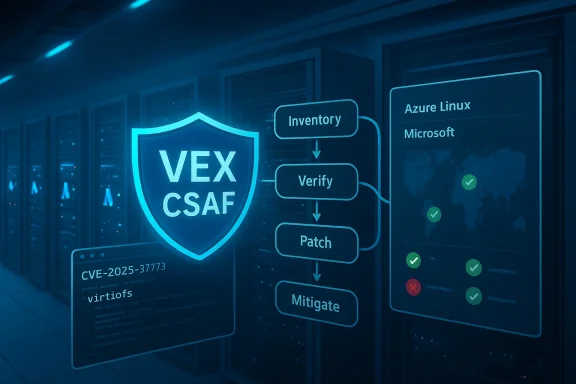
Microsoft’s advisory language for a number of Linux kernel CVEs has followed a consistent pattern: for a given CVE, MSRC may publish a short, machine‑readable attestation that names one Microsoft product family (for example, Azure Linux) as a confirmed carrier of the upstream open‑source component implicated by that CVE. That phrasing is intentionally pragmatic: Microsoft has completed inventory and attestations for Azure Linux first as part of a phased rollout of machine‑readable CSAF/VEX artifacts, and it has publicly committed to updating the CVE/VEX mapping if additional Microsoft products are later found to include the same upstream component. The company documented that VEX/CSAF rollout and the reasoning behind the phased approach in its transparency blog.Two consequences follow from this model:
- The statement “Azure Linux includes this open‑source library and is therefore potentially affected” is authoritative and actionable for Azure Linux customers. Treat Azure Linux images as in‑scope and apply Microsoft/Ubuntu/etc. patches as directed.
- The statement does not logically prove that no other Microsoft artifact or product could include the same vulnerable code. Other Microsoft artifacts that ship or embed Linux kernels (for example, WSL2 kernel builds, Marketplace VM images, AKS node images, linux‑azure kernels, appliau may publish) may or may not include the same upstream component depending on the kernel version, kernel configuration, and whether Microsoft backported the change. Until Microsoft publishes a VEX/CSAF attestation that lists a specific product as Not Affected or Fixed, the safe operational posture for those other artifacts is “unverified” rather than “clear.” Community and operations experts have repeatedly emphasized this product‑scoped interpretation.
Technical summary of CVE‑2025‑37773
The bug in plain terms
- Component: virtiofs, the kernel-side filesystem glue that enables efficient host↔guest shared mounts in virtualized environments.
- Fault: missing validation of the filesystem context source name; in certain corner cases (for example, fuzz testing or malformed requests) the source name can be NULL.
- Symptom: dereferencing a NULL pointer in kernel context can cause an immediate kernel panic (host crash), creating an availability / DoS condition.
- Threat model: local attacker or process with the ability to interact with a virtiofs mount on the host/guest, not an unauthenticated remote network exploit in the classic sense. Public trackers assign a medium severity and CVSS ~5.5 with an Attack Vector = Local.
Where the fix landed
Upstream kernel maintainers merged one or more small commits that add the missing check. Those patches are referenced in vulnerability trackers and OSV/OpenCVE entries; stable backports and distro advisories map those commits into vendor kernel releases. If you need to confirm whether a kernel release contains the fix, map your running kernel version to the upstream commit IDs listed by the distribution advisory or OSV.Is Azure Linux the only Microsoft product that includes the library?
Short answer: No — not necessarily.- Microsoft’s public attestation names Azure Linux because that is the Microsoft product family it has inspected and formally attested in machine‑readable VEX/CSAF format so far. That attestation is factual and actionable for Azure Linux images: if you run Azure Linux, you must assume the image is potentiaotion guidance promptly.
- However, Microsoft has also explicitly said it will update CVE/VEX records if impact to additional products is identified. This means the absence of other product names in the MSRC entry is not an explicit denial that other Microsoft artifacts cannot include the vulnerable virtiofs code. Other Microsoft Linux artifacts (WSL2 kernels, linux‑azure kernels, Marketplace or AKS images, appliances) may include the same upstream subsystem depending on how those artifacts are built. Independent community analyses and incident‑response playbooks have repeatedly called out this distinction between attested and possible carriers.
What operators should do now — practical checklist
The steps below assume you are a system owner, cloud operator, or a security team responsible for Linux workloads in Azure and for any Microsoft‑distributed Linux artifacts (WSL, Marketplace images, AKS nodes, appliance images).- Identify exposed assets (inventory)
- Start with Azure Linux images and VMs — Microsoft named Azure Linux explicitly; ensure they are patched first.
- Inventory other Microsoft‑provided artifacts in your environment: WSL2 kernel images used on Windows clients, custom Marketplace images, AKS node images, and appliance images pulled from Microsoft or its Marketplace.
- Maintain a canonical inventory mapping artifacts → kernel versions → package versions. This is the only defensible way to move from “unverified” to “verified” for a given artifact.
- Check whether virtiofs is present in a kernel or image
- On a running Linux system, use these quick checks:
- grep kernel config: grep -E -i "VIRTIO_FS" /boot/config-$(uname -r)
- check built‑in modules: grep -E "virtio(_blk|_net|_pci|fs)" /lib/modules/"$(uname -r)"/modules.builtin
- check loaded modules or mounts: lsmod | grep virtiofs ; mount | grep virtiofs
- These checks and the recommended commands are standard and documented in virtiofs/QEMU and cloud provider documentation. If virtiofs is neither built nor present as a module, the immediate kernel path for this CVE is not present on that host.
- Map kernel versions to the fixed commits
- Use OSV, NVD, or your distribution’s advisory page to find the upstream commit IDs referenced for CVE‑2025‑37773. If your kernel’s version or the vendor package contains that upstream commit (or a vendor backport), the kernel is fixed. Tools like OSV and OpenCVE can help map commits to releases.
- Patch or upgrade
- If the kernel is vulnerable, apply vendor patches or upgrade to a vendor kernel that includes the fix. Ubuntu, Debian, Amazon Linux and other vendors have published advisories and backports; apply them according to your organization’s change windows.
- For Azure Linux images, prefer Microsoft’s supplied updates or the image rebuilds Microsoft publishes; treat MSRC’s attestation as a direct remediation signal for Azure Linux customers.
- Mitigations when patching is delayed or impossible
- Restrict local access: because this bug requires local interaction with the virtiofs path, apply host hardening and limit untrusted users’ ability to mount or interact with virtiofs mounts.
- Avoid mounting untrusted virtiofs sharepplied.
- Where possible, remove or blacklist the virtiofs kernel module temporarily or rebuild kernels without CONFIG_VIRTIO_FS if your environment does not require guest↔host shared mounts — but treat this as a last resort and validate against your workloads (module removal may impact legitimate functionality). These approaches are operational mitigations and must be tested. ([virtio-fs.gitlfs.gitlab.io/howto-qemu.html)
- Monitoring and detection
- Monitor kernel oops and panic logs, set up alerting for spontaneous reboots or kernel panic traces, and correlate reboots with virtiofs activity.
- If you run host‑side virtiofs daemons (virtiofsd) or QEMU with virtiofs support, monitor their logs for malformed requests or abnormalities during the disclosure window.
How to verify Microsoft artifacts (WSL, Marketplace images, AKS nodes)
Many readers assume Microsoft’s limited attestation implies all Microsoft‑branded Linux artifacts are automatically safe. That is not the case. Here is how to verify other Microsoft artifacts:- WSL2 kernels (Windows Subsystem for Linux)
- Microsoft publishes kernel sources and kernel images for WSL2 in public repos. Check the WSL kernel version that your Windows host pulls and compare source/commit ranges to the upstream fixes for CVE‑2025‑37773. If the WSL kernel build includes the virtiofs component and is before the fixed commit, treat it as potentially affected until Microsoft attests otherwise. Community analyses have repeatedly pointed out WSL kernels are a plausible vector that must be verified separately.
- Azure Marketplace images and AKS node images
- Marketplace images and AKS node images are separate artifacts and may be assembled from different kernel packages. Do not assume their vulnerability status matches Azure Linux — query their package manifests, boot the image and run the kernel config checks listed earlier, or rely on explicit VEX/CSAF attestations from Microsoft for those SKUs.
- Apps published by Microsoft partners
- Vendors sometimes build appliances atop a base kernel which may ship upstream components. Inventory the image, inspect its kernel config, or request the vendor’s SBOM/VEX attestation.
Why this distinction matters for risk management
Treating Microsoft’s Azure Linux attestation as a global denial would be a brittle and potentially dangerous modeling error for defenders. The software supply chain — kernels, drivers, and packaging — is complex:- The same upstream code can appear in many different artifacts, depending on kernel versions and configuration flags.
- Vendors frequently backport fixes into their own kernel trees; conversely, they may omit certain subsystems when building a distribution kernel.
- Microsoft’s phased VEX rollout is an inventory and automation improvement — it reduces ambiguity for Azure Linux customers — but it cannot simultaneously attest every Microsoft SKU at disclosure time.
Confirmatory evidence: what the public trackers and vendors say
- NVD and OSV provide the canonical CVE summary that matches the upstream description: missing source‑name check in virtiofs; NULL can lead to kernel panic. Multiple distributors (Ubuntu, Debian, Amazon Linux) map the CVE to vendor advisories and list the same impact and mitigations.
- Upstream commits and OSV/OpenCVE references point to a handful of small patches; use those commit IDs to verify whether a given kernel release contains the fix. If your vendor advisory references a stable commit or patch ID, map your package’s changelog to that ID.
- Microsoft’s VEX/CSAF rollout blog explains the approach and explicitly documents the phased attestation approach that started with Azure Linux in October 2025. That is the stated source for Microsoft’s practice of publishing product‑level attestations first and adding other products as inventory completes.
Recommended detection commands and examples
Below are example on a Linux host or image to check for the presence of virtiofs and to assist triage. These are operational examples; adapt them to your environment.- Check kernel config for virtiofs support:
- grep -E -i "VIRTIO_FS" /boot/config-$(unac/config.gz exists: zgrep -E "VIRTIO_FS" /proc/config.gz
- Check for built‑in module entries:
- grep -E "virtio(_blk|_net|_pci|fs)" /lib/modules/"$(uname -r)"/modules.builtin
- Check loaded modules and mounts:
- lsmod | grep virtiofs
- mount | grep virtiofs
- Look for virtiofsd or QEMU usage on hosts that serve guest shares:
- ps -ef | grep virtiofsd
- ps -ef | grep qemu
Communications and transparency: why Microsoft’s approach is helpful
Microsoft’s decision to publish machine‑readable VEX/CSAF attestations (starting with Azure Linux) is a material improvement for defenders: it reduces noisy “is this product affected?” ambiguity and enables automation in tracking affected‑vs‑not‑affected SKUs. The tradeoff is practical: a phased rollout means the first product(s) will be published earlier and others will follow as inventory completes. The MSRC blog explains why Microsoft chose this phased path. For Azure Linux customers, the attestation is a direct signal to remediate; for everyone else, the attestation is a prompt to conduct artifact‑level verification.Community responders and operations teams have repeatedly recommended that vendors publish attestations product‑by‑product rather than issue broad denials or verbose multi‑SKU statements that are hard to automate; Microsoft’s approach follows that pattern and explicitly promises updates when scope changes.
Risks, limitations, and cautionary notes
- Unverified Microsoft artifacts: absence of a SKU in the MSRC attestation list does not equal Not Affected — it means “not yet attested.” Treat such artifacts as unknown and verify them.
- Local attack vector: this CVE requires local interaction with virtiofs; in multi‑tenant hosts or shared‑resource cloud environments, local attack paths can still arise (for example, a malicious container or an untrusted VM). Harden host isolation and privilege separation accordingly.
- Module removal caveats: blacklisting the virtiofs module can be an operational workaround if you do not require tt this may break legitimate host↔guest file sharing and must be tested. Always prefer vendor patches where available.
- Patch validation: after applying vendor updates, validate by confirming the kernel package contains the fix commit listed in the vendor advisory or by comparing the package changelog against the upstream patch IDs.
Bottom line (actionable summary)
- Microsoft’s MSRC attestation that “Azure Linux includes this open‑source library and is therefore potentially affected” is accurate and authoritative for Azure Linux and should be treated as a remediation signal for those images.
- That attestation is product‑scoped, not a universal denial. Other Microsoft artifacts — WSL2 kernels, Marketplace images, AKS node images, appliance images — may include the same virtiofs subsystem depending on kernel versions and build configuration; they must be verified individually.
- CVE‑2025‑37773 is documented in NVD and vendor trackers as a missing null‑check in virtiofs that can cause kernel panic; vendors have released patches and backports — apply them.
- Operational steps: inventory artifacts, run the kernel config checks, map kernels to upstream commits via OSV/NVD/vendor advisories, apply vendor patches or upgrades, and use mitigations (restrict local access, avoid untrusted virtiofs mounts) if you cannot patch immediately.
Microsoft has improved transparency by publishing VEX/CSAF attestations and committing to update mappings as more artifacts are validated. That change materially helps automation and reduces uncertainty for Azure Linux customers today. At the same time, defenders must not substitute a single product attestation for artifact‑level verification across a diverse fleet of Microsoft‑provided or Microsoft‑derived images. Do the artifact checks, apply patches, and document the evidence chain — that is the only way to move from “potentially affected” to “verified fixed” with confidence.
Conclusion: patch Azure Linux now if you run it; inventory and inspect other Microsoft artifacts in your environment; and insist on VEX/CSAF attestations or SBOM/kernel metadata for Microsoft SKUs you rely upon.
Source: MSRC Security Update Guide - Microsoft Security Response Center
