

Microsoft’s short MSRC attestation that “Azure Linux includes this open‑source library and is therefore potentially affected” is an authoritative, product‑scoped inventory statement for Azure Linux — but it is not a technical guarantee that no other Microsoft product could include the same vulnerable kernel code; other Microsoft artifacts must be treated as unverified until Microsoft publishes attestations or you confirm them through artifact‑level inspection.
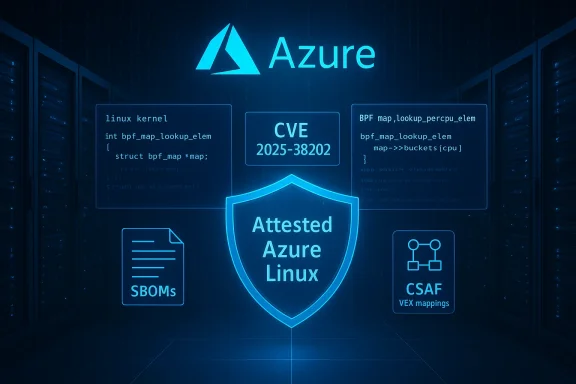
CVE‑2025‑38202 is a Linux kernel vulnerability in the BPF subsystem that was publicly recorded on July 4, 2025. The issue stems from missing lock assertions in the helper function path: specifically, the kernel did not enforce a check for rcu_read_lock_trace being held before calling certain per‑CPU BPF map helper paths such as bpf_map_lookup_percpu_elem(). Under interpreter mode (for example when BPF JIT is disabled) or on 32‑bit hosts where the helper is not inlined, using the helper from a sleepable BPF program can trigger a warning or unstable behavior because the program only holds the rcu_read_lock_trace lock rather than the stronger protection previously expected. Distributors have issued fixes; canonical advisories from Ubuntu and vendor trackers document the fix and the affected release mapping.
Why this matters: BPF is widely used for observability, networking, and security tooling. While this particular bug’s practical impact is primarily availability (kernel warnings and potential crashes under specific conditions), the presence of the code path in a shipping kernel means that any Microsoft product that ships a Linux kernel built from the affected upstream range — and that enables the relevant BPF helpers — could surface the same behavior. The fix involves adding the missing lock check to the helper so that sleepable BPF programs cannot invoke the helper under insufficient locking.
Put another way:
Source: MSRC Security Update Guide - Microsoft Security Response Center
 Background / Overview
CVE‑2025‑38202 is a Linux kernel vulnerability in the BPF subsystem that was publicly recorded on July 4, 2025. The issue stems from missing lock assertions in the helper function path: specifically, the kernel did not enforce a check for rcu_read_lock_trace being held before calling certain per‑CPU BPF map helper paths such as bpf_map_lookup_percpu_elem(). Under interpreter mode (for example when BPF JIT is disabled) or on 32‑bit hosts where the helper is not inlined, using the helper from a sleepable BPF program can trigger a warning or unstable behavior because the program only holds the rcu_read_lock_trace lock rather than the stronger protection previously expected. Distributors have issued fixes; canonical advisories from Ubuntu and vendor trackers document the fix and the affected release mapping.Why this matters: BPF is widely used for observability, networking, and security tooling. While this particular bug’s practical impact is primarily availability (kernel warnings and potential crashes under specific conditions), the presence of the code path in a shipping kernel means that any Microsoft product that ships a Linux kernel built from the affected upstream range — and that enables the relevant BPF helpers — could surface the same behavior. The fix involves adding the missing lock check to the helper so that sleepable BPF programs cannot invoke the helper under insufficient locking.
Precisely what Microsoft said — and how to read it
Microsoft’s Security Response Center (MSRC) pages for Linux CVEs have adopted a concise, product‑scoped phrasing to help customers triage quickly: for multiple kernel CVEs MSRC publishes the line that “Azure Linux includes this open‑source library and is therefore potentially affected,” and the company has committed to publishing machine‑readable CSAF/VEX attestations starting October 2025 and to update CVE mappings if additional Microsoft products are identified as carriers. That statement is an inventory attestation for the named product family (Azure Linux) — it confirms Microsoft inspected those artifacts and found the implicated upstream component. It does not claim exclusivity across all Microsoft artifacts.Put another way:
- What MSRC’s sentence means: Microsoft has verified that Azure Linux images and kernels contain the upstream code mapped to the CVE and therefore those images should be treated as *kpatched.
- What it does not mean: That no other Microsoft product or image can contain the same upstream source. Microsoft ships many kernel artifacts and images; until those are individually inventoried and attested they remain unverified, not confirmed clean.
Short answer to the user’s question
No — Azure Linux is not necessarily the only Microsoft product that includes the open‑source code behind CVE‑2025‑38202, but it is the only Microsoft product Microsoft has publicly attested to include the implicated code so far. Treat the MSRC entry as an authoritative instruction to prioritize and patch Azure Linux images; treat other Microsoft artifacts as unverified until Microsoft (via CSAF/VEX) or your own artifact inspection shows them to be Not Affected or Fixed.Why the cautious answer is the correct operational posture
There are three technical realities that make a blanket “only Azure Linux” claim unsafe:- Kernel provenance is artifact‑level. The presence or absence of a specific upstream commit or a particular helper function depends on the exact kernel version and the compile‑time kernel configuration (CONFIG_* settings) used to build that kernel artifact. Microsoft ships multiple kernel families — Azure Linux kernels, linux‑azure kernels, WSL2 kernels, Marketplace images, managed node images for AKS, and other platform artifacts — each potentially built from different upstream commit ranges and with different CONFIG choices. Any of them could include the code depending on build choices.
- Distribution backports complicate version‑based triage. A vendor can backport a fix inckage (so a kernel package version number alone is not a reliable binary-level proof that the vulnerable code is present or absent). Conversely, a kernel that looks “new enough” might still lack a backport applied by a specific vendor. That’s why artifact‑level attestations (CSAF/VEX) and SBOMs matter.
- Microsoft’s published wording is an inventory statement, not an exclusivity claim. Multiple community analyses and vendor advisories (and Microsoft’s own FAQ text) reiterate that the Azure Linux attestation reduces uncertainty only for the named product family; it does not imply Microsoft has completed a full corporate inventory. Microsoft has committed to updating CVE/VEX when additional products are found to include the code. ([archive.ph](https://archive.ph/2025.12.07-18552...vulnerability/CVE-2024-26757?utm_source=crete impact scenarios — what to check in your estate
- Azure Linux images (VMs, AKS node pools designated to use Azure Linux) — MSRC attests these are in scoy the vendor patch immediately.
- WSL2 kernel builds used on Windows desktops and servers — Microsoft publishes WSL kernel builds and configuras are built from upstream trees. If the WSL kernel build in your environment contains the affected commit range and enables the BPF helpers, it could be impacted. Verify the WSL kernel version and config.
- linux‑azur kernel packages used in Azure VM SKUs — these are distinct build artifacts and must be checked individually.
- Marketplace images, container base images and curated appliances distributed via Microsoft channels e distribution kernels or packaged kernels; inspect SBOMs or run binary/package inspections.
- CBL‑Mariner or other Microsoft OSS base images used internally by services — these must be inventoried separately; MSRC has historically listed CBL‑Mariner kernel builds in some CVE attestations when relevant.
Practical triage checklist (step‑by‑step)
- Inventory and prioritize
- Identify all Microsoft‑supplied Linux artifacts you run: Azure Linux VMs, AKS node images, WSL2, linux‑azure packages, Marketplace images, curated containers, and any managed platform node images.
- Prioritize Azure Linux images immediately — Microsoft’s attestation makes them highest priority.
- Verify kernel version and config per artifact
- On running systems:
- Run uname -r to get kernel version.
- Check /proc/config.gz or /boot/config-$(uname -r) for CONFIG_BPF and related options. (If /proc/config.gz exists, zcat /proc/config.gz | grep -i bpf)
- Search boot images/packages for the presence of helper symbols: e.g., strings /boot/vmlinuz-$(uname -r) | grep bpf_map_lookup_percpu_elem (artifact inspection; results vary by build).
- For images, containers, and packages:
- Extract kernel package metadata or inspect SBOMs / package manifests for kernel versions and package release notes.
- Apply vendor patches
- For Azure Linux: apply Microsoft’s updates and follow MSRC guidance for the CVE. Azure Linux customers should update kernel packages or apply image updates promptly.
- For Linux distributions (Ubuntu, Debian, Red Hat, etc.): apply distribution security updates. Ubuntu’s advisory and vendor trackers list the fixed package information for CVE‑2025‑38202.
- Rebuild and redeploy where necessary
- If you produce custom images or containers that bundle an affected kernel, rebuild them with patched kernel packages and redeploy.
- For baked‑in kernels in appliances, coordinate firmware/OS updates and regression testing.
- Monitor and mitigate in the short term
- If immediate patching is infeasible, minimize exposure by restricting untrusted local users from loading BPF programs (where policy permits).
- Audit kernel logs for BPF helper warnings and crashes indicative of the issue; these are the observable signatures described in vendor advisories.
- Track Microsoft CSAF/VEX and vendor advisories
- Subscribe to MSRC CSAF/VEX feeds and your distribution vendor advisories so you can automatically detect when Microsoft updates product mappings to include other artifacts. Microsoft committed to updating CVE mappings when additional products are discovered to ship the component.
Why binary / artifact checks beat version heuristics
Many teams triage by kernel version numbers alone. That can be misleading because:- Kernel versions do not always indicate whether a specific upstream commit was included or backported.
- Kernel configuration flags determine whether the offending helper is built, inlined, or enabled — two kernel artifacts with the same version might differ in CONFIG choices.
- Vendors may apply backports or targeted patches that change vulnerability status without a simple version upgrade.
Technical cross‑checks and corroboration
To reduce the risk of relying on a single source, corroborate the claim across independent advisories:- Ubuntu security advisory for CVE‑2025‑38202 documents the description and the distributions in which the fix landed. This confirms the technical nature of the fix and the affected helper semantics.
- Vendor vulnerability trackers and databases (Rapid7, Wiz, and others) list the CVE, provide a CVSS/impact summary (local attack vector, mainly DoS), and map affected kernel versions across distributions. These independent trackers confirm the vulnerability’s classification and priority.
- Microsoft’s MSRC pages (and archived copies where relevant) show the exact product‑attestation phrasing and the CSAF/VEX rollout note; thes policy and public commitment for product‑scoped inventory attestations.
Risk assessment: likely impact and exploitability
Based on public advisories and vendor analyses:- Attack vector: Local — an unprivileged user or process capable of loading/triggering BPF programs and exercising the non‑inlined helper can provoke the warning/behavior. This is not a remote network‑facing RCE in ordinary configurations.
- Impact: mainly availability (kernel warnings, potential crash/DoS) under the tested conditions; the vulnerability is not described as permitting arbitrary code execution or confidentiality loanalyses.
- Exploit complexity: moderate — requires local ability to load a sleepable BPF program and the appropriate kernel build conditions (JIT disabled, 32‑bit host, or interpreter mode), so attacker scenarios are narrower than many networked CVEs.
Recommendations for Microsoft customers and administrators
- Prioritize patching Azure Linux images and kernels immediately — MSRC has attested Azure Linux as potentially affected and will provide VEX artifacts for automation.
- Perform artifact‑level discovery across your environment to identify any other Microsoft‑supplied kernels or images you run:
- WSL2 kernels on developer desktops
- linux‑azure kernels for specialized VM SKUs
- Marketplace and curated images
- AKS node images and any orchestration node pools using Microsoft‑provided images
- If you find an unpatched artifact and cannot patch immediately, consider mitigating configuration controls:
- Limit the ability of unprivileged BPF programs (through kernel lockdown, restricted capabilities, or host policy).
- Isolate untrusted workloads from critical infrastructure host namespaces.
- Subscribe to MSRC CSAF/VEX feeds and your distribution vendor security advisories so you receive automated attestations and fixed package releases as they’re published. Microsoft has committed to updating CVE mappings if other products are found to ship th
Critical analysis — strengths and gaps in Microsoft’s approach
Strengths- Microsoft’s move to publish product‑scoped CSAF/VEX attestations is a meaningful step toward transparent, machine‑actionable vulnerability mapping. It gives Azure Linux customers a deterministic inventory result they can use to automate rces both noise and time‑to‑patch for the named product family.
- Phased attestations leave other artifacts in a state of “unknown.” Large vendors ship many distinct binary artifacts; until those are inventoried and attested, customers must perform their own discovery. The MSRC sentence naming Azure Linux is correct but incomplete for enterprises that consume diverse Microsoft images beyond Azure Linux. This leaves a short‑term verification burden on customers.
- Public messaging can be misread as exclusivity. Multiple community threads have already shown confusion where some readers interpret “Azure Linux includes…” to mean “only Azure Linux includes…”. That misreading is dangerous operationally — it can delay checks on WSL kernels, Marketplace images, or other Microsoft artifacts. Vendor messaging should be explicit when limited to a product family; MSRC’s CSAF/VEX rollout note helps but customers must still verify.
Conclusion and actionable takeaways
- Microsoft’s MSRC attestation naming Azure Linux confirms that Azure Linux images include the upstream code mapped to CVE‑2025‑38202 and are therefore known affected; Azure Linux customers should apply the available updates immediately.
- That attestation does not mean Azure Linux is the only Microsoft product that could include the same vulnerable code. Any Micrhips a Linux kernel built from the affected upstream range and with the relevant kernel config could be impacted until it is explicitly attested as Not Affected or Fixed. Operators must therefore run artifact‑level discovery (SBOMs, kernel symbol/package inspection, WSL kernel checks, Marketplace image inspections) for other Microsoft images in their environment.
- Corroborate technical details using independent vendor advisories (Ubuntu, Red Hat trackers) and vulnerability databases to confirm the scope, impact, and fixed package mapping for CVE‑2025‑38202. Then patch or rebuild affected artifacts, monitor kernel logs for BPF warnings, and subscribe to MSRC’s CSAF/VEX artifacts for future attestations.
Source: MSRC Security Update Guide - Microsoft Security Response Center
