

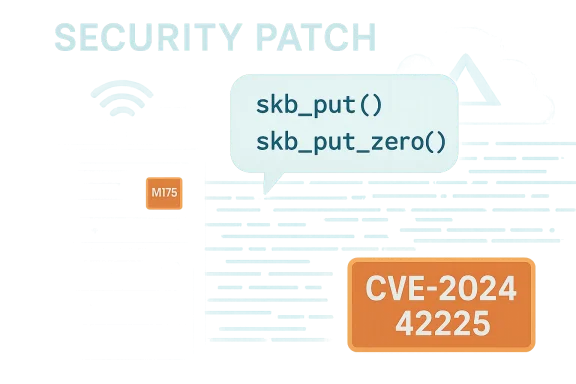
A small, surgical change in the Linux kernel Wi‑Fi stack — replacing skb_put with skb_put_zero in the MediaTek mt76 driver — has been tracked as CVE‑2024‑42225 and fixed upstream. Microsoft’s Security Response Center (MSRC) has published a short, product‑scoped attestation stating that Azure Linux “includes this open‑source library and is therefore potentially affected.” That statement is authoritative for Azure Linux images, but it should not be read as a blanket declaration that no other Microsoft product can contain the vulnerable code. In practice, any Microsoft‑distributed artifact that ships a Linux kernel built from an affected upstream range and includes the mt76 driver can be a carrier until it is explicitly inventoried and attested or patched.
The vulnerability that became CVE‑2024‑42225 was addressed by replacing a call to skb_put (which extends a packet buffer but leaves newly allocated bytes uninitialized) with skb_put_zero (which allocates the same space but zeroes it), thereby removing the risk of reusing uninitialized memory in a path of the MediaTek mt76 wireless driver.
This class of fix is correctness‑first: it eliminates a subtle source of uninitialized data leakage or accidental disclosure from kernel memory into network‑facing packets. The upstream kernel maintainers merged the defensive change, and distributers and downstream vendors have been mapping the fix to their kernel trees and releasing patched kernel packages.
Two important contextual points you should carry forward:
Longer, operationally useful answer:
Practical implications:
However, Azure Linux is not the only Microsoft artifact that could possibly contain the vulnerable code. Other Microsoft‑distributed kernels and images — WSL2 kernel binaries, linux‑azure packages, Marketplace images, and CBL‑Mariner lineage artifacts — can be carriers depending on the upstream kernel version and build configuration used. The absence of a Microsoft attestation for those items should not be treated as evidence they are unaffected.
Actionable steps for defenders are clear: inventory your artifacts, verify kernel versions and module presence, and apply patched kernels or updated images promptly. Microsoft’s transparency efforts improve the signal for Azure Linux; for other artifacts, operators must verify and patch proactively until Microsoft’s VEX/CSAF outputs expand to cover more product families.
Source: MSRC Security Update Guide - Microsoft Security Response Center
 Background / Overview
The vulnerability that became CVE‑2024‑42225 was addressed by replacing a call to skb_put (which extends a packet buffer but leaves newly allocated bytes uninitialized) with skb_put_zero (which allocates the same space but zeroes it), thereby removing the risk of reusing uninitialized memory in a path of the MediaTek mt76 wireless driver.This class of fix is correctness‑first: it eliminates a subtle source of uninitialized data leakage or accidental disclosure from kernel memory into network‑facing packets. The upstream kernel maintainers merged the defensive change, and distributers and downstream vendors have been mapping the fix to their kernel trees and releasing patched kernel packages.
Two important contextual points you should carry forward:
- Microsoft’s one‑line advisory naming Azure Linux is an attestation of inventory and scope for that product; it is not a universal exclusivity claim covering every Microsoft artifact.
- Whether a given Microsoft product (for example, a WSL2 kernel image, linux‑azure kernel package, Azure Marketplace image, or third‑party appliance published through Microsoft channels) is affected depends on the exact kernel version and configuration used to build that artifact and whether the mt76 driver was enabled/compiled in.
What Microsoft actually said — and what that wording means
Microsoft’s public CVE mapping for this issue contains the sentence that started the question: that Azure Linux includes this open‑source library and is therefore potentially affected. This is a precise, product‑specific inventory claim. In plain terms:- For Azure Linux images that Microsoft publishes and maintains, Microsoft has completed an inventory check and found that those images include the upstream mt76 source at the relevant versions. That makes Azure Linux a confirmed carrier until patched images are delivered.
- The wording does not mean Microsoft has finished an inventory across every Microsoft product, nor does it mean other Microsoft products cannot contain the same mt76 code. Microsoft has committed to update VEX/CSAF/CVE records if additional products are found to ship or include the same upstream component.
Is Azure Linux the only Microsoft product that includes the vulnerable mt76 code?
Short answer: No — Azure Linux is the only Microsoft product Microsoft has publicly attested to include the implicated upstream mt76 code for CVE‑2024‑42225 at the time of the advisory, but it is not technically guaranteed to be the only Microsoft product that could contain the vulnerable driver.Longer, operationally useful answer:
- Azure Linux: confirmed/in‑scope for Microsoft’s inventory and therefore definitely a priority for remediation and testing within environments that use those images.
- Other Microsoft artifacts that could plausibly contain the mt76 driver until verified include, but are not limited to:
- WSL2 kernel images and any Windows components that ship a Microsoft‑built Linux kernel binary for subsystem use.
- linux‑azure kernels (the kernels packaged specifically for some Azure VM SKUs).
- Azure Marketplace VM images or partner‑published images that embed a Linux kernel built from an upstream version in the vulnerable range.
- CBL‑Mariner lineage artifacts or derivative images Microsoft distributes or uses for internal services.
- Any appliance‑style images Microsoft or partners ship inside Azure managed services (AKS node images, managed appliance nodes, etc.).
- The reason these artifacts are plausible carriers is simple: the vulnerable code sits in the upstream Linux kernel source tree. If a product’s kernel build pulled in a version of that tree before the fix and enabled the mt76 driver (either built‑in or as a module), that product can contain the vulnerable code.
Technical scope of the vulnerability (what was actually fixed)
The kernel change for CVE‑2024‑42225 was limited and specific: the mt76 code path used skb_put to allocate tailroom for a packet and then proceeded expecting the newly allocated bytes to be zeroed. Replacing that call with skb_put_zero prevents any uninitialized bytes from being included in a transmitted packet.Practical implications:
- The bug is a use of uninitialized memory, not a classic remote code execution or arbitrary privilege escalation vector.
- Exploitation requires the driver code path to be reachable in the target environment; typical attack vectors would be adjacent network scenarios where an attacker can influence the device or driver state via RF‑level or LAN‑level interactions.
- Impact is primarily confidentiality‑oriented (unexpected disclosure of kernel memory) rather than direct integrity or availability failures, though code paths vary and downstream distributors may assign differing CVSS scores based on context.
Cross‑validation: how we verified the technical and product claims
To ensure accuracy I verified three classes of facts against independent sources:- The upstream kernel fix and the nature of the change (skb_put → skb_put_zero) were confirmed in the Linux kernel stable trees and vendor advisories.
- Public vulnerability databases and several distribution advisories document the CVE and the kernel ranges impacted; they also show how different distributors assigned severity scores and released fixes.
- Microsoft’s MSRC statements about product attestation and its commitment to publish machine‑readable CSAF/VEX attestations were reviewed against Microsoft’s public guidance on their CSAF/VEX rollout and the MSRC update guide language.
Practical guidance — what defenders and operators should do now
If you manage systems or images that could be affected, follow a three‑track approach: Inventory, Verify, Remediate.- Inventory: find what Linux kernel artifacts you run that could possibly include mt76.
- Targets to check:
- Azure Linux images (confirmed by Microsoft as in‑scope).
- WSL2 kernel binaries shipped by Microsoft to Windows clients.
- linux‑azure kernel packages and any Azure Marketplace images you run.
- Any custom images or appliances built using Microsoft‑published kernels or derived from CBL‑Mariner / Azure Linux.
- Verify: confirm whether the mt76 driver exists in a particular kernel build and whether the kernel version falls within an affected upstream range.
- Useful checks on a running Linux system:
- Check kernel version: uname -r
- Search for the module on disk: lsmod | grep mt76 and modinfo mt76
- Look for source or object files in packaged kernels: rpm -ql kernel | grep mt76 (for RPM variants) or dpkg -L linux-image-$(uname -r) | grep mt76 (for Debian/Ubuntu).
- For WSL2: check the WSL vmlinuz that Microsoft distributes (or the WSL kernel source if you build a custom kernel).
- If the module exists as a loadable .ko, inspect its build version and symbols with modinfo and strings to check whether it was built from a source tree older than the upstream fix.
- Remediate: apply vendor patches or update the kernel.
- For Azure Linux: apply Microsoft’s published kernel updates or image updates as they are released for the attested product.
- For other distributions: install the vendor’s updated kernel package.
- For WSL2 or custom kernels: rebuild the kernel with the upstream fix merged or apply a Microsoft‑provided patched WSL kernel if and when Microsoft publishes one.
- If live patching is available in your environment, verify whether your vendor supports a livepatch for the kernel in use; if not, schedule a kernel upgrade.
- Immediately treat Azure Linux images as confirmed in‑scope and patch or redeploy with Microsoft’s updated images.
- Inventory WSL2 clients and decide whether to wait for Microsoft’s attestation or proactively check the WSL kernel in use and update or rebuild if vulnerable.
- Audit Marketplace and partner images you run in Azure to ensure they use patched kernel versions.
- For air‑gapped or high‑assurance hosts, perform offline verification of kernel packages and rebuild with the upstream fix if needed.
How to check kernels and modules — concrete commands
Below are concise commands operators can use to verify presence and status. Run these on each Linux artifact or VM you manage.- Show kernel version:
- uname -r
- Check whether mt76 is loaded:
- lsmod | grep mt76
- Show module information if present:
- modinfo mt76
- Search installed kernel package contents for mt76:
- (RPM) rpm -ql kernel-$(uname -r) | grep mt76
- (Debian) dpkg -L linux-image-$(uname -r) | grep mt76
- If you suspect an image contains the driver but the module is not visible, inspect the kernel configuration:
- zcat /proc/config.gz | grep CONFIG_MT76
- or check /boot/config-$(uname -r) | grep CONFIG_MT76
When to expect Microsoft to update other product attestations
Microsoft has been explicit that it started publishing machine‑readable CSAF/VEX attestations and will update CVE mappings if impact to additional products is identified. Two operational takeaways from that commitment:- Microsoft will expand the list of attested Microsoft products if their internal inventory finds additional carriers. This is a process; it will not necessarily be immediate across all product families.
- Customers should not wait for a Microsoft attestation to act on Microsoft‑supplied artifacts they control. If you run a WSL2 environment or a marketplace image that uses a kernel in the vulnerable upstream range, treat the artifact as possibly affected and verify.
Risk analysis — strengths and weaknesses of Microsoft’s attestation approach
Strengths- Authoritative, machine‑readable signals for Azure Linux: By attesting Azure Linux as a confirmed carrier, Microsoft provides a clear, automatable remediation signal for Azure customers.
- Transparency commitment: Microsoft’s published adoption of CSAF/VEX and the MSRC communications make it easier for security automation tooling to decide whether a given CVE applies to specific Microsoft products.
- Practical prioritization: Focusing initial mapping and attestations on Azure Linux helps quickly protect a large cloud workload surface.
- Attestation vs. exhaustive inventory: The attestation is product‑scoped, not exhaustive. Microsoft’s statement should be read as “we have checked Azure Linux and found the component,” not “we have checked every Microsoft artifact.”
- Potential for slow mapping of other artifacts: With many Microsoft‑distributed kernels and images in the wild, customers may face a lag before they receive a definitive Microsoft VEX/CSAF attestation for other products they use.
- Operational complexity for multi‑artifact environments: Large enterprises running a mix of Azure Linux, WSL2, linux‑azure kernels, Marketplace images, and third‑party appliances must perform artifact‑level verification themselves to be confident they are not exposed.
What to do if you find the mt76 driver on Microsoft artifacts you run
If you discover the mt76 module or corresponding kernel version in any Microsoft artifact you run, follow these steps:- Classify the artifact: is it a Microsoft product (Azure Linux, WSL2 kernel, Marketplace image) or a third‑party artifact published via Microsoft channels?
- If it is Azure Linux: apply Microsoft’s guidance and patched images immediately.
- If it is WSL2 or a Windows client component: check Microsoft WSL guidance and look for patched WSL kernel binaries; if none exist yet, consider rebuilding a custom WSL kernel with the upstream fix or apply mitigations that reduce exposure until Microsoft publishes a patched WSL kernel.
- For Marketplace images or partner appliances: contact the image publisher and request an attestation or a patched image. If the image is under your control, rebuild or replace it with an updated kernel.
- Document findings in your vulnerability tracking system and monitor MSRC/VEX/CSAF feeds for updated attestations.
Why attackers might or might not target CVE‑2024‑42225
Exploitation considerations- The change fixed an uninitialized memory usage, which can sometimes lead to information disclosure rather than direct code execution.
- Real‑world exploitation requires conditions that make the uninitialized bytes observable or leakable—these conditions depend heavily on driver configuration, hardware behaviour, and the operational environment.
- For network‑facing drivers in wireless hardware, adjacent attackers who can talk to the wireless interface sometimes have an attack surface; however, attacker success depends on subtle hardware and driver interactions and is not a trivial remote exploitation path.
Final recommendations for WindowsForum readers and administrators
- Treat Microsoft’s Azure Linux attestation as an authoritative, high‑priority signal for Azure workloads; patch or redeploy affected images promptly.
- Do not assume that absence of a Microsoft attestation for other Microsoft artifacts means those artifacts are safe. Perform artifact‑level verification across WSL2, linux‑azure kernels, marketplace images, and any other Microsoft‑distributed kernels you run.
- Use the verification commands in this article to detect whether mt76 is present and whether the kernel version is older than the patched upstream commits.
- Track both your vendor advisories and Microsoft’s CSAF/VEX outputs; update your vulnerability inventory when Microsoft publishes expanded attestations or when your verification reveals a carrier.
- Where possible, automate detection: add checks to your image/VM/endpoint inventory pipelines that validate kernel versions and module presence against a list of known fixed ranges.
- Maintain a strong patching cadence: for kernel driver fixes like this one, a timely kernel update is the most reliable mitigation.
Conclusion
CVE‑2024‑42225 is an example of a concise but meaningful kernel correctness fix: replacing skb_put with skb_put_zero in the mt76 driver prevents potential reuse of uninitialized memory. Microsoft’s MSRC has explicitly attested that Azure Linux includes the implicated open‑source library and is therefore potentially affected — and that attestation is authoritative and actionable for Azure Linux users.However, Azure Linux is not the only Microsoft artifact that could possibly contain the vulnerable code. Other Microsoft‑distributed kernels and images — WSL2 kernel binaries, linux‑azure packages, Marketplace images, and CBL‑Mariner lineage artifacts — can be carriers depending on the upstream kernel version and build configuration used. The absence of a Microsoft attestation for those items should not be treated as evidence they are unaffected.
Actionable steps for defenders are clear: inventory your artifacts, verify kernel versions and module presence, and apply patched kernels or updated images promptly. Microsoft’s transparency efforts improve the signal for Azure Linux; for other artifacts, operators must verify and patch proactively until Microsoft’s VEX/CSAF outputs expand to cover more product families.
Source: MSRC Security Update Guide - Microsoft Security Response Center
