

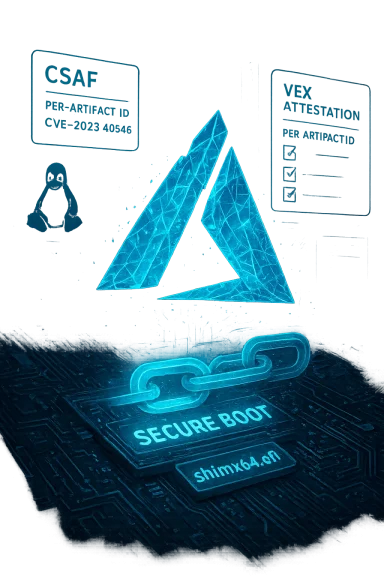
A careful reading of Microsoft’s short MSRC advisory shows what it actually is: a product‑scoped inventory attestation naming Azure Linux (Microsoft’s cloud‑focused Linux distribution) as a confirmed carrier of the affected open‑source code — not a categorical statement that no other Microsoft product could possibly contain the same library. Microsoft says it will expand machine‑readable attestations (CSAF/VEX) and update CVE mappings if additional Microsoft products are later found to ship the component. (msrc.microsoft.com)
Shim is a tiny but critical piece of the UEFI Secure Boot ecosystem: an EFI application that is frequently used by Linux distributions as the first‑stage bootloader to allow distribution‑signed bootloaders and kernels to run on Secure Boot‑enabled systems. Because shim is widely distributed and (in many cases) Microsoft‑signed for compatibility with PC firmware, a vulnerability in shim can affect large numbers of Linux images and devices.
CVE‑2023‑40546 is one of several shim defects disclosed in the same period. In this particular CVE the issue is a robustness error: when shim fails to create a new ESL (enrolled signing list) variable, it attempts to log an error message using parameters that don’t match the format string. Under some builds / runtime conditions that mismatch can allow an out‑of‑bounds read or NULL dereference and crash the shim process — which in practice can produce an early‑boot denial‑of‑service (the system fails to boot while Secure Boot is enforced). The public CVE/NVD descriptions characterize the impact as an availability/DoS issue rather than remote code execution.
At the time Microsoft published its short FAQ text associated with this (and similar third‑party CVEs), the company also published its plan to provide machine‑readable VEX/CSAF attestations beginning with the Azure Linux product family as part of a phased rollout of vendor attestations. That work — intended to tell customers, in a deterministic and automatable way, whether a Microsoft product is Known Affected / Not Affected / Under Investigation / Fixed for a given CVE — began in October 2025. Microsoft’s blog explains the phased approach and why Azure Linux was chosen as an early pilot.
Two operational consequences:
Source: MSRC Security Update Guide - Microsoft Security Response Center
 Background / overview
Shim is a tiny but critical piece of the UEFI Secure Boot ecosystem: an EFI application that is frequently used by Linux distributions as the first‑stage bootloader to allow distribution‑signed bootloaders and kernels to run on Secure Boot‑enabled systems. Because shim is widely distributed and (in many cases) Microsoft‑signed for compatibility with PC firmware, a vulnerability in shim can affect large numbers of Linux images and devices.CVE‑2023‑40546 is one of several shim defects disclosed in the same period. In this particular CVE the issue is a robustness error: when shim fails to create a new ESL (enrolled signing list) variable, it attempts to log an error message using parameters that don’t match the format string. Under some builds / runtime conditions that mismatch can allow an out‑of‑bounds read or NULL dereference and crash the shim process — which in practice can produce an early‑boot denial‑of‑service (the system fails to boot while Secure Boot is enforced). The public CVE/NVD descriptions characterize the impact as an availability/DoS issue rather than remote code execution.
At the time Microsoft published its short FAQ text associated with this (and similar third‑party CVEs), the company also published its plan to provide machine‑readable VEX/CSAF attestations beginning with the Azure Linux product family as part of a phased rollout of vendor attestations. That work — intended to tell customers, in a deterministic and automatable way, whether a Microsoft product is Known Affected / Not Affected / Under Investigation / Fixed for a given CVE — began in October 2025. Microsoft’s blog explains the phased approach and why Azure Linux was chosen as an early pilot.
What Microsoft’s line actually means (and what it doesn’t)
The literal, narrow interpretation (what MSRC said)
- When MSRC writes that “Azure Linux includes this open‑source library and is therefore potentially affected,” that is an authoritative inventory statement for Azure Linux artifacts only. Microsoft inspected the Azure Linux product artifacts and found the implicated component, so Azure Linux is in‑scope for remediation and VEX attestations. (msrc.microsoft.com)
The practical (operational) interpretation
- The MSRC phrasing is not an exclusivity guarantee. It is a snapshot of Microsoft’s inventory work at the time of publication. Absence of a VEX/CSAF attestation for some other Microsoft product is not evidence that the product is clean; it means Microsoft has not yet published an attestation for that product. Until Microsoft publishes attestations for other products, those artifacts remain unverified from the vendor attestation perspective.
Why the distinction is important
- Kernel and bootloader components are artifact‑specific. Whether a given Microsoft product includes a particular upstream file depends on:
- The exact kernel/bootloader version and commit range used to build the artifact,
- Kernel and bootloader compile‑time options (CONFIG_* flags),
- Whether the vendor or distribution backported a fix or a change, and
- The specific set of packages and image build pipelines used to assemble the product.
- In other words, two Microsoft images with similar names might differ in whether the vulnerable code is present. That’s why the VEX/CSAF attestation model — which provides per‑product, per‑CVEx status — matters.
Is Azure Linux the only Microsoft product that includes shim (and therefore potentially affected)?
Short answer: No — but with a specific meaning.- Azure Linux is the only Microsoft product Microsoft has publicly attested (so far) to include the implicated open‑source component for the CVE referenced on the MSRC CVE page. That is factual and actionable for Azure Linux customers: treat the MSRC attestation as authoritative for that product. (msrc.microsoft.com)
- However, technically and operationally, Azure Linux is not necessarily the only Microsoft artifact that could include the shim bootloader or other affected libraries. Any Microsoft product that ships a Linux kernel, an EFI image, a marketplace VM image, a Gen‑2 VM image with UEFI, or other compiled Linux artifacts could — depending on build choices and kernel versions — carry the same upstream code and therefore be in scope until verified. That includes, for example:
- Azure Marketplace images and Azure VM images that use distro kernels,
- Microsoft‑maintained kernel builds such as those used for WSL2 (where Microsoft publishes a WSL kernel build),
- Managed node images (AKS node images) or partner appliances published through Microsoft channels,
- Any Microsoft appliance or image that packages a Linux kernel or bootloader.
- Microsoft’s own messaging recognizes this operational reality: the company said it began publishing CSAF/VEX attestations in October 2025 and will update the CVE to reflect impact to additional products if they are identified. That is a promise to expand inventory coverage and to change the published mapping when their scanning finds other Microsoft artifacts that ship the vulnerable code.
How shim’s ecosystem makes blanket statements fragile
Shim functions at the firmware/boot boundary; distributions package it as signed EFI binaries (shimx64.efi, shim.efi, etc.) so that Secure Boot‑enabled hardware will run a distributor’s signed chain. Because shim is a small open‑source project maintained in the rhboot/shim repository and is integrated by virtually every major Linux distribution, a vulnerability in shim typically triggers a multi‑vendor response. Major distro vendors (Debian, Ubuntu, Red Hat, SUSE, Fedora, AlmaLinux, CentOS downstreams and others) shipped updates to their shim packages when the 15.8 release fixed multiple CVEs. That ubiquity is why a shim bug is rarely limited to a single distro or image family.Two operational consequences:
- If you run Linux images in Azure (or any cloud) and those images include shim (most Secure Boot‑enabled distro images do), they may be affected until patched.
- If you rely on vendor attestations (VEX/CSAF) to automate triage, the attestation needs to map down to the exact artifact you run (image name + version + build ID). Product‑level attestations are helpful but incomplete unless you can tie them back to the exact image in your fleet.
Evidence and verification — what the public record shows
- CVE/NVD and distro advisories: The CVE description and NVD record describe the shim bug as an out‑of‑bounds read / logging‑format/NULL dereference problem that can crash shim and cause a DoS. Multiple distribution advisories (Ubuntu, Red Hat, Debian, CentOS, SUSE) mapped the issue and published shim package updates.
- Microsoft’s MSRC advisory text: Microsoft’s CVE page included the product‑scoped line that Azure Linux includes the implicated library and is potentially affected, and it references Microsoft’s VEX/CSAF rollout commitment. That is the source text prompting the customer question and the inventory distinction. (msrc.microsoft.com)
- Widespread distro updates and package metadata: public package repositories and mirror metadata show shim packages and shim‑signed packages in many distributions; a single CVE in shim therefore produced coordinated fixes across multiple distros. The RPM metadata and distro advisories are evidence that shim is widely present.
- Third‑party coverage and researcher credits: independent security write‑ups and vendor advisories documented multiple shim CVEs (including CVE‑2023‑40546 and the related CVE‑2023‑40547 RCE issue discovered by MSRC researcher Bill Demirkapi). These independent analyses underscore both the severity of some shim issues and their broad distributional impact.
- Azure platform behavior: Azure supports UEFI Secure Boot and Trusted Launch for Gen‑2 VMs; that means Azure VM images that are Gen‑2 and have Secure Boot enabled use the platform’s UEFI chain and thus will behave equivalently to physical systems where shim governs boot behavior. Any shim present inside a VM image matters when the VM’s firmware enforces Secure Boot. That makes Azure VM image inventories (and Marketplace image inventories) operationally relevant for any shim CVE.
Practical guidance for operators and security teams
If you saw Microsoft’s MSRC wording and asked “Is Azure Linux the only MS product that could be affected?”, here’s a pragmatic checklist to triage and remediate risk across your estate.- Treat the MSRC Azure Linux attestation as authoritative and urgent for Azure Linux images. Patch those images immediately via your usual image management or Azure update channels. (msrc.microsoft.com)
- Inventory Microsoft‑distributed artifacts in your environment. Ask:
- Do you run Azure Marketplace images (official distro images or vendor appliances) that include shim?
- Do you run Gen‑2 VMs with Trusted Launch / Secure Boot enabled?
- Do you run WSL2 instances that rely on the Microsoft WSL kernel build?
- Do you run AKS node images, Marketplace appliances, or partner images obtained via Microsoft channels?
Where you find kernels or EFI images, map the image version to distro advisories and CVE‑fix commits. - Use artifact‑level checks:
- Check the shim package version in images (e.g., shim‑15.8 or newer fixes several recent CVEs). If the binary or package is older than the fixed release, the image is likely vulnerable.
- For kernels, map the kernel version / commit to upstream fixes and distro backports. Kernel version alone is not always sufficient — check the build configuration and vendor backports.
- Consume VEX/CSAF attestations programmatically:
- Microsoft published its VEX rollout beginning October 2025; ingest VEX/CSAF outputs (when available for a product artifact) to automatize whether a vendor‑shipped artifact is Known Affected / Not Affected / Fixed. But do not rely solely on VEX coverage until the vendor attests the specific artifact you run.
- Harden boot/boot‑time attack vectors:
- Where possible, use platform features (Trusted Launch, vTPM) and attestation to reduce risk exposure from manipulated PXE/HTTP boot or untrusted boot media.
- If an unpatched shim CVE can be triggered only via local access or network boot, reduce those attack vectors by hardening PXE/HTTP infrastructure and limiting local user privileges.
- For cloud scale: rotate images and rebuild pipelines:
- For VMs and container hosts, prefer redeploying instances from rebuilt images that contain patched shim packages rather than attempting in‑place manual fixes at scale. Image rotation reduces configuration drift and ensures the boot chain is correct on redeployed nodes.
Risk analysis — strengths of Microsoft’s approach and residual gaps
Strengths
- Microsoft’s decision to publish VEX/CSAF attestations is an important step toward machine‑actionable inventory transparency. VEX reduces noisy false positives and helps automate triage for customers that consume Microsoft artifacts (particularly Azure Linux). Microsoft’s October 2025 rollout and blog about the program make the intent and structure explicit.
- Naming Azure Linux first is pragmatic: Microsoft can produce high‑confidence attestations for a product it builds and maintains, giving customers a clear remediation path for those images. That is immediately valuable for Azure Linux customers.
Residual risks and limitations
- Partial coverage while the rollout proceeds. A phased attestation rollout necessarily leaves gaps while other product families are inventoried. During that window, customers must treat non‑attested Microsoft artifacts as unknown until verified. The MSRC language explicitly commits to expanding attestations, but there is operational friction while the work continues.
- Artifact granularity. Product‑level attestations help, but the operational need is to know whether this exact image or this specific kernel binary is affected. VEX/CSAF assists only when it includes artifact identifiers (build IDs, SBOM entries, image names) that match what you run. If the vendor attests only a product family without per‑artifact identifiers, you must still perform local verification.
- Complex supply‑chain reality. Many distributions and vendors integrate shim and then sign or repackage it. A vulnerability fixed upstream may be backported differently across vendors, complicating the mapping between CVE dates and patched package versions. Coordinated vendor updates are necessary and helpful, but the customer must still validate the final artifact they run.
Final recommendations (concise playbook)
- Patch Azure Linux images now — Microsoft’s attestation means Azure Linux artifacts are a confirmed priority. Automate the patch and redeploy pipeline if possible. (msrc.microsoft.com)
- Inventory Microsoft‑distributed images and kernels in your environment (Marketplace images, AKS nodes, WSL kernels, Gen‑2 VM images). Treat non‑attested artifacts as unknown and verify them locally.
- Ingest Microsoft’s CSAF/VEX outputs and configure your vulnerability management to prefer vendor‑attested outcomes — but continue to validate artifact identifiers against your own image inventory and SBOMs.
- Harden boot and provisioning paths (PXE/HTTP boot, image upload channels) to reduce the practical exploit surface for bootloader vulnerabilities. Use Trusted Launch / vTPM where available.
- Maintain an operational habit: assume “not yet attested” means “verify locally.” Don’t equate a lack of VEX entries with safety until the vendor explicitly attests the artifact or you confirm it yourself.
Conclusion
Microsoft’s wording — that “Azure Linux includes this open‑source library and is therefore potentially affected” — is accurate, actionable, and important for Azure Linux customers. But it is deliberately scoped: it confirms what Microsoft has checked so far, and it does not prove that other Microsoft artifacts are free of the same upstream component. Microsoft’s commitment to publish machine‑readable CSAF/VEX attestations (the rollout that began in October 2025) will materially improve clarity over time, but until VEX coverage includes the exact artifacts you run, the defensible operational stance is simple and unchanged: patch the attested product now; inventory and verify other Microsoft‑distributed images and kernels; and automate VEX/CSAF ingestion so future product attestations cut the manual work required to triage exposure. (msrc.microsoft.com)Source: MSRC Security Update Guide - Microsoft Security Response Center
