

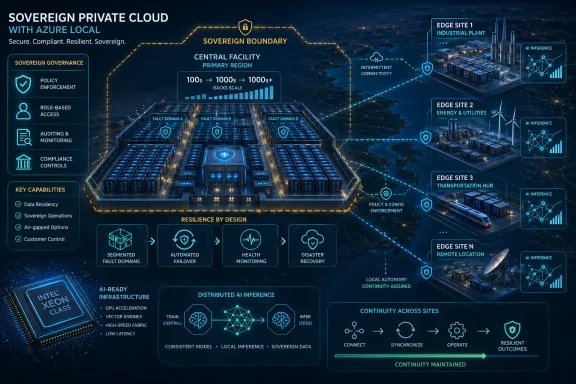
Microsoft has expanded the scale of its Sovereign Private Cloud strategy, announcing that Azure Local can now support deployments of up to thousands of servers within a single sovereign environment. The move is aimed at governments, regulated industries, telecommunications providers, critical infrastructure operators and organizations that need cloud-style capabilities while retaining control over infrastructure, data, operations and jurisdictional boundaries.
Azure Local serves as the infrastructure foundation for Microsoft Sovereign Private Cloud. It allows organizations to run Azure-consistent services on hardware they own and operate, including in datacenters, industrial environments, edge locations and environments with limited or no public cloud connectivity. Microsoft is positioning the expanded scale as a way for customers to run much larger local workloads without redesigning their infrastructure as demand grows.
The announcement reflects a broader shift in enterprise and public sector cloud strategy. Many organizations are under increasing pressure to meet data residency, operational autonomy, compliance and sovereignty requirements. At the same time, AI and analytics workloads are moving closer to where data is created, especially in sectors such as defense, telecommunications, manufacturing, public services and national infrastructure.
Azure Local is designed for connected, intermittently connected and fully disconnected deployments. In disconnected scenarios, organizations can continue to apply policy enforcement, role-based access control, auditing and compliance configurations locally. That means critical controls can remain available even when a deployment is not dependent on a continuous public cloud connection.
The new scale target expands Azure Local from smaller edge and departmental deployments to much larger private cloud footprints. Microsoft says Sovereign Private Cloud environments can now grow from hundreds to thousands of servers within a single sovereign boundary. This matters for organizations that need to support large application estates, data-heavy workloads, AI inference, analytics and mission-critical services while keeping operations under local control.
Resilience is also a central part of the announcement. Larger deployments require more robust approaches to fault isolation and workload continuity. Microsoft says expanded fault domains and infrastructure pools are intended to help prevent hardware failures from becoming service outages, especially for services that must remain operational across datacenters, edge sites or environments with inconsistent connectivity.
AI is another key driver. At larger scale, customers can run data-intensive AI inference and analytics workloads within their own controlled environments. With support for high-performance GPU infrastructure, sensitive models and operational data can remain inside customer-operated infrastructure, while identity, access, auditing and compliance controls stay within the sovereign deployment.
Microsoft highlighted several customer examples. AT&T is deploying Azure Local for mission-critical infrastructure on hardware it owns and operates, emphasizing control, governance and the consistency of the Azure operating model. Kadaster, the Netherlands’ land registry and mapping agency, is using Azure Local to maintain control over sensitive public data. FiberCop in Italy is deploying Azure Local across edge locations to deliver sovereign cloud and AI services while keeping data sovereignty and compliance requirements close to national operations.
The partner ecosystem is also part of the strategy. Azure Local is available with validated compute and enterprise storage platforms from vendors including DataON, Dell Technologies, Everpure, Hitachi Vantara, HPE, Lenovo and NetApp. Microsoft says this enables organizations to integrate existing storage area networks and preserve prior infrastructure investments while scaling compute and storage independently.
At the processor level, Microsoft points to Intel Xeon 6 as a compute foundation for these deployments. The processors include Intel AMX acceleration, which can support AI inference and generative AI workloads without always requiring separate specialized infrastructure. Combined with validated hardware, enterprise storage, accelerated compute and Azure Local’s management model, Microsoft is presenting Sovereign Private Cloud as a datacenter-scale platform for highly controlled environments.
The broader message is that sovereign cloud is no longer just about where data is stored. It is increasingly about who operates the infrastructure, how workloads are governed, whether services can continue during connectivity disruptions, and whether AI workloads can be processed close to sensitive data sources. Azure Local’s expanded scale gives Microsoft a stronger platform for customers that want cloud-consistent operations without giving up local control.
For organizations with strict residency, compliance, security or disconnected operation requirements, this update makes Azure Local a more significant part of Microsoft’s hybrid and sovereign cloud portfolio. It supports a deployment model that can start with a single edge node and grow into a large enterprise-scale private cloud environment, while keeping lifecycle management aligned with Azure.
Source: The Official Microsoft Blog Microsoft Sovereign Private Cloud scales to thousands of nodes with Azure Local - The Official Microsoft Blog
