

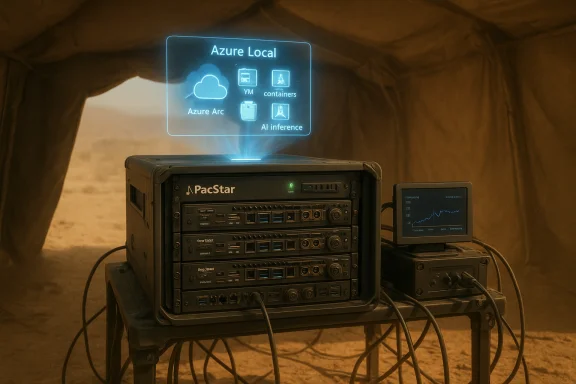
Curtiss‑Wright’s PacStar 451, 452, 453 and 454 tactical edge servers have been announced as validated for Microsoft Azure Local, a development that—if operationalized in customer programs—brings a fully supported Azure control plane into extremely small, rugged, SWaP‑optimized hardware designed for disconnected, denied and bandwidth‑limited operations. The company says the PacStar modules now form part of a validated PacStar Modular Data Center (MDC) able to run Azure Local at the tactical edge, enabling on‑site execution of enterprise‑grade VMs, containers and selected Azure services for mission‑critical workloads.
Microsoft’s rebranded Azure Local (the successor to Azure Stack HCI) is explicitly positioned to let customers run a consistent Azure management and services experience on validated, customer‑owned or partner‑hosted hardware. Azure Local combines Hyper‑V‑based virtualization, Storage Spaces Direct software storage, and management via Azure Arc so that local infrastructure can be administered through the Azure portal while keeping data and compute physically close to the point of need. Microsoft’s documentation describes the product family, naming changes and the delivery model for validated hardware partners.
Curtiss‑Wright’s PacStar line is a well‑established family of rugged, small‑form‑factor server modules used by defense and first‑responder organizations. The PacStar 400‑series modules (including the 451, 452, 453 and 454) are engineered for expeditionary use: they target small, mobile installations where size, weight and power (SWaP) matter and connectivity may be intermittent or unavailable. PacStar modules already support a range of enterprise and sensor processing workloads (video analytics, AI inference, VDI, mission planning and cybersecurity applications). Curtiss‑Wright’s public product pages and recent product updates describe ruggedized processors, NVMe storage, TPM/IPMI management and GPU enhancements on the 453/454 variants.
The announcement framing from Curtiss‑Wright emphasizes that Azure Local validation extends Microsoft’s hybrid cloud capability onto small, tactical hardware, enabling a true hybrid model even in Denied, Disrupted, Intermittent and Limited‑bandwidth (DDIL) environments. The company positions the validated PacStar MDC as a means to deliver enterprise‑grade cloud services at the tactical edge—local AI inference, real‑time data fusion, mission planning tools and more—without dependence on reach‑back connectivity to enterprise or public cloud.
That said, the practical value for any program depends on careful verification: exact validation artifacts from Microsoft, confirmed firmware/driver matrices, proven offline update procedures, and contractually guaranteed support SLAs. The headline is real and important—but it must be followed by rigorous procurement discipline and technical acceptance testing to realize the promised benefits safely and reliably. Buyers and systems integrators should treat the announcement as a live market signal and an operational opportunity, but insist on the evidence and playbooks that convert a validation claim into a deployable, supportable capability.
Acknowledgment: The technical context in this article uses Microsoft Azure Local documentation and Curtiss‑Wright product materials to verify product capabilities and platform compatibility. Readers evaluating tactical‑edge Azure Local deployments should cross‑check the vendor validation package with Microsoft’s Azure Local catalog and request written validation artifacts before contract award.
Source: NewswireToday Curtiss-Wright Achieves Microsoft Azure Local Validation for PacStar Tactical Edge Servers - Electronics / Instrumentation / RFID - Curtiss-Wright Corporation | NewswireToday
 Background / Overview
Microsoft’s rebranded Azure Local (the successor to Azure Stack HCI) is explicitly positioned to let customers run a consistent Azure management and services experience on validated, customer‑owned or partner‑hosted hardware. Azure Local combines Hyper‑V‑based virtualization, Storage Spaces Direct software storage, and management via Azure Arc so that local infrastructure can be administered through the Azure portal while keeping data and compute physically close to the point of need. Microsoft’s documentation describes the product family, naming changes and the delivery model for validated hardware partners.Curtiss‑Wright’s PacStar line is a well‑established family of rugged, small‑form‑factor server modules used by defense and first‑responder organizations. The PacStar 400‑series modules (including the 451, 452, 453 and 454) are engineered for expeditionary use: they target small, mobile installations where size, weight and power (SWaP) matter and connectivity may be intermittent or unavailable. PacStar modules already support a range of enterprise and sensor processing workloads (video analytics, AI inference, VDI, mission planning and cybersecurity applications). Curtiss‑Wright’s public product pages and recent product updates describe ruggedized processors, NVMe storage, TPM/IPMI management and GPU enhancements on the 453/454 variants.
The announcement framing from Curtiss‑Wright emphasizes that Azure Local validation extends Microsoft’s hybrid cloud capability onto small, tactical hardware, enabling a true hybrid model even in Denied, Disrupted, Intermittent and Limited‑bandwidth (DDIL) environments. The company positions the validated PacStar MDC as a means to deliver enterprise‑grade cloud services at the tactical edge—local AI inference, real‑time data fusion, mission planning tools and more—without dependence on reach‑back connectivity to enterprise or public cloud.
What “Microsoft Azure Local validation” means in practice
Validation is not just a sticker
When a hardware platform is "validated for Azure Local" it typically means Microsoft has tested and accepted a specific hardware configuration — firmware, BIOS, driver versions, storage configuration and networking — as compatible with the Azure Local software stack and the operational processes Microsoft supports for that stack. Validation includes interoperability with Hyper‑V, Storage Spaces Direct (S2D), clustering, and the Azure Arc control plane that provides centralized management. Microsoft Learn and the Azure Local pages explain the validated‑hardware model, how validated machines and instances are represented, and the procurement/operational patterns customers should follow.What buyers should expect from a validated solution
- A defined hardware‑software compatibility matrix (exact host SKUs, firmware and driver versions).
- A supported installation and lifecycle path (installation images, update cadence and support procedures).
- The ability to manage the local instance from the Azure portal via Azure Arc and to use a subset of Azure services locally.
- Microsoft support expectations and partner/firmware update coordination to maintain validated state.
PacStar hardware and software profile: small, rugged, capable
PacStar 400‑series: platform highlights
Curtiss‑Wright’s PacStar 400‑series modules are deliberately compact and interoperable across PacStar chassis and packaging options. Key technical points (as published by Curtiss‑Wright) include:- PacStar 451: a baseline small‑form‑factor server (Intel Xeon‑D family designs historically used) with NVMe storage options and enterprise networking ports.
- PacStar 452: adds support for additional E1.S NVMe drives for greater local storage density and high‑throughput local I/O.
- PacStar 453 & 454: GPU‑enhanced variants intended for accelerated inference, video analytics and sensor processing—Curtiss‑Wright lists NVIDIA GPU options, NVMe storage, TPM 2.0 and remote management features.
Azure Local on small form factors: technical fit
Azure Local’s architecture supports a range of validated host sizes—from compact HCI nodes up to larger cluster deployments. Microsoft’s documentation confirms the ability to deploy Azure Local on validated hardware with centralized control via the Azure portal and Azure Arc. The platform supports VMs and container workloads and can be configured for disconnected or intermittent operations when designed properly. Running Azure Local on small, rugged hardware requires:- A supported hypervisor stack and storage configuration.
- Verified firmware/driver/OS versions for long‑life, rugged hardware.
- Clear update and patch procedures for disconnected operations.
Microsoft Learn explicitly documents naming changes (Azure Stack HCI → Azure Local) and the compatibility/management model that applies to validated hardware.
Operational benefits for tactical and DDIL environments
Faster local decision cycles and reduced latency
A local Azure Local instance provides a managed control plane and the ability to run cloud‑native services close to sensors and operators. For mission applications—AI‑powered analytics, object detection, real‑time sensor fusion and mission planning—the primary win is lower latency and the ability to continue operations autonomously when connectivity is restricted. Curtiss‑Wright emphasizes these use cases in its product literature and in the validation announcement.Enterprise‑grade management at the edge
Azure Local brings a consistent management experience (Azure portal + Azure Arc) to on‑site hardware. That consistency matters for teams that already depend on Azure tooling and policies—operators can extend the same monitoring, RBAC and update pipelines to edge nodes, simplifying cross‑domain governance and incident response. Microsoft docs highlight this integrated governance model and centralized observability.SWaP gains and logistical advantages
PacStar’s modular approach and Curtiss‑Wright’s emphasis on transportable, ruggedized packaging reduce logistical friction when deploying compute into forward areas. Azure Local validation on such hardware promises that those small systems can be brought online quickly and managed under the same operational model as larger enterprise deployments—important where speed of deployment and resupply cycles are as crucial as compute horsepower.Security, compliance and sovereignty: benefits and caveats
Local control helps with data residency and auditability
Running workloads on validated hardware inside an operational theatre allows organizations to keep data and inference local—which helps with data residency and certain compliance regimes. Microsoft has been explicit that Azure Local and other sovereign capabilities are intended to provide customers with demonstrable control over where data and processing occur. Microsoft documentation on Azure Local and broader sovereign offerings shows the company’s intent to align product features with procurement and regulatory needs.Legal reality: contractual guarantees and legal jurisdiction still matter
Technical placement of compute does not, by itself, change legal jurisdiction or remove extraterritorial authorities. Independent analyses of sovereign/cloud offers have repeatedly emphasized that contractual terms, government‑to‑vendor agreements and legal frameworks (for example, extraterritorial legislation) still matter. Organizations should insist on clear contractual appendices that enumerate the validated hardware list, the exact Azure Local build/version, and operational exceptions. Microsoft’s own documentation and market analyses recommend explicit written assurances—customers should not accept high‑level marketing claims in isolation.Patching, updates and disconnected operation
Disconnection introduces operational complexity: how will nodes receive security updates, firmware patches and mitigations for zero‑day vulnerabilities? Microsoft supports disconnected/air‑gapped operation modes in its roadmap, but the burden of defining safe update procedures, offline patch bundles and validated rollback plans falls to operators and their integrators. The validated‑hardware process should include an agreed update and support workflow for disconnected use.Procurement and deployment checklist — what to demand before you buy
When a supplier or integrator says a product is “validated for Azure Local,” procurement and program teams should request the following, in writing:- Exact validation artifact:
- Host SKU(s), BIOS/firmware versions and driver versions that were validated.
- Azure Local version and feature set:
- The specific Azure Local release (build number) used during validation and which Azure services are supported locally.
- Validation scope:
- Whether validation covered GPU SKUs (if applicable), SAN attachments vs S2D, and any storage or network topologies that were not validated.
- Support & lifecycle:
- Who is the first‑line support contact (partner or Microsoft), escalation paths, SLAs for security fixes and how offline patching is handled.
- Security & compliance evidence:
- Penetration tests, SOC/ISO attestations, and evidence of Common Criteria or equivalent testing where applicable.
- Operational playbooks:
- Install/runbooks, verification tests, and failback/failover plans for connection loss.
- Performance verification:
- Benchmarks for representative workloads (AI inference, sensor fusion, VDI) in the validated configuration.
- Exit & migration:
- Procedures and guarantees for moving workloads off the hardware (for example, to public Azure or to another validated instance) and data custodianship during offboarding.
Technical and operational risks — what can go wrong
- Validation scope mismatch: Marketing claims sometimes overgeneralize a single validation run. Procurement must confirm whether the validation covered all variants (e.g., PacStar 451/452 vs GPU variants 453/454) and the exact hardware‑firmware combinations. Failure to do so creates unsupported configurations in the field.
- Storage model mismatch: Azure Local uses Storage Spaces Direct (S2D) by design; many enterprise sites use SANs or specialized arrays. If a tactical center needs to reuse a SAN topology, ask whether Microsoft validated SAN attachment or whether the validated configuration relied on S2D—differences matter for performance and certification.
- Update & patch logistics: In disconnected deployments, delivering emergency security patches or firmware updates in a timely, traceable, and validated manner is non‑trivial. Confirm the offline update mechanisms and test rollback paths before deploying.
- GPU and model support caveats: Running GPU‑accelerated inference locally requires validated GPU drivers, firmware and (for some vendors) secure firmware components. Where Blackwell or other server‑class GPUs are involved, customers should confirm the exact GPU SKU, driver version and validated AI runtime stack. Market analyses caution that vendor claims about GPU availability must be validated against Microsoft’s certified SKU lists.
- Total cost of ownership and subscription economics: Azure Local is billed per core (host subscription model) and introduces ongoing host fees in addition to hardware costs. Buyers should model multi‑year TCO including training, patching and support (and avoid surprise double‑billing during migration waves). Independent vendor guidance notes these as common procurement surprises.
Use cases that become materially easier with validated Azure Local on PacStar hardware
- Local AI inference and sensor fusion: run object detection, multisensor correlation and low‑latency analytics on the device nearest the sensor suite to speed decision timelines.
- Mission planning and tactical collaboration: host mission planning tools and secure VDI environments locally so teams can continue planning during periods of intermittent connectivity.
- Coalition and joint task force (CJTF) operations: create private tactical clouds for coalition partners that need consistent tooling while preserving localized control and interoperability.
- Local autonomous systems and robotics: run perception stacks and decision agents on validated hardware with GPU acceleration in forward deployed vehicles or shelters.
Curtiss‑Wright highlights many of these scenarios in their product literature for PacStar modules; the Azure Local validation claim is framed as enabling those same applications under Microsoft’s Azure management model.
Verification and next steps for program teams
- Confirm the validation:
- Ask the vendor (Curtiss‑Wright or their systems integrator) to provide Microsoft validation documentation and the Azure Local catalog entry or validation certificate.
- Pilot the exact configuration:
- Run a short proof of concept with the validated host SKUs, the same BIOS/firmware and workload mix to confirm performance and operational playbooks in your environment.
- Exercise disconnection scenarios:
- Test patching, backups, telemetry buffering and failback to ensure the systems behave as required in DDIL conditions.
- Agree SLAs and runbooks:
- Negotiate explicit support SLAs for security fixes, and ensure contract appendices enumerate exactly what was validated and what is out of scope.
- Plan lifecycle and refresh:
- Define how validated hardware will be refreshed and how new firmware/driver combinations will be validated and rolled out without breaking operations.
Strengths and strategic implications
- Rapidly brings Azure management and cloud‑native services to extremely small and rugged platforms, expanding where enterprise‑grade cloud services can run.
- Aligns tactical edge hardware with mainstream Azure tooling, lowering training and operational complexity for organizations already invested in Microsoft ecosystems.
- Enables local AI inference and more autonomous operations—particularly valuable for defense, public safety and critical infrastructure programs where connectivity cannot be guaranteed.
Limitations and outstanding verification items
- Public confirmation in Microsoft’s validated hardware catalog is the authoritative proof that a given SKU is supported — program teams should request the catalog entry and validation certificate from the vendor. Microsoft’s docs and partner catalog are the reference points for that validation.
- The press release asserts validation but does not, in its public text, publish the exact validation artifact (the SKU IDs, firmware levels and Azure Local build used). That means buyers must treat the announcement as an invitation to verify rather than proof of compatibility for every variant of PacStar hardware. Request the supporting validation documents before specification lock‑in.
- Running GPU‑accelerated inference on tiny, rugged modules is feasible, but customers must validate thermal, power and driver/firmware support for continuous AI workloads in the field—double‑check cooling and power provisioning for sustained GPU loads. Curtiss‑Wright’s product pages highlight GPU options but program teams should validate real‑world duty cycles.
Conclusion
The announced Microsoft Azure Local validation for Curtiss‑Wright’s PacStar 451, 452, 453 and 454 modules is a notable step toward mainstreaming enterprise‑grade hybrid cloud into the most constrained and tactical corners of operations. By combining PacStar’s rugged, small‑form‑factor, SWaP‑optimized hardware with Azure Local’s consistent Azure control plane and management surface, organizations get a credible path to run managed VMs, containers and local Azure services where connectivity cannot be relied upon.That said, the practical value for any program depends on careful verification: exact validation artifacts from Microsoft, confirmed firmware/driver matrices, proven offline update procedures, and contractually guaranteed support SLAs. The headline is real and important—but it must be followed by rigorous procurement discipline and technical acceptance testing to realize the promised benefits safely and reliably. Buyers and systems integrators should treat the announcement as a live market signal and an operational opportunity, but insist on the evidence and playbooks that convert a validation claim into a deployable, supportable capability.
Acknowledgment: The technical context in this article uses Microsoft Azure Local documentation and Curtiss‑Wright product materials to verify product capabilities and platform compatibility. Readers evaluating tactical‑edge Azure Local deployments should cross‑check the vendor validation package with Microsoft’s Azure Local catalog and request written validation artifacts before contract award.
Source: NewswireToday Curtiss-Wright Achieves Microsoft Azure Local Validation for PacStar Tactical Edge Servers - Electronics / Instrumentation / RFID - Curtiss-Wright Corporation | NewswireToday
