

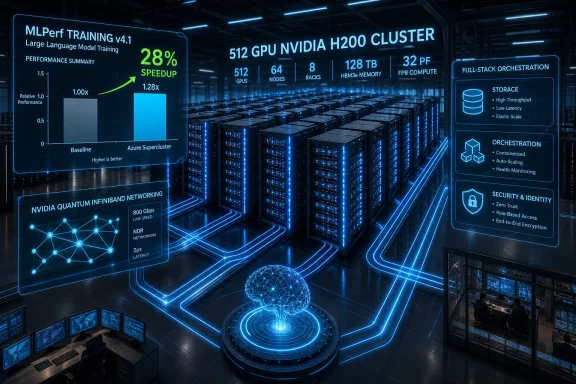
Microsoft said on March 18, 2025, that Azure had achieved leading MLPerf Training v4.1 results using a 512-GPU cluster of Nvidia H200 accelerators, showing a 28 percent speedup over comparable H100-based runs in large-scale AI training workloads. The announcement is not just another trophy in the benchmark cabinet; it is a signal about where cloud AI is heading. Microsoft is trying to prove that Azure is no longer merely renting Nvidia silicon by the hour, but engineering a full-stack training platform where GPUs, networking, storage, orchestration, and developer services move as one system.
That distinction matters because the AI race has entered its industrial phase. The bottleneck is no longer whether a lab can assemble a few fast accelerators, but whether a cloud provider can make hundreds, thousands, and eventually tens of thousands of them behave like a coherent machine. Azure’s H200 milestone is therefore less about one benchmark chart than about Microsoft’s argument that the future of AI development will be won by whoever can package supercomputing as dependable cloud infrastructure.
MLPerf exists because vendor claims in AI hardware are otherwise almost impossible to compare. Everyone has a chart; everyone has a workload tuned to flatter their architecture; everyone has a press release saying their platform is faster, cheaper, or more efficient than the last one. MLCommons’ training benchmarks do not eliminate marketing, but they do force participants to run agreed workloads under defined rules.
That makes Azure’s 512-GPU H200 result useful, but not magical. It tells us Microsoft and Nvidia can coordinate a large cluster well enough to produce verified training performance at a meaningful scale. It does not tell us that every Azure customer will see a neat 28 percent improvement on every model, dataset, or training pipeline.
The headline number still has weight because of what large-scale training exposes. At a few GPUs, performance is mostly about the accelerator. At hundreds of GPUs, performance is about the whole data center. The job becomes a choreography of memory bandwidth, interconnect latency, collective communication, software kernels, scheduling, storage throughput, fault tolerance, and power delivery.
That is why the H200 result lands as a cloud infrastructure story rather than a chip story. Nvidia made the accelerator, but Microsoft is selling the system. Azure’s pitch is that customers should not have to become hyperscale infrastructure engineers just to train or fine-tune frontier-class models.
Large models are hungry in several directions at once. Parameters, optimizer states, activations, gradients, and training data all compete for space and bandwidth. When memory is tight, engineers spend more effort slicing, checkpointing, offloading, recomputing, and otherwise working around the machine rather than training the model.
The H200’s value is that it gives the same broad software ecosystem a better memory envelope. For customers already invested in CUDA, PyTorch, DeepSpeed, Megatron-style training stacks, or Azure Machine Learning workflows, that is important. A GPU upgrade that does not demand a wholesale software rewrite can be more valuable than a theoretically bigger leap that arrives with rougher tooling.
That is also why the 28 percent improvement over H100 configurations is plausible as a platform-level milestone rather than a simple spec-sheet comparison. Better memory bandwidth reduces stalls. More memory capacity can improve batch sizes or model partitioning choices. Better cluster tuning can reduce the communication tax that usually eats scaling gains.
Microsoft’s use of Nvidia Quantum InfiniBand is central to the result. Distributed training depends heavily on collective operations, where many GPUs exchange gradients or synchronization data repeatedly throughout a job. Small delays compound quickly. A training run that looks efficient on eight GPUs can become embarrassingly wasteful when scaled to hundreds if the network is underbuilt or poorly tuned.
This is where Azure’s benchmark record has relevance for IT pros beyond the tiny club of organizations training frontier models. The cloud is increasingly being judged not just by available instance types, but by the topology behind them. Customers want to know whether the provider can deliver large contiguous GPU clusters, predictable network behavior, and enough operational maturity to keep long-running jobs from collapsing under their own complexity.
That is a different buying conversation from traditional virtual machines. In the old cloud era, enterprises compared CPU cores, RAM, storage tiers, regions, discounts, and compliance attestations. In the AI cloud era, they ask whether the provider can reserve a supercomputer, feed it data, protect it, monitor it, and keep it stable long enough for a training job whose failure may cost six or seven figures.
Benchmarks are controlled contests. They reward optimization against known tasks and known success criteria. Real enterprise AI work is messier. Data may live in fragmented systems, governance may slow access, models may need domain adaptation, and training jobs may be interrupted by quota limits, budget controls, or compliance reviews.
For many organizations, the practical bottleneck is not whether GPT-3-class training can be done a little faster. It is whether they can justify doing it at all. The cost of high-end GPU clusters remains punishing, and the opportunity cost is just as serious. Every hour spent on a custom model is an hour not spent evaluating whether a hosted foundation model, retrieval-augmented generation, small language model, or conventional analytics pipeline would do the job.
That does not diminish Azure’s result. It puts it in context. Microsoft is building for the customers that do need scale: OpenAI-style model developers, image and video generation companies, enterprise AI labs, scientific computing teams, and large organizations trying to own more of their AI stack. For everyone else, the result matters indirectly because capacity at the top of the market eventually shapes the services sold further down the stack.
That is classic Microsoft. The company has always been strongest when it turns underlying complexity into an operating environment. Windows did this for PC hardware. Office did it for business documents. Azure is trying to do it for cloud infrastructure. Now Microsoft wants to do the same thing for AI development.
The challenge is that AI infrastructure is less forgiving than traditional enterprise software. A spreadsheet can open a little slowly and still be useful. A training cluster that underperforms by 20 percent can destroy the economics of a project. A flaky interconnect, inconsistent storage pipeline, or poorly managed driver stack can turn cloud convenience into cloud waste.
This is why Microsoft’s partnership with Nvidia is both a strength and a dependency. Nvidia brings the accelerators, software libraries, networking fabric, and developer gravity that define the current AI stack. Microsoft brings global cloud capacity, enterprise relationships, security frameworks, and integration with the broader Microsoft ecosystem. Together they make Azure more credible as an AI supercomputing platform, but they also reinforce how concentrated the AI infrastructure market has become.
Customers want Nvidia because the software ecosystem is mature, the developer base is enormous, and the performance is proven. Alternative accelerators may compete on cost, availability, efficiency, or specialized workloads, but the broadest path of least resistance still runs through Nvidia GPUs. For a cloud provider, offering the newest Nvidia parts at scale is a competitive necessity.
Azure’s H200 result demonstrates that Microsoft is not merely adding GPU SKUs to a catalog. It is building clusters designed around Nvidia’s assumptions about how AI systems should scale. That includes InfiniBand networking, Nvidia software components, and VM families tuned for the data movement patterns of modern training and inference.
The risk is lock-in at multiple layers. Customers may become dependent not just on Azure, but on Azure’s implementation of Nvidia’s stack, plus the model frameworks and services layered above it. In the short term, that can accelerate development. In the long term, it can make portability more theoretical than practical.
This is the paradox of AI infrastructure in 2025 and beyond: the hardware improves so quickly that every buying decision feels both urgent and premature. Wait too long and competitors may ship first. Move too early and the next GPU generation may reset the economics. Cloud is supposed to soften that dilemma by turning capital expenditure into operating expenditure, but scarce high-end capacity can still force strategic commitments.
Blackwell is especially important because Nvidia has framed it around larger models, faster inference, and more efficient handling of emerging workloads such as reasoning and multimodal AI. Those are not niche features. They map directly onto where the AI product market is moving: agents that plan across steps, models that combine text and images and video, and systems that need to serve many users at tolerable latency and cost.
For Microsoft, the roadmap gives Azure a story of continuity. H100 established scale, H200 improves memory and performance within Hopper, GB200 and Blackwell push into the next phase. The company wants customers to believe that choosing Azure now gives them a migration path through each wave of Nvidia’s platform rather than a one-off cluster that ages out.
The industry often talks about large language models as if they are the whole AI market. They are not. Image generation, video generation, 3D asset creation, code generation, scientific modeling, drug discovery, robotics simulation, and enterprise copilots all stress infrastructure differently. Some are memory-bound. Some are latency-sensitive. Some require enormous training runs followed by unpredictable inference spikes.
That diversity is good for Azure if Microsoft can abstract enough of the complexity. A single customer may need H200 training, GB200 inference, storage optimized for huge datasets, model governance, private networking, identity controls, and integration with developer workflows. The cloud provider that can bundle those pieces coherently gets more than GPU rental revenue. It becomes part of the customer’s production line.
The danger is that “AI supercomputing” becomes a premium lane available mostly to the best-funded firms. If capacity is scarce and pricing remains high, smaller developers may find themselves dependent on model APIs rather than able to train or tune their own systems. Azure can democratize access compared with buying hardware outright, but the democratization has limits when the underlying machines are among the most sought-after assets in computing.
Who gets access to the GPU quota? How are training datasets classified and audited? Which identities can deploy models? Where do logs go? How are secrets handled? What happens when a model endpoint becomes business-critical? How do cost controls prevent a runaway experiment from becoming a budget incident?
These are not theoretical concerns. The more Microsoft integrates AI into Azure, Microsoft 365, GitHub, Windows, and developer platforms, the more AI infrastructure becomes another part of the Microsoft estate that IT must govern. The same admins who learned to manage Exchange migrations, Active Directory forests, Intune policies, Defender alerts, and Azure subscriptions will increasingly be asked to understand model deployment pipelines and GPU-backed services.
That does not mean every Windows shop needs a 512-H200 cluster. It means the architectural center of gravity is moving. Enterprise IT will need enough AI infrastructure literacy to challenge vendor claims, design sensible governance, and avoid treating cloud AI as a magic box that sits outside normal operational discipline.
High-end AI accelerators have been supply-constrained for years, and cloud providers compete fiercely for allocation. A benchmark proves capability, but customers care about availability. If the cluster exists only for flagship partners or limited regions, its strategic value is narrower than the press release suggests.
Microsoft has one advantage here: it has already had to build extreme AI infrastructure for OpenAI and for its own Copilot ambitions. That internal demand forces Azure to mature quickly. Lessons learned from running large AI systems for Microsoft’s own products can flow into public cloud offerings, at least in theory.
But there is a tension between internal consumption and external availability. Microsoft needs enormous capacity for its own AI services, and its largest partners need the same scarce hardware. Enterprise customers will watch closely to see whether Azure’s benchmark leadership translates into accessible capacity or whether the best clusters remain effectively reserved for the top tier of AI buyers.
That creates a trust problem. Customers need to know not just who won a benchmark, but how closely the benchmark maps to their workload. They need transparency about instance availability, networking topology, storage assumptions, software versions, thermal constraints, and failure behavior. A single performance number is a useful signal, but it is not an architecture review.
MLPerf helps because it imposes discipline on the conversation. Still, the most important enterprise questions sit outside the chart. How much does the run cost? How easy is it to reproduce? What happens under mixed tenancy? What support path exists when distributed training fails halfway through? What are the security boundaries around data used in model development?
Microsoft’s job is to turn benchmark credibility into operational confidence. That is harder than announcing a speedup, but it is where cloud providers actually win or lose enterprise trust.
For IT leaders and developers, the near-term lesson is to treat AI infrastructure decisions as architecture decisions, not procurement checkboxes. The GPU model matters, but so do the network, memory, storage path, software stack, region, quota model, and governance layer. The wrong cluster can be expensive even when it is fast.
The second lesson is that portability needs to be planned early. Once a training workflow depends on a specific cloud GPU family, a specific distributed training stack, and a specific managed service, moving it later may be painful. That may be acceptable, but it should be a conscious tradeoff rather than an accidental outcome.
The third lesson is that the infrastructure curve is still steep. H200 is impressive, but Blackwell and Blackwell Ultra are already part of the roadmap. Organizations should avoid designing AI strategies around a single generation of hardware and instead build processes that can absorb faster accelerators without rethinking governance every six months.
Microsoft and Nvidia’s latest Azure milestone is therefore best understood as a marker on the road from cloud computing to cloud supercomputing. The companies have shown that 512 H200 GPUs can be made to train at record-setting pace under benchmark conditions, and Microsoft will use that proof to argue that Azure is ready for the next generation of AI builders. The next test will be more difficult: turning elite benchmark engineering into everyday infrastructure that enterprises can actually obtain, afford, govern, and trust.
That distinction matters because the AI race has entered its industrial phase. The bottleneck is no longer whether a lab can assemble a few fast accelerators, but whether a cloud provider can make hundreds, thousands, and eventually tens of thousands of them behave like a coherent machine. Azure’s H200 milestone is therefore less about one benchmark chart than about Microsoft’s argument that the future of AI development will be won by whoever can package supercomputing as dependable cloud infrastructure.
 Azure’s Benchmark Win Is Really a Claim About the Cloud Becoming the Computer
MLPerf exists because vendor claims in AI hardware are otherwise almost impossible to compare. Everyone has a chart; everyone has a workload tuned to flatter their architecture; everyone has a press release saying their platform is faster, cheaper, or more efficient than the last one. MLCommons’ training benchmarks do not eliminate marketing, but they do force participants to run agreed workloads under defined rules.That makes Azure’s 512-GPU H200 result useful, but not magical. It tells us Microsoft and Nvidia can coordinate a large cluster well enough to produce verified training performance at a meaningful scale. It does not tell us that every Azure customer will see a neat 28 percent improvement on every model, dataset, or training pipeline.
The headline number still has weight because of what large-scale training exposes. At a few GPUs, performance is mostly about the accelerator. At hundreds of GPUs, performance is about the whole data center. The job becomes a choreography of memory bandwidth, interconnect latency, collective communication, software kernels, scheduling, storage throughput, fault tolerance, and power delivery.
That is why the H200 result lands as a cloud infrastructure story rather than a chip story. Nvidia made the accelerator, but Microsoft is selling the system. Azure’s pitch is that customers should not have to become hyperscale infrastructure engineers just to train or fine-tune frontier-class models.
The H200 Is an Incremental GPU With Outsized Platform Consequences
The Nvidia H200 is not a clean architectural break from the H100. It is built on the same Hopper generation, but it brings substantially more high-bandwidth memory and more memory bandwidth. In AI training, that matters because memory pressure is often what turns theoretical compute into real-world waiting.Large models are hungry in several directions at once. Parameters, optimizer states, activations, gradients, and training data all compete for space and bandwidth. When memory is tight, engineers spend more effort slicing, checkpointing, offloading, recomputing, and otherwise working around the machine rather than training the model.
The H200’s value is that it gives the same broad software ecosystem a better memory envelope. For customers already invested in CUDA, PyTorch, DeepSpeed, Megatron-style training stacks, or Azure Machine Learning workflows, that is important. A GPU upgrade that does not demand a wholesale software rewrite can be more valuable than a theoretically bigger leap that arrives with rougher tooling.
That is also why the 28 percent improvement over H100 configurations is plausible as a platform-level milestone rather than a simple spec-sheet comparison. Better memory bandwidth reduces stalls. More memory capacity can improve batch sizes or model partitioning choices. Better cluster tuning can reduce the communication tax that usually eats scaling gains.
At 512 GPUs, Networking Stops Being Plumbing and Becomes the Product
The least glamorous part of AI infrastructure is often the part that decides whether expensive accelerators earn their keep. A 512-GPU training run is only as good as the network moving data between those GPUs. If the interconnect cannot keep up, the cluster becomes a room full of brilliant workers waiting for meetings to end.Microsoft’s use of Nvidia Quantum InfiniBand is central to the result. Distributed training depends heavily on collective operations, where many GPUs exchange gradients or synchronization data repeatedly throughout a job. Small delays compound quickly. A training run that looks efficient on eight GPUs can become embarrassingly wasteful when scaled to hundreds if the network is underbuilt or poorly tuned.
This is where Azure’s benchmark record has relevance for IT pros beyond the tiny club of organizations training frontier models. The cloud is increasingly being judged not just by available instance types, but by the topology behind them. Customers want to know whether the provider can deliver large contiguous GPU clusters, predictable network behavior, and enough operational maturity to keep long-running jobs from collapsing under their own complexity.
That is a different buying conversation from traditional virtual machines. In the old cloud era, enterprises compared CPU cores, RAM, storage tiers, regions, discounts, and compliance attestations. In the AI cloud era, they ask whether the provider can reserve a supercomputer, feed it data, protect it, monitor it, and keep it stable long enough for a training job whose failure may cost six or seven figures.
MLPerf Is a Benchmark, Not a Business Model
The strongest version of Microsoft’s claim is technical: Azure can scale modern Nvidia hardware effectively. The weaker version is economic: therefore Azure customers will automatically get cheaper or faster AI. That second claim needs more caution.Benchmarks are controlled contests. They reward optimization against known tasks and known success criteria. Real enterprise AI work is messier. Data may live in fragmented systems, governance may slow access, models may need domain adaptation, and training jobs may be interrupted by quota limits, budget controls, or compliance reviews.
For many organizations, the practical bottleneck is not whether GPT-3-class training can be done a little faster. It is whether they can justify doing it at all. The cost of high-end GPU clusters remains punishing, and the opportunity cost is just as serious. Every hour spent on a custom model is an hour not spent evaluating whether a hosted foundation model, retrieval-augmented generation, small language model, or conventional analytics pipeline would do the job.
That does not diminish Azure’s result. It puts it in context. Microsoft is building for the customers that do need scale: OpenAI-style model developers, image and video generation companies, enterprise AI labs, scientific computing teams, and large organizations trying to own more of their AI stack. For everyone else, the result matters indirectly because capacity at the top of the market eventually shapes the services sold further down the stack.
Microsoft Wants Azure AI to Feel Less Like Renting GPUs and More Like Buying an Operating Environment
The interesting part of Microsoft’s announcement is the way the company wraps hardware performance in platform language. Azure AI Foundry, Azure Machine Learning, Nvidia microservices, InfiniBand clusters, and GPU VM families are not separate talking points. They are pieces of a strategy to make Azure the default workplace for building, training, tuning, deploying, and governing AI systems.That is classic Microsoft. The company has always been strongest when it turns underlying complexity into an operating environment. Windows did this for PC hardware. Office did it for business documents. Azure is trying to do it for cloud infrastructure. Now Microsoft wants to do the same thing for AI development.
The challenge is that AI infrastructure is less forgiving than traditional enterprise software. A spreadsheet can open a little slowly and still be useful. A training cluster that underperforms by 20 percent can destroy the economics of a project. A flaky interconnect, inconsistent storage pipeline, or poorly managed driver stack can turn cloud convenience into cloud waste.
This is why Microsoft’s partnership with Nvidia is both a strength and a dependency. Nvidia brings the accelerators, software libraries, networking fabric, and developer gravity that define the current AI stack. Microsoft brings global cloud capacity, enterprise relationships, security frameworks, and integration with the broader Microsoft ecosystem. Together they make Azure more credible as an AI supercomputing platform, but they also reinforce how concentrated the AI infrastructure market has become.
Nvidia’s Dominance Is Now a Feature Azure Sells, Not a Problem It Hides
Microsoft has its own silicon ambitions, including custom chips for AI and cloud workloads. But Azure’s public AI infrastructure story remains deeply tied to Nvidia. That is not an embarrassment; it is the current reality of the market.Customers want Nvidia because the software ecosystem is mature, the developer base is enormous, and the performance is proven. Alternative accelerators may compete on cost, availability, efficiency, or specialized workloads, but the broadest path of least resistance still runs through Nvidia GPUs. For a cloud provider, offering the newest Nvidia parts at scale is a competitive necessity.
Azure’s H200 result demonstrates that Microsoft is not merely adding GPU SKUs to a catalog. It is building clusters designed around Nvidia’s assumptions about how AI systems should scale. That includes InfiniBand networking, Nvidia software components, and VM families tuned for the data movement patterns of modern training and inference.
The risk is lock-in at multiple layers. Customers may become dependent not just on Azure, but on Azure’s implementation of Nvidia’s stack, plus the model frameworks and services layered above it. In the short term, that can accelerate development. In the long term, it can make portability more theoretical than practical.
The Blackwell Roadmap Raises the Stakes Before H200 Has Even Settled In
The H200 milestone arrives with a built-in expiration date. Microsoft has already pointed to Nvidia GB200 virtual machines and future Blackwell Ultra-based Azure offerings. That means customers evaluating H200 clusters are doing so in the shadow of the next platform.This is the paradox of AI infrastructure in 2025 and beyond: the hardware improves so quickly that every buying decision feels both urgent and premature. Wait too long and competitors may ship first. Move too early and the next GPU generation may reset the economics. Cloud is supposed to soften that dilemma by turning capital expenditure into operating expenditure, but scarce high-end capacity can still force strategic commitments.
Blackwell is especially important because Nvidia has framed it around larger models, faster inference, and more efficient handling of emerging workloads such as reasoning and multimodal AI. Those are not niche features. They map directly onto where the AI product market is moving: agents that plan across steps, models that combine text and images and video, and systems that need to serve many users at tolerable latency and cost.
For Microsoft, the roadmap gives Azure a story of continuity. H100 established scale, H200 improves memory and performance within Hopper, GB200 and Blackwell push into the next phase. The company wants customers to believe that choosing Azure now gives them a migration path through each wave of Nvidia’s platform rather than a one-off cluster that ages out.
Black Forest Labs Shows Why Image and Video Models Are Infrastructure Customers Now
Microsoft’s mention of Black Forest Labs is not incidental. Generative image companies are exactly the kind of customers that expose the new shape of AI demand. They need massive training capacity, but they also need inference infrastructure that can serve creative tools at scale.The industry often talks about large language models as if they are the whole AI market. They are not. Image generation, video generation, 3D asset creation, code generation, scientific modeling, drug discovery, robotics simulation, and enterprise copilots all stress infrastructure differently. Some are memory-bound. Some are latency-sensitive. Some require enormous training runs followed by unpredictable inference spikes.
That diversity is good for Azure if Microsoft can abstract enough of the complexity. A single customer may need H200 training, GB200 inference, storage optimized for huge datasets, model governance, private networking, identity controls, and integration with developer workflows. The cloud provider that can bundle those pieces coherently gets more than GPU rental revenue. It becomes part of the customer’s production line.
The danger is that “AI supercomputing” becomes a premium lane available mostly to the best-funded firms. If capacity is scarce and pricing remains high, smaller developers may find themselves dependent on model APIs rather than able to train or tune their own systems. Azure can democratize access compared with buying hardware outright, but the democratization has limits when the underlying machines are among the most sought-after assets in computing.
Windows Administrators Should Care Because AI Infrastructure Is Becoming Enterprise Infrastructure
At first glance, a 512-GPU MLPerf result may seem remote from the daily world of Windows admins, endpoint management, identity, patching, and line-of-business applications. But the distance is shrinking. AI workloads are moving from research labs into enterprise estates, and when they arrive, they bring familiar operational questions in unfamiliar packaging.Who gets access to the GPU quota? How are training datasets classified and audited? Which identities can deploy models? Where do logs go? How are secrets handled? What happens when a model endpoint becomes business-critical? How do cost controls prevent a runaway experiment from becoming a budget incident?
These are not theoretical concerns. The more Microsoft integrates AI into Azure, Microsoft 365, GitHub, Windows, and developer platforms, the more AI infrastructure becomes another part of the Microsoft estate that IT must govern. The same admins who learned to manage Exchange migrations, Active Directory forests, Intune policies, Defender alerts, and Azure subscriptions will increasingly be asked to understand model deployment pipelines and GPU-backed services.
That does not mean every Windows shop needs a 512-H200 cluster. It means the architectural center of gravity is moving. Enterprise IT will need enough AI infrastructure literacy to challenge vendor claims, design sensible governance, and avoid treating cloud AI as a magic box that sits outside normal operational discipline.
The Real Competition Is Not Just AWS or Google, but Time-to-Capacity
Azure’s AI infrastructure race is usually framed against Amazon Web Services and Google Cloud. That comparison is valid, but incomplete. The more immediate competition for many customers is time. Can they get enough GPUs when they need them, in the region they need, under the compliance regime they require, with support that understands the workload?High-end AI accelerators have been supply-constrained for years, and cloud providers compete fiercely for allocation. A benchmark proves capability, but customers care about availability. If the cluster exists only for flagship partners or limited regions, its strategic value is narrower than the press release suggests.
Microsoft has one advantage here: it has already had to build extreme AI infrastructure for OpenAI and for its own Copilot ambitions. That internal demand forces Azure to mature quickly. Lessons learned from running large AI systems for Microsoft’s own products can flow into public cloud offerings, at least in theory.
But there is a tension between internal consumption and external availability. Microsoft needs enormous capacity for its own AI services, and its largest partners need the same scarce hardware. Enterprise customers will watch closely to see whether Azure’s benchmark leadership translates into accessible capacity or whether the best clusters remain effectively reserved for the top tier of AI buyers.
The Benchmark Arms Race Is Becoming a Trust Exercise
Every major AI infrastructure announcement now carries a whiff of inevitability. Faster GPUs, bigger clusters, more parameters, lower time-to-train, better inference throughput. The numbers keep moving upward, and the language keeps getting grander.That creates a trust problem. Customers need to know not just who won a benchmark, but how closely the benchmark maps to their workload. They need transparency about instance availability, networking topology, storage assumptions, software versions, thermal constraints, and failure behavior. A single performance number is a useful signal, but it is not an architecture review.
MLPerf helps because it imposes discipline on the conversation. Still, the most important enterprise questions sit outside the chart. How much does the run cost? How easy is it to reproduce? What happens under mixed tenancy? What support path exists when distributed training fails halfway through? What are the security boundaries around data used in model development?
Microsoft’s job is to turn benchmark credibility into operational confidence. That is harder than announcing a speedup, but it is where cloud providers actually win or lose enterprise trust.
The Practical Lesson Hidden Inside the 512-GPU Headline
Azure’s H200 result should be read neither as pure marketing nor as a universal prescription. It is a proof point in a larger infrastructure transition: AI workloads are forcing the cloud to become more specialized, more vertically integrated, and more dependent on hardware-software co-design.For IT leaders and developers, the near-term lesson is to treat AI infrastructure decisions as architecture decisions, not procurement checkboxes. The GPU model matters, but so do the network, memory, storage path, software stack, region, quota model, and governance layer. The wrong cluster can be expensive even when it is fast.
The second lesson is that portability needs to be planned early. Once a training workflow depends on a specific cloud GPU family, a specific distributed training stack, and a specific managed service, moving it later may be painful. That may be acceptable, but it should be a conscious tradeoff rather than an accidental outcome.
The third lesson is that the infrastructure curve is still steep. H200 is impressive, but Blackwell and Blackwell Ultra are already part of the roadmap. Organizations should avoid designing AI strategies around a single generation of hardware and instead build processes that can absorb faster accelerators without rethinking governance every six months.
The 28 Percent Speedup Is the Small Number Inside the Bigger Shift
Microsoft’s announcement is easy to reduce to a few figures, but the implications are broader than the benchmark line item. The important facts are concrete, and they point in the same direction.- Azure demonstrated large-scale MLPerf Training v4.1 performance using a 512-GPU Nvidia H200 cluster.
- Microsoft said the H200-based configuration delivered a 28 percent speedup over comparable H100-based training runs.
- The result depends on the surrounding system, including Nvidia Quantum InfiniBand networking and software optimization, not merely on swapping one GPU for another.
- Azure’s H200, H100, GB200, and planned Blackwell Ultra offerings show Microsoft building a staged Nvidia roadmap for enterprise AI customers.
- The practical value for most organizations will depend on capacity, cost, governance, workload fit, and the ability to reproduce benchmark-like efficiency in production.
- For Windows and Azure administrators, AI infrastructure is becoming another operational domain that must be secured, monitored, budgeted, and governed like the rest of the enterprise stack.
Microsoft and Nvidia’s latest Azure milestone is therefore best understood as a marker on the road from cloud computing to cloud supercomputing. The companies have shown that 512 H200 GPUs can be made to train at record-setting pace under benchmark conditions, and Microsoft will use that proof to argue that Azure is ready for the next generation of AI builders. The next test will be more difficult: turning elite benchmark engineering into everyday infrastructure that enterprises can actually obtain, afford, govern, and trust.
References
- Primary source: Crypto Briefing
Published: 2026-06-17T00:30:10.284580
Azure achieves fastest AI training milestone with Nvidia partnership
Microsoft Azure set new MLPerf Training v4.1 benchmark records using 512 Nvidia H200 GPUs, achieving a 28% speedup over H100 configurations in AI training.cryptobriefing.com - Related coverage: developer.nvidia.com
NVIDIA Blackwell Doubles LLM Training Performance in MLPerf Training v4.1 | NVIDIA Technical Blog
As models grow larger and are trained on more data, they become more capable, making them more useful. To train these models quickly, more performance…developer.nvidia.com
- Related coverage: blogs.nvidia.com
Cloud Service, OEMs Raise the Bar on MLPerf AI Tests | NVIDIA Blog
Using NVIDIA AI, Dell, Inspur Electronic Information, Supermicro and Microsoft's Azure cloud service set records for training AI models in the MLPerf 1.1 benchmarks.blogs.nvidia.com - Related coverage: forums.developer.nvidia.com
NVIDIA Blackwell Doubles LLM Training Performance in MLPerf Training v4.1 - Technical Blog - NVIDIA Developer Forums
Originally published at: https://developer.nvidia.com/blog/nvidia-blackwell-doubles-llm-training-performance-in-mlperf-training-v4-1/ As models grow larger and are trained on more data, they become more capable, maki… forums.developer.nvidia.com
- Related coverage: businesswire.com
- Related coverage: blogs.oracle.com
- Related coverage: developer.nvidia.cn
NVIDIA Blackwell 在 MLPerf 训练 v4.1 中将 LLM 训练性能提高一倍 - NVIDIA 技术博客
随着模型规模的扩大以及使用更多数据进行训练,它们的能力也随之提升,实用性也随之提升。为了快速训练这些模型,需要在数据中心规模上提供更高的性能。developer.nvidia.cn
- Related coverage: wccftech.com
NVIDIA Blackwell Up To 2.2x Faster Than Hopper In MLPerf v4.1 AI Training Benchmarks, New World Records Set & Hopper Now Even Better
NVIDIA has shared the first benchmarks of its Blackwell GPUs in MLPerf v4.1 AI Training workloads, delivering a 2.2x gain over Hopper.wccftech.com
- Related coverage: news.nvinio.com
NVIDIA Blackwell Doubles LLM Training Performance in MLPerf Training v4.1 - NViNiO News & Search ™
As models grow larger and are trained on more data, they become more capable, making them more useful. To train these models quickly, more performance,...news.nvinio.com - Related coverage: nvidia.com
- Official source: azure.microsoft.com
Microsoft Azure delivers game-changing performance for generative AI Inference | Microsoft Azure Blog
Learn more about how Microsoft delivers performance for Generative AI inference by introducing even more powerful GPUs to the cloud. azure.microsoft.com
