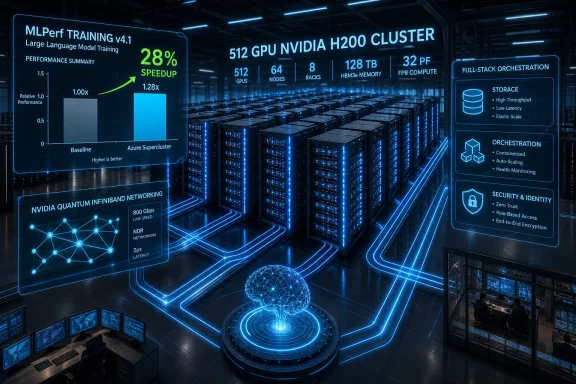
Microsoft Azure and NVIDIA claimed on June 16, 2026, that Azure had set a new large-language-model training record in the latest MLPerf Training results, using full-stack cloud infrastructure rather than a boutique lab cluster. The announcement is not just another trophy in the AI benchmark cabinet. It is Microsoft’s argument that the next phase of cloud competition will be won by companies that can make thousands of accelerators behave like one machine. For WindowsForum readers, the real story is not the bragging rights; it is what this says about the future cost, availability, and governance of enterprise AI.
The headline version is simple: Azure trained a leading LLM benchmark faster, at larger reported scale, with NVIDIA hardware and a Microsoft-managed cloud stack. But benchmark announcements are rarely only about benchmarks. They are public demonstrations of engineering discipline, supplier leverage, and product positioning.
For Microsoft, the message is that Azure is not merely renting GPUs by the hour. It wants customers to see Azure as a vertically tuned AI factory: silicon, racks, networking, storage, software libraries, orchestration, monitoring, and managed services all optimized as a single system. That matters because frontier-model training is no longer a matter of “add more GPUs” and wait for the bill.
At extreme scale, the bottleneck moves around. One month it is GPU availability, the next it is network fabric, the next it is checkpointing, power delivery, or the software layer that keeps a multi-thousand-GPU job from collapsing when one component hiccups. A record training run is therefore a proxy for something more commercially useful: whether the platform can keep enormous distributed jobs fed, synchronized, and recoverable.
Microsoft’s partnership with NVIDIA is central to that story. NVIDIA supplies the accelerators, interconnect technologies, libraries, and performance culture that dominate modern AI infrastructure. Microsoft supplies hyperscale deployment, customer channels, identity and compliance plumbing, and the enterprise wrapper that turns raw compute into a procurement line item.
The harder question is whether a provider can coordinate that capacity. Training a modern language model is a distributed systems problem wearing a machine-learning costume. GPUs perform the matrix math, but everything around them determines whether the job reaches target quality quickly or wastes expensive cycles waiting on data, communication, or recovery.
That is why Microsoft’s “full stack” phrasing is not just marketing filler. In AI training, full-stack design means the storage tier must serve data fast enough, the network must keep synchronization overhead low, the cluster scheduler must place workloads intelligently, and the training framework must exploit hardware features without forcing every customer to become a systems research lab.
This is where cloud providers are trying to differentiate. Amazon, Google, Microsoft, Oracle, CoreWeave, and others can all point to accelerator supply. The larger strategic question is who can turn that supply into predictable throughput for customers whose training jobs cost real money and whose executive sponsors expect results on a calendar, not just a dashboard.
Azure’s record should be read in that context. It is Microsoft telling enterprise buyers that the company can do more than participate in the GPU economy. It can industrialize it.
That dominance is not just about chips. NVIDIA’s moat includes CUDA, optimized communication libraries, reference architectures, software tooling, and a developer ecosystem that makes its hardware the default target for AI frameworks. A rival accelerator can look compelling on paper and still struggle if the software path is rough, the debugging tools are immature, or the model code needs invasive changes.
Microsoft’s strategy is pragmatic. It can build custom silicon where it makes sense, especially for internal workloads and inference economics, while continuing to lean heavily on NVIDIA for the most demanding training clusters. The company does not need ideological purity; it needs enough performance, capacity, and supply diversity to serve OpenAI, Microsoft 365 Copilot, Azure AI Foundry customers, and enterprises building private models.
That balance is increasingly important. Hyperscalers do not want to be wholly dependent on one supplier, but they also cannot afford to be late to the AI performance race. The result is a mixed infrastructure future: NVIDIA at the high end, custom accelerators in carefully chosen lanes, and software layers designed to hide as much of that heterogeneity as possible from customers.
A benchmark run has a defined model, dataset, convergence target, software stack, and measurement methodology. A production training workload may involve messy proprietary data, custom tokenization, privacy constraints, uneven storage paths, experimental model architecture, and organizational habits that make ideal utilization difficult. The benchmark tells you what the platform can do under controlled conditions. It does not guarantee what your team will do with it on a Tuesday afternoon.
That does not make the result irrelevant. In fact, the opposite is true. At the scale Microsoft and NVIDIA are describing, small efficiency improvements compound into enormous savings. If a platform can reduce training time from weeks to days, or from days to hours, it changes the rhythm of model development.
The practical benefit is iteration speed. Faster training means teams can test more hypotheses, recover more quickly from failed runs, tune models more aggressively, and bring specialized models into production with less calendar risk. For companies trying to build domain-specific AI systems, that matters more than the abstract glamour of a world record.
Still, training performance matters to them. A healthcare company tuning a model for clinical documentation, a bank building a risk-analysis assistant, or a manufacturer optimizing a maintenance model may not need a frontier-scale run. But they do benefit from the same infrastructure improvements that make large benchmark wins possible.
That is the trickle-down effect of hyperscale AI engineering. The networking and scheduling work required for massive training jobs can improve smaller distributed workloads. Better checkpointing and recovery reduce wasted compute. More efficient kernels and precision formats can lower cost per experiment. Managed services can make advanced training techniques usable by teams that do not have a dedicated supercomputing staff.
Microsoft’s best commercial argument is not “you too can train at frontier scale.” It is “the infrastructure built for frontier scale can make your more modest AI work faster, cheaper, and less fragile.” That is a much more persuasive message for enterprise IT.
Copilot is not a single feature so much as a dependency chain. Its responsiveness, availability, pricing, and capability all depend on the economics of training and inference. If Microsoft can train and optimize models faster, it can refresh features more often, target specialized scenarios, and potentially reduce the cost pressure that otherwise shows up as licensing complexity or usage limits.
Azure AI Foundry is the enterprise-facing side of that same strategy. Microsoft wants organizations to build, customize, evaluate, and deploy AI systems inside its cloud orbit. The training record gives Microsoft another proof point for why customers should trust Azure as the platform beneath those workflows.
This matters for sysadmins because AI is becoming part of the Microsoft estate rather than a separate experiment. Identity, data governance, endpoint policy, logging, retention, compliance, and security review are all being pulled into AI deployment. The infrastructure story is no longer “someone else’s datacenter.” It is part of the operating environment administrators must understand.
But the cost story is complicated. A faster platform can reduce unit costs while still encouraging organizations to consume more compute overall. This is the classic efficiency paradox: when a capability becomes cheaper and easier, demand often expands. Enterprises may run more experiments, train larger models, keep more variants, and deploy AI into more business processes.
That is not inherently bad. More experimentation can produce better products and more useful internal tools. But CIOs and finance teams should not assume that infrastructure efficiency automatically means lower total AI spending. It may mean more AI work for the same budget, or a larger budget justified by faster output.
The real procurement question is whether Azure can make AI spending more predictable. Enterprises can tolerate expensive infrastructure if it produces measurable value and if cost models are understandable. What they cannot tolerate indefinitely is a cloud bill that behaves like a slot machine.
At scale, failure is normal. Components break, networks misbehave, jobs need to restart, and software bugs appear only when enough machines are involved. The art is not eliminating failure; it is designing systems that contain it, recover from it, and make the failure modes observable.
Microsoft’s full-stack claim implicitly includes reliability. If Azure is going to be a serious home for large AI workloads, it has to provide not only fast clusters but also operational maturity: telemetry, support, quota planning, workload placement, capacity commitments, and incident handling. Those are the things customers discover after the benchmark glow fades.
This is where Microsoft’s enterprise history helps. The company knows how to sell managed complexity to organizations that do not want to assemble every layer themselves. The open question is whether the AI infrastructure layer can reach the same level of predictability that customers expect from more mature cloud services.
Azure’s role as an enterprise cloud gives Microsoft both an advantage and a burden. The advantage is that many customers already use Microsoft identity, compliance, security, and data-governance tools. The burden is that enterprise customers will expect AI infrastructure to fit those controls rather than live outside them.
That expectation will only intensify. A company training a model on sensitive financial records, health data, source code, customer conversations, or regulated operational data needs more than GPU speed. It needs isolation guarantees, logging, access controls, encryption, residency options, and a defensible story for auditors.
This is where the benchmark story intersects with compliance. Performance gets the attention. Governance closes the deal.
Those two stories are increasingly in tension. More efficient training can reduce the energy required for a given workload, but overall demand for AI compute may still rise faster than efficiency improves. The industry is betting that better chips, better datacenter design, cleaner power procurement, and software optimization can keep the curve manageable.
Customers should ask for more transparency. Training time is useful, but energy consumption, utilization, carbon accounting, and water impact are becoming part of responsible AI procurement. A benchmark that says “fastest” is only one axis of performance.
Microsoft has an opportunity here. If it wants to frame Azure as the enterprise-grade AI platform, it should treat environmental reporting as part of the product maturity story, not as an afterthought handled by a separate sustainability slide.
That translation is hard. A model-training team wants speed. A procurement team wants discounts and commitments. A security team wants control. A legal team wants compliance. A business unit wants a feature shipped yesterday. Azure’s pitch is that Microsoft can unify enough of those concerns under one platform to make the decision easier.
Competitors will not stand still. Google will continue to push TPU economics and integrated AI research. AWS will lean on Trainium, Inferentia, and its enormous cloud footprint. Oracle and newer AI cloud specialists will compete on capacity, performance, and willingness to host hungry AI labs. NVIDIA itself will keep expanding its role as both supplier and platform company.
That is why Microsoft’s Azure record matters beyond one benchmark table. It is a signal in the larger contest to become the default operating layer for enterprise AI.
A public record can show what is technically possible. An enterprise service has to show what is operationally available. The difference between those two is where many AI projects either become durable platforms or expensive pilots.
The most useful takeaway is that AI performance is now a systems property. The GPU matters enormously, but so do the network, storage, orchestration layer, training framework, resiliency model, and managed-service wrapper. Buyers who evaluate only the accelerator generation are missing much of the cost and reliability picture.
Microsoft and NVIDIA have every incentive to frame this as a milestone in practical enterprise AI, and they are not wrong. But customers should still demand workload-specific proof. A vendor record is a starting point for a technical conversation, not the end of one.
 Azure’s Benchmark Win Is Really a Datacenter Argument
The headline version is simple: Azure trained a leading LLM benchmark faster, at larger reported scale, with NVIDIA hardware and a Microsoft-managed cloud stack. But benchmark announcements are rarely only about benchmarks. They are public demonstrations of engineering discipline, supplier leverage, and product positioning.For Microsoft, the message is that Azure is not merely renting GPUs by the hour. It wants customers to see Azure as a vertically tuned AI factory: silicon, racks, networking, storage, software libraries, orchestration, monitoring, and managed services all optimized as a single system. That matters because frontier-model training is no longer a matter of “add more GPUs” and wait for the bill.
At extreme scale, the bottleneck moves around. One month it is GPU availability, the next it is network fabric, the next it is checkpointing, power delivery, or the software layer that keeps a multi-thousand-GPU job from collapsing when one component hiccups. A record training run is therefore a proxy for something more commercially useful: whether the platform can keep enormous distributed jobs fed, synchronized, and recoverable.
Microsoft’s partnership with NVIDIA is central to that story. NVIDIA supplies the accelerators, interconnect technologies, libraries, and performance culture that dominate modern AI infrastructure. Microsoft supplies hyperscale deployment, customer channels, identity and compliance plumbing, and the enterprise wrapper that turns raw compute into a procurement line item.
The Cloud Race Has Moved From Capacity to Coordination
The first phase of the generative AI infrastructure boom was about scarcity. Enterprises wanted H100s, then Blackwell systems, then whatever came next, and the cloud providers competed to prove they had enough accelerator capacity to satisfy demand. That phase is not over, but it is no longer sufficient.The harder question is whether a provider can coordinate that capacity. Training a modern language model is a distributed systems problem wearing a machine-learning costume. GPUs perform the matrix math, but everything around them determines whether the job reaches target quality quickly or wastes expensive cycles waiting on data, communication, or recovery.
That is why Microsoft’s “full stack” phrasing is not just marketing filler. In AI training, full-stack design means the storage tier must serve data fast enough, the network must keep synchronization overhead low, the cluster scheduler must place workloads intelligently, and the training framework must exploit hardware features without forcing every customer to become a systems research lab.
This is where cloud providers are trying to differentiate. Amazon, Google, Microsoft, Oracle, CoreWeave, and others can all point to accelerator supply. The larger strategic question is who can turn that supply into predictable throughput for customers whose training jobs cost real money and whose executive sponsors expect results on a calendar, not just a dashboard.
Azure’s record should be read in that context. It is Microsoft telling enterprise buyers that the company can do more than participate in the GPU economy. It can industrialize it.
NVIDIA Remains the Gravity Well in AI Infrastructure
The announcement also reinforces a less comfortable truth for the rest of the industry: NVIDIA remains the gravitational center of AI infrastructure. Microsoft has its own silicon ambitions, including Maia accelerators, and every hyperscaler wants more control over its supply chain. Yet when it comes to public performance records in large-scale training, NVIDIA remains the platform everyone has to measure against.That dominance is not just about chips. NVIDIA’s moat includes CUDA, optimized communication libraries, reference architectures, software tooling, and a developer ecosystem that makes its hardware the default target for AI frameworks. A rival accelerator can look compelling on paper and still struggle if the software path is rough, the debugging tools are immature, or the model code needs invasive changes.
Microsoft’s strategy is pragmatic. It can build custom silicon where it makes sense, especially for internal workloads and inference economics, while continuing to lean heavily on NVIDIA for the most demanding training clusters. The company does not need ideological purity; it needs enough performance, capacity, and supply diversity to serve OpenAI, Microsoft 365 Copilot, Azure AI Foundry customers, and enterprises building private models.
That balance is increasingly important. Hyperscalers do not want to be wholly dependent on one supplier, but they also cannot afford to be late to the AI performance race. The result is a mixed infrastructure future: NVIDIA at the high end, custom accelerators in carefully chosen lanes, and software layers designed to hide as much of that heterogeneity as possible from customers.
Benchmarks Are Useful, but They Are Not Your Workload
There is always a temptation to treat a record benchmark as a universal promise. IT buyers should resist that instinct. MLPerf is valuable precisely because it gives the industry a more disciplined comparison point than vendor slideware, but no public benchmark captures the full messiness of an enterprise AI project.A benchmark run has a defined model, dataset, convergence target, software stack, and measurement methodology. A production training workload may involve messy proprietary data, custom tokenization, privacy constraints, uneven storage paths, experimental model architecture, and organizational habits that make ideal utilization difficult. The benchmark tells you what the platform can do under controlled conditions. It does not guarantee what your team will do with it on a Tuesday afternoon.
That does not make the result irrelevant. In fact, the opposite is true. At the scale Microsoft and NVIDIA are describing, small efficiency improvements compound into enormous savings. If a platform can reduce training time from weeks to days, or from days to hours, it changes the rhythm of model development.
The practical benefit is iteration speed. Faster training means teams can test more hypotheses, recover more quickly from failed runs, tune models more aggressively, and bring specialized models into production with less calendar risk. For companies trying to build domain-specific AI systems, that matters more than the abstract glamour of a world record.
Enterprise AI Wants Faster Iteration, Not Just Bigger Models
The public conversation around AI infrastructure often assumes that everyone is trying to train the next frontier model. Most enterprises are not. They are trying to adapt, fine-tune, distill, evaluate, and deploy models that solve specific business problems without blowing through budget, compliance, or operational tolerance.Still, training performance matters to them. A healthcare company tuning a model for clinical documentation, a bank building a risk-analysis assistant, or a manufacturer optimizing a maintenance model may not need a frontier-scale run. But they do benefit from the same infrastructure improvements that make large benchmark wins possible.
That is the trickle-down effect of hyperscale AI engineering. The networking and scheduling work required for massive training jobs can improve smaller distributed workloads. Better checkpointing and recovery reduce wasted compute. More efficient kernels and precision formats can lower cost per experiment. Managed services can make advanced training techniques usable by teams that do not have a dedicated supercomputing staff.
Microsoft’s best commercial argument is not “you too can train at frontier scale.” It is “the infrastructure built for frontier scale can make your more modest AI work faster, cheaper, and less fragile.” That is a much more persuasive message for enterprise IT.
The Windows Angle Is Copilot, Foundry, and the Return of Infrastructure as Strategy
For Windows users and administrators, Azure AI records can feel distant. Most people are not standing up multi-thousand-GPU clusters from a desktop. But Microsoft’s AI infrastructure choices increasingly shape the software experiences that arrive in Windows, Microsoft 365, GitHub, Dynamics, Security Copilot, and Azure management tools.Copilot is not a single feature so much as a dependency chain. Its responsiveness, availability, pricing, and capability all depend on the economics of training and inference. If Microsoft can train and optimize models faster, it can refresh features more often, target specialized scenarios, and potentially reduce the cost pressure that otherwise shows up as licensing complexity or usage limits.
Azure AI Foundry is the enterprise-facing side of that same strategy. Microsoft wants organizations to build, customize, evaluate, and deploy AI systems inside its cloud orbit. The training record gives Microsoft another proof point for why customers should trust Azure as the platform beneath those workflows.
This matters for sysadmins because AI is becoming part of the Microsoft estate rather than a separate experiment. Identity, data governance, endpoint policy, logging, retention, compliance, and security review are all being pulled into AI deployment. The infrastructure story is no longer “someone else’s datacenter.” It is part of the operating environment administrators must understand.
Cost Efficiency Is the Real Prize, and It Is Still Unproven for Many Customers
The user-facing promise is lower cost. If Azure can train models faster at scale, Microsoft can argue that customers will spend less to reach a usable result. In theory, higher utilization and better end-to-end throughput should reduce wasted accelerator time, which is the most expensive waste in the modern cloud.But the cost story is complicated. A faster platform can reduce unit costs while still encouraging organizations to consume more compute overall. This is the classic efficiency paradox: when a capability becomes cheaper and easier, demand often expands. Enterprises may run more experiments, train larger models, keep more variants, and deploy AI into more business processes.
That is not inherently bad. More experimentation can produce better products and more useful internal tools. But CIOs and finance teams should not assume that infrastructure efficiency automatically means lower total AI spending. It may mean more AI work for the same budget, or a larger budget justified by faster output.
The real procurement question is whether Azure can make AI spending more predictable. Enterprises can tolerate expensive infrastructure if it produces measurable value and if cost models are understandable. What they cannot tolerate indefinitely is a cloud bill that behaves like a slot machine.
Reliability Is the Hidden Benchmark
Training records emphasize time-to-train, but enterprise buyers also care about reliability. A large training run that fails late is not just inconvenient. It is financially painful, operationally disruptive, and demoralizing for teams working under product deadlines.At scale, failure is normal. Components break, networks misbehave, jobs need to restart, and software bugs appear only when enough machines are involved. The art is not eliminating failure; it is designing systems that contain it, recover from it, and make the failure modes observable.
Microsoft’s full-stack claim implicitly includes reliability. If Azure is going to be a serious home for large AI workloads, it has to provide not only fast clusters but also operational maturity: telemetry, support, quota planning, workload placement, capacity commitments, and incident handling. Those are the things customers discover after the benchmark glow fades.
This is where Microsoft’s enterprise history helps. The company knows how to sell managed complexity to organizations that do not want to assemble every layer themselves. The open question is whether the AI infrastructure layer can reach the same level of predictability that customers expect from more mature cloud services.
Regulatory Gravity Will Follow the Compute
The faster and cheaper it becomes to train advanced models, the more attention regulators will pay to how those models are built. Data sovereignty, privacy, copyright, safety testing, auditability, and model risk management are no longer abstract policy topics. They are deployment blockers.Azure’s role as an enterprise cloud gives Microsoft both an advantage and a burden. The advantage is that many customers already use Microsoft identity, compliance, security, and data-governance tools. The burden is that enterprise customers will expect AI infrastructure to fit those controls rather than live outside them.
That expectation will only intensify. A company training a model on sensitive financial records, health data, source code, customer conversations, or regulated operational data needs more than GPU speed. It needs isolation guarantees, logging, access controls, encryption, residency options, and a defensible story for auditors.
This is where the benchmark story intersects with compliance. Performance gets the attention. Governance closes the deal.
The Environmental Ledger Is Becoming Harder to Ignore
Large-scale AI training consumes power, water, land, chips, and political patience. A record-breaking training run is impressive engineering, but it also sits inside a broader debate about datacenter expansion and energy demand. Microsoft, like its peers, has made public sustainability commitments while also racing to deploy ever more AI capacity.Those two stories are increasingly in tension. More efficient training can reduce the energy required for a given workload, but overall demand for AI compute may still rise faster than efficiency improves. The industry is betting that better chips, better datacenter design, cleaner power procurement, and software optimization can keep the curve manageable.
Customers should ask for more transparency. Training time is useful, but energy consumption, utilization, carbon accounting, and water impact are becoming part of responsible AI procurement. A benchmark that says “fastest” is only one axis of performance.
Microsoft has an opportunity here. If it wants to frame Azure as the enterprise-grade AI platform, it should treat environmental reporting as part of the product maturity story, not as an afterthought handled by a separate sustainability slide.
The Benchmark War Will Shape the Next Cloud Contract
The cloud AI market is entering a phase where benchmark wins will be used as negotiating weapons. Vendors will point to MLPerf results, inference throughput, tokens per second, cost per token, cluster size, accelerator generation, and model availability. Customers will have to translate those claims into workloads, risk, and contracts.That translation is hard. A model-training team wants speed. A procurement team wants discounts and commitments. A security team wants control. A legal team wants compliance. A business unit wants a feature shipped yesterday. Azure’s pitch is that Microsoft can unify enough of those concerns under one platform to make the decision easier.
Competitors will not stand still. Google will continue to push TPU economics and integrated AI research. AWS will lean on Trainium, Inferentia, and its enormous cloud footprint. Oracle and newer AI cloud specialists will compete on capacity, performance, and willingness to host hungry AI labs. NVIDIA itself will keep expanding its role as both supplier and platform company.
That is why Microsoft’s Azure record matters beyond one benchmark table. It is a signal in the larger contest to become the default operating layer for enterprise AI.
The Fine Print Behind Azure’s Record Is Where Buyers Should Look
Microsoft’s announcement deserves attention, but the smartest readers will focus on the details behind the headline. Which benchmark was used, what model size was involved, how many accelerators participated, what precision formats were used, what software stack ran the job, and how repeatable the result is for ordinary customers all matter.A public record can show what is technically possible. An enterprise service has to show what is operationally available. The difference between those two is where many AI projects either become durable platforms or expensive pilots.
The most useful takeaway is that AI performance is now a systems property. The GPU matters enormously, but so do the network, storage, orchestration layer, training framework, resiliency model, and managed-service wrapper. Buyers who evaluate only the accelerator generation are missing much of the cost and reliability picture.
Microsoft and NVIDIA have every incentive to frame this as a milestone in practical enterprise AI, and they are not wrong. But customers should still demand workload-specific proof. A vendor record is a starting point for a technical conversation, not the end of one.
What Azure’s LLM Training Record Actually Changes
This milestone is most important as evidence that hyperscale AI is becoming more industrialized. The following points are the concrete ones IT leaders should carry into planning conversations.- Azure’s record strengthens Microsoft’s claim that it can operate AI training infrastructure as an integrated cloud platform rather than a loose collection of expensive GPUs.
- NVIDIA remains the dominant performance partner for large-scale AI training, even as Microsoft and other hyperscalers continue investing in custom silicon.
- Faster training can reduce model-development cycle times, but it does not automatically guarantee lower total AI spending for enterprises.
- The most important customer benefits will likely come from reliability, scheduling, managed services, and repeatability rather than from the headline benchmark number alone.
- Compliance, data governance, and environmental reporting will become more important as advanced training becomes accessible to more organizations.
- Enterprise buyers should treat benchmark records as useful evidence, but they should validate claims against their own data, model architecture, security requirements, and cost constraints.
References
- Primary source: blockchain.news
Published: 2026-06-17T00:00:09.608230
Azure GPUs shatter LLM training record | AI News Detail
According to @satyanadella, Azure hit fastest training time at largest scale for a leading LLM benchmark, citing full stack co-design with Nvidia.blockchain.news - Official source: blogs.microsoft.com
Microsoft at NVIDIA GTC: New solutions for Microsoft Foundry, Azure AI infrastructure and Physical AI - The Official Microsoft Blog
Microsoft combines accelerated computing with cloud scale engineering to bring advanced AI capabilities to our customers. For years, we’ve worked with NVIDIA to integrate hardware, software and infrastructure to power many of today’s most important AI breakthroughs. What’s new at NVIDIA GTC...blogs.microsoft.com - Official source: azure.microsoft.com
- Official source: techcommunity.microsoft.com
Azure ND GB200 v6 Delivers Record Performance for Inference Workloads
Achieving peak AI performance requires both cutting-edge hardware and a finely optimized infrastructure. Azure’s ND GB200 v6 Virtual Machines, accelerated by... techcommunity.microsoft.com
- Related coverage: blogs.nvidia.com
NVIDIA Wins Every MLPerf Training v5.1 Benchmark | NVIDIA Blog
In MLPerf Training v5.1, NVIDIA swept all seven tests, delivering the fastest time to train across LLMs, image generation, recommender systems, computer vision and graph neural networks.blogs.nvidia.com - Related coverage: developer.nvidia.com
NVIDIA Blackwell Architecture Sweeps MLPerf Training v5.1 Benchmarks | NVIDIA Technical Blog
The NVIDIA Blackwell architecture powered the fastest time to train across every MLPerf Training v5.1 benchmark, marking a clean sweep in the latest round of…developer.nvidia.com
- Related coverage: tomshardware.com