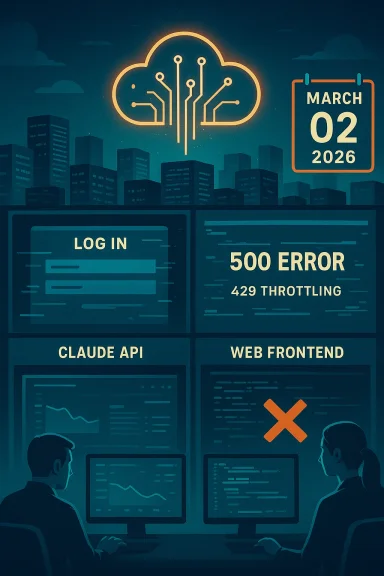
Anthropic’s Claude experienced a high-profile service disruption on March 2, 2026, leaving users worldwide unable to access the web app and causing intermittent failures across Claude.ai, the developer console, and Claude Code before the company rolled out fixes and began monitoring recovery.
Anthropic’s Claude has emerged over the past year as one of the major alternatives to other large language models, positioning itself as an enterprise‑friendly assistant with a strong emphasis on safety guardrails. The product suite — commonly referenced by its public endpoints and client products as Claude, Claude.ai, Claude API (api.anthropic.com), and Claude Code — sees daily traffic from individual users, startups, and large enterprises. That scale of adoption has driven frequent scrutiny of reliability and availability as real‑world workloads migrate to LLM-backed workflows.
In the weeks before March 2, Anthropic’s service health pages and independent outage trackers recorded several shorter incidents affecting specific models (Opus and Sonnet series), authentication flows, and UI components. Those prior events conditioned many customers to watch the status feed closely; when elevated error rates reappeared on March 2, the outage quickly became the top topic across user forums and social platforms.
Anthropic’s messaging emphasized that fixes were being implemented and monitored; the final status entries for the day reflected resolution after a series of mitigations rather than a single root‑cause rollback. That pattern — multiple short fixes with progressive monitoring — is typical for live incidents where remediation tasks carry risk and must be validated incrementally.
For developers and businesses, consequences were more tangible:
At the same time, several users and observers criticized the speed of contextual detail: initial status posts were brief and technical, and some customers wanted clearer root‑cause guidance and an explicit post‑mortem commitment. For enterprise clients with contractual SLAs, that level of detail matters for incident reporting, RCA (root cause analysis), and remediation commitments.
It is important to separate two distinct threads:
For IT leaders and power users, the practical lesson is straightforward: treat generative AI services like other mission‑critical cloud dependencies. Design for failure, prepare fallbacks, and demand transparency from providers. The next headline about an LLM outage won’t be the last — but with better preparedness, its business impact can be significantly reduced.
Source: Newsweek https://www.newsweek.com/claude-down-ai-anthropic-outage-11603990/
 Background
Anthropic’s Claude has emerged over the past year as one of the major alternatives to other large language models, positioning itself as an enterprise‑friendly assistant with a strong emphasis on safety guardrails. The product suite — commonly referenced by its public endpoints and client products as Claude, Claude.ai, Claude API (api.anthropic.com), and Claude Code — sees daily traffic from individual users, startups, and large enterprises. That scale of adoption has driven frequent scrutiny of reliability and availability as real‑world workloads migrate to LLM-backed workflows.In the weeks before March 2, Anthropic’s service health pages and independent outage trackers recorded several shorter incidents affecting specific models (Opus and Sonnet series), authentication flows, and UI components. Those prior events conditioned many customers to watch the status feed closely; when elevated error rates reappeared on March 2, the outage quickly became the top topic across user forums and social platforms.
What happened: a concise timeline
Below is the timeline condensed from Anthropic’s incident updates and user reports on March 2, 2026 (all times UTC):- 11:49 — Anthropic’s status page lists an Investigating incident: “Elevated errors on claude.ai”. Users worldwide begin reporting login failures, 500 errors, and “This isn’t working right now” responses from the web interface.
- 12:06–12:21 — Status updates indicate ongoing investigation. Anthropic posts that the Claude API appears to be operational, while the web front‑end and authentication/login/logout paths are implicated.
- 13:15–14:05 — Engineers identify the primary failure modes and deploy preliminary fixes. Additional errors in some API methods are discovered during remediation.
- 15:49–17:24 — Anthropic reports that fixes have been implemented and enters Monitoring. Some users still report degraded performance while sessions and UI components gradually restore.
- 17:55 — Incidents are marked Resolved for the main outage entries; monitoring continues.
How Anthropic described the issue
Anthropic’s public incident updates framed the disruption as elevated error rates concentrated on the web interface and some related services. The company’s updates repeatedly distinguished between the web‑front end (claude.ai and platform console) and the Claude API, noting that the API was initially operational while user‑facing login/logout and session endpoints were failing or rate‑limited.Anthropic’s messaging emphasized that fixes were being implemented and monitored; the final status entries for the day reflected resolution after a series of mitigations rather than a single root‑cause rollback. That pattern — multiple short fixes with progressive monitoring — is typical for live incidents where remediation tasks carry risk and must be validated incrementally.
How widespread was the impact?
The outage registered across multiple signals:- User reports surged on social platforms and dedicated outage trackers during the incident window, with forums and subreddits filling with “Is Claude down?” posts and first‑hand error screenshots.
- Users across geographies reported similar experiences: inability to sign in, broken UI components, or error pages. Some reported being able to access parts of Claude (for example, via CLI or alternate API hosts), while others saw a total interruption.
- Enterprise customers relying on Claude for time‑sensitive workflows experienced delays and interruptions that affected code generation, document drafting, and automation tasks.
Technical analysis: what likely went wrong
Public incident messages, combined with the failure symptoms observed by users, point to several overlapping failure modes. The following breaks down the most plausible technical causes, how they interact, and why they produced the observed symptoms.1. Authentication and session control-plane failures
The earliest and most consistently reported failures were in login/logout and usage/session related pages. Those failures typically point to a problem in the control plane — the components that validate tokens, fetch user entitlements, and provide session state to the UI. When control‑plane systems degrade you often see:- Inability to log in or receive magic‑link emails
- UIs that render but fail to populate user‑specific data (usage bars, session history)
- 500 errors on calls that aggregate account metadata
2. Rate limiting and cascading throttles
Users reported 429 responses when hitting usage endpoints and intermittently when refreshing the UI. Rate‑limiters and API gateways can kick in under burst traffic or when upstream services are slow. When authentication services start timing out, client retries can multiply, producing upstream cascading throttles that amplify the outage.3. Partial API inconsistency and degraded performance
Anthropic’s early status notes said the Claude API was working as intended while UI endpoints struggled; later updates acknowledged some API methods also failed. This pattern suggests a phased failure where initial control‑plane problems caused retries and degraded load that propagated into other microservices. Complex microservice topologies and shared infrastructure (datastores, caches, message buses) can turn a localized degradation into a multi‑component incident.4. Capacity surge — demand versus provisioning
Several outlet reports and company comments pointed to an unprecedented surge in demand over recent days. When traffic spikes suddenly (for example, rapid onboarding after publicity or a competitor disruption), services provisioned for steady growth can be overwhelmed. The result is intermittent authentication failures, rate limits, and UI timeouts even while raw inference capacity remains nominal.5. Cloud and third‑party dependencies
Modern LLM vendors run hybrid stacks across public clouds and managed services (for hosting, orchestration, and identity). If a single underlying provider or a third‑party dependency (DNS, auth provider, CDN) fails or experiences throttling, that can surface as an LLM provider incident. While Anthropic’s status messages did not attribute the outage to a single cloud vendor, the architecture realities make such dependencies a common failure vector.User experience: real consequences for workflows
For individual users, the outage meant lost momentum: interrupted prompts, mid‑completion drafts not saved locally, and blocked authentication flows. For knowledge workers who schedule tasks around LLM outputs, the incident translated to missed deadlines and manual fallbacks.For developers and businesses, consequences were more tangible:
- Automation pipelines that embed Claude for code generation, summarization, or triage were interrupted, potentially causing blocked CI/CD runs or degraded customer support workflows.
- Internal tools that rely on session continuity experienced state loss, requiring retriggering or reauthentication.
- Enterprises with compliance and audit needs faced anxiety about whether logs and usage metrics were recorded properly during degraded states.
Anthropic’s public posture and communication
Anthropic’s communication during the incident aligned with best practices for customer‑facing incident reporting: immediate investigation status, repeated updates, a distinction between affected components, and final resolution with monitoring. That cadence gave customers visibility while engineers validated fixes.At the same time, several users and observers criticized the speed of contextual detail: initial status posts were brief and technical, and some customers wanted clearer root‑cause guidance and an explicit post‑mortem commitment. For enterprise clients with contractual SLAs, that level of detail matters for incident reporting, RCA (root cause analysis), and remediation commitments.
Why this matters beyond a single outage
The incident highlights systemic issues in the AI supply chain and platform engineering:- Concentration risk. Many teams have optimized their productivity around a small set of LLM providers. When one of those providers falters, entire workflows can stall. This is the same concentration risk that has driven debates about cloud monoculture.
- Control-plane fragility. Separating inference from authentication and session management reduces blast radius in theory, but it also creates operational coupling. A control-plane fault can block access to otherwise healthy compute resources.
- Scale unpredictability. LLM usage is bursty by nature, and viral adoption or competitor churn can produce demand surges that exceed typical capacity planning assumptions.
- Enterprise trust and procurement. Repeated incidents — even short ones — erode enterprise confidence. Organizations considering multi‑year contracts will weigh availability history, incident transparency, and remediation commitments heavily.
The political and business context (and what to be careful about)
The outage arrived in a fraught political moment for Anthropic. Recent headlines have focused on a separate government dispute that led to federal restrictions on Anthropic’s participation in certain government procurement pathways. That dispute — centered on the company’s refusal to relax specific safety guardrails — has been widely reported and has real implications for Anthropic’s government business.It is important to separate two distinct threads:
- Operational outages and engineering root causes (capacity, rate limiting, control‑plane faults).
- Political and regulatory actions that affect contracts and procurement rights.
Practical guidance for IT teams and power users
This outage is a practical reminder that resilience strategies matter. Below are concrete mitigations for teams that rely heavily on LLMs.- Maintain multi‑provider fallbacks
- Use a second LLM provider as a hot standby for critical workflows.
- Architect feature flags or runtime routing so that requests can be redirected quickly.
- Separate speculative and critical workloads
- Reserve on‑prem or private inference for high‑assurance or latency‑sensitive paths; use public LLMs for exploratory tasks.
- Implement robust retry and exponential backoff
- Build client‑side heuristics for safe retries; avoid tight retry loops that magnify outages.
- Decouple authentication from inference where possible
- Consider issuing long‑lived service tokens for machine‑to‑machine tasks while keeping user authentication distinct to reduce single points of failure.
- Cache deterministic outputs
- For repeated or deterministic prompts, cache responses to avoid repeat hits during transient degradation.
- Monitor SLA metrics and contractual remedies
- Ensure contracts specify incident response expectations, credits, and post‑incident reporting.
- Prepare incident playbooks
- Have runbooks ready for switching providers, failing to safe modes, and notifying customers when LLM dependencies are interrupted.
Broader industry lessons
The March 2 incident is one episode in a year marked by high‑visibility outages across the cloud and AI ecosystem. Collectively, these incidents point to several industry takeaways:- Multi‑cloud and multi‑model redundancy should be treated as standard best practice for production AI systems.
- Transparency and timely, concrete post‑mortems improve customer trust more than optimistic statements about “fixed” systems without follow‑up.
- Infrastructure design patterns must recognize that model inference is only part of the stack; authentication, entitlements, and UX components are equally critical.
- Regulators and enterprise procurement teams will increasingly insist on resilience metrics and proof of operational maturity when awarding large contracts.
Strengths, risks, and the tradeoffs Anthropic faces
Strengths
- Anthropic’s rapid public updates and monitoring‑first approach minimized confusion and provided a visible remediation path.
- The company’s emphasis on safety and guardrails continues to resonate with users and some enterprise buyers, offering a differentiator from competitors.
- Partial availability of API endpoints during the incident demonstrated architectural separation that limited a total service outage.
Risks
- Frequent incidents, even when short, degrade enterprise trust and can slow long‑term adoption for mission‑critical workloads.
- Political and regulatory friction — particularly when it involves procurement bans or designations — introduces business uncertainty that can affect partnerships and cloud relationships.
- Operational scale challenges (unexpected surges) remain a persistent risk for any AI provider that experiences rapid user growth or shifting demand patterns.
What to expect next
Short term, Anthropic will focus on stabilizing capacity, hardening control‑plane resiliency, and providing customers with RCAs and follow‑up remediation plans. Expect engineering changes aimed at:- Improving rate‑limiting heuristics and backpressure management
- Shoring up authentication and session state redundancy
- Providing clearer operational SLAs for enterprise customers
- Enterprises demanding multi‑vendor architectures and contractual guarantees.
- Increased investment in private or on‑premise inference to reduce exposure to third‑party outages.
- Elevated scrutiny of vendor transparency and incident reporting practices during procurement evaluations.
Conclusion
The March 2, 2026 disruption that affected Anthropic’s Claude services was a vivid demonstration that as artificial intelligence becomes integral to work and commerce, operational reliability is no longer a secondary concern — it is central to trust and adoption. Anthropic’s status updates showed competent incident management, and the company achieved recovery within hours; nevertheless, the event underlines that resilience requires ongoing engineering investment, clear communication, and diversified architectures for the customers who depend on these systems.For IT leaders and power users, the practical lesson is straightforward: treat generative AI services like other mission‑critical cloud dependencies. Design for failure, prepare fallbacks, and demand transparency from providers. The next headline about an LLM outage won’t be the last — but with better preparedness, its business impact can be significantly reduced.
Source: Newsweek https://www.newsweek.com/claude-down-ai-anthropic-outage-11603990/