

Qumulo said on June 3, 2026, in Seattle that it is expanding its Microsoft Azure collaboration with new Azure Native Qumulo data services aimed at moving large enterprise NAS workloads into Azure without waiting for constrained on-premises storage hardware. The announcement, timed to Microsoft Build 2026, is framed as a practical answer to a less glamorous but increasingly decisive enterprise problem: the storage array that cannot arrive on time. Qumulo’s pitch is that the cloud is no longer merely the destination for refactored applications; it is becoming the overflow valve for infrastructure procurement itself. The deeper story is that Microsoft and its storage partners are trying to make Azure feel less like a migration project and more like a pressure-release system for data-heavy businesses.
For years, cloud storage was sold primarily as an elasticity story. Enterprises were told that if their data grew unpredictably, hyperscale infrastructure would absorb the spike better than a procurement cycle built around three-year depreciation schedules. That argument was often true, but it collided with reality in the most stubborn corner of enterprise IT: file storage.
Large unstructured datasets are not polite. Media archives, genomic pipelines, engineering simulations, EDA workloads, AI training corpora, research images, backup-adjacent repositories, and giant home-directory environments tend to accrete around NAS systems because NAS is where applications, permissions, and human workflows already live. Moving that estate into the cloud is rarely a matter of uploading files and changing a few paths.
Qumulo’s new Azure Native Qumulo push is aimed squarely at that friction. The company argues that hardware scarcity, especially around DRAM and NVMe, is forcing enterprise customers to rethink the assumption that fresh on-premises capacity will be available when the business needs it. Whether one accepts the full drama of Qumulo’s “Silicon Squeeze” framing or not, the broader pressure is real enough: AI infrastructure demand has made advanced components more strategic, more expensive, and more contested.
That makes this announcement less about a single storage service and more about a change in posture. Qumulo and Microsoft are presenting Azure as a way to keep file-heavy businesses moving when their physical infrastructure plans stall. In that model, the cloud does not replace the data center in one heroic migration. It becomes a second capacity plane attached to the existing operational model.
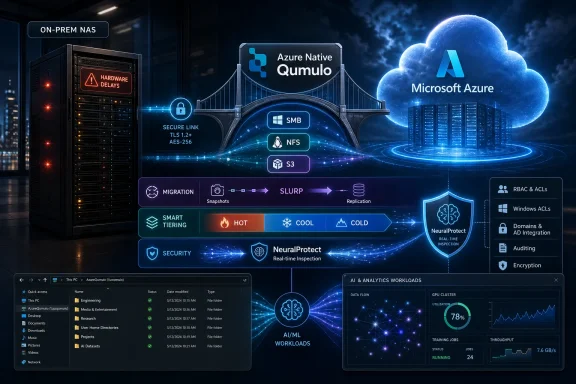
Azure Native Qumulo is a fully managed file service developed by Microsoft and Qumulo, exposed through Azure as a native partner service. It supports familiar file and object protocols, including SMB, NFS, FTP, and S3, while presenting Qumulo’s enterprise file system capabilities through Azure procurement and management surfaces. The point is not to make cloud storage conceptually pure. The point is to make it boring enough that existing workloads can use it.
That is a subtle but important distinction. A great deal of enterprise cloud architecture has historically presumed that applications should be modernized before they can take full advantage of cloud services. That is sensible for new software, but punitive for the large body of operational workloads that still depend on shared file systems.
Qumulo is betting that many customers do not need another sermon about stateless design. They need capacity, namespace continuity, permission fidelity, and performance without waiting months for a new storage platform to be delivered, racked, burned in, and integrated. In that context, ANQ’s value proposition is not ideological. It is pragmatic.
Enterprise AI initiatives often begin with a deceptively simple sentence: “We already have the data.” In practice, that data may be spread across file shares, departmental NAS appliances, research clusters, backup repositories, regional silos, and regulatory enclaves. It may be readable by humans and legacy applications but awkward for modern analytics and AI pipelines to consume.
By placing ANQ closer to Microsoft Foundry, Microsoft Fabric, and Copilot-oriented workflows, Qumulo is selling proximity as much as capacity. If the data can remain in a file-native environment while becoming accessible to Azure AI services, then the enterprise avoids a costly duplicate-data stage. That is the meaning behind the “zero-copy” language in the announcement.
Zero-copy should be read carefully. It does not mean there is no data movement anywhere in the broader system, nor does it magically solve governance, indexing, or model-readiness problems. It means Qumulo wants ANQ to function as the place where the data can stay while adjacent Azure services act on it, reducing the need to create parallel staging repositories simply to feed AI pipelines.
That preservation claim is critical. File migrations fail politically as often as they fail technically. Users forgive downtime less than expected, applications break on small permission differences, and compliance teams get nervous when the provenance and access semantics of critical data are disturbed. A migration tool that preserves metadata, permissions, and snapshot-based synchronization is not a convenience; it is table stakes for making the rest of the cloud story believable.
The promise of “no downtime” also deserves the usual enterprise caution. In real environments, cutovers are governed by application behavior, network capacity, change windows, identity integration, and the willingness of stakeholders to accept risk. But even if the ideal is softened into “less downtime” or “shorter migration windows,” that still matters. The difference between a weekend cutover and a quarter-long migration program can decide whether a cloud storage project survives budget review.
SLURP is therefore part of the argument that cloud file storage has matured beyond a greenfield service. Qumulo is not merely saying Azure has capacity. It is saying the path from aging NAS to Azure-native file storage is becoming operationally familiar enough to attempt under pressure.
In practice, tiering has always been one of cloud storage’s trickiest economic promises. The raw per-gigabyte price of a colder tier can look excellent until retrieval charges, early deletion fees, transaction costs, and operational complexity enter the equation. Administrators know the danger: a storage bill that appears optimized in architecture review can become unpredictable once real users and applications start touching data.
That is why Qumulo’s emphasis on no retrieval penalties, no early delete costs, and low API fees is not just marketing garnish. Predictability is the difference between a cloud storage tiering strategy that finance accepts and one that becomes a monthly surprise. If Microsoft’s smart tiering integration can reduce that unpredictability while Qumulo continues to present the data through familiar enterprise file services, the combination is more compelling than either half alone.
Still, this is an area where customers will need to test against their own access patterns. A media archive, a genomics repository, and a VDI profile environment do not behave alike. Smart tiering is only smart in relation to the workload it observes, and the real proof will come from bills, latency measurements, and support tickets after deployment.
The storage-layer framing is important because ransomware defense has traditionally been split across endpoints, identity systems, backup platforms, network monitoring, and user education. Those remain necessary. But ransomware ultimately wants to alter data, and file storage platforms occupy a privileged position at the moment those changes happen.
If a storage system can detect suspicious writes before encryption or corruption cascades across a share, it has a chance to interrupt the attack at a valuable choke point. That is the theory behind NeuralProtect. Qumulo’s claim is not merely that it can help restore data after the blast radius is known, but that it can intervene earlier in the sequence.
The caveat is that storage-layer protection must be judged by false positives, false negatives, performance impact, administrative control, and incident-response integration. Blocking malicious writes is useful; blocking a business-critical render farm, research pipeline, or end-of-quarter finance job because a model misread behavior is a different kind of outage. The more deeply protection is embedded into primary storage, the more customers will want transparency about how decisions are made and how exceptions are handled.
Even so, the direction is sensible. Backup remains essential, but backup alone is increasingly inadequate as a ransomware strategy. Recovery after encryption can take too long, and clean restore points are not always as clean as organizations hope. A defensive layer at the file system gives enterprises another shot at containing the problem before recovery becomes the only option.
Azure Native Qumulo gives Microsoft another answer for the “we have petabytes of unstructured file data” conversation. It lets Microsoft say that customers can bring demanding file workloads into Azure while retaining familiar protocols and enterprise NAS behavior. That matters because AI services do not sell themselves into empty rooms; they sell into environments with existing data gravity.
The Foundry and Fabric references are therefore strategic. Microsoft does not only want customers to store data in Azure. It wants that data to become usable by the higher-margin, higher-lock-in layers of the Azure platform. A file service that reduces migration friction can become the bridge between legacy storage estates and Microsoft’s AI application stack.
This is also where customers should maintain a clear-eyed view of incentives. Microsoft benefits when data lands in Azure. Qumulo benefits when customers use its managed file platform rather than a competing storage path. Those incentives do not make the technology bad; they simply mean enterprise buyers should test the architecture against portability, exit costs, security controls, billing behavior, and long-term operational fit.
Qumulo’s announcement reflects that reality. The company is not telling customers to abandon on-premises file storage tomorrow. It is arguing that Azure can become part of the same data fabric, allowing capacity bursts, migration, AI access, and security services without rewriting every application or retraining every user. That is a more credible enterprise story than a forced march into cloud purity.
The supply-chain angle strengthens the case. When hardware lead times stretch, hybrid cloud stops being a strategy workshop term and becomes a procurement workaround. If a business unit needs capacity now, and the storage array arrives next quarter, the cloud option becomes not merely attractive but operationally necessary.
But hybrid also introduces complexity. Identity must be consistent. Network performance must be understood. Data governance must span locations. Security controls must map across on-premises and cloud environments. Costs must be monitored with more discipline than many organizations applied to capital purchases. A hybrid file system can reduce some migration pain while creating new management obligations.
That is why the “single hybrid solution” phrasing in Qumulo’s announcement should be read as an aspiration rather than a magic wand. Hybrid cloud is only simple in vendor diagrams. In production, it rewards teams that know their workloads, their data flows, and their tolerance for latency.
For a small Windows file share, ANQ may be overkill. For workloads already redesigned around object storage, it may be unnecessary. For organizations with strict data residency limits, specialized latency requirements, or sunk investments in existing storage platforms, the decision will be more nuanced. For some, adding another managed service and another vendor relationship inside Azure may simplify operations. For others, it may complicate them.
The strongest case appears in sectors where data growth and infrastructure scarcity collide: media and entertainment, life sciences, high-performance computing, chip design, manufacturing, energy, public sector research, and large-scale VDI. These environments often have giant file datasets that are expensive to move, difficult to reorganize, and increasingly valuable for AI analysis.
Qumulo’s bet is that these customers do not want to choose between waiting for hardware and rewriting their data estate. If ANQ can offer credible file semantics, scalable performance, automated tiering, migration tooling, and storage-layer defense, it becomes a practical bridge rather than a speculative modernization project.
Performance is the next test. Qumulo and Microsoft describe ANQ as scalable to very large capacity and throughput, but no headline number substitutes for workload testing. File workloads can be sensitive to metadata operations, directory depth, small-file behavior, latency, and chatty application patterns. A benchmark that flatters sequential throughput may say little about a real engineering or VDI environment.
Cost analysis must be similarly grounded. The most meaningful comparison is not cloud list price versus array purchase price. It is cloud operating cost, migration cost, network cost, management cost, risk reduction, time-to-capacity, and the value of putting data closer to Azure services. A storage array that arrives too late can be cheap in accounting terms and expensive in business terms.
Security teams should also ask how NeuralProtect fits with existing endpoint, SIEM, backup, and incident-response workflows. Storage-layer defense is valuable, but it should not become an isolated console. If the storage system sees ransomware behavior first, the rest of the security stack needs to know quickly and act coherently.
That argument resonates because storage has often been treated as a conservative layer. Compute gets the glamour. AI models get the budget presentations. Developers get the keynote demos. Storage gets noticed when it fills up, slows down, fails, or becomes the bottleneck nobody planned for.
Qumulo and Microsoft are trying to move file storage into the strategic conversation by tying it to AI readiness, ransomware resilience, and supply-chain volatility. That is savvy positioning. It also reflects a real shift: data infrastructure is no longer just about keeping files accessible. It is about whether organizations can act on data quickly enough to matter.
The risk is that enterprises may respond to urgency with under-tested architecture. A fast cloud bridge can be the right answer, but only if it is validated under production conditions. Capacity relief should not become governance debt. AI proximity should not become uncontrolled data sprawl. Automated tiering should not become unreadable billing. Ransomware defense should not become a substitute for backups and identity hygiene.
VDI and Azure Virtual Desktop environments are especially relevant. Profile containers, shared application data, and user home directories can create demanding file patterns at scale. A managed, high-performance file service in Azure may reduce architectural friction for organizations already moving desktop workloads into Microsoft’s cloud, but only if latency, concurrency, and cost behave predictably.
Sysadmins should also consider how this changes disaster recovery planning. If an organization uses ANQ as a burst target, migration destination, or active AI-adjacent data layer, the service becomes part of the resilience architecture. That means testing failover, restore, access recovery, and administrative escalation before an incident.
The most mature buyers will treat ANQ less like a storage SKU and more like a platform dependency. That is the right level of seriousness for any service that may hold the data feeding AI models, business workflows, or ransomware recovery operations.
That is why the collaboration feels more consequential than a routine marketplace integration. It combines procurement relief, migration tooling, cost automation, AI adjacency, and ransomware protection into a single narrative. Some of that narrative is vendor optimism, but the underlying market direction is hard to dismiss.
Enterprises are being squeezed from both sides. Data volumes are rising because AI, analytics, media, instrumentation, and compliance all create more reasons to keep more information for longer. Hardware procurement is becoming less predictable because the same components needed for enterprise storage are also feeding the global AI buildout. Cloud file services are a logical pressure valve.
The question is whether they can be a disciplined pressure valve. The cloud can solve scarcity while introducing new forms of lock-in, cost variability, and operational opacity. Qumulo and Microsoft are trying to reduce those trade-offs, but customers should assume the work is theirs to verify.
 The Storage Crisis Has Become a Cloud Sales Motion
For years, cloud storage was sold primarily as an elasticity story. Enterprises were told that if their data grew unpredictably, hyperscale infrastructure would absorb the spike better than a procurement cycle built around three-year depreciation schedules. That argument was often true, but it collided with reality in the most stubborn corner of enterprise IT: file storage.Large unstructured datasets are not polite. Media archives, genomic pipelines, engineering simulations, EDA workloads, AI training corpora, research images, backup-adjacent repositories, and giant home-directory environments tend to accrete around NAS systems because NAS is where applications, permissions, and human workflows already live. Moving that estate into the cloud is rarely a matter of uploading files and changing a few paths.
Qumulo’s new Azure Native Qumulo push is aimed squarely at that friction. The company argues that hardware scarcity, especially around DRAM and NVMe, is forcing enterprise customers to rethink the assumption that fresh on-premises capacity will be available when the business needs it. Whether one accepts the full drama of Qumulo’s “Silicon Squeeze” framing or not, the broader pressure is real enough: AI infrastructure demand has made advanced components more strategic, more expensive, and more contested.
That makes this announcement less about a single storage service and more about a change in posture. Qumulo and Microsoft are presenting Azure as a way to keep file-heavy businesses moving when their physical infrastructure plans stall. In that model, the cloud does not replace the data center in one heroic migration. It becomes a second capacity plane attached to the existing operational model.
Azure Native Qumulo Is Not Trying to Teach Old Apps New Tricks
The most important phrase in Qumulo’s announcement is not “AI” or “ransomware,” though both appear prominently. It is “without re-platforming.” That is the promise that matters to administrators who have spent years watching cloud transformation decks underestimate the tenacity of file paths, SMB shares, NFS exports, ACLs, and application dependencies.Azure Native Qumulo is a fully managed file service developed by Microsoft and Qumulo, exposed through Azure as a native partner service. It supports familiar file and object protocols, including SMB, NFS, FTP, and S3, while presenting Qumulo’s enterprise file system capabilities through Azure procurement and management surfaces. The point is not to make cloud storage conceptually pure. The point is to make it boring enough that existing workloads can use it.
That is a subtle but important distinction. A great deal of enterprise cloud architecture has historically presumed that applications should be modernized before they can take full advantage of cloud services. That is sensible for new software, but punitive for the large body of operational workloads that still depend on shared file systems.
Qumulo is betting that many customers do not need another sermon about stateless design. They need capacity, namespace continuity, permission fidelity, and performance without waiting months for a new storage platform to be delivered, racked, burned in, and integrated. In that context, ANQ’s value proposition is not ideological. It is pragmatic.
The Build Timing Says the Quiet Part Out Loud
Microsoft Build 2026 has been dominated by the company’s AI developer narrative: agents, Copilot, Foundry, Fabric, models, and the tooling layer that Microsoft wants developers to inhabit. Qumulo’s announcement attaches itself to that story, but from the underside. AI strategy has a storage problem, and the storage problem is usually not where keynote demos spend their time.Enterprise AI initiatives often begin with a deceptively simple sentence: “We already have the data.” In practice, that data may be spread across file shares, departmental NAS appliances, research clusters, backup repositories, regional silos, and regulatory enclaves. It may be readable by humans and legacy applications but awkward for modern analytics and AI pipelines to consume.
By placing ANQ closer to Microsoft Foundry, Microsoft Fabric, and Copilot-oriented workflows, Qumulo is selling proximity as much as capacity. If the data can remain in a file-native environment while becoming accessible to Azure AI services, then the enterprise avoids a costly duplicate-data stage. That is the meaning behind the “zero-copy” language in the announcement.
Zero-copy should be read carefully. It does not mean there is no data movement anywhere in the broader system, nor does it magically solve governance, indexing, or model-readiness problems. It means Qumulo wants ANQ to function as the place where the data can stay while adjacent Azure services act on it, reducing the need to create parallel staging repositories simply to feed AI pipelines.
The Migration Tool Is the Unsexy Part That May Matter Most
The announcement also highlights Qumulo SLURP, the company’s Simple Lightweight Universal Replication Program. The name is almost aggressively informal for a tool aimed at massive enterprise data migration, but the job is serious: move large unstructured datasets from legacy NAS systems into Azure Native Qumulo while preserving metadata and permissions.That preservation claim is critical. File migrations fail politically as often as they fail technically. Users forgive downtime less than expected, applications break on small permission differences, and compliance teams get nervous when the provenance and access semantics of critical data are disturbed. A migration tool that preserves metadata, permissions, and snapshot-based synchronization is not a convenience; it is table stakes for making the rest of the cloud story believable.
The promise of “no downtime” also deserves the usual enterprise caution. In real environments, cutovers are governed by application behavior, network capacity, change windows, identity integration, and the willingness of stakeholders to accept risk. But even if the ideal is softened into “less downtime” or “shorter migration windows,” that still matters. The difference between a weekend cutover and a quarter-long migration program can decide whether a cloud storage project survives budget review.
SLURP is therefore part of the argument that cloud file storage has matured beyond a greenfield service. Qumulo is not merely saying Azure has capacity. It is saying the path from aging NAS to Azure-native file storage is becoming operationally familiar enough to attempt under pressure.
Smart Tiering Turns Cloud Economics Into a Moving Target
The collaboration also introduces integration with Azure Blob smart tiering, which automatically moves data among hot, cool, and cold access tiers based on usage patterns. On paper, this is exactly the sort of feature storage buyers say they want: automatic cost optimization without a human having to chase access patterns across billions of objects.In practice, tiering has always been one of cloud storage’s trickiest economic promises. The raw per-gigabyte price of a colder tier can look excellent until retrieval charges, early deletion fees, transaction costs, and operational complexity enter the equation. Administrators know the danger: a storage bill that appears optimized in architecture review can become unpredictable once real users and applications start touching data.
That is why Qumulo’s emphasis on no retrieval penalties, no early delete costs, and low API fees is not just marketing garnish. Predictability is the difference between a cloud storage tiering strategy that finance accepts and one that becomes a monthly surprise. If Microsoft’s smart tiering integration can reduce that unpredictability while Qumulo continues to present the data through familiar enterprise file services, the combination is more compelling than either half alone.
Still, this is an area where customers will need to test against their own access patterns. A media archive, a genomics repository, and a VDI profile environment do not behave alike. Smart tiering is only smart in relation to the workload it observes, and the real proof will come from bills, latency measurements, and support tickets after deployment.
Ransomware Defense Moves Down the Stack
Qumulo NeuralProtect, announced shortly before this Azure collaboration update and positioned as available first on ANQ in this context, brings the security part of the pitch into sharper focus. The company describes it as real-time ransomware and malware protection at the storage layer, inspecting files at the point of write, isolating malicious activity, creating defensive snapshots, and enabling rapid recovery.The storage-layer framing is important because ransomware defense has traditionally been split across endpoints, identity systems, backup platforms, network monitoring, and user education. Those remain necessary. But ransomware ultimately wants to alter data, and file storage platforms occupy a privileged position at the moment those changes happen.
If a storage system can detect suspicious writes before encryption or corruption cascades across a share, it has a chance to interrupt the attack at a valuable choke point. That is the theory behind NeuralProtect. Qumulo’s claim is not merely that it can help restore data after the blast radius is known, but that it can intervene earlier in the sequence.
The caveat is that storage-layer protection must be judged by false positives, false negatives, performance impact, administrative control, and incident-response integration. Blocking malicious writes is useful; blocking a business-critical render farm, research pipeline, or end-of-quarter finance job because a model misread behavior is a different kind of outage. The more deeply protection is embedded into primary storage, the more customers will want transparency about how decisions are made and how exceptions are handled.
Even so, the direction is sensible. Backup remains essential, but backup alone is increasingly inadequate as a ransomware strategy. Recovery after encryption can take too long, and clean restore points are not always as clean as organizations hope. A defensive layer at the file system gives enterprises another shot at containing the problem before recovery becomes the only option.
Microsoft Gets a File Story for the AI Era
For Microsoft, deeper Qumulo integration helps address a gap that appears whenever cloud AI meets enterprise reality. Azure already has multiple storage services, and Microsoft has invested heavily in object storage, managed disks, NetApp-based file offerings, Azure Files, Data Lake Storage, and the broader Fabric ecosystem. But enterprise file estates remain heterogeneous, and customers often arrive with operational expectations shaped by years of NAS administration.Azure Native Qumulo gives Microsoft another answer for the “we have petabytes of unstructured file data” conversation. It lets Microsoft say that customers can bring demanding file workloads into Azure while retaining familiar protocols and enterprise NAS behavior. That matters because AI services do not sell themselves into empty rooms; they sell into environments with existing data gravity.
The Foundry and Fabric references are therefore strategic. Microsoft does not only want customers to store data in Azure. It wants that data to become usable by the higher-margin, higher-lock-in layers of the Azure platform. A file service that reduces migration friction can become the bridge between legacy storage estates and Microsoft’s AI application stack.
This is also where customers should maintain a clear-eyed view of incentives. Microsoft benefits when data lands in Azure. Qumulo benefits when customers use its managed file platform rather than a competing storage path. Those incentives do not make the technology bad; they simply mean enterprise buyers should test the architecture against portability, exit costs, security controls, billing behavior, and long-term operational fit.
The Hybrid Cloud Has Stopped Apologizing for Itself
A decade ago, hybrid cloud was often treated as a transitional compromise, a halfway house for organizations not yet ready to go all-in on public cloud. That framing has aged poorly. For many enterprises, hybrid is not a phase. It is the operating model.Qumulo’s announcement reflects that reality. The company is not telling customers to abandon on-premises file storage tomorrow. It is arguing that Azure can become part of the same data fabric, allowing capacity bursts, migration, AI access, and security services without rewriting every application or retraining every user. That is a more credible enterprise story than a forced march into cloud purity.
The supply-chain angle strengthens the case. When hardware lead times stretch, hybrid cloud stops being a strategy workshop term and becomes a procurement workaround. If a business unit needs capacity now, and the storage array arrives next quarter, the cloud option becomes not merely attractive but operationally necessary.
But hybrid also introduces complexity. Identity must be consistent. Network performance must be understood. Data governance must span locations. Security controls must map across on-premises and cloud environments. Costs must be monitored with more discipline than many organizations applied to capital purchases. A hybrid file system can reduce some migration pain while creating new management obligations.
That is why the “single hybrid solution” phrasing in Qumulo’s announcement should be read as an aspiration rather than a magic wand. Hybrid cloud is only simple in vendor diagrams. In production, it rewards teams that know their workloads, their data flows, and their tolerance for latency.
The Best Use Case Is Not Every Use Case
The danger in any infrastructure announcement is that the vendor’s sweet spot gets stretched into a universal answer. Azure Native Qumulo is most compelling where organizations have large, active, unstructured datasets; existing NAS-dependent applications; urgent capacity needs; and a strategic reason to place data near Azure compute or AI services. That is a meaningful but not universal category.For a small Windows file share, ANQ may be overkill. For workloads already redesigned around object storage, it may be unnecessary. For organizations with strict data residency limits, specialized latency requirements, or sunk investments in existing storage platforms, the decision will be more nuanced. For some, adding another managed service and another vendor relationship inside Azure may simplify operations. For others, it may complicate them.
The strongest case appears in sectors where data growth and infrastructure scarcity collide: media and entertainment, life sciences, high-performance computing, chip design, manufacturing, energy, public sector research, and large-scale VDI. These environments often have giant file datasets that are expensive to move, difficult to reorganize, and increasingly valuable for AI analysis.
Qumulo’s bet is that these customers do not want to choose between waiting for hardware and rewriting their data estate. If ANQ can offer credible file semantics, scalable performance, automated tiering, migration tooling, and storage-layer defense, it becomes a practical bridge rather than a speculative modernization project.
The Admin’s Checklist Has Shifted From Capacity to Control
For Windows and Azure administrators, the practical evaluation should begin with control. Can the service fit into existing identity models? Can SMB and NFS access be governed the way the organization expects? Can snapshots, quotas, exports, shares, permissions, and auditing be managed without creating a parallel universe of exceptions?Performance is the next test. Qumulo and Microsoft describe ANQ as scalable to very large capacity and throughput, but no headline number substitutes for workload testing. File workloads can be sensitive to metadata operations, directory depth, small-file behavior, latency, and chatty application patterns. A benchmark that flatters sequential throughput may say little about a real engineering or VDI environment.
Cost analysis must be similarly grounded. The most meaningful comparison is not cloud list price versus array purchase price. It is cloud operating cost, migration cost, network cost, management cost, risk reduction, time-to-capacity, and the value of putting data closer to Azure services. A storage array that arrives too late can be cheap in accounting terms and expensive in business terms.
Security teams should also ask how NeuralProtect fits with existing endpoint, SIEM, backup, and incident-response workflows. Storage-layer defense is valuable, but it should not become an isolated console. If the storage system sees ransomware behavior first, the rest of the security stack needs to know quickly and act coherently.
Qumulo’s Real Claim Is That Waiting Has a Cost
The most persuasive part of the announcement is not that Azure has infinite capacity, a claim that every hyperscaler can make in some form. It is that waiting for traditional storage expansion now carries a strategic cost. If AI projects, research pipelines, rendering workloads, and analytics initiatives are blocked by hardware availability, then infrastructure delay becomes business delay.That argument resonates because storage has often been treated as a conservative layer. Compute gets the glamour. AI models get the budget presentations. Developers get the keynote demos. Storage gets noticed when it fills up, slows down, fails, or becomes the bottleneck nobody planned for.
Qumulo and Microsoft are trying to move file storage into the strategic conversation by tying it to AI readiness, ransomware resilience, and supply-chain volatility. That is savvy positioning. It also reflects a real shift: data infrastructure is no longer just about keeping files accessible. It is about whether organizations can act on data quickly enough to matter.
The risk is that enterprises may respond to urgency with under-tested architecture. A fast cloud bridge can be the right answer, but only if it is validated under production conditions. Capacity relief should not become governance debt. AI proximity should not become uncontrolled data sprawl. Automated tiering should not become unreadable billing. Ransomware defense should not become a substitute for backups and identity hygiene.
The Fine Print Windows Shops Should Actually Read
For Windows-heavy environments, ANQ’s SMB support and Azure-native procurement will draw attention, but the operational details will decide adoption. Domain integration, permissions behavior, DFS expectations, client compatibility, backup integration, and user experience are the mundane issues that determine whether a file platform feels native or merely claims to be.VDI and Azure Virtual Desktop environments are especially relevant. Profile containers, shared application data, and user home directories can create demanding file patterns at scale. A managed, high-performance file service in Azure may reduce architectural friction for organizations already moving desktop workloads into Microsoft’s cloud, but only if latency, concurrency, and cost behave predictably.
Sysadmins should also consider how this changes disaster recovery planning. If an organization uses ANQ as a burst target, migration destination, or active AI-adjacent data layer, the service becomes part of the resilience architecture. That means testing failover, restore, access recovery, and administrative escalation before an incident.
The most mature buyers will treat ANQ less like a storage SKU and more like a platform dependency. That is the right level of seriousness for any service that may hold the data feeding AI models, business workflows, or ransomware recovery operations.
The Cloud Bridge Is Only Useful If It Carries the Messy Stuff
Qumulo’s announcement is strongest where it acknowledges enterprise messiness. The company is not promising that every workload becomes cloud-native overnight. It is promising a route for the workloads that resist neat modernization: giant file estates, legacy NAS dependencies, metadata-sensitive migrations, and security needs that sit close to the data.That is why the collaboration feels more consequential than a routine marketplace integration. It combines procurement relief, migration tooling, cost automation, AI adjacency, and ransomware protection into a single narrative. Some of that narrative is vendor optimism, but the underlying market direction is hard to dismiss.
Enterprises are being squeezed from both sides. Data volumes are rising because AI, analytics, media, instrumentation, and compliance all create more reasons to keep more information for longer. Hardware procurement is becoming less predictable because the same components needed for enterprise storage are also feeding the global AI buildout. Cloud file services are a logical pressure valve.
The question is whether they can be a disciplined pressure valve. The cloud can solve scarcity while introducing new forms of lock-in, cost variability, and operational opacity. Qumulo and Microsoft are trying to reduce those trade-offs, but customers should assume the work is theirs to verify.
The Azure File Bet Comes Down to Five Practical Tests
The announcement is best understood as a practical enterprise storage bet rather than a revolution. If Qumulo and Microsoft can make large-scale file data easier to move, cheaper to age, safer to defend, and more useful to Azure AI services, ANQ becomes a serious option for organizations trapped between data growth and hardware delay.- Enterprises should evaluate Azure Native Qumulo first for large unstructured file workloads that already depend on NAS semantics and cannot easily be rewritten for object-native storage.
- Qumulo SLURP matters because migration credibility depends on preserving metadata, permissions, and synchronization behavior, not just moving bytes quickly.
- Azure Blob smart tiering integration could improve cloud economics, but customers should validate it against real access patterns and monthly billing behavior.
- NeuralProtect adds a potentially valuable storage-layer ransomware control, but it should complement rather than replace endpoint security, backups, identity controls, and incident response.
- The AI value depends on whether data can remain governed and accessible in place while Microsoft Foundry, Fabric, Copilot-related tooling, and other Azure services operate near it.
- The strongest business case may be time-to-capacity, because a cloud bridge that avoids months of hardware delay can be worth more than a narrow storage price comparison suggests.
References
- Primary source: HPCwire
Published: Thu, 04 Jun 2026 00:07:24 GMT
BigDATAwire - Data Science • AI • Advanced Analytics
SEATTLE, June 3, 2026 — Qumulo today announced an expanded collaboration with Microsoft. Unveiled in conjunction with the Microsoft Build developer conference, this integration introduces advanced data services designed to provide […]www.hpcwire.com - Official source: learn.microsoft.com
Azure Native Qumulo overview - Azure Native Integrations | Microsoft Learn
Learn about what Azure Native Qumulo offers you.learn.microsoft.com - Related coverage: businesswire.com
- Related coverage: qumulo.com
Qumulo | Azure
Harness the full potential of your data with a unified global file system that spans data centers and clouds. Facilitate efficient accelerated computing and broaden data accessibility without being constrained by protocols or transport limitations.qumulo.com - Official source: azure.microsoft.com
Azure Native Qumulo Scalable File Service provides seamless, secure data storage | Microsoft Azure Blog
We are glad to announce today that the storage suite of Azure products has grown with the addition of Azure Native Qumulo Scalable File Service. azure.microsoft.com
- Related coverage: docs.qumulo.com
Azure Native Qumulo Administrator Guide | Qumulo Documentation Portal
The Azure Native Qumulo (ANQ) Administrator Guide explains how the service works, how to configure virtual networking for the service, and how to get started with using the service in Azure.docs.qumulo.com
- Related coverage: techtarget.com
Qumulo expands Scale Anywhere to Azure | TechTarget
Qumulo can now be run natively in Azure as a managed service.www.techtarget.com - Official source: azuremarketplace.microsoft.com
Microsoft Marketplace | cloud solutions, AI apps, and agents
azuremarketplace.microsoft.com
- Related coverage: futurumgroup.com
Abstract digital technology background concept.
Abstract digital technology background concept. Motion of digital data flow. Transferring of big data. Transfer and storage of data sets. , block chain, server, internet.futurumgroup.com
- Related coverage: techradar.com
From code-first to intent-first: Microsoft Build 2026 could be the end of programming as we know it | TechRadar
Redefining what it means to be a developer with agentic AIwww.techradar.com - Related coverage: tomsguide.com
Biggest Microsoft Build 2026 announcements — agentic AI, RTX Spark Dev Box, GitHub Copilot app, new MAI models, and more | Tom's Guide
All the big news from Microsoft's AI-focused eventwww.tomsguide.com - Related coverage: windowscentral.com
How to watch Microsoft Build 2026: Windows 11, NVIDIA RTX Spark, AI agents, and more | Windows Central
Build isn't just some boring developer conference. It showcases the future of Windows and computing.www.windowscentral.com - Official source: news.microsoft.com
Microsoft Build Live
The home for real-time coverage of the news as it is announced from Microsoft Build, June 2-3, 2026.news.microsoft.com - Related coverage: notebookcheck.com
Microsoft Build 2026: Das erwartet Zuschauer bei der Keynote am 2. Juni - Notebookcheck News
Die Microsoft Build 2026 beginnt am 2. Juni in San Francisco. Im Mittelpunkt stehen KI-Agenten, Neuerungen für GitHub Copilot sowie lokale KI-Funktionen für Windows. Das können Entwickler von der Konferenz erwarten. www.notebookcheck.com
- Official source: build.microsoft.com
Your home for Microsoft Build
Go deep on real code and real systems with the teams building and scaling AI at Microsoft Build, June 2–3, 2026, in San Francisco and online.build.microsoft.com - Related coverage: windowsreport.com
Microsoft Shares the Dates for Its Build 2026 Developer Conference
Build 2026 takes place June 2–3, with free online streaming and in-person tickets, centered on practical AI development and workshops. windowsreport.com
- Official source: cdn.techcommunity.microsoft.com
