

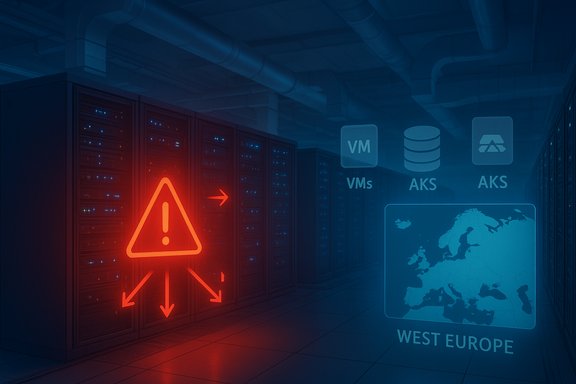
Microsoft acknowledged an infrastructure incident affecting its West Europe Azure region after a news report said a “thermal event” in a Netherlands datacenter knocked multiple storage scale units offline and produced degraded performance across Virtual Machines, Azure Database for PostgreSQL Flexible Servers, MySQL Flexible Servers, Azure Kubernetes Service, Storage, Service Bus, Virtual Machine Scale Sets and Databricks workloads.
Background / Overview
The initial public signal for this story came from trade reporting that cited a Microsoft status update describing an environmental “thermal event” that tripped datacenter cooling systems in a single availability zone, causing a subset of storage scale units to go offline and producing knock-on effects for services that rely on those storage units. The report gave specific timestamps and said one storage scale unit had recovered while other recovery efforts were ongoing, with Microsoft estimating visible recovery on affected units in roughly 90 minutes. That framing—an environmental fault inside a datacenter cooling system—differs from the more common software or network misconfiguration outages that have dominated recent hyperscaler headlines.This article synthesizes the public reporting, vendor documentation and historical incident patterns to explain what a thermal event means operationally, why it can cascade beyond a single availability zone, the real risks for Azure tenants, and practical mitigations IT teams should apply immediately. Where claims could not be independently corroborated in Microsoft’s public status channels or independent telemetry at the time of writing, those statements are flagged so readers can treat them as reported rather than verified.
What Microsoft’s public signals show (and what we could verify)
Microsoft operates a public Azure status dashboard and per-tenant Azure Service Health notices; the latter is the authoritative, subscription‑scoped channel for customer-impact details. At the time this analysis was prepared, the general Azure status dashboard showed region listings and health categories but did not publish a clearly worded, region-level incident matching the full “thermal event” narrative in the trade report. The public Azure status infrastructure is updated frequently and is used for broad, service‑wide incidents. Microsoft’s own technical documentation explains how different storage redundancy choices map to physical failure domains. Locally Redundant Storage (LRS) keeps replicas within the same datacenter or availability zone; Zone‑Redundant Storage (ZRS) spreads replicas synchronously across multiple availability zones in a region. Microsoft explicitly warns that LRS can be vulnerable to datacenter-level events such as fire, flooding — and temporary events like a datacenter thermal problem — and recommends ZRS, GRS, or GZRS where higher resilience is required. Those architectural notes are central to understanding why a cooling system failure inside one availability zone can still produce customer-visible impacts beyond the immediately affected facility. Because the trade report named specific services (VMs, database flexible servers, AKS, Databricks and storage), two possibilities explain customer experience in a storage-related fault: either the storage accounts backing those services used LRS or zone-local storage constructs, or the impacted storage scale units were part of the control‑plane or storage fabric whose failure produced transient I/O errors and higher latency visible to downstream services. Either case is consistent with how Azure maps storage durability to physical replication strategies and how platform services depend on those storage units for state or metadata.Why a “thermal event” matters operationally
Cooling systems are not cosmetic — they’re mission critical
Datacenter cooling systems maintain component temperatures within operating limits. Rising hardware temperatures are detected by automated monitoring; in many designs the safety response is to offline or throttle affected components or entire storage scale units to avoid hardware damage. Hardware-level automated protections can therefore produce rapid, coordinated withdrawals of storage capacity when thermal thresholds are exceeded.If a storage scale unit is taken offline to protect hardware, workloads that rely on that unit can experience I/O failures, increased retries, queueing in the platform orchestration layer, and in some cases dependency timeouts that propagate into compute, database and container services. That matches the class of impacts reported in the trade coverage. Where redundancy is insufficiently spread across independent failure domains, the result is user-visible disruption. The Microsoft storage redundancy guidance explains these failure-domain tradeoffs and recommended mitigations.
Availability zones reduce but do not eliminate common‑mode risks
Hyperscalers design regions as geographically clustered datacenter groupings and provide availability zones as separate physical failure domains with independent power, cooling and networking. That architecture reduces the probability that a single facility incident will take an entire region offline.However, zones are nearby by design and often share upstream transit, regional management planes, or indirect dependencies. When a storage scale unit in one zone is an integrated part of a larger storage fabric (for example, when platform metadata, orchestration or some replicas reside in a single zone), zonal failure can cascade. Multiple recent incident reviews and aggregated community analyses show patterns where zone-local faults produced service-level knock‑on effects for cross‑zone dependencies. This is why architects are counseled to use ZRS or geo‑redundancy for critical data and to design for cross‑region failover when SLAs require it.
How this incident (as reported) tracks with prior Azure failure modes
The cloud outages examined across 2024–2025 reveal several recurring themes: control‑plane misconfigurations, edge/AFD fabric problems, network transit failures, and hardware or zone-local storage issues. When the root cause lies in a physical event inside a datacenter — as a thermal or cooling system failure would be — the immediate technical signature is often a discrete set of hardware units being withdrawn by automated protections, followed by platform-level retries, degraded throughput and cascading timeouts in services that require synchronous storage operations.Independent incident analyses and internal community threads from past Azure events document how such local failures have produced outsized downstream effects when the platform’s redundancy assumptions or tenants’ redundancy choices did not match the failure domain. Those reviews also show the common mitigation steps operators take: isolate affected units, fail workloads away where possible, restart impacted orchestration nodes, and progressively restore capacity while avoiding repeated flapping.
The practical risk to customers: what actually breaks
- Short-duration I/O errors and increased latency for disks and files hosted on impacted storage accounts.
- Virtual Machines entering degraded states or failing to boot if they require synchronous access to an affected storage replica.
- Database transactions hitting timeouts, causing increased retries and possible application-level errors for PostgreSQL/MySQL flexible servers.
- Kubernetes nodes or pods that persist state on affected storage volumes reporting errors or evicting workloads.
- Databricks clusters failing to launch all‑purpose or jobs compute nodes when underlying storage-backed workspace state or Unity Catalog metadata is slow or unavailable.
- Secondary effects for dependent services: service bus messaging backlogs, scale‑set provisioning delays, and management‑plane operations timing out.
Microsoft’s communications and the limits of public telemetry
In fast-moving incidents, Microsoft typically posts incident summaries on the Azure Status page for broadly visible events and uses Azure Service Health for tenant-specific advisories. Public status pages are an important signal but can lag tenant scoped messages and internal telemetry. Community incident threads and aggregated analyses from prior outages often documented a tension: customers seeing green or stale status while suffering real degradation, and later post‑incident reviews filling in detail. For critical operations, the authoritative source for an impacted tenant remains the Service Health blade and the Azure health advisory emails that are scoped to subscriptions. Independent community dossiers on earlier outages show Microsoft using the standard operational playbook: block changes, fail critical control‑plane traffic away from troubled fabrics, restart affected orchestration units, roll back suspect configurations and reintroduce capacity in staged waves. Those steps are conservative and aim to avoid oscillation but they make recovery gradual rather than instantaneous. The company’s incident cadence and transparency are often scrutinized after large events; prior writeups highlight user frustration at sparse early detail, followed by deeper post‑incident analysis.What this means for high‑availability design: stark takeaways
- Availability zones are robust but not infallible. Zones minimize correlated risk but do not guarantee immunity to faults that touch shared platform pieces or upstream dependencies.
- Storage redundancy choice matters a great deal. LRS protects against drive and rack failure but may be insufficient for datacenter‑level events. ZRS or geo‑replication provide stronger protection at a higher cost. Microsoft’s storage docs enumerate these tradeoffs and encourage ZRS/GZRS for production workloads that demand high availability.
- Critical state and metadata are single points of failure if they are not replicated across failure domains. Platform services that store essential state synchronously in a local unit can make otherwise distributed services brittle.
- Operational runbooks must be exercised. Relying on vendor status pages alone is risky; organizations should test failover steps, maintain programmatic management access (PowerShell/CLI) and prepare cross‑region recovery playbooks.
Immediate mitigation checklist for Azure customers
- Verify redundancy: Check all critical storage accounts and disk resources to confirm whether they use LRS, ZRS, GRS, or GZRS. If using LRS for critical data, plan migration to ZRS or geo‑replication.
- Review Service Health: Use the Azure Service Health blade and subscription‑scoped advisories rather than the global Azure status page for the most accurate impact details affecting your tenant.
- Harden Databricks and stateful workloads: Where Databricks SQL and Unity Catalog metadata are business‑critical, ensure workspace metadata is backed up and that compute can be failed to another region or workspace if needed.
- Implement resilient deployment patterns:
- Use ZRS for storage that supports high availability within a region.
- Use geo‑replication for disaster recovery.
- Design application-level retries and idempotency for transient storage errors.
- Use messaging and buffering patterns (e.g., durable queues) to decouple front‑end requests from synchronous storage dependencies.
- Test cross‑region failover: Run dry‑run failovers for critical services and document the steps and expected RTO/RPO.
- Prepare runbooks for management plane unavailability: Keep programmatic scripts (PowerShell/CLI) to reconfigure or redeploy resources if the Portal is unreachable.
Strategic recommendations for IT leaders and architects
- Treat hyperscaler resilience as probabilistic, not absolute. Assume individual datacenters and sometimes whole availability zones can have transient or sustained failures; plan for cross‑region recovery when outages would cause unacceptable business damage.
- Map and catalogue dependencies. Create a service dependency map that identifies critical storage accounts and the services that depend on them; prioritize replication and multi‑region failover for those pieces.
- Balance cost and risk: For some workloads the cost of geo‑replication is justified; for others, increased application‑level resilience (retries, eventual consistency) is a cheaper and adequate mitigation. Evaluate on an SLA basis.
- Demand better post‑incident transparency in contracts: When outages produce material business impact, organizations should exercise audit and post‑incident rights in vendor agreements to obtain timelines, root‑cause analyses and remediation plans.
Critical analysis — strengths and outstanding questions
- Strengths: Microsoft’s scale gives it mature automation, rapid diagnostics and the capacity to rebalance loads across a global backbone. The architecture includes multiple redundancy models and explicit guidance for customers to choose appropriate durability options. Those engineered options are powerful weapons in an architect’s toolkit when used correctly.
- Weaknesses and risk exposures:
- Common‑mode dependencies remain a recurring problem. When control planes, edge fabrics or critical storage fabrics are shared at scale, a single fault or safety action can produce broad effects.
- Transparency friction: Historically, community reports and customer telemetry sometimes surface issues before the vendor’s global status page shows a matching incident, creating confusion and delayed operational response for tenants. Prior incident threads document this pattern and the ensuing user frustration.
- Architectural mismatch risk: Tenants who default to lower-cost redundancy (LRS) for regional data may be surprised by datacenter-level failures. The vendor guidance is explicit but the real-world cost pressures and ignorance can leave production data at unnecessary risk.
- Unverified or open items:
- The trade report’s specific phrasing—“thermal event affecting datacenter cooling systems” and the 90‑minute recovery estimate—could not be located in an identical form on the public Azure status pages at the time of checking. That does not mean the event did not occur; it may reflect timing differences between tenant advisories and global status postings or rapidly evolving internal telemetry. Customers experiencing impact should rely on their subscription‑scoped Azure Service Health messages as the authoritative source. Treat the exact timeline and estimated recovery windows cited in press reports as reported rather than fully verified until Microsoft publishes the tenant‑scoped advisory or a formal post‑incident report.
What to watch next
- Formal post‑incident review from Microsoft: For a high‑impact hardware or datacenter environmental event, Microsoft usually produces a post‑incident analysis that explains root cause, mitigation steps and longer-term remediations. Obtain that report when available and correlate it with your tenant’s Service Health timeline.
- SSR and SLA follow‑ups: Organizations materially impacted should collect evidence (timestamps, telemetry, invoices for lost business) and engage Microsoft’s support and account teams about contractual remedies and RCA access.
- Product configuration checks: If your tenant uses LRS for critical disks or dependencies for Databricks metadata, plan an immediate risk assessment and migration road map.
Conclusion
A “thermal event” inside a single datacenter is a reminder that physical infrastructure — cooling, power and the environmental envelope — remains a first‑order risk for cloud operations. Modern hyperscalers design for redundancy and build automation to protect hardware, but protective actions themselves (automatically taking storage units offline) can produce painful operational consequences when redundancy is not aligned with the true failure domain.For Azure customers the lesson is practical and immediate: verify your redundancy choices, exercise cross‑region failovers and maintain tested runbooks that do not depend solely on a single management plane or a single storage replication model. Where downtime could be costly, invest in ZRS or geo‑replication, test your recovery procedures, and keep Service Health monitoring and programmatic toolchains ready so that recovery and mitigation don’t depend entirely on public dashboards.
Finally, treat press reports about root causes and recovery timelines as initial signals. Cross‑check them with tenant‑scoped Service Health notices and Microsoft’s subsequent post‑incident report before drawing definitive operational conclusions. Public incident analyses from past Azure outages show both the power and the limits of hyperscale automation; the right combination of platform choices and disciplined operational practice is the best defense when the physical world reminds us that even cloud infrastructure needs good old‑fashioned environmental control.
Source: theregister.com Azure stumbles in Europe, Microsoft blames 'thermal event'
