Azure Validates NVIDIA NVL72 Rack Scale AI for Large Scale Inference

  • Thread Author
Microsoft Azure has validated and readied its datacenters to run NVIDIA’s new Vera Rubin NVL72 rack‑scale AI system, positioning Azure as the first public cloud to claim production validation of the GB300 “Blackwell Ultra” NVL72 platform — a move that crystallizes the shift from server‑level GPU instances to rack‑as‑the‑accelerator thinking and escalates the hyperscale cloud AI arms race.

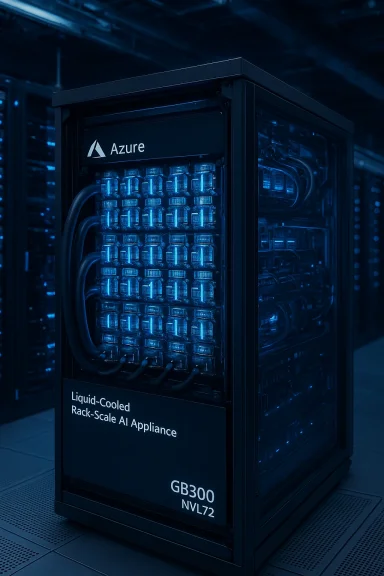
Azure liquid-cooled rack-scale AI appliance in a data center.Background / Overview​

Microsoft’s announcement frames the validation as the first large‑scale, production‑grade readiness of NVIDIA’s GB300 NVL72 racks in a public cloud environment. Azure packages the capability as the new ND GB300 v6 (NDv6 GB300) virtual machine offering, designed specifically for reasoning‑class inference, agentic workloads, and massive multimodal models. The vendor materials and press coverage describe an installation that stitches together thousands of Blackwell Ultra GPUs behind NVIDIA’s next‑generation InfiniBand fabric to deliver extremely high intra‑rack bandwidth and pooled memory.
The NVL72 concept treats a liquid‑cooled rack as a single, coherent compute appliance: each rack contains 72 Blackwell Ultra GPUs paired with Grace‑family CPUs, large pools of very‑high‑bandwidth memory (HBM), and ultra‑low‑latency interconnects. Microsoft and NVIDIA position this as the practical building block for multitrillion‑parameter models and the heavy‑duty inference workloads used by OpenAI and other frontier AI customers.

What exactly was validated?​

NVL72 (GB300 / Blackwell Ultra) — the hardware baseline​

The validated hardware family is described as NVIDIA’s GB300 NVL72 platform — colloquially “Blackwell Ultra” — a rack‑scale AI factory optimized for inference and reasoning. Key technical motifs mentioned across briefings and coverage include:
  • 72 GPUs per rack in a tightly coupled, liquid‑cooled chassis.
  • Paired Grace‑family CPUs (one or more per rack) to handle host‑side orchestration and to feed the GPUs.
  • Pooled HBM / high‑bandwidth memory and accelerated NVLink/Interconnect fabrics inside the rack, enabling large models to reside and operate across the rack without constant remote memory access.
  • Quantum‑X800 / next‑generation InfiniBand to stitch racks into pod‑scale superclusters when workloads demand beyond a single rack’s capacity.
Azure exposes this hardware as the ND GB300 v6 VM family for customers who require very large inference clusters, dedicated reasoning infrastructure, or OpenAI‑class workloads. That packaging is important: it’s how enterprises and model providers will consume rack‑scale capability without direct hardware procurement.

Scale claims and what they mean​

Industry coverage and Microsoft’s materials refer to initial clusters that contain “more than 4,600” Blackwell Ultra GPUs, described as the first of many such production clusters planned for Azure’s AI‑optimized data centers. Those numbers, if accurate, represent a substantial single‑installation scale that goes beyond simple pilot deployments and into supercluster territory. However, the claim of 4,600+ GPUs comes from vendor and press statements and has not been independently audited in the public domain; treat absolute totals as vendor‑reported until third‑party verification is available.

Deep technical analysis: why rack‑scale is a different architecture​

From GPU instances to rack‑as‑accumulator​

For most cloud users in the past decade, the atomic unit was the server or the VM with 1–8 GPUs. NVL72 changes that by elevating the rack to the role of a single, pooled accelerator. The difference is crucial for model classes that require:
  • Very large aggregated HBM capacity to host multitrillion‑parameter models without constant RDMA to slow storage.
  • Extremely high NVLink bandwidth between GPUs so that gradient updates and attention operations can be pipelined efficiently.
  • Low‑latency pod‑scale fabric to enable multi‑rack model parallelism with acceptable performance loss.
Treating a rack as an accelerator reduces inter‑chip latency and increases the effective memory available to a single model instance. For inference and reasoning models that rely on prompt latencies and multi‑modal fusion, this is a substantial systems advantage.

Cooling, power and density realities​

Liquid cooling and rack‑level thermal management are no longer optional for this density of GPUs. The NVL72 designs referenced are liquid‑cooled, which delivers higher power density and better thermal headroom than air‑cooled designs, but they also introduce new site requirements:
  • Increased chilled‑water or direct‑to‑chip infrastructure at the data center.
  • More complex servicing procedures and a different spare‑parts model.
  • Higher initial capital costs for retrofit vs new builds.
Microsoft’s validation signals that Azure has either retrofitted or built datacenter capacity that can support these liquid‑cooled racks at scale — a nontrivial logistical and capital undertaking.

Networking: NVLink inside, InfiniBand between racks​

The NVL72 approach prioritizes abundant NVLink within racks and relies on Quantum‑X800 InfiniBand fabric to scale across racks. That hybrid approach keeps model shards local when possible, reducing cross‑rack synchronization overhead. For scale‑out training and distributed inference, the packing and fabric choices are decisive for latency and throughput.

Business and strategic implications for the cloud AI race​

Azure’s competitive positioning​

Validating NVL72 places Microsoft Azure in a leadership narrative: first to declare production readiness for NVIDIA’s most aggressive rack‑scale offering. That matters for several reasons:
  • Customer trust and lock‑in: Enterprises and model providers seeking the lowest latency and highest throughput for reasoning models may choose Azure to access validated NVL72 capacity.
  • Vendor co‑engineering: The announcement underscores the long partnership between Microsoft and NVIDIA on co‑designed cloud platforms — an advantage that makes Azure attractive for early access to advanced hardware.
  • Market signaling: Claiming the first production NVL72 validation sends a signal to competitors (AWS, Google Cloud) that hyperscalers must either match with NVIDIA racks or accelerate their own custom silicon programs.

The counterpunch: hyperscaler silicon and diversification​

Microsoft is not just buying the fastest third‑party silicon: it is simultaneously developing custom inference silicon (the Maia program) to reduce per‑token costs and diversify supplier dependence. The existence of Maia‑class chips and Azure’s in‑house designs complicates the long‑term lock‑in story — hyperscalers may pursue a hybrid strategy of hosting NVIDIA GB300 racks for some customers and moving other high‑volume inference to proprietary accelerators. This strategy is visible in Microsoft’s broader infrastructure messaging.

What this means for customers and model owners​

Immediate benefits​

  • Access to reasoning‑class inference: Customers running very large models or requiring agentic reasoning will have an on‑demand environment that materially reduces latency and increases throughput compared to multi‑host, air‑cooled GPU instances.
  • Simpler procurement: Organizations that cannot or will not build their own liquid‑cooled clusters can rent validated rack‑scale capacity as ND GB300 v6 VMs, removing capital and operational barriers.
  • Faster experiments at scale: Model teams can test production‑scale inference without long lead times for hardware procurement.

Unknowns and practical caveats​

  • Pricing and availability: Vendor statements about validation and initial clusters do not equate to immediate, globally available capacity at predictable prices. Microsoft has not published standardized per‑token or per‑hour pricing for NDv6 GB300 in the coverage we reviewed; enterprises should expect staged availability and partner engagement for large reservations.
  • Data locality and compliance: Rack‑scale capacity often lives in specialized data centers. Customers with strict data residency or compliance constraints should validate region placement and control plane isolation before committing sensitive workloads.
  • Migration complexity: Not every model will naturally benefit from rack‑scale deployment; some will require substantial rework for model parallelism and deployment orchestration to extract performance gains.

Risks, tradeoffs, and unresolved questions​

Vendor concentration and supply chain risk​

Azure’s validation deepens the commercial reliance on NVIDIA’s NVL72 rack design for the highest‑end workloads. That concentration amplifies the potential impact of supply disruptions, geopolitical export controls, or single‑vendor software dependencies. Microsoft’s parallel investment in Maia silicon suggests recognition of this risk, but the current reality still depends heavily on NVIDIA supply and roadmap alignment.

Operational and failure modes​

Rack‑scale designs change failure domains: a micro‑fault or coolant leak can affect a whole rack. Operational playbooks for fault isolation, hardware replacement, and software failover must be matured for cloud‑grade SLAs. Azure’s validation shows they’ve addressed many of these concerns internally, but customers should still request operational runbooks, MTTR guarantees, and redundancy plans prior to mission‑critical adoption.

Energy and sustainability questions​

Higher density equals higher energy per rack, and liquid cooling changes the energy and water use profile. Azure’s operational footprint and carbon accounting for GB300 NVL72 clusters is an open question; customers and regulators will press hyperscalers for transparent PUE and lifecycle carbon numbers. Treat sustainability claims as a material procurement factor.

Economic tradeoffs: cost vs. performance​

For many workloads, absolute performance is not the only metric: cost per inference token, model throughput, and predictable billing matter more. Microsoft and NVIDIA emphasize performance and capability, but customers must run pilot cost analyses comparing NDv6 GB300 to alternative deployment paths (e.g., smaller GPU instances, on‑prem racks, or Maia‑powered Azure instances). Vendor pricing transparency will be critical.

Practical checklist for IT leaders evaluating NVL72 on Azure​

  • Assess workload fit:
  • Confirm whether your models are reasoning‑class or multimodal and can exploit rack‑scale memory and NVLink.
  • Request technical documentation:
  • Obtain Azure’s NDv6 GB300 VM specifications, network topology diagrams, and cooling/power requirements.
  • Pilot with a scoped project:
  • Run a bounded inference experiment comparing NDv6 GB300 to your current best alternative, measuring latency, throughput, and cost per token.
  • Negotiate capacity and pricing:
  • For large, continuous workloads, negotiate reservations or committed use discounts and include SLAs for availability and MTTR.
  • Validate compliance and data residency:
  • Confirm region placement and contractual controls for data handling, logging, and audit.
  • Plan for hybrid and fallback strategies:
  • Avoid single‑supplier lock‑in by designing multi‑cloud or on‑prem fallbacks where business critical.
  • Monitor sustainability metrics:
  • Request PUE, water usage, and carbon accounting for the deployment locations to align with corporate sustainability goals.

Competitive dynamics: how rivals might respond​

  • AWS and Google Cloud are expected to accelerate competitive offerings — either by validating similar NVIDIA NVL72 racks themselves or by doubling down on alternative approaches (e.g., proprietary accelerator silicon or mixed‑fleet GPU strategies).
  • Hyperscalers’ custom silicon: Microsoft’s Maia program demonstrates that the big cloud providers will actively explore vertical integration to control costs and reduce dependence on any single GPU supplier. That trend is likely to produce a market with hybrid deployment choices: best‑in‑class NVIDIA racks for certain workloads and hyperscaler chips for extremely high‑volume inference.
  • System integrators and appliance vendors will offer hosted or managed rack‑scale deployments for enterprises that require dedicated footprints but lack the datacenter scale to run NVL72 themselves.

Verifiability and journalistic caution​

Several of the most striking numerical claims (for example, the “more than 4,600 GPUs” figure) are drawn from vendor and press statements associated with Microsoft’s announcement and reporting. While multiple outlets and the Azure briefing repeat the number, independent third‑party audits or datacenter‑level telemetry to corroborate aggregate counts are not publicly available at the time of this article. Readers should treat scale metrics reported by vendors as informative but vendor‑reported until audited or corroborated by independent observers.
Where possible, we have cross‑checked claims against multiple, independent writeups in the briefing and in separate industry coverage to provide corroboration: the overall architecture (NVL72, 72 GPUs per rack, liquid cooling, Quantum‑X800 fabric) is consistently described across the materials reviewed, which strengthens confidence in the technical characterization even while absolute counts and rollout schedules remain vendor‑controlled.

Longer‑term impact: three scenarios to watch​

  • Accelerated specialization (most likely): Hyperscalers deploy a mix of NVL72 racks for the top‑end, specialized inference workloads while shifting high‑volume, cost‑sensitive inference to custom accelerators and optimized runtimes. This hybrid model favors customers who can segment workloads by cost and latency requirements.
  • Rapid commoditization: If competitors quickly validate similar rack designs and pricing pressure emerges, NVL72 capability may become widely available, pushing prices down but also pushing energy and operational challenges to the fore.
  • Supply constraints and regional divergence (risk): Geopolitical export controls, chip shortages, or supply chain disruptions could make NVL72 capacity concentrated in certain regions, creating vendor advantage for the hyperscalers that secure early supply and complicating global deployment plans for multinational customers.

Final assessment and guidance​

Microsoft Azure’s validation of NVIDIA’s Vera Rubin NVL72 (GB300 Blackwell Ultra) marks a clear technical and narrative milestone: the cloud is now treating racks — liquid‑cooled, NVLink‑rich, HBM‑pooled units — as the primary acceleration appliance for the most demanding inference and reasoning workloads. For organizations building or running multitrillion‑parameter models, Azure’s ND GB300 v6 packaging offers a compelling, managed path to access that capability without the up‑front capital and datacenter engineering burden.
However, the win comes with tradeoffs. Expect complex operational requirements, potential vendor concentration, staged availability, and pricing uncertainties. Savvy IT leaders will pilot selectively, insist on contractual transparency (pricing, capacity, SLAs), and design hybrid deployment patterns that avoid single‑supplier lock‑in. Microsoft’s parallel investment in custom silicon (Maia) further complicates the landscape — the long‑term winner will likely be the provider who can flexibly mix best‑in‑class hardware with cost‑optimized, proprietary accelerators while delivering predictable, sustainable operations.
For readers evaluating adoption now: prioritize a short, targeted pilot on NDv6 GB300 where your workload has clear, measurable performance or latency goals; do not assume immediate global availability; and make contractual arrangements that include transparency on capacity, maintenance, and energy/sustainability metrics. In the fast‑moving cloud AI race, hardware leadership matters — but so does predictable economics and operational maturity.


Source: parameter.io Microsoft (MSFT) Azure Leads Cloud Race with First Nvidia Vera Rubin NVL72 Validation - Parameter
Source: Blockonomi Microsoft (MSFT) Leads Cloud Race as First to Validate Nvidia's Vera Rubin NVL72 AI System - Blockonomi
Source: MoneyCheck Microsoft (MSFT) Takes Lead as First to Deploy Nvidia's Vera Rubin AI Superchip - MoneyCheck
Source: CoinCentral Microsoft (MSFT) Becomes First Cloud Provider to Validate Nvidia's Most Powerful AI Chip - CoinCentral
 

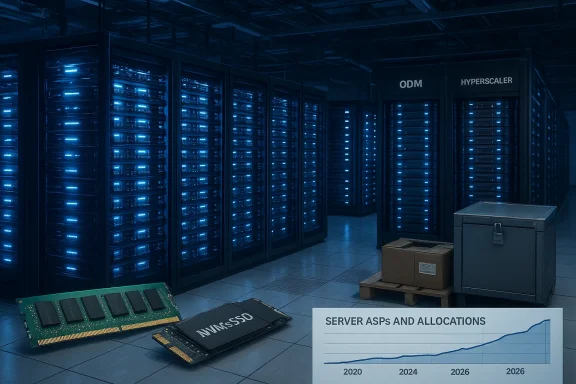
The server market has run hotter than most analysts expected in 2025, pushed by an unprecedented build‑out of AI infrastructure — but a parallel surge in memory and storage prices is already reintroducing discipline into buying decisions and could reshape how organizations allocate budgets through 2026. IDC’s latest trackers show the industry ballooning to the mid‑hundreds of billions in annual vendor revenue as hyperscalers race to deploy GPU‑dense racks; meanwhile, suppliers and enterprise buyers face a near‑term reality of constrained DRAM and NAND supply, elevated ASPs, and longer lead times that blunt some of the boom’s shine.

Blue-lit data center with rows of server racks, RAM modules, and a chart on server allocations.Background / Overview​

IDC’s public Server Market Insights page reports a dramatic expansion in the worldwide server market during 2025, with full‑year value rising into the hundreds of billions of U.S. dollars and double‑digit — in many periods triple‑digit — quarter‑over‑quarter growth tied directly to accelerated AI server demand. The firm’s published 2024–2026 forecast shows a step function: total server market value increasing from roughly $253 billion in 2024 to about $455 billion in 2025, and jumping again toward $566 billion in 2026. This expansion is not evenly distributed: accelerated, GPU‑embedded systems and non‑x86 platforms (driven largely by hyperscaler custom designs and Arm‑based architectures) are the fastest‑growing segments.
At the same time, multiple industry observers and vendors have warned about memory and flash shortages. Shortages and price hikes for DRAM and enterprise SSDs are creating practical constraints that affect delivery times, configuration choices, and the economics of on‑premises AI deployments for enterprises and cloud providers alike.

What changed in 2025: AI spending rewrites the server market rules​

The hyperscaler effect and accelerated servers​

The single biggest structural change is the concentration of demand among hyperscalers and large cloud service providers. Where past server cycles were driven by refreshes and broad enterprise buying, 2025 has been dominated by a relatively small set of large buyers ordering racks upon racks of GPU‑accelerated servers for training and inference clusters.
  • Hyperscalers are ordering GPU‑dense systems in large volumes, favoring designs with multiple high‑bandwidth GPUs per node.
  • Many of these buys are direct or ODM‑direct, bypassing traditional OEM channels in whole‑rack purchases.
  • The result: accelerated servers (those with embedded or tightly coupled GPUs/accelerators) now account for a disproportionately large share of server revenue.
This concentration has two consequences. First, average selling prices (ASPs) for servers have jumped, because AI‑oriented systems cost much more per unit than legacy two‑socket CPU boxes. Second, the market is becoming lumpy — a few very large orders can swing entire quarters.

Non‑x86 momentum: Arm and custom silicon move into the mainstream​

Another notable shift is the rapid expansion of non‑x86 revenues. Arm‑based server designs and other alternative architectures have gained traction where hyperscalers prioritize energy efficiency, custom memory subsystems, or integrated architectures optimized for large language model (LLM) workloads. IDC’s published forecasts show non‑x86 server value rising sharply relative to 2024 levels, reflecting both new product introductions and hyperscaler preference for vertically integrated systems.
  • Arm designs are attractive to hyperscalers and cloud providers because they enable custom SoC integration and better power per throughput for some AI workloads.
  • Vendors that support flexible chassis and custom motherboard designs have benefited as hyperscalers place ODM orders.

x86 remains the largest base — but the growth profile has changed​

x86 servers still represent the majority of market value, but their growth is outpaced by accelerated and non‑x86 segments in 2025. Many customers still run x86‑based inference and mixed workloads, and OEMs with broad x86 portfolios continue to capture significant revenue. But the mix is shifting — higher‑value accelerated platforms are changing the composition of total dollars vs. unit counts.

Memory and storage: the constraint that threatens to cap growth​

What’s happening to DRAM and NAND supply​

A critical and recurring theme through the year has been memory allocation and pricing. Manufacturers and market analysts reported constrained allocations of server DRAM and enterprise‑grade NAND as wafer capacity is increasingly diverted to higher‑margin products and AI‑specific memory (such as HBM families) and as fabs prioritize capacity plans that favor advanced nodes and specialty product families.
  • Buyers report longer lead times and partial order fulfillment for DDR5 server DIMMs.
  • Server SSDs and enterprise NAND prices have risen as production is refocused and demand for fast local storage in training and caching increases.
  • Some customers are opting to fix prices and secure allocations by contracting early or paying premiums to suppliers, further tightening availability for more price‑sensitive buyers.

Price movement and practical impact​

Price increases are not uniform across all memory types, but data from several industry trackers and vendor commentary in late 2025 and early 2026 point to material inflation in DRAM and enterprise SSDs. Procurement teams are seeing elevated quotes for:
  • High‑capacity DDR5 RDIMMs used in 4+ TB server builds.
  • High endurance, NVMe enterprise SSDs used for data staging and model caches.
  • HBM and other accelerator‑adjacent memory remain prioritized for AI accelerators, absorbing much of advanced capacity.
The net effects for end users:
  • Higher upfront capital costs for the same rack configuration.
  • Potential delays in deploying capacity for planned AI projects.
  • Trade‑offs between memory size and the number of GPU nodes that can be fielded under a fixed budget.

Strategic responses by buyers and vendors​

Buyers and vendors are responding with a range of workarounds and commercial strategies:
  • Locking in prices and allocations through forward purchase agreements.
  • Accepting mixed memory configurations and using software to compensate (e.g., memory tiering, offload to NVMe).
  • Increased use of subscription or consumption models to shift capital exposure.
  • Prioritizing GPU/accelerator procurement where possible and adapting CPU/memory configs to available supply.

Who won in 2025 — OEMs, ODMs, and the rest of market​

OEM leaders and the rise of ODM/direct sales​

The 2025 spending surge benefitted multiple OEMs, but the windfall was split between traditional OEMs that successfully adapted their product lines for accelerated workloads and the ODMs that sell directly to hyperscalers.
  • Established OEMs with strong accelerated server portfolios — and the ability to deliver at scale — captured a substantial share of vendor revenue.
  • ODMs and the “rest of market” category (companies supplying hyperscalers directly) grew even faster in percentage terms, reflecting cloud providers’ tendency to buy at rack scale from contract manufacturers.
This market dynamic is notable because it erodes some of the middleman role that OEMs historically played: hyperscalers increasingly specify and buy optimized rack designs from ODMs, reducing reliance on branded system sellers for large-scale deployments.

Regional footprints: where the money moved​

Geography mattered a lot in 2025:
  • The United States accounted for the fastest growth in server revenue, where hyperscaler buildouts and AI projects are most concentrated.
  • Canada also saw outsized growth, often tied to North American hyperscaler expansions.
  • EMEA and APAC showed healthy double‑digit growth, while China and Latin America trailed at a lower rate. Japan showed pockets of decline in some quarters as hyperscaler buys concentrated elsewhere.
The imbalance matters for global supply chains: regions with the highest demand pushed suppliers to prioritize allocations — often in favor of U.S. and large cloud customers.

Practical implications for IT pros and procurement teams​

For enterprise IT teams considering on‑premises AI​

If you’re an IT leader planning on‑prem AI infrastructure in 2026:
  • Reassess timelines and budgets: expect higher memory and storage costs and longer lead times for target configurations.
  • Prioritize architecture decisions: decide whether you need the absolute highest memory per node or whether you can compensate with fast NVMe tiers and software techniques.
  • Consider hybrid cloud: where hyperscalers can provide flexible consumption models, offloading some capacity to cloud providers may be more budget‑efficient than competing in the tight hardware market.

For channel partners and system integrators​

  • Reprice proposals to reflect current component costs and be explicit about lead times.
  • Diversify supply lines and include memory alternatives in BOMs where feasible.
  • Build consulting offerings around cost‑effective AI deployment patterns that reduce memory footprint without sacrificing model performance.

For CFOs and procurement​

  • Explore forward purchase agreements for predictable workloads, but weigh the opportunity cost of capital.
  • Push vendors for flexible commercial arrangements — leases, consumption models, or staged deliveries that reduce immediate capital outlays.
  • Insist on clear SLAs for fulfillment and contingency plans for partial shipments.

Strengths in the current cycle — and why the market’s fundamentals still look solid​

  • Demand drivers are structural, not cyclical. AI model complexity and the appetite for LLMs and generative AI workloads are creating sustained need for specialized compute.
  • Innovation is accelerating: new form factors, integrated GPU/CPU platforms, and Arm‑based and custom silicon options give buyers more choices tailored to specific AI workloads.
  • The economics of hyperscale deployments favor continued investment: companies with data advantage are incentivized to keep building infrastructure to protect and monetize their AI efforts.
These are not one‑quarter phenomena. The combination of larger models, latency‑sensitive applications, and edge‑to‑cloud inference needs provide ongoing tailwinds for a server market that has been re‑priced materially higher in 2025.

Risks, fragilities, and second‑order effects to watch​

1. Concentration risk: hyperscalers shape the market​

When a small group of buyers accounts for a large portion of demand, market dynamics can become volatile. A slowdown or strategic shift by hyperscalers — for example, moving from fresh infrastructure to optimizing existing capacity — could materially depress orders and produce sudden revenue contraction for suppliers that had scaled for sustained orders.

2. Component reallocation and supplier incentives​

Manufacturers will rationally prioritize the most profitable product lines. If fabs continue prioritizing high‑margin memory types or HBM for accelerators, traditional server DRAM and enterprise NAND could stay constrained, inflating prices further and encouraging substitution or software workarounds.

3. Inflation, ASP creep, and buyer pushback​

Higher ASPs for servers are manageable for large cloud providers, but many enterprises have fixed budgets. If prices for memory and SSDs stay elevated, companies may delay refreshes or opt for cloud alternatives, reducing the breadth of buyers and concentrating revenue further in hyperscalers.

4. Environmental and power constraints​

Deploying GPU‑dense racks increases power and cooling requirements. Not all data centers can be upgraded quickly, and the easiest path for many customers may be to colocate with hyperscalers or specialized providers — again concentrating demand and creating potential capacity bottlenecks at sites with the necessary electrical and cooling infrastructure.

5. Supply chain opacity and geopolitical risk​

As OEMs and ODMs reconfigure supply chains, geopolitical events or export controls affecting advanced nodes, memory, or accelerators could further destabilize supply and prices.

Tactical recommendations for organizations evaluating AI infrastructure in 2026​

  • Be explicit about must‑have vs nice‑to‑have in hardware BOMs. Memory capacity is expensive right now; quantify model performance sensitivity to memory reductions.
  • Explore software mitigations: memory tiering, quantization, model pruning, and offload strategies can materially reduce memory requirements for inference and training.
  • Treat provisioning as a portfolio decision: combine on‑prem capacity for sensitive workloads with cloud capacity for bursty training needs.
  • Negotiate allocation and fulfillment terms with suppliers; consider staged delivery schedules to get partial capacity sooner.
  • Revisit total cost of ownership (TCO) models to include higher prices for DRAM and SSDs — don’t assume historical component cost baselines.

What vendors and data‑center operators should be doing now​

  • Strengthen visibility into wafer‑level allocations for memory and flash and communicate realistic lead times.
  • Offer alternative configurations and scaled service options to capture buyers unwilling to pay memory premiums.
  • Build or expand consumption and financing programs that smooth customer spend and reduce friction from shortfalls.
  • Invest in energy‑efficient rack and cooling technologies to lower operational barriers for GPU‑heavy deployments.

Looking ahead: will price pressure temper the boom?​

The short answer: some tempering is likely, but the broader trend of high demand for AI compute is still firmly in place.
  • Memory and NAND price pressure will likely continue into 2026 while fabs reallocate capacity and increase production for specialized products. That means higher ASPs and potentially fewer units shipped for the same dollars — a dynamic that benefits revenue totals but complicates unit growth and diversity of buyers.
  • Hyperscalers will continue to invest aggressively in the near term because the economics of owning training and inference capacity remain favorable; however, the market is becoming more dependent on a handful of large buyers, increasing systemic risk.
  • Software innovations that reduce memory footprint or improve model efficiency will gradually reduce pressure on raw hardware demand — but those gains will not immediately eliminate the need for scale. In practice, the market will likely oscillate between periods of rapid capacity additions and pauses as budgets and supply align.

Conclusion​

The server market’s 2025 surge — a watershed moment in enterprise infrastructure driven by AI — demonstrates how transformational workloads can rewrite demand patterns almost overnight. For IT pros, procurement teams, and channel partners, the most important takeaway is that value is being re‑priced; hardware dollars now buy different mixes of compute, memory, and storage than they did a year earlier. Memory shortages and sustained price increases are the most immediate constraint and will shape procurement, architecture, and financial choices into 2026.
Organizations that navigate this period successfully will do so by combining realistic procurement strategies, architectural flexibility, and a willingness to blend cloud consumption with on‑prem investments. Vendors and integrators that offer clarity on lead times, flexible commercial options, and design alternatives will capture the largest share of incremental demand. The boom is real — but so are the pressures that could slow or reshape it. The coming 12–18 months will determine which players emerge as durable winners in a market that has, very quickly, been remade by AI.

Source: IT Pro Memory shortages take the shine off record-breaking server growth
 

Microsoft and NVIDIA used the GTC 2026 stage to stage a clear inflection: Azure has moved from GPU instance upgrades to full rack‑scale, liquid‑cooled “AI factories,” and Microsoft presents its first production deployment of NVIDIA’s GB300 NVL72 Blackwell Ultra racks as a serviceable, cloud‑native supercluster intended to run OpenAI‑scale reasoning, inference, and multimodal workloads.

Blue-lit data center with racks labeled GB300/NVL72 and two technicians at consoles.Background / Overview​

Microsoft Azure’s announcement at GTC 2026 was framed as more than a product launch — it’s a strategic statement about the next phase of cloud AI infrastructure. Rather than delivering incremental GPU instance updates, Azure says it has deployed a production‑scale cluster built from NVIDIA’s GB300 NVL72 rack systems, linking tens of rack‑scale nodes into a single fabric and exposing the capacity as the new ND GB300 v6 virtual machine family. Microsoft’s materials claim the initial deployment stitches together more than 4,600 NVIDIA Blackwell Ultra GPUs and that this rollout will be the first of many as Azure scales to meet frontier AI demand.
This announcement intersects three trends that have shaped the past 24 months: the shift to rack‑first accelerator design, the emergence of rack‑scale fabrics (NVLink and InfiniBand stitched into pod‑scale fabrics), and hyperscalers’ attempt to package those systems as managed cloud offerings for enterprises and AI labs. The Azure + NVIDIA move signals that hyperscalers are now operationalizing co‑designed hardware at scale rather than treating accelerators as commodity blades to be slotted into generic servers.

What Microsoft and NVIDIA said at GTC 2026​

The headline claims​

  • Azure is offering a new ND GB300 v6 VM family built from NVIDIA’s GB300 NVL72 rack architecture, purpose‑engineered for reasoning‑class inference and large‑model workloads.
  • The initial production cluster is described as a single installation stitching more than 4,600 Blackwell Ultra GPUs behind NVIDIA’s Quantum‑X800 InfiniBand fabric. Microsoft positions this as the industry’s first production‑scale GB300 NVL72 deployment.
  • The NVL72 rack packs a rack‑scale configuration (commonly described as 72 GPUs per rack), paired with companion Grace‑family CPUs and pooled, high‑bandwidth memory to treat the rack as a single coherent accelerator.
These are bold claims — and Microsoft framed them as a deliberate shift: treat the rack (and the pod) as the fundamental unit of acceleration, not the single GPU or server node. The argument is straightforward: modern reasoning models require enormous aggregated memory, ultra‑low latency intra‑rack connectivity, and deterministic performance that commodity multi‑server arrays struggle to deliver.

How Azure packages it​

Azure is exposing this capacity as the ND GB300 v6 series (or NDv6 GB300), a VM family that, by Microsoft’s description, lets customers consume rack‑scale GPU performance via ordinary cloud contracts. That packaging is critical: it converts what would otherwise be a hyperscaler‑only supercomputer into a managed cloud service that enterprises and model operators can buy into.

Technical anatomy: GB300 NVL72, Blackwell Ultra, and Quantum‑X800​

Rack architecture and compute​

The GB300 NVL72 is a rack‑scale AI factory: liquid‑cooled NVL72 racks, each comprising a dense collection of Blackwell Ultra GPUs and Grace‑family CPUs. The design emphasizes pooled on‑rack memory, NVLink (or equivalent high‑bandwidth GPU interconnects), and a fabric that allows models to scale across an entire rack with minimal communication overhead. Azure’s briefing describes the rack as the “coherent” accelerator unit that nodes and orchestration treat as a single compute target.
Key hardware points presented at GTC and in Azure materials:
  • Blackwell Ultra GPUs optimized for inference and reasoning workloads, deployed in high counts per rack.
  • NVL72 racks commonly summarized as holding 72 GPUs per rack, paired with 36 companion CPUs and large pooled memory. Microsoft describes these systems as liquid‑cooled and engineered for continuous, production‑grade operation.
  • Quantum‑X800 InfiniBand fabric for low‑latency, high‑bandwidth pod‑scale connectivity that stitches racks into a single, serviceable supercluster.

Networking and fabric considerations​

The networking fabric is a central technical differentiator. Azure’s deployment uses NVIDIA’s next‑generation InfiniBand topology — described as Quantum‑X800 in vendor briefings — to deliver the intra‑rack and inter‑rack bandwidth needed for multitrillion‑parameter models and reasoning tasks. The fabric’s role is to minimize cross‑GPU latency and present a unified memory and communication plane to model runtimes. Without that fabric, the rack‑as‑accelerator abstraction collapses into a collection of slower, loosely coupled instances.

Thermal and power engineering​

Liquid cooling, closed‑loop thermal management, and power provisioning were explicitly called out as prerequisites for operating GB300 NVL72 racks at scale. Azure’s language emphasizes that these are not lab prototypes but production infrastructure deployed in a datacenter environment, implying hardened processes for coolant management, leak containment, and serviceability. This is a nontrivial operational lift compared with air‑cooled GPU fleets.

Productization: ND GB300 v6 VM family​

Azure’s ND GB300 v6 is the cloud‑exposed manifestation of the GB300 NVL72 hardware. The packaging is important for two reasons:
  • It lowers the barrier to entry for customers who need rack‑scale performance without buying or operating their own supercomputers.
  • It standardizes how operator teams manage allocation, tenancy, and billing for these high‑value resources.
Microsoft’s pitch is that developers and enterprises can request NDv6 GB300 instances for inference and reasoning workloads that previously required bespoke engineering to deploy. Whether the billing granularity, preemption policies, and multi‑tenant isolation meet enterprise expectations remains to be tested in production.

Why this matters: use cases and performance expectations​

Target workloads​

Azure and NVIDIA positioned GB300 NVL72 and NDv6 GB300 for the heaviest inference tasks: reasoning engines, agentic systems, and large multimodal models where latency, memory capacity, and deterministic throughput are first‑order concerns. These workloads include:
  • Real‑time reasoning pipelines that require consistent latency at scale.
  • Massive multimodal inference (video, audio, text) that benefits from pooled memory and high interconnect bandwidth.
  • Model serving for multitrillion‑parameter models where single‑rack aggregation reduces sharding overhead and communication bottlenecks.

Claimed scale and expected gains​

Microsoft’s initial deployment figures — more than 4,600 Blackwell Ultra GPUs — are presented as evidence that Azure has achieved meaningful scale already. The company’s public materials assert the configuration reduces model training and inference cycles by condensing compute and communication into optimized rack first assemblies. These claims, if borne out in independent benchmarks, would represent a material step forward for production reasoning workloads. However, they remain vendor‑provided claims until third‑party benchmarks and customer reports confirm typical throughput and cost per token.

Strategic implications for hyperscalers and cloud customers​

For Microsoft​

  • This move cements Azure’s positioning as a cloud that will host frontier AI workloads in production. Azure’s ability to expose rack‑scale systems as managed VMs removes a barrier for large model operators that cannot build or staff their own supercomputing facilities.
  • Microsoft is also signaling that it will continue to invest across the stack — hardware, datacenter design, and software orchestration — to keep control of latency, cost, and availability for services like Azure AI and partner offerings.

For NVIDIA​

  • The partnership demonstrates NVIDIA’s ability to move beyond discrete GPUs into co‑designed rack systems and to monetize rack‑scale designs through hyperscaler agreements. It is a validation of NVIDIA’s Blackwell Ultra roadmap and the GB300 NVL72 architecture.

For competitors (AWS, Google Cloud, Oracle, etc.)​

  • Hyperscalers that have not yet fielded comparable rack‑scale NVL systems will face pressure to match the performance envelope or offer competitive alternatives, such as custom accelerators (TPUs, in‑house ASICs) or specialized inference fabrics. Microsoft’s public deployment could accelerate similar announcements or deployments from competitors.

Risks, unknowns, and points of skepticism​

No single vendor claim should be taken at face value — especially when it concerns “world’s first” or “industry‑leading” scale. The key areas that demand scrutiny:
  • Independent verification: The 4,600+ GPU figure and statements that this is the industry’s first production GB300 NVL72 supercluster are vendor claims until validated externally with benchmarks or third‑party reports. Watch for independent throughput, latency, and cost per token measurements.
  • Multi‑tenant security and isolation: Packing many high‑value GPUs into single racks increases the stakes for tenant isolation. Azure must demonstrate robust hardware and software isolation to prevent noisy neighbor effects, side‑channel leakage, and tenant escapes in multi‑tenant deployments.
  • Operational complexity: Liquid‑cooled racks and high‑density fabrics create new operational failure modes — coolant leaks, more complex maintenance, and longer mean‑time‑to‑repair compared with traditional air‑cooled servers. Azure needs mature runbooks and hardware‑level protections to keep SLAs intact.
  • Vendor lock‑in: Customers that tie their training and inference pipelines to an ND GB300 v6 tenancy may face migration challenges if they later want to move workloads to different architectures or clouds. Portability of optimized runtimes and model sharding strategies will be essential.
  • Environmental and power footprint: Rack‑scale deployments at the scale Azure describes carry heavy power and cooling requirements. While liquid cooling increases thermal efficiency, the overall energy demand and carbon footprint remain material concerns for large‑scale AI suppliers.

Operational and cost considerations for customers​

If you’re evaluating ND GB300 v6 as a customer, consider these practical questions:
  • Workload fit: Is your model architecture and inference pattern suited to a single‑rack accelerator (low cross‑rack traffic, large memory working set)?
  • Billing granularity: Are committed use discounts, reservation options, or sustained‑use models available for NDv6 GB300? Azure’s packaging will matter for cost forecasting.
  • Software compatibility: What runtimes (CUDA versions, Triton, cuDNN, NCCL) are supported out of the box? How much engineering is required to adapt your pipeline to a rack‑first topology?
  • Reliability SLAs: What availability guarantees and maintenance windows apply to ND GB300 v6? How does Azure handle hardware failures inside an NVL72 rack?

Broader industry context: the hyperscaler arms race​

Azure’s GB300 NVL72 deployment is not happening in isolation. Hyperscalers are responding to the same pressures — extreme demand for inference capacity, model owners’ need for deterministic latency, and the economics of operating millions of accelerators. A few contextual notes drawn from industry activity:
  • Microsoft is simultaneously investing in first‑party silicon and system designs (projects such as Cobalt and Maia were discussed in related industry briefings), signaling a dual strategy: buy best‑of‑breed from NVIDIA where it accelerates time‑to‑value, and build bespoke components where control of supply, cost, or integration is essential.
  • The move toward rack‑first designs reshapes procurement, datacenter planning, and supply chain practices. Hyperscalers will need to coordinate chassis manufacturing, plumbing, and firmware distribution at scale — a logistic challenge different from purchasing thousands of commodity blades.
  • Competitive responses may include accelerated rollouts of custom accelerators, more aggressive multi‑cloud partnerships, or differentiation through software value (model optimization, lower‑precision quantization toolchains, and containerized runtimes).

What to watch next​

  • Independent benchmarks from reputable labs or customers demonstrating throughput, latency, and cost per token for ND GB300 v6 workloads. Those numbers will determine whether rack‑scale architectures deliver promised economics for mainstream adoption.
  • Azure’s expansion plans: whether the 4,600+ GPU cluster is a single datacenter testbed or the first node in a global roll‑out. Microsoft has signaled plans to scale to many such clusters, but cadence, regions, and capacity guarantees will determine competitive impact.
  • Software and ecosystem maturity: availability of prebuilt AMIs/VM images, runtime support for Triton and popular ML frameworks, and portability tools that ease migration between on‑prem and Azure ND GB300 v6 instances.
  • Operational reports: uptime, maintenance incidents, and Azure’s evolving documentation around ND GB300 v6 will reveal whether production reliability meets enterprise expectations.

Strengths and opportunities​

  • Raw scale and ambition: If Azure’s claims are accurate and repeatable, the ability to rent rack‑scale Blackwell Ultra performance will materially change how organizations consume frontier AI compute.
  • Reduced engineering burden: Packaging rack‑scale systems as VMs lowers the operational bar for many organizations that cannot design or staff their own liquid‑cooled AI data centers.
  • Ecosystem leverage: NVIDIA’s software ecosystem — CUDA, cuDNN, NCCL, and model serving tools — remains an advantage for customers migrating existing workloads to Azure GB300 hardware.
  • Platform integration: Azure can bundle these hardware capabilities into managed AI services, data labeling, MLOps pipelines, and trusted computing stacks that benefit enterprise customers.

Weaknesses and threats​

  • Vendor dependency and lock‑in: Heavy use of NVLink/NVL72 topology and NVIDIA‑specific runtimes increases migration friction to alternate clouds or in‑house accelerators.
  • Operational risk: Liquid cooling and rack density increase the complexity of field maintenance and incident response. Failures in a dense rack can have outsized customer impact without careful mitigation.
  • Economic uncertainty: The real cost per token, after accounting for premium infrastructure, power, and networking, remains to be seen outside vendor claims. Early adopters will pay for that transparency.
  • Competitive countermeasures: Rival hyperscalers may accelerate their own rack‑scale rollouts or emphasize differentiated software and specialized accelerators to blunt Azure’s advantage.

Practical guidance for WindowsForum readers and IT decision‑makers​

  • If you operate production inference for large language or multimodal models, start conversations with your Azure account team now to understand the ND GB300 v6 offering, expected availability in your region, and trial options. Ask for clear SLAs and benchmarks representative of your workloads.
  • For proof‑of‑concept work, validate portability: ensure your model can be deployed on ND GB300 v6, and test end‑to‑end latency, cold‑start behavior, and cost at realistic QPS. Don’t rely solely on vendor microbenchmarks.
  • Treat rack‑scale deployments as a platform decision, not a simple instance size choice. Consider operational models, multi‑region redundancy, and exit strategies if you later need to migrate workloads.

Conclusion​

GTC 2026’s Microsoft + NVIDIA moment is less about a single product and more about a directional shift: hyperscalers are embracing rack‑scale, liquid‑cooled, fabrics‑first designs as the practical way to deliver deterministic, low‑latency, large‑model inference at cloud scale. Azure’s ND GB300 v6 and the touted 4,600+ Blackwell Ultra GPU cluster are bold evidence of that shift; they promise new capabilities for model owners but also introduce operational, economic, and security questions that only real‑world deployments and independent benchmarks can answer. For enterprises and platform teams, the next months will be about validating vendor claims with workload‑level tests, negotiating SLAs and pricing, and preparing architecture roadmaps that balance the benefits of true rack‑scale performance against the risks of new operational complexity and vendor lock‑in.

Source: ServeTheHome NVIDIA GTC 2026 Keynote Microsoft Azure - ServeTheHome
 

Back
Top