

Eon’s new integration with Microsoft Fabric and OneLake promises to convert an organization’s most secure, under‑used asset — its database backups — into a live, queryable data layer that supports analytics, AI/ML training, and BI without the usual heavy duplication and ETL overheads, while claiming substantial cloud storage cost reductions for enterprises.
Database backups are a compliance and continuity lifeline for enterprises, but they have long been treated as inert archives: stored to satisfy recovery objectives and legal retention, then left untouched. That separation forces organizations to maintain duplicate copies of data — one for production and one or more for analytics, reporting, or model training — driving storage bills and operational complexity. Eon’s proposition is to collapse that gap by making backups themselves first‑class, queryable data assets, surfaced directly into Microsoft Fabric and OneLake as open table formats that analytics and AI services can read without rehydration or ETL. Microsoft’s OneLake is designed as a tenant‑wide, unified data lake with support for open formats (Parquet, Delta, Iceberg) and mechanisms for "shortcuts" and metadata virtualization that let services access external storage locations as if they were native Fabric tables. OneLake exposes table APIs compatible with Iceberg and Delta metadata standards, which enable third‑party engines to read table metadata and query data in place. These platform capabilities are the technical foundation Eon relies on to deliver zero‑copy queryability of backups inside Fabric. Eon’s public messaging — and the recent press distribution picked up by trade outlets — frames the integration as a way to lower cloud storage costs, accelerate time‑to‑insight for analytics and AI projects, and preserve enterprise security and governance boundaries by keeping backups in the customer’s tenancy. Eon’s product pages describe automatic conversion of backups into Apache Iceberg or Delta/Parquet artifacts and the use of OneLake Shortcuts to expose those artifacts to Fabric workloads.
Eon’s broader messaging — backed by the company’s engineering pedigree and venture funding — indicates a clear market push to make backups actively useful rather than merely insurance. Organizations evaluating this approach should pair technical pilots with compliance and security reviews, treat vendor cost claims as starting hypotheses to validate, and ensure that recovery readiness remains inviolable as backup artifacts move into the analytics domain.
Source: The Manila Times Eon Collaborates with Microsoft to Turn Database Backups into a Growth Engine for Enterprises
 Background / Overview
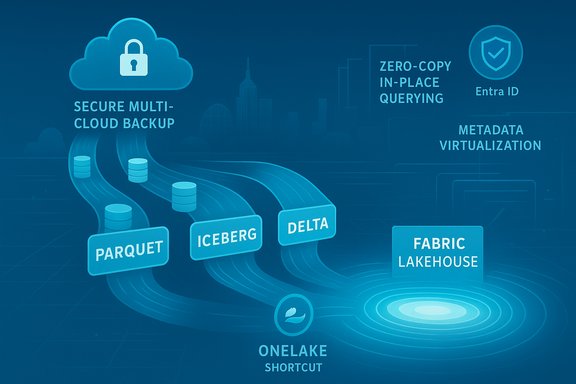
Database backups are a compliance and continuity lifeline for enterprises, but they have long been treated as inert archives: stored to satisfy recovery objectives and legal retention, then left untouched. That separation forces organizations to maintain duplicate copies of data — one for production and one or more for analytics, reporting, or model training — driving storage bills and operational complexity. Eon’s proposition is to collapse that gap by making backups themselves first‑class, queryable data assets, surfaced directly into Microsoft Fabric and OneLake as open table formats that analytics and AI services can read without rehydration or ETL. Microsoft’s OneLake is designed as a tenant‑wide, unified data lake with support for open formats (Parquet, Delta, Iceberg) and mechanisms for "shortcuts" and metadata virtualization that let services access external storage locations as if they were native Fabric tables. OneLake exposes table APIs compatible with Iceberg and Delta metadata standards, which enable third‑party engines to read table metadata and query data in place. These platform capabilities are the technical foundation Eon relies on to deliver zero‑copy queryability of backups inside Fabric. Eon’s public messaging — and the recent press distribution picked up by trade outlets — frames the integration as a way to lower cloud storage costs, accelerate time‑to‑insight for analytics and AI projects, and preserve enterprise security and governance boundaries by keeping backups in the customer’s tenancy. Eon’s product pages describe automatic conversion of backups into Apache Iceberg or Delta/Parquet artifacts and the use of OneLake Shortcuts to expose those artifacts to Fabric workloads. How the integration works — technical anatomy
1. Backup ingestion and table generation
Eon connects to a tenant’s cloud backup vaults (Azure, AWS, GCP) and converts snapshots and backup artifacts into open table formats (Apache Iceberg or Delta Lake) stored as Parquet files with associated metadata. This conversion includes schema inference, type conversion, and the generation of metadata logs so that standard engines and query clients can understand the data structure without custom transforms. The produced tables represent point‑in‑time and historical views of the original databases, versioned and cataloged for discovery.2. OneLake visibility via shortcuts and metadata virtualization
Once backup data is represented as Iceberg/Delta artifacts in object storage, Eon creates OneLake Shortcuts (or integrates via OneLake’s supported external sources) to make those locations visible inside a Fabric lakehouse or KQL database. Microsoft OneLake’s metadata virtualization layer can present Iceberg tables as Delta tables (and vice versa) so Fabric engines — SQL, Spark, Power BI, and AI Foundry — can query backup data natively. OneLake also offers table API endpoints that support Iceberg REST Catalog (IRC) and Unity Catalog–compatible endpoints, enabling third‑party engines to interact with OneLake metadata programmatically.3. Live query without rehydration
Fabric workloads query the tables in place — no rehydration, no ETL pipeline, no separate analytics copy. Query requests reference OneLake paths (shortcuts) and Fabric translates or virtualizes the storage metadata so engines can execute reads directly against the backup artifacts. In this model, the backup copy becomes a live bronze layer for analytics and model training while remaining functionally a backup for recovery operations.4. Governance and protection
Eon states that access is governed using Entra ID (Azure AD) and Fabric’s security model; object immutability, encryption at rest/in‑transit, and anomaly detection are applied to ensure backups remain secure and tamper‑resistant. OneLake and Fabric provide cataloging, lineage, and workspace‑level RBAC that enterprises can use to enforce separation of duties between recovery and analytics teams. However, the implementation details and scope of identity‑aware access must be validated during evaluation because platform behavior differs by workspace, connection type, and engine.What this changes for enterprises — potential upside
- Cost efficiency through zero‑copy analytics. By avoiding a separate analytics copy of production data, organizations can reduce redundant storage and the compute needed for ETL and rehydration. Eon markets potential storage reductions (the press messaging claims “up to 50%” savings in cloud storage) by eliminating duplicate analytics copies and using incremental‑forever, deduplicated storage representations. That figure is vendor‑stated and will vary by workload and retention policies; it requires careful validating in a proof‑of‑concept.
- Faster time to insight. Teams can query historical point‑in‑time snapshots for lineage checks, retrospectives, training data for models, and forensic analyses immediately, without waiting for ETL jobs or restore windows. This lowers time‑to‑value for data science and BI projects that need historical fidelity.
- Single source of truth for historical state. Backups retain the original transaction order and point‑in‑time integrity that many analytic reconstructions approximate. Making backups queryable preserves that fidelity for audits, compliance, and model training where historical correctness matters.
- Multicloud continuity. Eon’s platform advertises support across Azure, AWS, and GCP; by presenting those backup artifacts into OneLake (or other lakehouses), a unified analytics surface can be maintained across cloud boundaries while keeping the protected copies securely under the organization’s control.
- Enables new AI workflows. Backups are a dense source of labeled, historical event data — useful for anomaly detection, forecasting, supervised model training, and agentic workflows. When backups are queryable and cataloged, ML teams can iterate faster on feature extraction and experiments without spinning fresh copies.
Critical analysis: strengths, limitations, and open questions
Strengths
- Technical fit with Fabric/OneLake. Microsoft’s OneLake supports Iceberg and Delta formats, metadata virtualization, and table APIs that make read‑in‑place patterns possible; the platform design intentionally enables zero‑copy integrations with partner systems. This provides a real technical path for backup‑as‑data scenarios.
- Vendor momentum for zero‑copy ecosystem. Multiple independent vendors (Celonis, Fivetran, Confluent, Reltio and others) have announced zero‑copy or OneLake integration stories with Microsoft Fabric this year, demonstrating market alignment around reducing data duplication and accelerating AI/analytics. The repeated presence of this pattern in partner announcements shows that the platform is being used for exactly this class of capability.
- Operational simplicity for data teams. Removing ETL and rehydration reduces engineering overhead and the maintenance cost of data pipelines; when backups are maintained in open formats, standard tools can operate on them without bespoke connectors.
Limitations and risk areas
- Vendor claims vs. customer reality. Claims such as “cut cloud storage costs by up to 50%” are device‑and‑workload dependent. Savings are driven by whether organizations maintain separate analytics copies today, their deduplication efficiency, retention policies, and the cost profile of their cloud storage tiers. Those numbers should be treated as estimates until validated in a representative pilot with production retention and query characteristics.
- Performance and cost tradeoffs. Querying cold or deep‑archive snapshots in place can incur higher per‑query latency and different egress/bandwidth costs depending on storage tiers, network location, and engine optimizations. Enterprises must model query patterns: frequent ad‑hoc queries across large historical snapshots may still be more cost‑effective if pre‑aggregated or moved to hot analytics storage. OneLake shortcuts reduce duplication but do not magically remove the compute/IO costs associated with scanning large datasets.
- Consistency and application‑aware restores. Database backups must preserve transactional and application consistency for recovery purposes. Converting backups to queryable tables is valuable, but teams must ensure that the conversion process does not alter the semantics required for point‑in‑time restores or violate RPO/RTO guarantees. The platform must support application‑consistent snapshots, and organizations should maintain tested restore playbooks that remain usable alongside the analytics layer. This is a place where marketing gloss often omits important operational nuance; technical validation is essential.
- Security and privileged access risks. Making backups queryable broadens the surface area for data access. Recovery copies are often kept more tightly controlled and isolated (air‑gapped, immutable) specifically to reduce the risk of ransomware or insider threats. Exposing those copies to analytics — even read‑only — requires careful RBAC, logging, SIEM integration, and the assurance that analytic workloads cannot cause accidental or malicious modification of backup assets. Fabric/OneLake provide governance tools, but enterprises must map these into their security posture and run least‑privilege tests.
- Regulatory and retention conflicts. Backups often have different retention and legal hold semantics than operational analytics datasets. Presenting backups to analytics teams risks accidental exposure of data that should remain under restricted retention or discovery controls. Integration must preserve retention labels, legal holds, and eDiscovery controls, or organizations may face compliance exposure.
- Operational ownership and cost allocation. If backup storage becomes a multi‑purpose asset, finance and engineering must rework chargeback and FinOps models: who pays for backup storage when used for ML training? Which budget lines absorb compute costs for large analytic scans of backups? Absent clear policies, teams can inadvertently shift costs or create contention between SRE/ops and analytics groups.
Verification checklist — what procurement and architecture teams should validate
- Run a small pilot with representative backup datasets and realistic retention windows; measure end‑to‑end storage and query costs for typical analytic workloads.
- Confirm application‑consistent snapshot behavior and validate point‑in‑time restore procedures alongside analytics access; perform DR tabletop and live restores.
- Validate identity and access integration: ensure Entra ID roles, delegated shortcuts, and Spark/SQL execution contexts enforce least privilege across analytic consumers.
- Measure query latency and IO profiles from Fabric engines against backup artifacts in the expected storage tier (hot vs. cool vs. archive).
- Validate immutable/air‑gapped vault configurations remain intact and cannot be accidentally modified or deleted through Fabric shortcuts or APIs.
- Check OneLake table API support in your region and workspace (preview vs GA features can have different behaviors and limitations).
- Model FinOps: who is billed for storage vs compute vs egress; create cost allocation rules and thresholds.
- Audit for compliance: map retention policies and legal holds across backup artifacts exposed to OneLake.
- Review vendor SLAs for backup integrity, metadata correctness, and restore guarantees.
- Review third‑party independent benchmarks or case studies (if available) that show end‑to‑end results for workloads similar to yours.
Real‑world context and industry validation
OneLake and Microsoft Fabric have been positioned by Microsoft as a platform meant to reduce data duplication and support zero‑copy integrations. Multiple partners and ISVs have already announced zero‑copy or OneLake integrations (Celonis, Fivetran, Reltio, Confluent), illustrating that the architectural approach Eon is following is consistent with other vendor strategies to reduce ETL overhead and storage duplication. Those announcements frequently stress the same benefits Eon highlights: immediate query access, standard table APIs, and governance maintained by Microsoft Fabric. Eon itself is a well‑funded startup founded by members of the CloudEndure team and ex‑AWS migration and DR leaders; its funding and executive background have been publicly reported in industry press and PR channels, demonstrating the company has established venture backing and a leadership team with prior enterprise backup and migration experience. That background gives the project credibility while also underlining the importance of independent evaluation when adopting a platform that touches recovery posture. Community and enterprise examples using OneLake to create single, governed lakes — for example, corporate migrations that use mirroring and OneLake shortcuts to avoid copies — underscore that the OneLake model is already being applied to operational workloads and analytics. These case studies help show the feasibility of a backup‑as‑data approach but do not substitute for vendor‑specific proof points on restore reliability or precise cost savings.Practical deployment considerations and a short migration playbook
Pre‑deployment: define objectives
- Determine whether the goal is primarily cost reduction, faster analytics access, or enriched ML training data. Each objective requires different success metrics and validation steps.
- Inventory current backup sources, formats, retention policies, and ETL pipelines that would be replaced or augmented by the Eon+OneLake flow.
Pilot steps (1–6)
- Select a representative database workload (size, transaction rate, retention window).
- Configure Eon to write a mirrored Iceberg/Delta representation of recent and historical backups into an isolated storage account.
- Create a OneLake Shortcut to that storage and expose it to a Fabric workspace used by data engineers.
- Run a set of queries for typical analytics and model training data extraction; measure latency, IO, and cost.
- Run a restore test from the same backup artifacts to ensure recovery semantics are preserved.
- Verify governance controls, RBAC behavior, and audit logging for both analytics and restore operations.
Rollout and governance
- Update runbooks and emergency recovery playbooks to reflect the new discovery and access paths.
- Define FinOps rules for analytics queries that scan backup datasets: implement query limits, quotas, or access windows to control cost.
- Map retention and legal hold policies into the OneLake cataloging and enforce them via Purview/lineage technologies.
Bottom line
Eon’s integration with Microsoft Fabric and OneLake is a technically plausible and strategically interesting step toward dismantling a long‑standing barrier between backups and analytics. Microsoft’s OneLake platform explicitly supports the mechanisms (shortcuts, Iceberg/Delta metadata virtualization, and table APIs) required to expose storage‑resident artifacts as queryable tables, and Eon’s platform is built to convert backups into those artifacts so they can be used without duplicate copies. That alignment between platform capability and vendor implementation is the core reason this announcement is notable for enterprises running Microsoft‑centric analytics stacks. However, the headline promises — especially the claimed “up to 50%” storage savings — are vendor‑provided estimates that depend heavily on each customer’s current backup architecture, retention policies, and analytics patterns. Practical adoption requires careful pilots that validate restore semantics, governance controls, performance characteristics, and cost models in your environment. Enterprises that do their homework can reasonably expect to unlock meaningful savings and new AI/analytics use cases from dormant backup data, but the move should be pursued as a controlled program, not a drop‑in replacement for existing recovery and compliance practices.Eon’s broader messaging — backed by the company’s engineering pedigree and venture funding — indicates a clear market push to make backups actively useful rather than merely insurance. Organizations evaluating this approach should pair technical pilots with compliance and security reviews, treat vendor cost claims as starting hypotheses to validate, and ensure that recovery readiness remains inviolable as backup artifacts move into the analytics domain.
Source: The Manila Times Eon Collaborates with Microsoft to Turn Database Backups into a Growth Engine for Enterprises
