

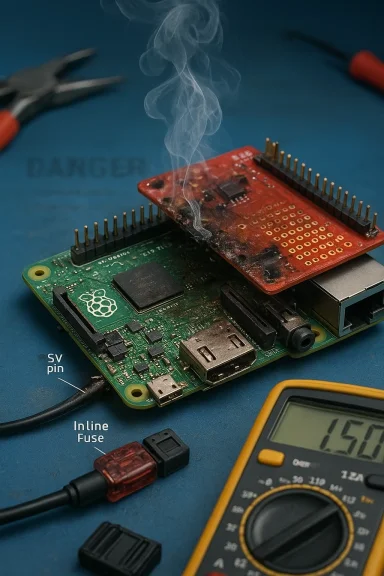
A Microsoft engineering manager's weekend tinkering ended with the smell of burning plastic and the all-too-familiar “magic smoke” rising from a Raspberry Pi 5 after a HAT was accidentally fitted the wrong way around — a small error with an expensive lesson attached. The incident, documented by the engineer on social posts and amplified by tech press, is a useful microcosm of a much larger set of tensions: the freedom and fragility of hobbyist hardware, the rise in component costs that makes mistakes costlier, and the perennial trade-offs between accessibility, standardisation, and electrical safety on single-board computers.
The Raspberry Pi family established its reputation by making capable, low-cost single-board computers accessible to hobbyists, educators, and prosumers. One of the platform’s enduring strengths is the 40‑pin General Purpose Input/Output (GPIO) header: a compact, general-purpose interface that lets HATs (Hardware Attached on Top) and other expansion boards add sensors, accelerators, power hatting, and custom circuitry.
Source: theregister.com Microsoft manager releases magic smoke from a Raspberry Pi
 Background
The Raspberry Pi family established its reputation by making capable, low-cost single-board computers accessible to hobbyists, educators, and prosumers. One of the platform’s enduring strengths is the 40‑pin General Purpose Input/Output (GPIO) header: a compact, general-purpose interface that lets HATs (Hardware Attached on Top) and other expansion boards add sensors, accelerators, power hatting, and custom circuitry.- The standard GPIO header exposes power rails (commonly 5V and 3.3V), ground pins, and a mixture of digital I/O and alternate-function pins (I2C, SPI, UART, PWM, etc.).
- HATs historically adhered to a formal specification that included an ID EEPROM and a mechanical footprint; newer iterations (HAT+) relax some mechanical constraints while adding features appropriate to Raspberry Pi 5 era hardware.
- HATs and add‑ons vary widely in electrical requirements: some simply provide a sensor or LEDs; others, like modern AI accelerators, contain their own memory and high‑performance chips that draw substantial power.
Why a backward HAT can kill a Pi
The header is powerful and unforgiving
The 40‑pin header gives the user direct access to supply rails. Unlike PC connectors that are mechanically keyed and include shrouds or keyed housings, many Raspberry Pi HATs rely on simple pin headers that can be mechanically symmetric. When a HAT is reversed, a 5V supply pin can line up with a data pin or a component that expects 3.3V or ground. Electronics don’t negotiate: they either survive or they don’t.Limited on‑board protection by design
Raspberry Pi single‑board computers prioritise cost, size, and compatibility. That design philosophy carries trade-offs:- Many GPIO pins are driven directly by the SoC or powered through the local power distribution without intermediate current limiting.
- On the host board, designers can add polyfuses, current sense, isolation, and supervisory chips — but every addition increases BOM cost and board complexity.
- HAT designers are expected to follow the HAT/HAT+ guidance (including cautions about back‑powering and recommended protection mechanisms), but the Pi itself historically relies on correct user behaviour rather than defensive, foolproof hardware.
The incident in context: not just “oops,” but systemic signals
Mistakes happen to everyone
Tinkering is inherently hands‑on and error‑prone. Engineers and maintainers at companies with massive hardware shops are often hobbyists off the clock — they make mistakes the same way the rest of us do. A Principal Engineering Manager at a major platform vendor frying a Pi is both humanising and a reminder that even experienced engineers can make elementary errors.The rising cost of error
Component pricing has shifted since the Pi’s heyday. Memory and other components have seen volatility driven by server and AI infrastructure demand. Where a Pi 5 4GB used to be a cheap sacrificial device for experimentation, recent price increases have made those lessons costlier. What used to be a $35 mistake can now be an $80–$200 mistake depending on the model and region.More powerful HATs increase risk surface
HATs are no longer just small sensor boards. Modern add‑ons — notably AI accelerators with dedicated memory and chips — bring higher power draws and additional rails. That raises two problems:- A miswired connection can route higher currents into pins that are not designed to handle them, leading to catastrophic failure.
- With increased onboard RAM and chips, replacements are more expensive, and the damage from a single mistake is correspondingly larger.
Technical anatomy: what goes wrong electrically
To understand the danger, you only need to follow a few simple electrical principles:- Most GPIO logic on Raspberry Pi devices runs at 3.3V. Feeding 5V into a GPIO pin can cause immediate over‑stress of transistors, latch‑up, or permanent damage to the SoC’s I/O bank.
- Power rails (5V and 3.3V) are often present on adjacent pins on the 40‑pin header. A reversed board can map the 5V pin to a data input or to the ID pins, back‑powering or shorting non‑power nets.
- If the HAT contains its own power supply or attempts to back‑power the Pi, the system needs diodes or ideal‑diode circuits to prevent current flowing into unintended places.
- Shorts or overcurrents may cause heat to build in small surface mount components (voltage regulators, MOSFETs, PMICs), causing smoke or component destruction in seconds.
What the hardware ecosystem currently recommends (and where gaps remain)
Raspberry Pi’s HAT guidance and mechanical specs include several practical recommendations:- HATs that may back‑power the Pi should include safety diodes or other topology to prevent conflicts if both the Pi and the HAT supply 5V.
- HATs should adhere to electrical rules for pins that might be driven during boot (to avoid contention).
- The HAT spec historically included an ID EEPROM to allow safe, automated configuration and to reduce misconfiguration; HAT+ expanded on mechanical issues for the Pi 5 era.
Practical guidance for hobbyists and IT pros: how to avoid the smoke
The good news is that many straightforward, low‑cost mitigations dramatically reduce the chance of frying your Pi.Before you plug anything in
- Always power the Pi down before adding or removing HATs or jumper wires. There’s no substitute for removing live power when rearranging connectors.
- Visually inspect orientation. Pin 1 on Raspberry Pi headers is marked on both the Pi and most HAT PCBs; align these marks. Take an extra second to confirm.
- Use a multimeter continuity check if you’re unsure how a header maps — confirm that the pins are where you expect before powering up.
Minimal hardware protections you can add (low cost)
- Fit an inline fuse on external 5V feeds. A cheap polyfuse or small glass fuse matched to the expected current will save the board from sustained overcurrent.
- Use a shrouded header or keyed connector on the HAT side. Shrouded housings and keyed ribbon cables eliminate the possibility of 180° flips.
- Add a series resistor or small MOSFET for critical data lines when you’re prototyping with unknown hardware to limit the current during accidental shorting.
- When using motors, solenoids, or inductive loads, always add flyback diodes and use driver circuits (MOSFET drivers, motor drivers) rather than feeding them directly from GPIO.
Software and configuration precautions
- Keep devices that use boot‑time signals (ID pins, pins used for UART boot messages, or those used by the Pi’s firmware) documented. Know which pins the HAT expects to use.
- Where possible, test HATs in a controlled environment (with current monitoring) to spot abnormal draws quickly.
Buy or demand safer designs
- Choose HATs that include mechanical keying, a shrouded header, or a PCB notch that makes improper orientation physically difficult.
- Prefer HATs that follow the HAT/HAT+ guidance on back‑powering protections and that document power draw clearly.
Recommendations for manufacturers and the Raspberry Pi Foundation
This sort of incident is a signal to industry as much as it is a caution to the end user. There are pragmatic steps vendors and standards bodies can take to lower the accident rate without losing the accessibility that made the platform successful.- Encourage or require clearer mechanical polarity markers and shrouded headers on HATs intended for general consumers.
- Consider optional, low‑cost protection on the host Pi for vulnerable rails: resettable polyfuses, a current sense that triggers a controlled shutdown, or sacrificial TVS diodes on vulnerable nets.
- Make power‑handling and mounting information more visible and prominent in product listings: list maximum currents, whether back‑powering is supported, and whether safety diodes are included.
- For particularly expensive HATs (high RAM AI accelerators and the like), insist on packaging and documentation that treat installation as a deliberate act: “Power down before connecting. Align Pin 1. Use standoffs.”
- Explore mechanical keying in future connector revisions that preserve compatibility but reduce the chance of 180° mating.
The wider implications: education, culture, and the value of “sacrificial” hardware
Hobbyist platforms succeed in part because they are forgiving: cheap parts allow experimentation. As component inflation places more advanced boards and add‑ons at a higher price point, two risks emerge:- New users may be priced out of trial‑and‑error experimentation, or they may be tempted to skip safeguards for cost reasons.
- Experienced users risk being lulled into complacency; high‑value failures sting more and have greater downstream impact when used in production or field systems.
Case study: AI HATs and the next generation of risk
The newest class of HATs — those marketed to run local generative AI workloads — changes the calculus. These boards can include accelerators, coprocessor memory, and higher thermal and power requirements.- They bring value by enabling local inference, privacy, and offline functionality.
- They bring risk because they have larger power envelopes and often present multiple rails and connectors that, misaligned, can cause larger failures.
What this episode teaches managers and organisations
For IT teams and managers who encourage hands‑on learning, this incident is a reminder to treat hardware training like other operational safety:- Provide clear, documented lab procedures for add‑on installation and removal.
- Maintain a small pool of low‑value spare boards for destructive testing and training.
- Ensure that staff working on prototypes know the layout of the Pi’s header and the risks of live‑hot plugging.
- Encourage the use of basic electrical testing equipment (multimeters, current clamps, bench supplies with current limiters) during prototype assembly.
When the smoke clears: assessing the damage and repairability
Not every “letting the magic smoke out” means permanent loss. Some failures are local (a blown regulator, a toasted MOSFET), while others kill the SoC or the PMIC and are terminal. Practical post‑mortem steps:- Remove power immediately and inspect visually for burned components, lifted traces, or bulging capacitors.
- Smell and look for localized hotspots — identify which component overheated first.
- If confident and experienced, test supply rails with the unit unpopulated (or with removed suspicious components) — but do not reapply power blindly.
- Consider professional repair for boards with scorch marks on the power management area; otherwise, replacement may be cheaper and safer.
Final thoughts: balancing openness, cost, and safety
The story of a Microsoft manager frying a Raspberry Pi after fitting a HAT backward is entertaining, but it also reveals real design tensions. The Pi ecosystem’s low cost, flexibility, and hacker‑friendly nature are its greatest strengths — and those same traits mean accidents will continue to occur. As add‑ons get more capable and more expensive, the community and manufacturers must evolve their practices.- Users should adopt basic electrical discipline: power down, verify orientation, and add cheap protections.
- Vendors should make safety easier: mechanical keying, clear documentation, and basic protection circuits where the cost/benefit favors them.
- Standards stewards should continue updating HAT/HAT+ guidance to reflect modern power profiles and the realities of higher‑power peripherals.
Source: theregister.com Microsoft manager releases magic smoke from a Raspberry Pi
