

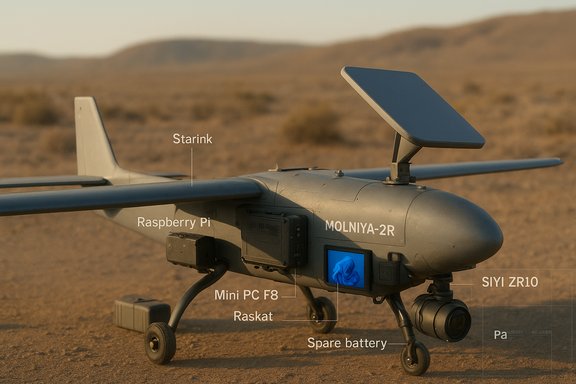
The Defence Intelligence of Ukraine has published a component-level breakdown of a newly observed reconnaissance variant of the Molniya family — the Molniya‑2R — showing a pragmatic recombination of commodity electronics, an industrial‑grade Chinese electro‑optical pod, and an off‑the‑shelf satellite terminal; the posted diagram and list specifically name a Raspberry Pi 5 SBC, a Chinese Mini PC F8 marketed under the Russian brand “Raskat” reportedly running a licensed installation of Windows 11, a SIYI ZR10 stabilized 10× optical‑zoom camera, and a Starlink satellite terminal to relay video and telemetry.
Russian improvised aerial systems built from widely available parts continue to evolve in the field. The Molniya family began as ultra‑cheap FPV strike / loitering munitions and has been iteratively modified for extended endurance and different mission roles. The Molniya‑2R — as described by Ukrainian intelligence — appears to be an ISR‑configured variant that shifts the platform from a single‑purpose kamikaze design toward multi‑sensor reconnaissance and remote targeting support.
Multiple open reporting streams have independently documented the emergence of Starlink‑equipped Russian UAVs across 2024–2025, and photographic evidence of mini‑Starlink terminals found attached to downed Molniya‑type airframes has been circulated in the public domain. That context makes the reported Molniya‑2R adaptation plausible even if some component‑level claims remain unverified.
At the same time, the use of consumer ecosystems (operating systems, cloud services, satellite networks) creates new touchpoints for defenders and investigators. If properly exploited, activation logs, telemetry routes and reseller records can help trace procurement flows. But that requires rapid and careful forensic work — ideally under multi‑national coordination — to turn recovered hardware into actionable intelligence.
The takeaway for technologists and defenders is straightforward: expect more battlefield innovation driven by commodity parts, invest in multi‑domain detection and forensics, and treat individual intelligence claims with appropriate caution until corroborated by recovered hardware, serials, or supply‑chain records.
The Molniya‑2R reporting underscores a simple but consequential reality: commercial computing, consumer satellite internet and accessible electro‑optical sensors are rapidly reshaping small UAV roles. That convergence presents both technical challenges for defenders and new opportunities for forensic attribution — but it also demands careful, evidence‑based verification of intelligence claims before drawing legal or operational conclusions.
Source: Мілітарний Molniya on Windows 11: Defence Intelligence of Ukraine Publishes List of Components of Molniya-2R Reconnaissance Drone - Militarnyi
 Background / Overview
Russian improvised aerial systems built from widely available parts continue to evolve in the field. The Molniya family began as ultra‑cheap FPV strike / loitering munitions and has been iteratively modified for extended endurance and different mission roles. The Molniya‑2R — as described by Ukrainian intelligence — appears to be an ISR‑configured variant that shifts the platform from a single‑purpose kamikaze design toward multi‑sensor reconnaissance and remote targeting support.Multiple open reporting streams have independently documented the emergence of Starlink‑equipped Russian UAVs across 2024–2025, and photographic evidence of mini‑Starlink terminals found attached to downed Molniya‑type airframes has been circulated in the public domain. That context makes the reported Molniya‑2R adaptation plausible even if some component‑level claims remain unverified.
What the Ukrainian intelligence posting shows
The published interactive diagram (reproduced in press summaries) lists and maps the following key components for the Molniya‑2R:- A Raspberry Pi 5 single‑board computer used as one of the onboard controllers.
- A Chinese Mini PC identified locally as “Mini PC F8” and branded in reporting as Raskat (New IT Project LLC), described as running a licensed Windows 11 installation.
- A SIYI ZR10 electro‑optical pod: a small, three‑axis stabilized camera with 10× optical zoom and up to hybrid zoom capability for long‑range identification.
- A Starlink satellite user terminal used to relay high‑bandwidth video, telemetry, and -- reportedly -- control commands beyond line of sight.
Technical verification and independent corroboration
This section cross‑checks the most important technical claims and notes where independent confirmation exists or is lacking.SIYI ZR10 camera: verified product and capabilities
The SIYI ZR10 is an existing commercial UAV electro‑optical pod widely listed by industrial drone vendors. Multiple product pages show:- 10× optical zoom (with higher hybrid/digital zoom ranges),
- 3‑axis gimbal stabilization,
- Support for RTSP streaming and Ethernet output,
- Lightweight construction (sub‑0.5 kg in listed specs) and power consumption in the single‑watt to low‑tens‑of‑watts range — making it suitable for medium‑sized UAVs.
Starlink satellite terminals on drones: multiple independent reports
Field reporting and imagery of Starlink or Starlink‑style mini terminals affixed to Molniya‑type drones have been publicly circulated and analysed throughout 2024–2025. Credible defence outlets and OSINT investigators have documented instances of drones with consumer Starlink hardware attached, and analysts have repeatedly warned that satellite user terminals materially change the reach and resilience of small UAVs. These observations corroborate the general practice of using consumer satellite terminals for extended beyond‑line‑of‑sight links, even where geofencing or export controls are nominally intended to prevent battlefield misuse.Raspberry Pi 5 plausibility and specs
The Raspberry Pi 5 is a mainstream single‑board computer with significantly higher compute, media, and I/O capacity than predecessors (Broadcom BCM2712, quad‑core Cortex‑A76, USB3, PCIe 2.0 x1 option, and multiple MIPI lanes). Its capability profile makes it an attractive, low‑cost choice for on‑platform tasks such as sensor interfacing, light video processing, and telemetry aggregation. Public specifications and reviews confirm the Pi 5’s suitability for moderate mission compute tasks, and hobbyist/industrial communities have documented using Pi models for UAV control and payload handling. That makes the claim that a Raspberry Pi 5 is used for some control or sensor‑fusion role aboard Molniya‑2R technically plausible.The Windows 11 / Raskat mini‑PC claim: unverified and needs caution
The most sensitive and consequential claim in the Ukrainian diagram is that a Chinese Mini PC F8, branded locally as Raskat (New IT Project LLC), is present and runs a licensed Windows 11 instance. At present:- The Windows 11 claim is reported by the Ukrainian intelligence summary and by press outlets that republished the GUR diagram, but open photographic evidence or supply‑chain records proving a licensed Windows activation on an in‑theatre mini‑PC have not been published.
- Searches for the specific vendor/model names (Raskat, Mini PC F8, Raskat Start 107) return no independent manufacturer pages, product registrations, or vendor listings that confirm the mini‑PC is a mass‑market product or that document Windows OEM licensing for such a SKU. This suggests the model name could be a small‑run rebrand or a local label, or it could be mis‑identified in the intelligence summary.
Why using commodity Windows on a tiny UAV matters
If a full, properly licensed Windows 11 instance were present on a fielded small UAV, it would be notable for several reasons:- Operational footprint: Windows 11 is a general‑purpose desktop OS with higher memory, storage, and CPU requirements compared with lightweight embedded Linux or RTOS stacks. Running Windows typically implies an x86 mini‑PC or similarly capable module rather than a simple microcontroller or SBC. That increases size, weight, power (SWaP) penalties and therefore affects endurance.
- Software ecosystem: Windows brings easy access to off‑the‑shelf imaging, compression, and telemetry software — a pragmatic benefit for rapid conversions. But this convenience comes with costs: update mechanics, driver complexity, and a larger attack surface.
- Traceability: Many Windows installations interact with Microsoft services (activation, telemetry, update servers). Even air‑gapped or disabled network stacks can leave forensic evidence on recovered storage media. That creates potential avenues for attribution or supply‑chain investigation if devices or serials are recovered.
- Vulnerability surface: A full desktop OS is exposed to a broad class of vulnerabilities and misconfigurations that embedded stacks typically avoid. In contested environments, that can be a tactical liability if the device is exposed to remote exploitation or simply becomes unstable under thermal/EM interference.
Tactical and operational implications
What satellite connectivity changes
Integrating a Starlink user terminal into an otherwise short‑range loitering platform changes the operational calculus:- It extends command and control beyond line of sight, enabling remote observers to maintain connectivity while the drone traverses electronically contested environments.
- It reduces the effectiveness of conventional local RF jamming aimed at VHF/UHF and LOS datalinks; the satellite path is a different domain for EW interference and requires different countermeasures.
- It supports higher‑bandwidth sensor feeds, enabling stabilized optical pods like the ZR10 to stream near‑real‑time imagery for target identification or battle damage assessment.
Effects on defenders and C‑UAS
The combination of stabilized zoom optics and satellite relay means defenders face a layered problem:- Detection must be improved (radar, acoustic, optical fusion) to spot small aircraft earlier in the engagement envelope.
- EW becomes more complex: jamming local links remains useful, but satellite‑based links require other approaches such as signal intelligence to detect unique bootstrap patterns or kinetic/soft‑kill measures to neutralise the platform.
- Forensics and interdiction: recovering hardware and storage is valuable because supply‑chain and licensing traces (if present) can enable attribution and legal pressure on intermediaries or vendors.
Strengths, limitations and risks of the Molniya‑2R approach
Strengths
- Rapid conversion using commodity parts makes production inexpensive and scalable.
- Starlink (or similar SATCOM) increases operational range and persistence compared with LOS‑only Molniya variants.
- A stabilized 10× optical pod dramatically improves target identification compared with standard FPV cameras, enabling precision ISR and refined strike correction.
Limitations
- Power and weight penalties: mini‑PCs and satellite terminals add mass and increase energy draw, reducing endurance.
- Detectability and forensic residue: consumer OSes and activated licences can leave logs and network traces.
- Reliability under contest: satellite links can be affected by orientation, weather, and initialization delays.
Strategic risks
- The use of widely available commercial parts lowers the barrier for proliferation and duplication; once a concept is fielded, it spreads rapidly because components are globally sourced.
- If a licensed Windows install is proven, it raises legal and supply‑chain tracing opportunities which might result in formal investigations or commercial interventions — but that requires the recovery of serial numbers or vendor records.
Recommendations for analysts and defenders
- Prioritise rapid forensic capture: photograph and preserve any recovered mini‑PCs, SBCs, storage media and satellite terminal serials under chain of custody. Extract OS images, drivers and activation metadata.
- Expand multi‑sensor detection investments: fuse radar, acoustic and optical sensors to detect small UAVs earlier and track them through handovers.
- Improve supply‑chain disruption efforts: identify intermediaries supplying consumer SATCOM and niche mini‑PC hardware and coordinate legal and diplomatic pressure to disrupt illicit procurement channels.
- Harden forensic and attribution capabilities: log and correlate activation patterns, IMEIs, serials and any telemetry that can be matched to vendor or reseller records. This is especially important if mainstream OS instances are found on recovered devices.
What remains unverified — and why it matters
The intelligence summary contains several statements that require independent confirmation before being treated as established facts:- The specific mini‑PC model “Mini PC F8” and the branding “Raskat”: no independent vendor pages, product registrations, or retail listings have been found that clearly identify these SKUs. This could reflect a small‑batch local rebrand or a misidentification.
- The claim that Windows 11 installed on the mini‑PC is a licensed copy: proving a license would require recovered activation metadata, vendor invoices, or other supply‑chain documentation. At present the assertion appears only in the GUR‑derived public summary and republished reporting. Treat this detail as provisional.
- Direct photographic evidence of the specific mini‑PC showing Windows branding, activation dialogs, or serials: up‑to‑date open imagery has shown Starlink terminals and EO pods on Molniya bodies, but images explicitly exposing the alleged mini‑PC internals or storage snapshots are not publicly available.
Broader context: commodity hardware and the modern battlefield
The Molniya‑2R is an example of a wider trend: the battlefield is increasingly populated by systems created from readily available, dual‑use components — SBCs, mini‑PCs, commercial cameras, and consumer SATCOM. That modular approach shortens the innovation loop: field technologists can prototype and iterate quickly, producing capability leaps by combining existing parts rather than by developing entirely new, bespoke systems. That makes detection, interdiction and policy responses harder, because supply chains are global and parts are commonly sold into many markets.At the same time, the use of consumer ecosystems (operating systems, cloud services, satellite networks) creates new touchpoints for defenders and investigators. If properly exploited, activation logs, telemetry routes and reseller records can help trace procurement flows. But that requires rapid and careful forensic work — ideally under multi‑national coordination — to turn recovered hardware into actionable intelligence.
Final assessment and caution for readers
The Defence Intelligence of Ukraine’s component listing for the Molniya‑2R documents an important capability trajectory: small, inexpensive airframes armed with high‑quality optics and satellite connectivity can serve as low‑cost ISR platforms that materially increase reach and lethality. The SIYI ZR10’s specifications and the repeated open reports of Starlink terminals on Molniya‑type drones support the core operational narrative. However, the most sensational component of the published list — a Raskat Mini PC F8 running a licensed Windows 11 — remains unverified in open sources. Treat that detail as a reported intelligence claim that requires photographic or forensic confirmation before assuming the legal and attribution implications that a licensed Windows install would carry.The takeaway for technologists and defenders is straightforward: expect more battlefield innovation driven by commodity parts, invest in multi‑domain detection and forensics, and treat individual intelligence claims with appropriate caution until corroborated by recovered hardware, serials, or supply‑chain records.
Quick technical checklist for recoveries and analysis
- Photograph the full airframe and external payload mounts at high resolution.
- Preserve any storage media (microSD, eMMC, NVMe) and image them under chain‑of‑custody.
- Record and extract serial numbers from SATCOM terminals and mini‑PCs; request vendor trace logs where lawful.
- Capture RF emissions and antenna construction details for satellite terminal identification.
- Note power architecture and battery chemistry for supply‑chain tracing.
The Molniya‑2R reporting underscores a simple but consequential reality: commercial computing, consumer satellite internet and accessible electro‑optical sensors are rapidly reshaping small UAV roles. That convergence presents both technical challenges for defenders and new opportunities for forensic attribution — but it also demands careful, evidence‑based verification of intelligence claims before drawing legal or operational conclusions.
Source: Мілітарний Molniya on Windows 11: Defence Intelligence of Ukraine Publishes List of Components of Molniya-2R Reconnaissance Drone - Militarnyi
