

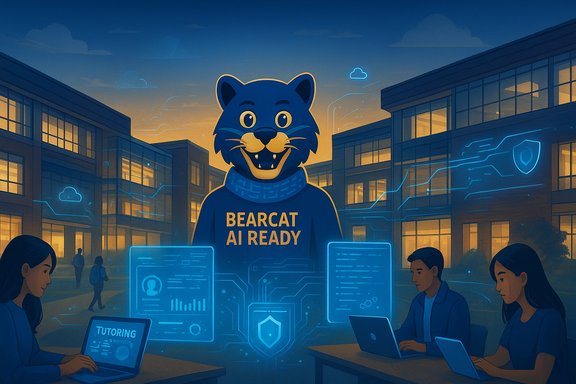
The University of Cincinnati is moving from AI curiosity to campus-wide capability with a coordinated program of initiatives branded Bearcat AI Ready!, a set of academic, research and operational efforts designed to make students, faculty and staff confident users, builders and governors of artificial intelligence across the institution.
The Bearcat AI Ready! campaign is the latest, institution-level push from UC’s Digital Technology Solutions (DTS) to accelerate digital transformation by combining tool access, pilot programs, governance structures and organized literacy efforts. The program builds on earlier work at UC — notably a university-hosted OpenAI/GPT pilot (BearcatGPT) running in a managed Azure environment — and the launch of an AI Enablement Community of Practice intended to coordinate cross-campus AI activity. UC leadership frames the effort as a leap from being merely “AI-fluent” toward becoming truly AI-ready: operationalizing AI in a way that’s secure, auditable and pedagogically sound. Vice President & Chief Digital Officer Bharath Prabhakaran said the initiative is intended to “support responsible, innovative AI adoption across the institution that will help accelerate UC’s efforts to enhance student success and streamline university processes.” This article examines what Bearcat AI Ready! actually includes, why UC is pursuing this path now, what technical and governance choices matter, and where the project’s benefits and risks lie for higher education institutions that are watching closely.
Source: University of Cincinnati Bearcat AI Ready! initiatives to accelerate digital transformation at UC
 Background / Overview
The Bearcat AI Ready! campaign is the latest, institution-level push from UC’s Digital Technology Solutions (DTS) to accelerate digital transformation by combining tool access, pilot programs, governance structures and organized literacy efforts. The program builds on earlier work at UC — notably a university-hosted OpenAI/GPT pilot (BearcatGPT) running in a managed Azure environment — and the launch of an AI Enablement Community of Practice intended to coordinate cross-campus AI activity. UC leadership frames the effort as a leap from being merely “AI-fluent” toward becoming truly AI-ready: operationalizing AI in a way that’s secure, auditable and pedagogically sound. Vice President & Chief Digital Officer Bharath Prabhakaran said the initiative is intended to “support responsible, innovative AI adoption across the institution that will help accelerate UC’s efforts to enhance student success and streamline university processes.” This article examines what Bearcat AI Ready! actually includes, why UC is pursuing this path now, what technical and governance choices matter, and where the project’s benefits and risks lie for higher education institutions that are watching closely.What Bearcat AI Ready! comprises
Core pillars
UC’s program stacks together several discrete but coordinated efforts. At a minimum, the visible pillars are:- Enterprise pilots and managed model environments — including BearcatGPT, UC’s private OpenAI/GPT pilot running inside Microsoft Azure to keep inference and telemetry under university tenancy.
- Tool provisioning and access — university-supplied access to productivity and creative AI tools (Microsoft Copilot for Microsoft 365, Zoom AI companion, Adobe Firefly licenses for qualified users), making sanctioned tools available through UC credentials.
- AI Enablement Community of Practice — a cross-functional group to coordinate pilots, pedagogy, procurement, and policy across academic, research and administrative units.
- Student success programs — course- and discipline-focused pilots such as adaptive tutoring, personalized guidance and learning-assist agents intended to reduce failure rates in STEM gateway courses.
- Governance, procurement and training — policies, procurement rules and training pathways for staff and faculty to ensure a phased, risk-managed adoption.
Selected components explained
- BearcatGPT Pilot: A UC-only OpenAI/GPT environment hosted on Azure that enables controlled experimentation across teaching, research and administrative use cases; DALL·E image generation has been added to the pilot environment to broaden testing for visual pedagogy and communication.
- Microsoft Copilot and productivity copilots: UC has provisioned Copilot and other productivity copilots for staff and — in some cases — for students through licensed pathways, which helps reduce the risk of users defaulting to consumer services with unknown data policies.
- Bearcat Achieve-style learning pilots: Adaptive tutoring and course-level AI interventions for high-risk STEM courses are being prototyped to increase engagement and reduce drop/failure rates for foundational content. These are tied to pedagogical redesign and faculty training to minimize integrity issues.
Why UC is accelerating now
Demand and strategic timing
Three forces are converging that make this the moment for a campus-scale push:- Student and staff demand: Students are already using consumer generative AI in study workflows; institutions that don’t provide managed, equitable alternatives risk widening access gaps and losing control over institutional data flows.
- Operational efficiency pressures: Administrative workloads and service-demand volumes are prime targets for task automation with AI (knowledge bases, triage, drafting); universities can capture measurable ROI if pilots are disciplined and monitored.
- Sector guidance and standards maturity: Practical frameworks from bodies such as EDUCAUSE and the NIST AI Risk Management Framework provide institutions with a playbook to govern AI responsibly; they make enterprise adoption less speculative and more actionable.
Institutional readiness
UC signals readiness by tying AI work to established digital leadership and organizational structures: the Digital Technology Solutions team, a chief digital officer with enterprise transformation experience, and an AI Enablement Community of Practice to coordinate cross-campus activity. Those are the governance and capability layers needed to move from pilots to scaled services.Technical and governance choices that matter
Deploying generative AI at scale in a university setting requires several explicit technical and contractual decisions. UC’s choices — and those it should prioritize — include:- Tenant-contained model hosting and private endpoints. Running model inference inside the university’s Azure tenant (as UC’s BearcatGPT pilot does) keeps data within institutional controls and improves traceability. This approach reduces exposure to public model telemetry flows but does not eliminate risk unless contracts specify data retention and non-training guarantees.
- Identity, access and role-based controls. Integrating campus identity (single sign-on/Entra ID) and strict role-based access reduces accidental sharing and enforces least-privilege for administrative or research workloads. This should be a gating step before broad agent or chatbot publishing.
- Comprehensive logging and immutable audit trails. To be auditable, systems must keep logs of prompts, outputs, user context and retention decisions that support incident investigations, research reproducibility, and compliance reporting.
- Contractual guarantees from vendors. Vendor marketing claims (non-use of prompts for training, deletion guarantees) are only useful when enforced in contracts, including audit rights and telemetry visibility. Procurement must prioritize verifiable commitments.
- Tiered deployment model. Different tiers for open/public experimentation, enterprise productivity, and sensitive-research-ready deployments allow universities to apply the right technical baseline for each use case and balance cost, governance and functionality.
Pedagogy, assessment and academic integrity
The pedagogical imperative
Integrating AI into teaching requires more than providing tools: it demands pedagogy redesign. EDUCAUSE and other sector guidance urge institutions to make AI literacy part of curricula, train instructors, and redesign assessments so that AI augments learning instead of masking lack of mastery. UC’s focus on workshops, faculty development and pilot courses fits this guidance.Practical classroom changes
- Require process evidence — drafts, annotated AI interactions, and reflections — alongside final submissions.
- Introduce staged assessments and oral defenses for high-stakes evaluation.
- Standardize brief AI-disclosure statements that accompany student submissions, describing tools used and level of assistance.
- Provide equal access to sanctioned AI resources during assignments so disadvantage is not introduced by paywalled consumer tools.
Benefits UC is pursuing
The institution articulates concrete gains it expects from Bearcat AI Ready!:- Improved student outcomes through personalized tutoring and adaptive learning that target weak points early.
- Operational efficiencies in administrative workflows (admissions triage, student services, HR onboarding) that free staff time for higher-value tasks.
- Research acceleration using private model environments for literature synthesis, code generation, and data-driven exploration while protecting sensitive research data.
- Workforce readiness by embedding AI competencies in curricula and co-curricular offerings.
Risks, unresolved questions and caveats
No institutional AI program is risk-free. The primary concerns UC — and every campus — must actively manage are:- Data privacy and telemetry leakage. Tenant-contained deployments reduce but do not eliminate telemetry exposure (logging services, vendor-managed connectors and third-party plugins can still leak data unless explicitly controlled and audited). Contracts must provide deletion, non-training clauses, and audit rights.
- Hallucinations and accuracy. Generative models produce fluent but sometimes incorrect outputs. When used for study aids, advising or clinical/research workflows, outputs must be verified, and humans must remain in the decision loop.
- Vendor lock-in and curriculum conditioning. Heavy reliance on a single vendor’s API or platform can make curricular artifacts and student skills less portable across toolchains. Institutions should prioritize vendor-agnostic literacy and insist on data portability.
- Costs and consumption management. Cloud-based model inference at scale can generate unpredictable bills. Cost controls, chargeback models and consumption limits are essential before broad rollouts.
- Equity and accessibility. Simply providing an AI tool does not solve device, bandwidth or disability-access gaps. Deployments must be accompanied by device-lending programs, accessible design, and alternative learning paths.
- Academic-skill atrophy. Overreliance on AI for final draft production can erode critical thinking and writing skills; faculty must design assignments that evaluate reasoning, not just a polished artifact.
How UC’s approach aligns with best practice
UC’s public statements and the specific technical choices described match widely recommended best practices for higher education AI adoption:- Governance-first, pilot-led scaling: Establish an oversight body, run small, measured pilots, and scale only after demonstrating measurable outcomes and security/compliance. This is consistent with EDUCAUSE action plans and the NIST AI RMF.
- Tenant-contained model hosting plus enterprise tooling: UC’s BearcatGPT pilot inside Azure follows the recommended pattern of keeping institutional data in controlled cloud environments while testing use cases. This reduces public-data exposure and supports auditability.
- Training + pedagogy integration: UC’s Community of Practice and faculty-development efforts reflect EDUCAUSE’s recommendation to pair tool rollout with AI literacy and assessment redesign.
- Procurement discipline: The emphasis on enterprise licensing and integrated identity reduces ad hoc use of consumer tools, aligning with procurement guidance across the sector.
Practical recommendations and next steps (for UC and peer institutions)
- Create a measurable pilot playbook that defines:
- Clear KPIs (student learning outcomes, response-time metrics, staff time-saved).
- Risk acceptance criteria and go/no-go gates.
- Required contractual clauses for vendor non-use of prompts for training, deletion and audit rights.
- Enforce identity and RBAC before public launches:
- Integrate campus SSO/Entra ID.
- Enforce least privilege and MFA for admin roles.
- Operationalize logging and auditability:
- Capture prompt/response traces with retention rules tied to data-classification policies.
- Build dashboards to monitor usage, drift, and anomalous behavior.
- Pair tool access with required literacy modules:
- Make short, mandatory AI literacy modules for incoming students and new staff.
- Offer role-specific labs for faculty and professional services.
- Implement cost governance:
- Set consumption caps, tagging and internal chargeback models to prevent runaway cloud bills.
- Design assessment reforms:
- Use staged submissions, reflective annotations of AI usage and oral components for high-stakes evaluations.
- Maintain vendor-agnostic competencies:
- Teach AI concepts, verification practices and prompt evaluation that transfer across platforms.
What success will look like — and how to measure it
A successful Bearcat AI Ready! rollout should show measurable improvements in both learning and operations while keeping controllable risk. Useful metrics include:- Student learning metrics: reduction in failure rates for pilot courses, improved formative feedback frequency, satisfaction scores for tutoring interventions.
- Operational metrics: decreased average response times for student services and percentage of repetitive queries handled by agents with human-in-the-loop thresholds.
- Governance metrics: volume of auditable prompts logged, percent of deployments with documented privacy/retention contracts, number of security incidents attributable to AI integrations (target: zero major incidents).
- Equity metrics: usage and outcome disaggregated by demographic groups to detect unintended disparities.
Critical analysis: strengths and blind spots
Notable strengths
- Strategic alignment: UC has paired leadership, pilots and a coordinating Community of Practice — the organizational ingredients that make sustained transformation realistic.
- Technical prudence: Tenant-contained BearcatGPT demonstrates an appropriate focus on data governance before mass rollouts.
- Pedagogy-aware approach: Embedding faculty development and piloting learning applications acknowledges the pedagogical complexity of AI adoption.
Potential blind spots and risks
- Overreliance on vendor ecosystems: Although Azure-tenant deployments reduce risk, heavy architectural dependence on a single cloud and model stack can create longer-term porting costs and curricular lock-in. Institutions must design for portability.
- Operational scaling pressures: The step from pilots to campus-scale services often reveals hidden costs (compute, staff, security) that can outstrip optimistic ROI projections; rigorous cost-management constructs are essential.
- Governance bandwidth: Creating policies is straightforward; sustaining enforcement and auditing across decentralized departments is the harder work and will require continuous funding and attention.
- Measuring learning impacts: Demonstrating causal learning gains from AI interventions is difficult; well-designed experiments (A/B testing, randomized rollouts) and academic research are required to separate novelty effects from durable learning improvements.
Conclusion
Bearcat AI Ready! is a mature, multi-pronged attempt by the University of Cincinnati to harness generative AI and associated tools for student success, research acceleration and operational improvement while retaining governance and pedagogical safeguards. The approach — tenant-contained pilots, coordinated cross-campus governance, and structured faculty development — aligns with leading sector guidance and risk-management frameworks. The initiative’s long-term success will hinge on several practical factors: rigorous procurement contracts that protect institutional data, measurable pilot KPIs that are publicly reported, continuous investment in faculty and staff AI literacy, and deliberate cost-control and audit mechanisms as deployments scale. If UC sustains both the technical guardrails and the pedagogical commitment, Bearcat AI Ready! can be a replicable model for research universities seeking to transform responsibly and equitably with AI.Source: University of Cincinnati Bearcat AI Ready! initiatives to accelerate digital transformation at UC
