

BearingPoint’s Dutch practice has been awarded the Microsoft Copilot Specialization, a recognition that cements the consultancy’s place among a growing roster of partners validated to deliver Microsoft 365 Copilot deployments, Copilot Studio extensions, Copilot Chat solutions and agentic integrations across enterprise environments.
Microsoft introduced the Copilot Specialization for partners as a formal way to recognise firms that can deliver end-to-end Copilot outcomes: advisory services, secure deployment, adoption and change management, and extensibility via Copilot Studio and agents. The specialization is designed to sit alongside Microsoft’s existing Solutions Partner designations and to act as a signal to enterprise buyers seeking validated expertise in Microsoft’s generative AI stack.
In the Netherlands, BearingPoint’s announcement follows a wave of partner certifications globally. The firm highlights a multidisciplinary, human-centric approach that combines technical delivery with change management and responsible AI practices, positioning its practice to address both the technical and organisational workstreams that determine Copilot project success.
This is especially relevant for sectors highlighted by BearingPoint — financial services, energy and retail — where data sensitivity, regulatory constraints and legacy application landscapes create unique challenges for Copilot deployments.
Organisations engaging a specialized partner like BearingPoint should expect a structured programme: readiness assessments, a pilot phase focused on high-value use cases, secure deployment and governance set-up, followed by a deliberate adoption and scaling plan. Ideally, that pathway will produce measurable efficiency gains and a durable operating model for Copilot-enabled work.
Organisations planning Copilot projects should treat the specialization as a strong starting point, then dig into references, architectures and adoption plans to ensure they get both fast value and a sustainable operating model for generative AI across their Microsoft 365 estate.
Conclusion
The Microsoft Copilot Specialization is reshaping how partners demonstrate generative AI delivery capability, and BearingPoint’s accreditation in the Netherlands brings a validated option to enterprises weighing Copilot adoption. The specialization raises expectations for skilling, verified customer impact and secure deployments; it also creates a pragmatic framework for buyers to evaluate partners. Success with Copilot will hinge on firms that combine technical integration with change management, robust governance, and measurable business outcomes — the very attributes BearingPoint emphasises as it expands Copilot readiness assessments, custom integrations and training offerings across the Dutch market.
Source: Consultancy.eu BearingPoint achieves Microsoft Copilot Specialization in the Netherlands
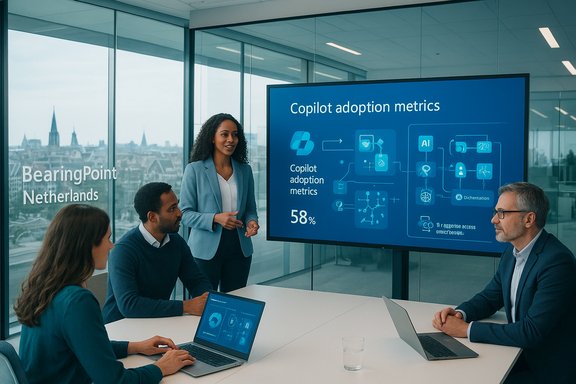 Background
Microsoft introduced the Copilot Specialization for partners as a formal way to recognise firms that can deliver end-to-end Copilot outcomes: advisory services, secure deployment, adoption and change management, and extensibility via Copilot Studio and agents. The specialization is designed to sit alongside Microsoft’s existing Solutions Partner designations and to act as a signal to enterprise buyers seeking validated expertise in Microsoft’s generative AI stack.In the Netherlands, BearingPoint’s announcement follows a wave of partner certifications globally. The firm highlights a multidisciplinary, human-centric approach that combines technical delivery with change management and responsible AI practices, positioning its practice to address both the technical and organisational workstreams that determine Copilot project success.
What the Microsoft Copilot Specialization actually is
A practical verification, not a marketing badge
The Copilot Specialization is a partner credential that goes beyond marketing: it requires measurable performance, certified skills among delivery staff, and verified customer outcomes. The specialization is typically active for a set period (renewed annually), and partners must meet thresholds across performance — such as measurable Copilot adoption metrics — skilling and documented customer references that demonstrate transformative outcomes, including at least one agent implementation.- Performance: Partners are required to show tangible Copilot adoption and growth metrics across customers.
- Skilling: Certified staff with specific Microsoft credentials and role-based courses are required to prove delivery capability.
- Customer references: Partners must supply verified references that show Copilot being used to transform workflows or processes, with real business outcomes.
Key capabilities the specialization tests
The specialization is structured to cover four core capabilities:- Advisory and readiness — framing use cases, governance and data readiness.
- Secure deployment — deploying Microsoft 365 Copilot in a way that respects security and compliance guardrails.
- Adoption and change management — driving user uptake and embedding Copilot into daily workflows.
- Extensibility and agents — customising Copilot Studio and building agentic solutions where Copilot acts as an orchestrator across systems.
Why BearingPoint’s achievement matters — locally and for enterprise buyers
A stronger signal for Dutch buyers
For public- and private-sector organisations in the Netherlands that already standardise on Microsoft 365, the specialization provides a clear procurement lever. BearingPoint’s accreditation means buyers can shortlist a partner on the basis of validated skills and references rather than solely commercial relationships.This is especially relevant for sectors highlighted by BearingPoint — financial services, energy and retail — where data sensitivity, regulatory constraints and legacy application landscapes create unique challenges for Copilot deployments.
Depth across business and people change
BearingPoint frames its differentiation as a multidisciplinary approach combining technology, deep industry knowledge and human-centred design. That combination aligns with emerging best practice for Copilot projects:- Technical integration without user adoption rarely yields ROI.
- Domain expertise helps surface high-value use cases for Copilot in complex processes (for example, credit adjudication in banking or compliance monitoring in energy).
- Human-centred design improves UX and reduces risky or unintended behaviours when generative AI is introduced.
Behind the badge: what Microsoft requires (and what that means in practice)
Microsoft’s partner framework for Copilot specialization sets concrete thresholds across several areas. These requirements are operational — not aspirational — and are intended to enforce a minimum scale of competency before the badge is granted.Performance thresholds
Partners must demonstrate measurable growth and customer wins with Microsoft 365 Copilot. In practice, this typically means documented customer deployments and active user growth over a trailing period. For organisations considering a partner, asking for the partner’s measured Copilot adoption numbers (for example, monthly active user growth or number of Copilot-enabled customers) is a reasonable due diligence step.Skilling and certified personnel
The specialization requires named people within the partner organisation to hold specific certifications or complete role-based learning related to Copilot, security and Copilot Studio. This ensures that delivery teams understand:- Microsoft 365 administration and governance,
- data protection and compliance when AI accesses enterprise content,
- the mechanics of creating and extending copilots via Copilot Studio and agent frameworks.
Customer references and agentic examples
Partners are required to provide customer references that demonstrate not only deployment but transformation — at least one reference must show a business process transformed using an agent implementation. This is significant because it shifts the emphasis from simple Copilot rollouts (e.g., enabling endpoint users) to higher-value work where Copilot orchestrates across systems, automates multi-step processes, or materially changes how work gets done.BearingPoint’s stated strengths and approach
Multidisciplinary delivery and responsible AI
BearingPoint emphasises a delivery model that includes change management, user adoption and responsible AI practices. These elements speak directly to common failure modes in enterprise AI projects:- Ad hoc deployment without governance can cause data leakage or compliance violations.
- Low user adoption produces poor ROI even when technology is well-implemented.
- Insufficient risk management around generative outputs creates exposure in regulated sectors.
Sector specialisation: finance, energy and retail
These sectors present demanding requirements for Copilot projects:- Financial services requires strong data governance, auditability and alignment with regulatory frameworks.
- Energy deployments must often integrate with operational systems and prioritize safety and resiliency.
- Retail presents high-volume use cases where improved productivity and better customer interactions can drive measurable revenue gains.
Service offerings to expect
BearingPoint plans to expand its Dutch Copilot offerings with services that mirror the specialization’s scope. Typical offerings will include:- Copilot readiness assessments — evaluating data, compliance posture and user workflows.
- Custom integrations — connecting Copilot with line-of-business systems and extending Copilot Studio.
- Training programmes — skilling users and administrators to accelerate adoption.
What this means for CIOs, procurement teams and IT leaders
Use the specialization as a selection filter — but validate the details
The Copilot Specialization is a meaningful shortlist criterion, but IT teams should still perform standard due diligence:- Ask for concrete customer references and the outcomes achieved.
- Request named delivery resources and evidence of their certifications.
- Verify the partner’s approach to data governance and model risk management.
- Understand the partner’s lifecycle approach to adoption and scaling.
Demand measurable business outcomes
Partners should demonstrate the business impact of Copilot through metrics such as time saved per task, reduction in manual steps, improved decision accuracy, or increased throughput. These KPIs turn Copilot from a technology project into a business transformation programme.Expect a hybrid programme of technical and change activities
Successful Copilot rollouts require a blend of:- migration and integration work,
- information protection and identity alignment,
- UX and workflow redesign,
- training and reinforcement mechanisms.
Risks and blind spots to watch
Overreliance on automation without human-in-the-loop controls
Copilot can automate or assist with many tasks, but enterprises must design for appropriate human oversight. Without clear escalation and verification points, errors or hallucinations can propagate through business processes.- Implement guardrails for high-risk scenarios.
- Define acceptance criteria for Copilot outputs.
- Maintain audit trails and explainability for critical decisions.
Data residency, compliance and IP exposure
When Copilot accesses corporate content, data governance becomes paramount. Organisations must validate:- Where prompts and context are processed,
- How Microsoft and partners handle telemetry,
- Whether sensitive data is automatically excluded or must be sanitized.
The gap between pilot and scale
Pilots can produce promising results, but scaling Copilot across an organisation introduces complexity: integration with dozens of legacy systems, diverse user populations and differing compliance needs. A partner’s track record for scaling — not just piloting — is the most important predictor of long-term success.Skills and long-term support
Microsoft’s specialization requires skilling, but organisations must also ensure they retain or develop in-house capability to manage, monitor and evolve Copilot implementations. Relying solely on external consultants can create vendor lock-in or slow response times for future change.How enterprises should evaluate partner claims about Copilot
A practical checklist for verification
- Ask for three recent customer references, including at least one agentic implementation with tangible KPIs.
- Review sample architectures showing how Copilot integrates with identity, information protection and line-of-business systems.
- Validate the partner’s named consultants and their certifications relevant to Copilot Studio and Microsoft 365 administration.
- Ask for an uplift plan for adoption: training outlines, change campaigns and ongoing coaching.
- Request an explicit security and compliance playbook for Copilot deployments.
Procurement clauses to include
- Measurable acceptance criteria tied to productivity or quality gains.
- Security and data handling commitments, including breach notification and data residency clauses.
- Knowledge transfer and training deliverables with timelines.
- Support and SLA commitments for critical production issues.
- Rights to review and audit telemetry and integration code.
Market context: why Microsoft is formalising partner competencies now
Microsoft’s launch of the Copilot Specialization is part of a broader push to industrialise enterprise generative AI adoption. Specializations create consistent expectations for partner capability, helping organisations navigate a crowded market of consultancies and system integrators claiming AI expertise.- Standardised partner requirements reduce variance in delivery quality.
- Requiring customer references and specific certifications raises the bar for firms to claim Copilot competency.
- The specialization supports Microsoft’s broader GTM strategy to embed Copilot into Microsoft 365 as a platform capability, ensuring partners can help customers extract measurable value.
Practical advice for Windows and Microsoft 365 administrators
Prepare your tenancy for Copilot adoption
- Conduct an information classification and data mapping exercise.
- Ensure Conditional Access and identity governance are mature.
- Implement information protection labels and policies before broad Copilot enablement.
- Run pilot scenarios with clearly defined test datasets and anonymisation where appropriate.
Design for incremental, measurable adoption
- Start with a handful of high-value use cases that have clear human validation steps.
- Measure productivity impact and adjust models, prompts and workflows accordingly.
- Expand to adjacent teams as confidence grows and governance processes mature.
Maintain observability and feedback loops
- Implement monitoring for Copilot usage patterns and unexpected behaviour.
- Create user feedback channels to capture hallucinations, errors and improvement opportunities.
- Maintain a governance board that includes legal, compliance, IT, and business stakeholders.
Where BearingPoint fits and what to expect next
BearingPoint’s achievement of the Copilot Specialization in the Netherlands is consistent with a broader trend of established consultancies formalising their Copilot practices. The firm’s emphasis on responsible AI, industry depth and user adoption is well-aligned with the specialization’s intent.Organisations engaging a specialized partner like BearingPoint should expect a structured programme: readiness assessments, a pilot phase focused on high-value use cases, secure deployment and governance set-up, followed by a deliberate adoption and scaling plan. Ideally, that pathway will produce measurable efficiency gains and a durable operating model for Copilot-enabled work.
Strengths, caveats and closing assessment
Notable strengths
- Validated capability: The specialization requires partners to demonstrate real-world deployments, not just conceptual expertise.
- Holistic approach: BearingPoint’s emphasis on change management and human-centred design addresses two of Copilot’s most common failure points.
- Sector focus: Expertise in financial services, energy and retail aligns with sectors where Copilot deployments must be carefully governed.
Potential risks and limitations
- Specialization is a floor, not a ceiling: The badge indicates baseline competence; detailed due diligence remains essential.
- Scaling complexity: Firms may have pilot success but still struggle to scale across diverse enterprise landscapes.
- Ongoing skills churn: Maintaining certified personnel and up-to-date practices is a continuous requirement; buyers should verify how partners sustain capability over time.
Final assessment
BearingPoint’s Copilot Specialization is a meaningful market signal in the Netherlands: it reduces procurement uncertainty and highlights the firm’s investment in the people, processes and technology required to deploy Microsoft 365 Copilot responsibly. For Windows and Microsoft 365 administrators, this development enables a more structured vendor selection process and raises the bar for what ‘Copilot expertise’ actually looks like in practice.Organisations planning Copilot projects should treat the specialization as a strong starting point, then dig into references, architectures and adoption plans to ensure they get both fast value and a sustainable operating model for generative AI across their Microsoft 365 estate.
Conclusion
The Microsoft Copilot Specialization is reshaping how partners demonstrate generative AI delivery capability, and BearingPoint’s accreditation in the Netherlands brings a validated option to enterprises weighing Copilot adoption. The specialization raises expectations for skilling, verified customer impact and secure deployments; it also creates a pragmatic framework for buyers to evaluate partners. Success with Copilot will hinge on firms that combine technical integration with change management, robust governance, and measurable business outcomes — the very attributes BearingPoint emphasises as it expands Copilot readiness assessments, custom integrations and training offerings across the Dutch market.
Source: Consultancy.eu BearingPoint achieves Microsoft Copilot Specialization in the Netherlands
