

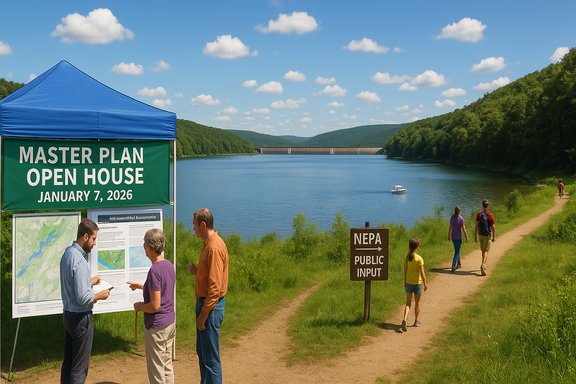
The U.S. Army Corps of Engineers is asking the public to weigh in on a first overhaul in more than five decades of the Beltzville Lake Master Plan, beginning with a drop-in open house on January 7, 2026 and a 30‑day public comment period that runs through February 6, 2026 — a revision meant to guide land use, recreation and natural‑resource management at Beltzville for the next quarter century.
Beltzville Lake and its dam were completed in 1971 as a multi‑purpose project authorized by Congress primarily for flood risk management, water supply and low‑flow augmentation, with secondary purposes for water quality and recreation. The Beltzville Lake Master Plan — the Army Corps’ strategic land‑use roadmap for how federal lands at the project are managed, developed and conserved — has not been substantively updated since that original approval in 1971. The Corps has stated the revision is needed to reflect regional land‑use changes, population growth, shifting outdoor recreation trends, and updated Army Corps management policy. The parklands surrounding the federal project are managed day‑to‑day by the Pennsylvania Department of Conservation & Natural Resources (DCNR) as Beltzville State Park, which today encompasses roughly 3,002 acres and serves as a major regional recreation hub. The dam itself sits on Pohopoco Creek and operates in coordination with Francis E. Walter Dam to reduce Lehigh River flooding downstream — an integrated system with both engineering and recreational responsibilities.
The Master Plan is a federal planning document; it sets the landscape for how the Corps will manage federally administered lands. Actual implementation — new boat ramps, parking expansion, major road repairs or law‑enforcement staffing — typically requires additional funding decisions, interagency agreements, or state and local investments. Citizens who attend the open house or submit comments should therefore be clear about which issues require Corps action and which are DCNR or municipal responsibilities; the Corps’ materials explicitly note that operational dam matters are outside the Master Plan’s remit.
Source: lehighvalleylive Beltzville’s management plan hasn’t been updated since 1971, and officials want input
 Background
Beltzville Lake and its dam were completed in 1971 as a multi‑purpose project authorized by Congress primarily for flood risk management, water supply and low‑flow augmentation, with secondary purposes for water quality and recreation. The Beltzville Lake Master Plan — the Army Corps’ strategic land‑use roadmap for how federal lands at the project are managed, developed and conserved — has not been substantively updated since that original approval in 1971. The Corps has stated the revision is needed to reflect regional land‑use changes, population growth, shifting outdoor recreation trends, and updated Army Corps management policy. The parklands surrounding the federal project are managed day‑to‑day by the Pennsylvania Department of Conservation & Natural Resources (DCNR) as Beltzville State Park, which today encompasses roughly 3,002 acres and serves as a major regional recreation hub. The dam itself sits on Pohopoco Creek and operates in coordination with Francis E. Walter Dam to reduce Lehigh River flooding downstream — an integrated system with both engineering and recreational responsibilities. What the draft Master Plan covers — and what it intentionally does not
Scope and legal framework
The Master Plan revision is an exercise in land‑use strategy and resource management: it addresses land‑use classifications, updated natural and recreational resource objectives, facility needs, and special topics such as invasive species management and habitat for threatened or endangered species. The revision is also proceeding in concert with National Environmental Policy Act (NEPA) processes (an Environmental Assessment accompanies the draft). What the revision will not cover are the technical and operational functions of the dam — flood‑risk operations, water‑level regulation and other engineering controls remain governed by separate Corps manuals and authorities and are outside the Master Plan’s scope.Timing and public process
The Corps will host an open house on January 7, 2026 from 4:00–6:00 p.m. at the Towamensing Township Volunteer Fire Company (105 Firehouse Road, Palmerton). The event is an informal, drop‑in format designed to let interested residents review maps and materials, talk to Corps staffers and submit written comments. A public comment period runs from January 7 through February 6, 2026; comments can be submitted at the open house, through the digital comment form on the Master Plan webpage, or via the Corps’ planning email address. Digital copies of the draft Master Plan and Environmental Assessment will be posted online at the Corps’ Beltzville project page.Why this update matters: recreation, risk and infrastructure
Beltzville Lake is both a flood‑control asset and a regional recreation engine. Since construction, the dam has been credited by the Corps with preventing tens of millions of dollars in flood damages to downstream communities — the agency’s public statements note a cumulative prevented‑damages figure in the low‑to‑mid tens of millions (different Corps materials list slightly different totals, discussed below). The reservoir and Beltzville State Park also attract hundreds of thousands of visitors each year, creating economic value for nearby towns while generating wear, congestion and environmental pressure on trails, shoreline and facilities. The Master Plan update is the Corps’ primary tool for balancing these priorities across federal project lands. Important data points:- The Corps’ news releases and project pages reference the dam’s construction in 1971 and its multi‑purpose authorization.
- The Corps has reported that since construction the dam has prevented more than tens of millions in flood damages; the specific total cited varies across agency documents (see verification note below).
- Beltzville State Park is managed by DCNR and is a major visitor destination with seasonally intense day‑use and boating demand; recent local reporting documents large visitor numbers at popular day‑use areas.
Key changes proposed in the draft Master Plan
The draft revision is focused on modernizing management to reflect social, ecological and infrastructural changes since 1971. Key elements highlighted by the Corps in briefing materials include:- Updated land‑use classifications that more precisely allocate federal lands to high‑use recreation, low‑use conservation, or mixed‑use categories.
- New natural‑resource objectives to address habitat protection, erosion control and improved stewardship of threatened or endangered species.
- Recreation facility needs that examine capacity, parking, boat launches, trail maintenance, sanitation and accessibility upgrades.
- Special topics: invasive species management, shoreline erosion from wakes, social trail proliferation and interpretive/educational programming.
Public concerns already surfaced: what the community is saying
Public input collected during earlier outreach (a scoping open house on October 10, 2024 and subsequent comment rounds) has produced a set of recurring local concerns that the draft seeks to address or at least frame for future action:- Overcrowding and local access: Long‑time residents report that formerly quiet coves and shoreline areas have been overtaken by transient visitors, reducing local access and the “secret spots” residents once enjoyed. This mirrors long‑running regional debates about how to manage day‑use popularity at Beltzville.
- Boat and water safety: Users have expressed worry about large motorized boats creating hazardous wake and wake‑erosion issues for swimmers, paddlecraft and small sailboats. Comments asked the Corps and DCNR to consider differential speed zones, enforcement and education.
- Park maintenance and aging infrastructure: Specific complaints surfaced about deteriorating park roadways (citizens have identified hazardous sections such as Old Mill Road), deferred structural repairs (the park’s historic covered bridge requires roof and timbers work), and insufficient canoe/kayak rack capacity at popular launches. Local volunteer groups have highlighted maintenance backlogs and the need for targeted repairs.
- Environmental stewardship and education: Conservation‑minded commenters support invasive species removal, native planting, protective fencing around sensitive habitats, and interpretive signage to inform visitors about biodiversity and responsible recreation. The Friends of Beltzville and other volunteer groups are active in these efforts.
- Behavior and enforcement: Calls for clearer rules, better signage and more consistent enforcement — especially during peak weekends — have been frequent in public comments. This includes concerns about littering, social trails, unauthorized shoreline uses and persistent unsafe boating behavior.
The governance question: who decides what?
The Beltzville project is an intersection of federal and state responsibilities: the U.S. Army Corps of Engineers owns and manages the federal project lands associated with the dam and reservoir, while DCNR operates the state park facilities under which day‑use and many day‑to‑day recreational services are provided. Local municipalities, volunteer organizations (for example, the Friends of Beltzville), and state and county elected officials also have a stake in decisions that affect access, safety and local economies.The Master Plan is a federal planning document; it sets the landscape for how the Corps will manage federally administered lands. Actual implementation — new boat ramps, parking expansion, major road repairs or law‑enforcement staffing — typically requires additional funding decisions, interagency agreements, or state and local investments. Citizens who attend the open house or submit comments should therefore be clear about which issues require Corps action and which are DCNR or municipal responsibilities; the Corps’ materials explicitly note that operational dam matters are outside the Master Plan’s remit.
Practical guidance for public comment — make your input count
If the Master Plan affects you — as a neighbor, frequent user, volunteer or business owner — the public comment window is a real opportunity to shape outcomes. Useful comments are specific, evidence‑based and actionable. Consider the following approach when preparing remarks:- Identify the precise location and issue (e.g., “Old Mill Road, southbound lane between markers X and Y has exposed rebar and a 6‑inch pothole near the culvert”).
- Attach or reference supporting evidence — photos with dates, GPS coordinates, incident reports, or usage counts — rather than relying on general impressions.
- Propose a clear remedy or preferred outcome (for example, “designate this area as low‑speed/no‑wake for paddlecraft safety” or “install X new canoe racks at Preacher’s Camp with funding phased across two years”).
- Offer to participate in volunteer maintenance or partner with local organizations if appropriate; the Corps and DCNR value coordinated volunteer efforts.
- Be concise and organized — written comments that are short, numbered and referenced to specific plan sections are easier for planners to incorporate.
Comparative lessons: how other reservoir managers handle similar pressures
Park and reservoir managers around the country have faced the same pressures Beltzville communities describe: exploding day‑use demand, wake‑induced shoreline erosion, invasive species, and aging support infrastructure. Successful strategies that have been used elsewhere — and that the Beltzville Plan can consider as options — include:- Timed access and reservation systems for peak weekend and holiday periods to spread demand while preserving walk‑in access for locals.
- Differentiated zoning that designates certain coves and nearshore areas as low‑speed/no‑wake or paddlecraft‑only to reduce conflict and erosion.
- Targeted capital campaigns using a mix of federal, state and private funds (including “friends” group fundraising) to repair trail bridges, roofs on historic structures and priority road segments.
- Volunteer‑led stewardship programs augmented with modest Corps/DCNR grants for interpretive signage, native plantings and invasive species control.
- Enhanced enforcement and education: seasonal ranger staffing, volunteer beach ambassadors and clear behavioral codes reinforced with signage and online outreach.
Risks and trade‑offs to watch for in the final plan
While updating the Master Plan is essential, several risks merit careful scrutiny during public review:- Over‑engineering recreation at the expense of conservation: Expanding parking, boat launches and hardscape to meet demand can accelerate habitat loss and erosion if not balanced with restoration and mitigation measures. The Master Plan should include measurable conservation outcomes as well as recreation targets.
- Shifting burdens to local governments or volunteers without stable funding: Proposals that rely on volunteer labor or municipal budgets for recurring maintenance can create sustainability gaps. Clear implementation and funding pathways are necessary.
- Unclear enforcement authority: The Master Plan may recommend zoning or use restrictions that require DCNR, the Corps, county sheriffs or state police to enforce. Unless enforcement roles and costs are clarified, new rules risk being unenforceable.
- Equity and access impacts: Measures like paid reservations or tightened capacity rules can disproportionately affect low‑income and nearby residents. The Corps and DCNR should evaluate equity impacts and consider priority access measures for locals.
- Unaddressed water‑operations concerns: Because the Master Plan deliberately excludes operational flood‑control measures, stakeholders who link low water levels, drawdowns or operational timing to recreation impacts must press separately for operational transparency and coordination with the Corps’ dam manuals. The Master Plan can still propose liaison mechanisms to ensure operational decisions consider recreation impacts.
Critical analysis: strengths and shortcomings of the Corps’ approach so far
Strengths:- The Corps has launched a structured public process with multiple scoping events, a public draft, an Environmental Assessment and a formal comment period — all of which are consistent with NEPA and best practices for federal planning.
- The draft’s explicit attention to invasive species, habitat protection, and updated land‑use classifications is an appropriate shift away from the recreational‑first planning mindset of the early 1970s toward integrated landscape stewardship.
- The Master Plan revision is a high‑level document and does not itself deliver capital projects or enforcement capacity. Stakeholders should demand clearer implementation timelines, funding strategies and interagency agreements that move priorities from paper into practice.
- Several technical and localized problems that commenters raised — hazardous road segments, the immediate need for covered bridge repairs, and limited canoe/kayak rack capacity — require near‑term fixes that the Master Plan alone cannot guarantee. The Corps should coordinate with DCNR and county officials to identify short‑term repair funding and to present a phased implementation schedule alongside the Plan.
- The Corps’ communications should be explicit about the difference between federal project lands and state‑managed park facilities so community members understand which agency to hold accountable for specific problems. The draft and public materials can be improved by including a clear responsibility matrix for common issues (roads, law enforcement, docks, interpretive services).
How the Master Plan can produce measurable outcomes
To avoid becoming a planning exercise without follow‑through, the final Master Plan should include:- A prioritized actions list with estimated costs, lead agency, potential funding sources and an implementation timeline (0–2 years, 3–5 years, 6–10 years).
- Measurable targets for habitat restoration, invasive species reduction, erosion control and visitor‑capacity thresholds.
- A monitoring plan with annual reporting to the public on progress against targets and a clearly defined process for revisiting allocations if metrics are missed.
- A coordination agreement between the Corps and DCNR that clarifies who pays for what, who enforces which rules, and how operations will be coordinated during peak seasons and emergency drawdowns.
What to watch for after the comment period closes
After the February 6, 2026 comment deadline, the Corps will review comments, incorporate feasible changes and issue a final Master Plan (or a revised draft followed by a Finding of No Significant Impact if the EA indicates so). Stakeholders should expect:- A summary of comments and the Corps’ responses posted online.
- Potential follow‑up meetings or targeted technical discussions around controversial items (e.g., zoning, parking, watercraft restrictions).
- Opportunities for grant applications, interagency MOUs or pilot projects that begin to fund visible improvements.
Conclusion
Beltzville Lake sits at the intersection of engineering, ecology and recreation. The Army Corps’ Master Plan revision is a rare, system‑level opportunity to set priorities for federal lands that support both flood‑risk management and the recreational life of the Lehigh Valley region. The public open house on January 7, 2026 and the January 7–February 6 comment period are the formal moments when neighbors, frequent users, business owners and conservation groups can shape the outcomes that will govern the next 25 years of use, restoration and access. That input — specific, evidence‑based, and focused on implementable results — is the single most effective lever the community has to ensure the Master Plan yields real repairs, fair access and resilient natural resources for future generations.Source: lehighvalleylive Beltzville’s management plan hasn’t been updated since 1971, and officials want input
