

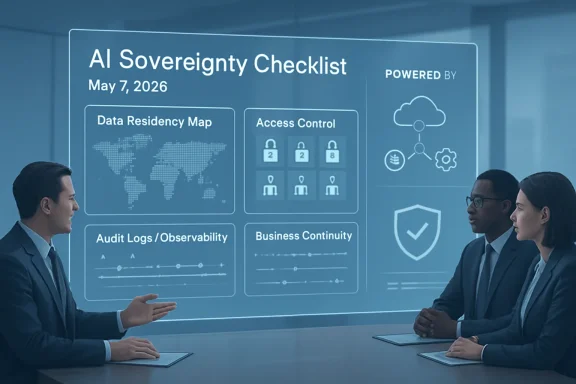
Microsoft published a May 7, 2026 sovereignty checklist for AI steering committees, arguing that enterprise AI programs must prove where data is processed, who can access systems, and how operations continue across jurisdictions. The message is not subtle: AI governance has escaped the architecture review board and landed in the boardroom. Microsoft is selling sovereignty as the missing control plane for companies that want global AI scale without building a patchwork of regional exceptions. That is both a practical warning and a very Microsoft answer to a problem Microsoft helped make unavoidable.
The old enterprise cloud pitch was speed first, compliance second. Move workloads, consolidate platforms, centralize identity, and let the hyperscaler handle the ugly infrastructure plumbing. AI has scrambled that bargain because the most valuable use cases are also the ones most likely to touch regulated data, employee records, customer histories, source code, legal documents, and operational secrets.
Microsoft’s new checklist frames sovereignty as the answer to a deceptively simple question: can a business move quickly without losing control? That question sounds like consultantware until you put it in front of a bank, hospital group, public agency, defense contractor, telecom provider, or multinational manufacturer. For those organizations, “AI transformation” does not mean sprinkling a chatbot over public marketing copy. It means letting probabilistic systems summarize contracts, classify claims, triage incidents, search internal archives, recommend next actions, and eventually operate as agents inside business processes.
That is where sovereignty becomes less about nationalist cloud branding and more about operational discipline. If an AI system retrieves a document in Vienna, processes it in another region, uses a model administered by a foreign operator, and logs prompts into a shared service, the business needs to know that before a regulator, customer, union, or procurement board asks. “Trust us” is not an architecture.
Microsoft’s answer is to make sovereignty a checklist item for the AI steering committee rather than a one-off compliance ticket. That framing matters. The committee is where legal, security, IT, risk, data, procurement, and business leadership collide. Microsoft is telling those leaders that sovereignty cannot be delegated downward after the AI pilot has already become a production dependency.
That phase was intoxicating because the demos were real. Generative AI made knowledge work feel newly compressible. It also made data boundaries feel suddenly porous. The same system that can retrieve the right policy paragraph can also expose the wrong one, cross a residency boundary, preserve a sensitive prompt, or create an audit trail nobody has mapped.
Microsoft’s blog points to a regulatory environment that is expanding quickly, with more than 1,000 policy initiatives globally across AI, cybersecurity, and privacy, and more than 100 nations enforcing privacy laws. The exact counting of policy initiatives matters less than the trend: AI governance is no longer a Brussels-only or Washington-only concern. It is a global operating condition.
The steering committee problem is that regulation rarely arrives in a tidy technology-shaped package. One country may emphasize data residency. Another may care about local operational control. A sector regulator may focus on model risk, auditability, or outsourcing exposure. A public-sector buyer may insist on local support, local encryption controls, or continuity during geopolitical disruption.
For a multinational enterprise, that means the AI platform is no longer just a cloud service. It is an expression of legal posture. The same assistant that feels harmless in a U.S. sales team may become complicated when applied to HR records in Germany, customer credit information in Austria, healthcare data in France, or public-sector documents in the Middle East.
That “something” may be mundane. An auditor asks where prompts are stored. A customer asks whether its data can be accessed by cloud operators outside the country. A legal team asks whether a vendor’s support engineer can inspect logs. A regulator asks whether a model output influenced a decision. A security team asks whether an agent took an action because of poisoned context.
Or the event may be acute. A region suffers a network outage. A government changes the rules. A contractual clause suddenly matters. A geopolitical conflict changes the risk analysis for remote administration. A cloud dependency that looked harmless in a pilot becomes a board-level exposure because a business process now depends on it every hour.
The most interesting part of Microsoft’s sovereignty message is that it does not reduce the topic to data residency. That would be convenient, because residency can be marketed as a map: your data lives here, the service runs there, the compliance box is checked. But AI sovereignty is more demanding than storage geography. It asks where inference happens, where indexes live, where logs go, how models are updated, who can administer the stack, how keys are controlled, and whether the system can keep operating when connectivity or trust assumptions change.
That is the uncomfortable truth for enterprises that spent years rationalizing cloud estates into global platforms. AI does not reverse the case for centralization, but it weakens the illusion that one global operating model can satisfy every local risk regime. The new work is not choosing between global cloud and local control. It is proving that global cloud can express local control without becoming a brittle maze.
For Microsoft, this is not merely altruistic compliance guidance. Sovereignty is now a competitive feature. If governments and regulated industries demand more local control, Microsoft would rather sell them a sovereign version of the Microsoft cloud than watch them drift toward national clouds, boutique providers, private AI stacks, or open-source platforms operated entirely outside the hyperscaler ecosystem.
That explains why Microsoft’s sovereign cloud messaging has broadened in 2026. The company has been emphasizing disconnected environments, Azure Local, Microsoft 365 Local, and Foundry Local capabilities for customers that need to run workloads with limited or no cloud connectivity. This is not a retreat from cloud computing. It is a reclassification of cloud as an operating model that can stretch from hyperscale regions to local infrastructure.
The sales logic is elegant. Enterprises get to keep Azure governance, Microsoft identity, Microsoft security tooling, Microsoft 365 integration, and Microsoft’s AI development environment. In exchange, they can point to more localized processing, stronger administrative boundaries, and continuity options for sensitive environments.
The risk is equally obvious. A sovereign Microsoft stack is still a Microsoft stack. It may answer many procurement and compliance requirements, but it does not eliminate concentration risk. If the business depends on Microsoft identity, Microsoft productivity tools, Microsoft AI orchestration, Microsoft security telemetry, and Microsoft cloud governance, then sovereignty becomes a feature inside a dependency rather than independence from it.
That is not necessarily a bad trade. Most enterprises are not seeking philosophical autonomy; they are seeking accountable control at a tolerable cost. But steering committees should be honest about what they are buying. Microsoft is offering managed sovereignty, not technological self-rule.
Raiffeisen developed an internal generative AI assistant using Microsoft Foundry to help employees summarize legal, regulatory, and banking documents and retrieve information more quickly. Microsoft says the solution supports more than 20,000 employees across multiple European markets, helping staff resolve customer requests faster while maintaining safeguards across jurisdictions.
The details matter because this is not the cartoon version of enterprise AI. It is not a public chatbot answering generic questions. It is a knowledge system inside a regulated institution, pointed at documents that can carry legal, financial, and operational consequences. The productivity gain is obvious: employees spend less time hunting for the right answer and more time applying it.
The governance challenge is just as obvious. A bank cannot allow an AI assistant to become an uncontrolled side channel around permissions, records management, risk classification, or audit obligations. If the assistant summarizes the wrong version of a document, retrieves material the employee should not see, or produces an answer without adequate provenance, the productivity story can become a controls failure.
That is why sovereignty is not an abstract cloud theme here. A bank operating across European markets needs consistency, but it also needs local compliance sensitivity. It needs shared tooling, but not a shared blind spot. It needs AI that is useful enough for thousands of employees, but bounded enough for regulators and risk teams to tolerate.
Microsoft’s argument is that a platform approach can thread that needle better than ad hoc AI adoption. The committee-level implication is blunt: if business units are going to build these assistants anyway, leadership would rather they do it on a governed platform than through a sprawl of disconnected experiments.
AI governance often fails because it documents principles without assigning power. A company can publish Responsible AI values, convene ethics boards, define risk tiers, and still have no practical way to halt a bad deployment, revoke an unsafe agent, inspect a model workflow, or prove what happened after an incident. Sovereignty raises the stakes because the failure may not be just reputational. It may be legal, contractual, or operational.
“Secure by design” sounds obvious until an AI team wants fast access to production data. “Map, Measure, Manage” sounds orderly until no one has a complete map of which models, plugins, connectors, indexes, and agents are active. “Agent observability” sounds mature until an agent has permission to read email, query a CRM, create tickets, call APIs, and summarize sensitive records into a place no one expected.
This is where Microsoft’s checklist becomes useful despite its marketing sheen. It pushes the steering committee away from model fascination and toward operating controls. The model is only one part of the system. The surrounding machinery — identity, permissions, data classification, logging, network boundaries, encryption, administration, incident response, and vendor access — determines whether AI is governable.
For WindowsForum readers, this should sound familiar. The history of enterprise IT is full of technologies that arrived as productivity accelerators and matured into control-plane problems. Active Directory, SharePoint, Teams, Exchange, mobile device management, SaaS identity, endpoint security, and cloud subscriptions all followed the same arc. First users want access. Then IT wants standards. Then auditors want proof. Then executives want assurance that the whole thing will not embarrass them.
AI is moving through that cycle faster because it touches everything at once.
The industry has spent decades learning how to audit human and application behavior. We know how to log sign-ins, file access, admin actions, network flows, endpoint alerts, mailbox rules, database queries, and privileged role changes. Agent behavior does not fit neatly into those categories because an agent’s meaningful action may be the product of a prompt, retrieved context, tool call, policy rule, model response, and user delegation all chained together.
That creates a new audit problem. If an agent creates a purchase order, changes a customer record, sends a message, modifies a ticket, or escalates a workflow, the organization needs to know not only that the action happened but why the system believed it was allowed. That “why” may include model reasoning that is not fully reproducible, retrieved context that changes over time, and permissions inherited from a user or service account.
Sovereignty compounds the issue. If logs are stored in a different region, if telemetry is inspected by external operators, or if model evaluation depends on services outside the jurisdiction, the audit trail itself becomes part of the compliance surface. You cannot prove local control with evidence that lives outside the control model.
This is why AI observability will become a budget line, not a nice-to-have. Enterprises that cannot see what their agents are doing will eventually be forced to limit what those agents can do. The more ambitious the automation, the more boring the logging must become.
AI makes residency necessary but insufficient. A document can reside in one region while embeddings, prompts, completions, indexes, monitoring data, support tickets, and administrative metadata create a wider footprint. The user experience may look local while the operational reality is distributed.
This distinction matters because AI systems manufacture new data from old data. A prompt that includes sensitive details may itself become sensitive. A summary of regulated documents may inherit regulatory constraints. An embedding may not be human-readable, but it can still represent protected information. A model output may be used in a decision even when the original source material remains locked down.
The steering committee therefore needs to ask a more precise question than “where is the data?” It needs to ask where every meaningful derivative of the data is processed, stored, logged, inspected, retained, and deleted. It also needs to know whether those answers change when a feature is updated, a connector is added, a model is swapped, or a service is moved from preview to general availability.
That is where hyperscaler integration cuts both ways. A tightly integrated platform can enforce policy consistently across services. It can also obscure complexity because the seams are hidden under product branding. “Copilot,” “Foundry,” “Azure,” and “Microsoft 365” are useful labels, but they are not substitutes for an architecture diagram.
Microsoft’s pitch to AI steering committees should be read in that context. It is telling customers that they do not need to choose between innovation and control, and that Microsoft’s environment can satisfy both. That is a compelling message for CIOs who are under pressure to deliver AI value this year, not after a three-year platform rethink.
But procurement should push past the slogan. If a vendor claims sovereign capabilities, the contract needs to define them in operational terms. Which personnel can access what? Under what legal process? With what customer notification? Where are support operations performed? How are keys managed? What happens during emergency support? What telemetry leaves the environment? What subcontractors are involved? What changes when new AI features are enabled by default?
These are not hostile questions. They are the questions that determine whether sovereignty survives contact with reality. A product page can promise control; an incident response procedure reveals who actually has it.
For Microsoft customers, the governance challenge is heightened by the company’s tendency to bundle new AI capability into familiar suites. That integration is useful, but it can blur adoption boundaries. A feature that appears inside an admin center, productivity app, or developer portal may become available faster than the policy process can evaluate it. Steering committees need a mechanism for saying “not yet” without becoming the department of no.
That translation will be messy. Many organizations still struggle with basic data classification. Permissions in file shares, SharePoint sites, Teams workspaces, and legacy applications are often more permissive than anyone wants to admit. AI does not create those problems, but it makes them searchable, summarizable, and actionable.
This is the dirty secret of enterprise AI readiness: the model may be ready before the tenant is. A company can buy a powerful AI assistant and discover that its biggest risk is not hallucination but decades of overexposed documents. When an AI system faithfully retrieves information a user technically can access but should not have, the failure is governance debt with a conversational interface.
Sovereignty adds another layer. The admin team must know not only who has access, but where that access is exercised and under which operational model. They must distinguish between end-user permissions, administrator privileges, vendor support access, automated service operations, and model-level data handling. Those categories often blur in the minds of business stakeholders, but they cannot blur in implementation.
The best steering committees will treat IT as a design partner, not a deployment function. The worst will approve an AI strategy full of noble language and then ask admins to make it compliant after launch. We have seen this movie before; it usually ends with emergency policy reviews, angry business units, and a spreadsheet called “AI inventory final v7.”
This is where many AI programs will stumble in 2026. The business case for AI usually counts saved hours, faster workflows, reduced support load, or new revenue. It often undercounts the cost of governance. That creates pressure to treat oversight as a lightweight wrapper around deployment rather than a permanent operating function.
Sovereignty makes that shortcut harder to defend. If a company is operating across jurisdictions, the governance function must track changing rules, map them to technical controls, and verify that deployments remain compliant as products evolve. That is not a quarterly meeting. It is continuous operations.
Microsoft’s advantage is that it can embed many controls into existing enterprise management surfaces. Its disadvantage is that customers may assume the platform has solved governance simply because the controls exist. A dashboard is not a program. A policy template is not assurance. A compliance certification is not a substitute for knowing your own workflows.
The steering committee’s job is to fund the difference.
Open-source models and private infrastructure can reduce some dependencies, but they do not magically solve governance. In many organizations, they may increase operational burden. A locally hosted model with poor access controls, weak logging, unclear patching, and no mature incident process is not sovereign in any meaningful enterprise sense. It is just local.
National or regional cloud providers may offer stronger jurisdictional alignment, but they may lack the integrated productivity, identity, developer, and security ecosystem that large enterprises already use. That gap matters because AI adoption is not happening in isolation. It is happening inside email, documents, meetings, CRM systems, ticketing platforms, ERP workflows, code repositories, and security operations.
Microsoft’s strongest argument is therefore not that its solution is pure. It is that purity is not what most organizations can operationalize. They need a practical middle ground: enough local control to satisfy risk requirements, enough global consistency to avoid fragmentation, and enough integration to make AI useful at scale.
That middle ground will appeal to boards because it preserves optionality. It lets organizations move forward with AI while building a more mature sovereignty posture over time. The danger is that “move forward now, mature later” becomes the same old enterprise compromise in a new vocabulary.
If AI becomes embedded in customer service, compliance review, logistics, fraud detection, IT operations, legal research, and software development, then outages are no longer merely productivity annoyances. They can become business interruptions. If those AI capabilities depend on cross-border connectivity, centralized control planes, or remote service operations, the organization needs a plan for what happens when those assumptions fail.
Microsoft’s disconnected and local cloud messaging is aimed squarely at this concern. Some customers need AI and productivity services that continue operating when external connectivity is unavailable or unacceptable. That includes defense, public sector, critical infrastructure, and highly regulated industries, but the logic will spread. Once executives see AI as operational infrastructure, they will ask infrastructure-grade resilience questions.
The uncomfortable part is that continuity requirements force prioritization. Not every AI feature deserves a disconnected mode. Not every workflow needs local inference. Not every department can justify sovereign architecture. Steering committees will need to classify AI workloads by criticality, sensitivity, and jurisdictional exposure.
That classification exercise may be the most useful thing they do. It cuts through hype. It forces the organization to distinguish between AI as convenience, AI as productivity layer, AI as regulated decision support, and AI as operational dependency. Each category deserves a different control model.
Microsoft’s checklist is useful because it gives executives a vocabulary for that leverage. It says sovereignty is not a late-stage compliance stamp. It is a design dimension alongside security, responsible AI, sustainability, and observability. That is the right framing, even if it arrives wrapped in a Microsoft go-to-market campaign.
Still, steering committees should resist the temptation to turn the checklist into a ceremonial artifact. The question is not whether the company can say it has considered sovereignty. The question is whether a sysadmin, auditor, regulator, or customer can test the claim and get a clear answer.
The companies that handle this well will be boring in the best way. They will know which AI systems exist, what data they touch, which jurisdictions matter, who can administer them, where logs live, how agents are monitored, how incidents are handled, and which workloads can continue during disruption. They will not eliminate risk, but they will make risk legible.
The companies that handle it badly will discover sovereignty through exceptions. A regional team will block a rollout. A regulator will ask for evidence the company cannot produce. A customer contract will prohibit a data flow no one mapped. A model feature will be disabled after employees have already built workflows around it. That is not governance; it is cleanup.
Source: Microsoft Your AI steering committee’s 2026 checklist: Sovereignty | The Microsoft Cloud Blog
 Microsoft Wants Sovereignty to Become an Executive Habit
The old enterprise cloud pitch was speed first, compliance second. Move workloads, consolidate platforms, centralize identity, and let the hyperscaler handle the ugly infrastructure plumbing. AI has scrambled that bargain because the most valuable use cases are also the ones most likely to touch regulated data, employee records, customer histories, source code, legal documents, and operational secrets.Microsoft’s new checklist frames sovereignty as the answer to a deceptively simple question: can a business move quickly without losing control? That question sounds like consultantware until you put it in front of a bank, hospital group, public agency, defense contractor, telecom provider, or multinational manufacturer. For those organizations, “AI transformation” does not mean sprinkling a chatbot over public marketing copy. It means letting probabilistic systems summarize contracts, classify claims, triage incidents, search internal archives, recommend next actions, and eventually operate as agents inside business processes.
That is where sovereignty becomes less about nationalist cloud branding and more about operational discipline. If an AI system retrieves a document in Vienna, processes it in another region, uses a model administered by a foreign operator, and logs prompts into a shared service, the business needs to know that before a regulator, customer, union, or procurement board asks. “Trust us” is not an architecture.
Microsoft’s answer is to make sovereignty a checklist item for the AI steering committee rather than a one-off compliance ticket. That framing matters. The committee is where legal, security, IT, risk, data, procurement, and business leadership collide. Microsoft is telling those leaders that sovereignty cannot be delegated downward after the AI pilot has already become a production dependency.
The AI Pilot Has Become a Jurisdictional Problem
Most organizations did not begin their AI journey with sovereignty diagrams. They began with productivity demos. A team connected a model to documents, a developer wired up retrieval-augmented generation, a business unit tried Copilot, and someone discovered that a model could turn 40 pages of internal material into a useful answer in ten seconds.That phase was intoxicating because the demos were real. Generative AI made knowledge work feel newly compressible. It also made data boundaries feel suddenly porous. The same system that can retrieve the right policy paragraph can also expose the wrong one, cross a residency boundary, preserve a sensitive prompt, or create an audit trail nobody has mapped.
Microsoft’s blog points to a regulatory environment that is expanding quickly, with more than 1,000 policy initiatives globally across AI, cybersecurity, and privacy, and more than 100 nations enforcing privacy laws. The exact counting of policy initiatives matters less than the trend: AI governance is no longer a Brussels-only or Washington-only concern. It is a global operating condition.
The steering committee problem is that regulation rarely arrives in a tidy technology-shaped package. One country may emphasize data residency. Another may care about local operational control. A sector regulator may focus on model risk, auditability, or outsourcing exposure. A public-sector buyer may insist on local support, local encryption controls, or continuity during geopolitical disruption.
For a multinational enterprise, that means the AI platform is no longer just a cloud service. It is an expression of legal posture. The same assistant that feels harmless in a U.S. sales team may become complicated when applied to HR records in Germany, customer credit information in Austria, healthcare data in France, or public-sector documents in the Middle East.
The Five Scenarios Are Really One Scenario
Microsoft’s checklist identifies five recurring sovereignty situations: evolving local regulation, regional AI scaling, provable access controls, data residency without fragmentation, and consistent control during regional disruption. These are presented as separate scenarios, but in practice they collapse into one enterprise question: who has authority over the AI system when something important happens?That “something” may be mundane. An auditor asks where prompts are stored. A customer asks whether its data can be accessed by cloud operators outside the country. A legal team asks whether a vendor’s support engineer can inspect logs. A regulator asks whether a model output influenced a decision. A security team asks whether an agent took an action because of poisoned context.
Or the event may be acute. A region suffers a network outage. A government changes the rules. A contractual clause suddenly matters. A geopolitical conflict changes the risk analysis for remote administration. A cloud dependency that looked harmless in a pilot becomes a board-level exposure because a business process now depends on it every hour.
The most interesting part of Microsoft’s sovereignty message is that it does not reduce the topic to data residency. That would be convenient, because residency can be marketed as a map: your data lives here, the service runs there, the compliance box is checked. But AI sovereignty is more demanding than storage geography. It asks where inference happens, where indexes live, where logs go, how models are updated, who can administer the stack, how keys are controlled, and whether the system can keep operating when connectivity or trust assumptions change.
That is the uncomfortable truth for enterprises that spent years rationalizing cloud estates into global platforms. AI does not reverse the case for centralization, but it weakens the illusion that one global operating model can satisfy every local risk regime. The new work is not choosing between global cloud and local control. It is proving that global cloud can express local control without becoming a brittle maze.
Microsoft’s Pitch Is Control Without Fragmentation
Microsoft’s preferred answer is predictable: keep the platform, add sovereign controls. The company wants customers to believe they can meet local requirements without splintering into separate tools, separate teams, and separate operating models. That is the strategic heart of the message.For Microsoft, this is not merely altruistic compliance guidance. Sovereignty is now a competitive feature. If governments and regulated industries demand more local control, Microsoft would rather sell them a sovereign version of the Microsoft cloud than watch them drift toward national clouds, boutique providers, private AI stacks, or open-source platforms operated entirely outside the hyperscaler ecosystem.
That explains why Microsoft’s sovereign cloud messaging has broadened in 2026. The company has been emphasizing disconnected environments, Azure Local, Microsoft 365 Local, and Foundry Local capabilities for customers that need to run workloads with limited or no cloud connectivity. This is not a retreat from cloud computing. It is a reclassification of cloud as an operating model that can stretch from hyperscale regions to local infrastructure.
The sales logic is elegant. Enterprises get to keep Azure governance, Microsoft identity, Microsoft security tooling, Microsoft 365 integration, and Microsoft’s AI development environment. In exchange, they can point to more localized processing, stronger administrative boundaries, and continuity options for sensitive environments.
The risk is equally obvious. A sovereign Microsoft stack is still a Microsoft stack. It may answer many procurement and compliance requirements, but it does not eliminate concentration risk. If the business depends on Microsoft identity, Microsoft productivity tools, Microsoft AI orchestration, Microsoft security telemetry, and Microsoft cloud governance, then sovereignty becomes a feature inside a dependency rather than independence from it.
That is not necessarily a bad trade. Most enterprises are not seeking philosophical autonomy; they are seeking accountable control at a tolerable cost. But steering committees should be honest about what they are buying. Microsoft is offering managed sovereignty, not technological self-rule.
The Bank Example Shows Why This Will Sell
Microsoft’s example of Raiffeisen Bank International is carefully chosen. Banking is a sovereignty stress test because it combines strict regulation, sensitive data, cross-border operations, legacy complexity, and high internal demand for faster information access. If a generative AI assistant can work there, Microsoft can argue it can work almost anywhere.Raiffeisen developed an internal generative AI assistant using Microsoft Foundry to help employees summarize legal, regulatory, and banking documents and retrieve information more quickly. Microsoft says the solution supports more than 20,000 employees across multiple European markets, helping staff resolve customer requests faster while maintaining safeguards across jurisdictions.
The details matter because this is not the cartoon version of enterprise AI. It is not a public chatbot answering generic questions. It is a knowledge system inside a regulated institution, pointed at documents that can carry legal, financial, and operational consequences. The productivity gain is obvious: employees spend less time hunting for the right answer and more time applying it.
The governance challenge is just as obvious. A bank cannot allow an AI assistant to become an uncontrolled side channel around permissions, records management, risk classification, or audit obligations. If the assistant summarizes the wrong version of a document, retrieves material the employee should not see, or produces an answer without adequate provenance, the productivity story can become a controls failure.
That is why sovereignty is not an abstract cloud theme here. A bank operating across European markets needs consistency, but it also needs local compliance sensitivity. It needs shared tooling, but not a shared blind spot. It needs AI that is useful enough for thousands of employees, but bounded enough for regulators and risk teams to tolerate.
Microsoft’s argument is that a platform approach can thread that needle better than ad hoc AI adoption. The committee-level implication is blunt: if business units are going to build these assistants anyway, leadership would rather they do it on a governed platform than through a sprawl of disconnected experiments.
The Real Checklist Is About Power, Not Paperwork
The checklist language in Microsoft’s post sounds procedural: define trust, secure by design, govern the loop, support sustainability, ensure visibility, and address digital sovereignty requirements. Those are sensible categories. They are also abstractions that can hide the harder question: who can stop the system?AI governance often fails because it documents principles without assigning power. A company can publish Responsible AI values, convene ethics boards, define risk tiers, and still have no practical way to halt a bad deployment, revoke an unsafe agent, inspect a model workflow, or prove what happened after an incident. Sovereignty raises the stakes because the failure may not be just reputational. It may be legal, contractual, or operational.
“Secure by design” sounds obvious until an AI team wants fast access to production data. “Map, Measure, Manage” sounds orderly until no one has a complete map of which models, plugins, connectors, indexes, and agents are active. “Agent observability” sounds mature until an agent has permission to read email, query a CRM, create tickets, call APIs, and summarize sensitive records into a place no one expected.
This is where Microsoft’s checklist becomes useful despite its marketing sheen. It pushes the steering committee away from model fascination and toward operating controls. The model is only one part of the system. The surrounding machinery — identity, permissions, data classification, logging, network boundaries, encryption, administration, incident response, and vendor access — determines whether AI is governable.
For WindowsForum readers, this should sound familiar. The history of enterprise IT is full of technologies that arrived as productivity accelerators and matured into control-plane problems. Active Directory, SharePoint, Teams, Exchange, mobile device management, SaaS identity, endpoint security, and cloud subscriptions all followed the same arc. First users want access. Then IT wants standards. Then auditors want proof. Then executives want assurance that the whole thing will not embarrass them.
AI is moving through that cycle faster because it touches everything at once.
Agent Observability Is the New Audit Log
Microsoft’s emphasis on observability is particularly important because agentic AI turns passive information access into active system behavior. A chatbot that answers a question can be wrong. An agent that takes action can be wrong at scale.The industry has spent decades learning how to audit human and application behavior. We know how to log sign-ins, file access, admin actions, network flows, endpoint alerts, mailbox rules, database queries, and privileged role changes. Agent behavior does not fit neatly into those categories because an agent’s meaningful action may be the product of a prompt, retrieved context, tool call, policy rule, model response, and user delegation all chained together.
That creates a new audit problem. If an agent creates a purchase order, changes a customer record, sends a message, modifies a ticket, or escalates a workflow, the organization needs to know not only that the action happened but why the system believed it was allowed. That “why” may include model reasoning that is not fully reproducible, retrieved context that changes over time, and permissions inherited from a user or service account.
Sovereignty compounds the issue. If logs are stored in a different region, if telemetry is inspected by external operators, or if model evaluation depends on services outside the jurisdiction, the audit trail itself becomes part of the compliance surface. You cannot prove local control with evidence that lives outside the control model.
This is why AI observability will become a budget line, not a nice-to-have. Enterprises that cannot see what their agents are doing will eventually be forced to limit what those agents can do. The more ambitious the automation, the more boring the logging must become.
Data Residency Was the Easy Part
For years, data residency has been the headline version of sovereignty. It is easy to explain to executives and procurement teams: certain data must remain in a certain country or region. Hyperscalers responded with more regions, more residency commitments, and more compliance documentation.AI makes residency necessary but insufficient. A document can reside in one region while embeddings, prompts, completions, indexes, monitoring data, support tickets, and administrative metadata create a wider footprint. The user experience may look local while the operational reality is distributed.
This distinction matters because AI systems manufacture new data from old data. A prompt that includes sensitive details may itself become sensitive. A summary of regulated documents may inherit regulatory constraints. An embedding may not be human-readable, but it can still represent protected information. A model output may be used in a decision even when the original source material remains locked down.
The steering committee therefore needs to ask a more precise question than “where is the data?” It needs to ask where every meaningful derivative of the data is processed, stored, logged, inspected, retained, and deleted. It also needs to know whether those answers change when a feature is updated, a connector is added, a model is swapped, or a service is moved from preview to general availability.
That is where hyperscaler integration cuts both ways. A tightly integrated platform can enforce policy consistently across services. It can also obscure complexity because the seams are hidden under product branding. “Copilot,” “Foundry,” “Azure,” and “Microsoft 365” are useful labels, but they are not substitutes for an architecture diagram.
The Sovereignty Debate Is Also a Procurement Fight
Sovereignty has become a political and commercial contest, especially in Europe, but the enterprise version is often less ideological. Procurement teams want vendors to prove that their services can satisfy local requirements without creating future lock-in or compliance surprises. Vendors want to prove that they can do so without giving up the economics of global platforms.Microsoft’s pitch to AI steering committees should be read in that context. It is telling customers that they do not need to choose between innovation and control, and that Microsoft’s environment can satisfy both. That is a compelling message for CIOs who are under pressure to deliver AI value this year, not after a three-year platform rethink.
But procurement should push past the slogan. If a vendor claims sovereign capabilities, the contract needs to define them in operational terms. Which personnel can access what? Under what legal process? With what customer notification? Where are support operations performed? How are keys managed? What happens during emergency support? What telemetry leaves the environment? What subcontractors are involved? What changes when new AI features are enabled by default?
These are not hostile questions. They are the questions that determine whether sovereignty survives contact with reality. A product page can promise control; an incident response procedure reveals who actually has it.
For Microsoft customers, the governance challenge is heightened by the company’s tendency to bundle new AI capability into familiar suites. That integration is useful, but it can blur adoption boundaries. A feature that appears inside an admin center, productivity app, or developer portal may become available faster than the policy process can evaluate it. Steering committees need a mechanism for saying “not yet” without becoming the department of no.
IT Pros Are About to Inherit the Committee’s Promises
The phrase “AI steering committee” sounds executive, but the work eventually lands on administrators, architects, security engineers, compliance analysts, and support teams. They will be the ones asked to translate sovereignty principles into tenant settings, conditional access policies, data loss prevention rules, sensitivity labels, retention policies, key management designs, network segmentation, model deployment choices, and incident playbooks.That translation will be messy. Many organizations still struggle with basic data classification. Permissions in file shares, SharePoint sites, Teams workspaces, and legacy applications are often more permissive than anyone wants to admit. AI does not create those problems, but it makes them searchable, summarizable, and actionable.
This is the dirty secret of enterprise AI readiness: the model may be ready before the tenant is. A company can buy a powerful AI assistant and discover that its biggest risk is not hallucination but decades of overexposed documents. When an AI system faithfully retrieves information a user technically can access but should not have, the failure is governance debt with a conversational interface.
Sovereignty adds another layer. The admin team must know not only who has access, but where that access is exercised and under which operational model. They must distinguish between end-user permissions, administrator privileges, vendor support access, automated service operations, and model-level data handling. Those categories often blur in the minds of business stakeholders, but they cannot blur in implementation.
The best steering committees will treat IT as a design partner, not a deployment function. The worst will approve an AI strategy full of noble language and then ask admins to make it compliant after launch. We have seen this movie before; it usually ends with emergency policy reviews, angry business units, and a spreadsheet called “AI inventory final v7.”
Responsible AI Needs an Operations Budget
Microsoft’s checklist includes Responsible AI principles, and that is appropriate. But principles do not operate systems. If a company wants responsible AI, it needs funding for the unglamorous work: risk assessment, red teaming, access review, documentation, training, monitoring, incident response, legal review, model evaluation, and lifecycle management.This is where many AI programs will stumble in 2026. The business case for AI usually counts saved hours, faster workflows, reduced support load, or new revenue. It often undercounts the cost of governance. That creates pressure to treat oversight as a lightweight wrapper around deployment rather than a permanent operating function.
Sovereignty makes that shortcut harder to defend. If a company is operating across jurisdictions, the governance function must track changing rules, map them to technical controls, and verify that deployments remain compliant as products evolve. That is not a quarterly meeting. It is continuous operations.
Microsoft’s advantage is that it can embed many controls into existing enterprise management surfaces. Its disadvantage is that customers may assume the platform has solved governance simply because the controls exist. A dashboard is not a program. A policy template is not assurance. A compliance certification is not a substitute for knowing your own workflows.
The steering committee’s job is to fund the difference.
Microsoft’s Sovereignty Story Is Strongest Where the Alternatives Are Weak
It is easy to criticize Microsoft for turning sovereignty into another platform sales motion. It is also important to acknowledge why customers may welcome it. Building sovereign AI capability from scratch is hard, expensive, and slow. Operating local infrastructure, managing models, securing data pipelines, enforcing identity, maintaining auditability, and satisfying regulators across markets is not a weekend project.Open-source models and private infrastructure can reduce some dependencies, but they do not magically solve governance. In many organizations, they may increase operational burden. A locally hosted model with poor access controls, weak logging, unclear patching, and no mature incident process is not sovereign in any meaningful enterprise sense. It is just local.
National or regional cloud providers may offer stronger jurisdictional alignment, but they may lack the integrated productivity, identity, developer, and security ecosystem that large enterprises already use. That gap matters because AI adoption is not happening in isolation. It is happening inside email, documents, meetings, CRM systems, ticketing platforms, ERP workflows, code repositories, and security operations.
Microsoft’s strongest argument is therefore not that its solution is pure. It is that purity is not what most organizations can operationalize. They need a practical middle ground: enough local control to satisfy risk requirements, enough global consistency to avoid fragmentation, and enough integration to make AI useful at scale.
That middle ground will appeal to boards because it preserves optionality. It lets organizations move forward with AI while building a more mature sovereignty posture over time. The danger is that “move forward now, mature later” becomes the same old enterprise compromise in a new vocabulary.
The Hardest Requirement Is Continuity
Among Microsoft’s sovereignty scenarios, business continuity may be the most underappreciated. Data location and access control are familiar compliance topics. Continuity during disruption is where sovereignty becomes visceral.If AI becomes embedded in customer service, compliance review, logistics, fraud detection, IT operations, legal research, and software development, then outages are no longer merely productivity annoyances. They can become business interruptions. If those AI capabilities depend on cross-border connectivity, centralized control planes, or remote service operations, the organization needs a plan for what happens when those assumptions fail.
Microsoft’s disconnected and local cloud messaging is aimed squarely at this concern. Some customers need AI and productivity services that continue operating when external connectivity is unavailable or unacceptable. That includes defense, public sector, critical infrastructure, and highly regulated industries, but the logic will spread. Once executives see AI as operational infrastructure, they will ask infrastructure-grade resilience questions.
The uncomfortable part is that continuity requirements force prioritization. Not every AI feature deserves a disconnected mode. Not every workflow needs local inference. Not every department can justify sovereign architecture. Steering committees will need to classify AI workloads by criticality, sensitivity, and jurisdictional exposure.
That classification exercise may be the most useful thing they do. It cuts through hype. It forces the organization to distinguish between AI as convenience, AI as productivity layer, AI as regulated decision support, and AI as operational dependency. Each category deserves a different control model.
The 2026 AI Committee Cannot Hide Behind the Pilot
The practical message for enterprises is that sovereignty must be designed before AI becomes invisible infrastructure. Once employees depend on an assistant, developers build around a model, and business processes assume automated summaries or agent actions, governance changes become politically harder. The pilot phase is when the organization still has leverage.Microsoft’s checklist is useful because it gives executives a vocabulary for that leverage. It says sovereignty is not a late-stage compliance stamp. It is a design dimension alongside security, responsible AI, sustainability, and observability. That is the right framing, even if it arrives wrapped in a Microsoft go-to-market campaign.
Still, steering committees should resist the temptation to turn the checklist into a ceremonial artifact. The question is not whether the company can say it has considered sovereignty. The question is whether a sysadmin, auditor, regulator, or customer can test the claim and get a clear answer.
The companies that handle this well will be boring in the best way. They will know which AI systems exist, what data they touch, which jurisdictions matter, who can administer them, where logs live, how agents are monitored, how incidents are handled, and which workloads can continue during disruption. They will not eliminate risk, but they will make risk legible.
The companies that handle it badly will discover sovereignty through exceptions. A regional team will block a rollout. A regulator will ask for evidence the company cannot produce. A customer contract will prohibit a data flow no one mapped. A model feature will be disabled after employees have already built workflows around it. That is not governance; it is cleanup.
The Checklist Microsoft Wants Boards to Read Twice
Microsoft’s sovereignty push is best understood as an attempt to normalize AI control questions before regulators, customers, and outages force them. The steering committee does not need to become a cloud architecture board, but it does need to demand answers that can survive implementation.- Organizations should treat sovereignty as an AI operating requirement, not as a regional legal footnote added after deployment.
- Data residency is only one part of the problem because prompts, embeddings, logs, outputs, indexes, and administrative metadata can all create sovereignty exposure.
- Agentic AI raises the stakes because observability must explain not just what happened, but which permissions, tools, data, and policies allowed it to happen.
- Microsoft’s sovereign cloud strategy offers a pragmatic path for customers already invested in Azure, Microsoft 365, Foundry, Entra, and Microsoft security tooling.
- Steering committees should require contractual and technical clarity on vendor access, support operations, key control, telemetry, continuity, and feature changes.
- The most successful AI programs in 2026 will classify workloads by sensitivity, jurisdictional exposure, and operational criticality before scaling them globally.
Source: Microsoft Your AI steering committee’s 2026 checklist: Sovereignty | The Microsoft Cloud Blog
