

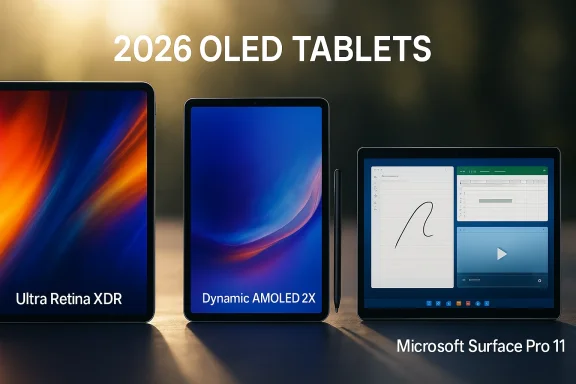
The 2026 tablet market has split into two very different OLED stories: premium consumer slates that chase the best possible display quality, and productivity-first tablets that use OLED as a feature rather than the whole selling point. If you want the short version, the current leaders are still defined by three things: brightness, color accuracy, and ecosystem strength. Apple’s iPad Pro with M5, Samsung’s Galaxy Tab S11 family, and Microsoft’s Surface Pro 11 with OLED each win in a different lane, and that makes the “best OLED tablet” question more nuanced than ever.
OLED has become the premium display technology of choice for tablets because it solves the oldest complaint about LCD: imperfect black levels. Where LCDs rely on a backlight, OLED pixels can switch off individually, which creates real blacks, higher perceived contrast, and better HDR performance. That matters more on tablets than on phones, because tablets are used for a broader mix of work, streaming, sketching, reading, and gaming. Apple’s own explanation of the iPad Pro display highlights how OLED enables thinness and HDR depth, while Samsung’s Tab S11 line leans on Dynamic AMOLED 2X to push brightness and outdoor usability.
The modern OLED tablet market also reflects a shift in how people buy tablets. A few years ago, the main differentiator was size. Now it is the balance between panel quality, processor performance, and software suitability for creative or office work. Apple has doubled down on tandem OLED for its iPad Pro, Samsung has focused on a very bright AMOLED experience with IP68 protection and included stylus support, and Microsoft has tried to make Windows tablets viable for people who need desktop-class apps in a portable form.
There is also a market reality that often gets missed in “best of” lists: tablet buyers are increasingly choosing by workflow, not just by specs. A designer, student, office worker, gamer, and movie watcher may all value OLED, but they do not value it equally. A tablet that is brilliant for Procreate or Final Cut-style editing may be awkward for desktop-class multitasking, while a Windows tablet may run critical software but still feel less polished for casual entertainment. That tension is exactly why the top OLED tablets in 2026 are so interesting.
Finally, brightness has become a major battleground. Apple now quotes 1,600 nits peak HDR brightness on iPad Pro with M5, Samsung quotes up to 1,600 nits peak on the Galaxy Tab S11 series, and Microsoft’s Surface Pro OLED sits lower in peak brightness but remains competitive in contrast and general image quality. In practical terms, that means OLED is no longer only about “pretty black levels”; it is also about whether the panel can survive bright offices, cafés, airplanes, and outdoor use without becoming washed out.
The M5 iPad Pro also matters because the display is matched by extreme performance. Apple describes the M5 as a significant leap in AI and graphics, and the chip is paired with Wi‑Fi 7, a new Apple wireless chip, and updated iPadOS 26 capabilities. For tablet buyers, that matters because a great screen is only one part of the experience; the device has to keep up with editing, illustration, split-screen work, and high-frame-rate gaming without hiccups.
In practical use, this means HDR video looks exceptional, but so do everyday elements like UI text, album art, and photo previews. The iPad Pro display has a way of making content feel finished rather than merely visible. That is a subtle distinction, but it is exactly what separates flagship OLED tablets from the rest of the market.
That said, Apple’s strength is also its constraint. iPadOS 26 is more capable than before, but it still does not behave like macOS or Windows when it comes to file handling, desktop multitasking, and certain plugin-heavy workflows. For many people that is fine; for others it remains the decisive flaw. The display may be the best, but the operating system still defines the ceiling. That tension is unlikely to disappear soon.
The Tab S11 is also a rare example of a tablet that tries to be both a media device and a serious productivity machine. Samsung pushes DeX, USB-C video output, microSD expansion, IP68 water and dust resistance, and a redesigned S Pen. That bundle creates a compelling value story because the device is not asking buyers to purchase every accessory separately just to unlock basic productivity.
The practical result is that the Tab S11 is not merely “good for an Android tablet.” It is a genuinely premium display experience that can stand next to Apple’s and, in some conditions, even challenge it. Samsung’s anti-reflection treatment also helps by reducing glare, which improves perceived contrast without requiring the screen to run flat-out all the time.
The downside is that Android tablet apps, while much better than they used to be, still lag behind iPadOS for premium creative workflows. That does not make the Tab S11 a compromise tablet, but it does mean Samsung is competing more on practicality and price than on software depth. In other words, Samsung wins on value, but Apple still owns the premium creative throne.
The appeal of the Ultra is not just size. It is also the way Samsung packages that size with usable features: S Pen support, DeX, microSD expansion, IP68 resistance, and strong battery life. Samsung’s launch materials position the Ultra as a thin, premium productivity device rather than a gimmick. That matters, because very large tablets often fail when they become too heavy or too awkward to carry.
It also improves entertainment in obvious ways. A 14.6-inch OLED display turns streaming into a near-laptop-sized cinema experience, and Samsung’s brightness claims mean the panel is not just large but also usable in more environments. The downside is that the device becomes more desk-dependent, which is a fair trade if you want a tablet that behaves like a portable workstation.
There is also a creative tradeoff. Even though Samsung’s display is excellent, Apple’s iPad Pro still holds the edge in some professional creative ecosystems. For a pure display-first purchase, the Ultra is outstanding. For a broad creative toolchain, Apple remains harder to beat.
Microsoft’s fact sheets list the OLED version as part of the Surface Pro 11th Edition lineup, with Snapdragon X Elite configurations and up to 120Hz dynamic refresh. The panel may not match the peak brightness claims of Apple and Samsung, but it still delivers the contrast and richness that OLED buyers expect. In a Windows context, that alone is a major quality-of-life upgrade.
That said, Windows on ARM still introduces friction. Compatibility has improved, but emulation is not the same as native performance, and not every application behaves perfectly. The result is a tablet that can be fantastic for the right professional and frustrating for anyone expecting effortless iPad-like simplicity. It is a productivity machine, not a universal crowd-pleaser.
Still, there is no denying that the Surface Pro 11 fills a rare niche. If you need an OLED tablet that behaves like a real PC, Microsoft is still the only major vendor delivering that experience at scale. The display may not be the brightest, but the platform is the point.
The practical differences show up in how each company prioritizes the display stack. Apple leans into color accuracy and pro workflows, Samsung pushes brightness and convenience features like S Pen inclusion and anti-reflection, and Microsoft uses OLED as a premium option rather than the headline. None of these approaches is wrong; they simply reflect different product philosophies.
A useful short checklist looks like this:
Apple has the strongest overall performance story, especially in graphics-heavy and creative work. Samsung’s Tab S11 family is notably strong in Android gaming and general responsiveness, while the Surface Pro 11 is more about desktop software compatibility than gaming benchmarks. That split is useful for shoppers because it keeps expectations realistic.
Samsung’s 120Hz AMOLED panel and Apple’s ProMotion display make them especially appealing for games that can actually take advantage of the refresh rate. Microsoft’s Surface Pro 11 can certainly play games, but that is not what it is best at. The Surface is a productivity-first machine that happens to have a good screen, not a gaming-first tablet.
That makes the 2026 OLED tablet market unusually segmented. There is no single “fastest” or “best” device in every sense. Instead, there are three excellent answers to three different problems, and the screen is only part of the answer. That is good news for buyers, but it also makes comparison shopping harder.
The key point is that OLED does not guarantee long battery life. It can help, especially with dark content, but brightness levels, refresh rates, chip efficiency, and software behavior all matter. That is why the best OLED tablets are the ones that combine panel efficiency with power-efficient silicon and mature power management.
The Tab S11 Ultra illustrates the tradeoff most clearly. Its large size makes it less convenient to hold, but the larger display improves productivity and entertainment enough that many buyers will accept the compromise. The point is not that one form factor is correct, but that OLED makes the tradeoff feel more worthwhile.
That split explains why no single OLED tablet dominates every chart. The best choice depends on whether your tablet is a movie screen, a note-taking tool, a creative workstation, or a portable PC. The most expensive option is not always the smartest one.
Samsung’s strategy is the simplest to appreciate because the S Pen is included, IP68 is built in, and DeX extends usability without forcing a separate laptop purchase. Apple keeps the hardware premium and the accessories modular, which gives buyers flexibility but raises the total cost. Microsoft offers the most PC-like accessory story, but at a price that can quickly outrun the value of the tablet itself.
Microsoft’s Slim Pen remains useful, especially for pen-centric workflows, but it is best seen as part of a larger Windows productivity setup. If you buy a Surface Pro 11, you are buying into an ecosystem that assumes a keyboard and pen are part of the plan. That is powerful, but also expensive.
A smart way to think about it is simple:
The broader market implication is that OLED is now table stakes in the premium segment. Once a feature becomes expected, the real competition shifts to battery efficiency, software polish, and accessory ecosystems. That is why the best tablets with OLED in 2026 are not identical products with different logos; they are highly differentiated devices competing for very different users.
What to watch next:
Source: MyNextTablet Top 4 Best Tablets with OLED Display | 2026 Edition
 Background
OLED has become the premium display technology of choice for tablets because it solves the oldest complaint about LCD: imperfect black levels. Where LCDs rely on a backlight, OLED pixels can switch off individually, which creates real blacks, higher perceived contrast, and better HDR performance. That matters more on tablets than on phones, because tablets are used for a broader mix of work, streaming, sketching, reading, and gaming. Apple’s own explanation of the iPad Pro display highlights how OLED enables thinness and HDR depth, while Samsung’s Tab S11 line leans on Dynamic AMOLED 2X to push brightness and outdoor usability.The modern OLED tablet market also reflects a shift in how people buy tablets. A few years ago, the main differentiator was size. Now it is the balance between panel quality, processor performance, and software suitability for creative or office work. Apple has doubled down on tandem OLED for its iPad Pro, Samsung has focused on a very bright AMOLED experience with IP68 protection and included stylus support, and Microsoft has tried to make Windows tablets viable for people who need desktop-class apps in a portable form.
There is also a market reality that often gets missed in “best of” lists: tablet buyers are increasingly choosing by workflow, not just by specs. A designer, student, office worker, gamer, and movie watcher may all value OLED, but they do not value it equally. A tablet that is brilliant for Procreate or Final Cut-style editing may be awkward for desktop-class multitasking, while a Windows tablet may run critical software but still feel less polished for casual entertainment. That tension is exactly why the top OLED tablets in 2026 are so interesting.
Finally, brightness has become a major battleground. Apple now quotes 1,600 nits peak HDR brightness on iPad Pro with M5, Samsung quotes up to 1,600 nits peak on the Galaxy Tab S11 series, and Microsoft’s Surface Pro OLED sits lower in peak brightness but remains competitive in contrast and general image quality. In practical terms, that means OLED is no longer only about “pretty black levels”; it is also about whether the panel can survive bright offices, cafés, airplanes, and outdoor use without becoming washed out.
Apple’s iPad Pro M5: The Display Benchmark
Apple’s iPad Pro M5 is still the tablet to beat if display quality is your top priority. Apple says the new iPad Pro uses its Ultra Retina XDR panel, which is built on tandem OLED technology, and the company quotes up to 1,600 nits peak HDR brightness along with 1,000 nits full-screen XDR brightness on the 13-inch model. That combination gives the iPad Pro an unusually strong claim: it is not just the most color-accurate tablet display, it is also one of the few OLED panels that can stay convincing in demanding bright-light scenarios.The M5 iPad Pro also matters because the display is matched by extreme performance. Apple describes the M5 as a significant leap in AI and graphics, and the chip is paired with Wi‑Fi 7, a new Apple wireless chip, and updated iPadOS 26 capabilities. For tablet buyers, that matters because a great screen is only one part of the experience; the device has to keep up with editing, illustration, split-screen work, and high-frame-rate gaming without hiccups.
Why tandem OLED matters
Tandem OLED is more than a marketing flourish. By stacking two OLED layers, Apple can increase brightness while preserving many of OLED’s signature strengths, including deep blacks and fine control over highlights. Apple’s support documentation emphasizes that this design exists specifically to deliver extremely high brightness across a large display area, which is one reason the iPad Pro has become the reference point for tablet panels.In practical use, this means HDR video looks exceptional, but so do everyday elements like UI text, album art, and photo previews. The iPad Pro display has a way of making content feel finished rather than merely visible. That is a subtle distinction, but it is exactly what separates flagship OLED tablets from the rest of the market.
The ecosystem advantage
The iPad Pro’s other major strength is its app ecosystem. Apple continues to benefit from deep creative support across Procreate, Affinity Photo, DaVinci Resolve, and a mature ecosystem of tablet-optimized software. When you combine that with Apple Pencil Pro support and the M5’s performance headroom, the iPad Pro becomes the most credible tablet for artists and media professionals who need more than just a beautiful display.That said, Apple’s strength is also its constraint. iPadOS 26 is more capable than before, but it still does not behave like macOS or Windows when it comes to file handling, desktop multitasking, and certain plugin-heavy workflows. For many people that is fine; for others it remains the decisive flaw. The display may be the best, but the operating system still defines the ceiling. That tension is unlikely to disappear soon.
Samsung Galaxy Tab S11: The Best Value OLED Tablet
Samsung’s Galaxy Tab S11 is the strongest argument that OLED does not have to be paired with Apple pricing. Samsung’s own materials say the Tab S11 has an 11.0-inch Dynamic AMOLED 2X display, up to 1,600 nits peak brightness, and 120Hz refresh. It also includes the S Pen in the box, which is a major practical advantage over Apple and Microsoft.The Tab S11 is also a rare example of a tablet that tries to be both a media device and a serious productivity machine. Samsung pushes DeX, USB-C video output, microSD expansion, IP68 water and dust resistance, and a redesigned S Pen. That bundle creates a compelling value story because the device is not asking buyers to purchase every accessory separately just to unlock basic productivity.
Brightness and outdoor use
Samsung’s 1,600-nit peak brightness figure places the Tab S11 in elite company. For streaming, reading, sketching, and office work near windows or outdoors, that higher brightness ceiling reduces one of OLED’s historical weaknesses: visibility in harsh light. Samsung also says the series reaches 1,000 nits in High Brightness Mode, which is the more realistic number buyers will feel during everyday use.The practical result is that the Tab S11 is not merely “good for an Android tablet.” It is a genuinely premium display experience that can stand next to Apple’s and, in some conditions, even challenge it. Samsung’s anti-reflection treatment also helps by reducing glare, which improves perceived contrast without requiring the screen to run flat-out all the time.
Samsung’s productivity pitch
Samsung’s biggest strength is that the Tab S11 feels complete out of the box. The S Pen ships with the tablet, Samsung Notes is deeply integrated, and DeX offers a desktop-like interface for multitasking. For students, note-takers, and Android-first users, that combination is often more useful than raw benchmark leadership.The downside is that Android tablet apps, while much better than they used to be, still lag behind iPadOS for premium creative workflows. That does not make the Tab S11 a compromise tablet, but it does mean Samsung is competing more on practicality and price than on software depth. In other words, Samsung wins on value, but Apple still owns the premium creative throne.
Samsung Galaxy Tab S11 Ultra: The Biggest OLED Canvas
If the standard Tab S11 is Samsung’s value play, the Galaxy Tab S11 Ultra is its statement piece. Samsung lists a 14.6-inch Dynamic AMOLED 2X display with the same 1,600-nit peak brightness class and 120Hz refresh, but the whole experience is designed around sheer visual scale. This is the tablet for people who want a giant canvas for movies, split-screen work, note-taking, and drawing.The appeal of the Ultra is not just size. It is also the way Samsung packages that size with usable features: S Pen support, DeX, microSD expansion, IP68 resistance, and strong battery life. Samsung’s launch materials position the Ultra as a thin, premium productivity device rather than a gimmick. That matters, because very large tablets often fail when they become too heavy or too awkward to carry.
Why bigger can be better
For reading documents, working in split-screen, or drawing with a stylus, the Ultra’s 14.6-inch panel gives you room that 11-inch tablets simply cannot match. The extra display area makes app layouts feel less cramped, and it reduces the feeling that you are always managing windows instead of getting work done. For many users, that is worth more than a small jump in benchmark numbers.It also improves entertainment in obvious ways. A 14.6-inch OLED display turns streaming into a near-laptop-sized cinema experience, and Samsung’s brightness claims mean the panel is not just large but also usable in more environments. The downside is that the device becomes more desk-dependent, which is a fair trade if you want a tablet that behaves like a portable workstation.
The cost of scale
The Ultra’s biggest weaknesses are physical, not technical. At this size, it is harder to hold for long sessions, less convenient in transit, and more expensive to insure and accessorize. That means the buyer has to be honest about how they use a tablet. If you mostly use it on a couch or desk, the Ultra makes sense; if you want a casual lap companion, it can feel excessive. Bigger is not automatically better.There is also a creative tradeoff. Even though Samsung’s display is excellent, Apple’s iPad Pro still holds the edge in some professional creative ecosystems. For a pure display-first purchase, the Ultra is outstanding. For a broad creative toolchain, Apple remains harder to beat.
Microsoft Surface Pro 11 OLED: The Windows Specialist
The Surface Pro 11 is the most interesting entry on this list because it is not really trying to win a display-only contest. Microsoft offers an optional 13-inch OLED panel with 120Hz refresh, and its positioning is more about making Windows 11 on ARM viable in a tablet form factor. For buyers who need desktop-class software, that distinction is everything.Microsoft’s fact sheets list the OLED version as part of the Surface Pro 11th Edition lineup, with Snapdragon X Elite configurations and up to 120Hz dynamic refresh. The panel may not match the peak brightness claims of Apple and Samsung, but it still delivers the contrast and richness that OLED buyers expect. In a Windows context, that alone is a major quality-of-life upgrade.
Why Windows changes the equation
For some users, the Surface Pro 11 is the only tablet that matters because it runs the apps they actually need. Adobe tools, Blender, office software, and specialized enterprise apps are often the real requirement, and on that front the Surface Pro remains uniquely relevant. Microsoft also improved the laptop-like experience with the kickstand, keyboard ecosystem, and slim pen support.That said, Windows on ARM still introduces friction. Compatibility has improved, but emulation is not the same as native performance, and not every application behaves perfectly. The result is a tablet that can be fantastic for the right professional and frustrating for anyone expecting effortless iPad-like simplicity. It is a productivity machine, not a universal crowd-pleaser.
A premium device with premium compromises
The Surface Pro OLED configuration is expensive once you add the keyboard and stylus, and that changes its value proposition sharply. Microsoft is asking buyers to pay a premium for the flexibility of Windows, the OLED display, and the tablet form factor all at once. For enterprise and niche creative users, that may be acceptable; for mainstream consumers, it can be a hard sell.Still, there is no denying that the Surface Pro 11 fills a rare niche. If you need an OLED tablet that behaves like a real PC, Microsoft is still the only major vendor delivering that experience at scale. The display may not be the brightest, but the platform is the point.
Display Technology: OLED, AMOLED, and Tandem OLED
It is easy to treat OLED as a single category, but the differences between panels matter a great deal. Apple’s tandem OLED is a structural innovation designed for brightness and longevity, while Samsung’s Dynamic AMOLED 2X is tuned for punchy color, smoothness, and strong outdoor performance. Microsoft’s Surface OLED implementation is more conservative, but still valuable because it brings OLED contrast to Windows hardware.The practical differences show up in how each company prioritizes the display stack. Apple leans into color accuracy and pro workflows, Samsung pushes brightness and convenience features like S Pen inclusion and anti-reflection, and Microsoft uses OLED as a premium option rather than the headline. None of these approaches is wrong; they simply reflect different product philosophies.
What buyers should actually compare
When evaluating OLED tablets, buyers should focus on a handful of factors rather than only the word “OLED” on a spec sheet. Brightness, refresh rate, anti-reflective treatment, stylus support, and software ecosystem usually matter more than panel branding. A tablet that looks great in a dark room may still disappoint on a sunny patio or in a professional workflow.A useful short checklist looks like this:
- Peak brightness and full-screen brightness.
- Refresh rate for scrolling and pen latency.
- Color accuracy for creative work.
- Reflection handling for real-world visibility.
- Accessory ecosystem for keyboards and pens.
- OS support for the apps you actually use.
Performance and Gaming
Tablet buyers often underestimate how much display quality and performance are linked. A high-refresh OLED panel feels wasted if the processor cannot keep frame pacing smooth, and that is why the M5 iPad Pro, Galaxy Tab S11 series, and Surface Pro 11 all matter as much for silicon as for screen technology. Apple’s M5, Samsung’s MediaTek Dimensity 9400+, and Microsoft’s Snapdragon X Elite each target different kinds of performance leadership.Apple has the strongest overall performance story, especially in graphics-heavy and creative work. Samsung’s Tab S11 family is notably strong in Android gaming and general responsiveness, while the Surface Pro 11 is more about desktop software compatibility than gaming benchmarks. That split is useful for shoppers because it keeps expectations realistic.
Gaming on OLED tablets
Gaming is one of the clearest use cases for OLED, because contrast and response time materially improve the experience. On all three platforms, a fast OLED panel makes dark scenes richer and motion feel cleaner. On Apple and Samsung, high-refresh support combines nicely with mobile game catalogs; on Microsoft, gaming is still more constrained by Windows-on-ARM compatibility and broader platform friction.Samsung’s 120Hz AMOLED panel and Apple’s ProMotion display make them especially appealing for games that can actually take advantage of the refresh rate. Microsoft’s Surface Pro 11 can certainly play games, but that is not what it is best at. The Surface is a productivity-first machine that happens to have a good screen, not a gaming-first tablet.
Creative workloads and pro apps
For creators, the hierarchy shifts. The iPad Pro remains strongest because of its app ecosystem and the power of the M5 chip. Samsung is excellent for note-taking, sketching, and media consumption, but it still cannot match Apple’s depth in professional tablet-native creative apps. Microsoft, meanwhile, wins whenever a user specifically needs full desktop software rather than a touch-first creative suite.That makes the 2026 OLED tablet market unusually segmented. There is no single “fastest” or “best” device in every sense. Instead, there are three excellent answers to three different problems, and the screen is only part of the answer. That is good news for buyers, but it also makes comparison shopping harder.
Battery Life and Real-World Portability
Battery life has become one of the most important OLED tablet metrics because the display is often the biggest power draw. Apple’s M5 iPad Pro claims strong endurance, and Samsung has also emphasized long battery life in the Tab S11 family. Microsoft’s Surface Pro 11 can be respectable for a Windows device, but the platform and workload variance make real-world expectations harder to predict.The key point is that OLED does not guarantee long battery life. It can help, especially with dark content, but brightness levels, refresh rates, chip efficiency, and software behavior all matter. That is why the best OLED tablets are the ones that combine panel efficiency with power-efficient silicon and mature power management.
Portability is not just weight
Tablet portability is often reduced to grams and millimeters, but usability is broader than that. A device can be physically light and still awkward if its software is clumsy or if the keyboard and stylus are sold separately at high prices. Apple and Microsoft both face this issue, while Samsung mitigates it by including the S Pen.The Tab S11 Ultra illustrates the tradeoff most clearly. Its large size makes it less convenient to hold, but the larger display improves productivity and entertainment enough that many buyers will accept the compromise. The point is not that one form factor is correct, but that OLED makes the tradeoff feel more worthwhile.
Consumer versus enterprise use
Consumers tend to prioritize entertainment, stylus ease, and battery life, while enterprise users care about app compatibility, security, and accessories. Samsung is unusually strong for consumers because it bundles the pen and offers Android flexibility, while Microsoft is naturally better aligned with enterprise needs because it runs Windows. Apple sits between those worlds, appealing to both creative consumers and prosumers who live in the iPad ecosystem.That split explains why no single OLED tablet dominates every chart. The best choice depends on whether your tablet is a movie screen, a note-taking tool, a creative workstation, or a portable PC. The most expensive option is not always the smartest one.
Accessories, Stylus Support, and Software
A tablet with OLED is only part of the story. For many buyers, the stylus, keyboard, and software ecosystem determine whether the device becomes a daily driver or a luxury gadget. Apple, Samsung, and Microsoft all understand this, but they package accessories very differently.Samsung’s strategy is the simplest to appreciate because the S Pen is included, IP68 is built in, and DeX extends usability without forcing a separate laptop purchase. Apple keeps the hardware premium and the accessories modular, which gives buyers flexibility but raises the total cost. Microsoft offers the most PC-like accessory story, but at a price that can quickly outrun the value of the tablet itself.
The stylus question
The included S Pen is a genuine competitive advantage for Samsung. It removes friction from the buying decision and makes the Tab S11 series more immediately useful for students, artists, and professionals who annotate documents or take notes. Apple Pencil Pro is arguably the best stylus experience overall, but it adds cost on top of already expensive tablets.Microsoft’s Slim Pen remains useful, especially for pen-centric workflows, but it is best seen as part of a larger Windows productivity setup. If you buy a Surface Pro 11, you are buying into an ecosystem that assumes a keyboard and pen are part of the plan. That is powerful, but also expensive.
Software ecosystems as buying filters
Software remains the decisive difference between the top OLED tablets. Apple has the deepest tablet creative ecosystem, Samsung has the best Android tablet utility bundle, and Microsoft has full desktop apps. Those are not interchangeable strengths, and buyers should not pretend they are.A smart way to think about it is simple:
- Buy Apple if you want the best display and the strongest creative apps.
- Buy Samsung if you want the best value and the easiest out-of-box productivity.
- Buy Microsoft if you need Windows and can tolerate the ecosystem tradeoffs.
Strengths and Opportunities
The strongest thing about the 2026 OLED tablet market is that buyers finally have excellent options across major ecosystems. Apple gives you the best display and creative software, Samsung offers an unusually strong value proposition, and Microsoft keeps Windows tablet workflows alive. That breadth is healthy for the market because it reduces the old assumption that one premium tablet must fit everyone.- Apple iPad Pro M5: best display technology and best creative app ecosystem.
- Samsung Galaxy Tab S11: strong value, included stylus, IP68 durability.
- Samsung Galaxy Tab S11 Ultra: largest and most immersive OLED canvas.
- Surface Pro 11 OLED: best option for Windows-first professionals.
- All three: 120Hz-class smoothness that makes OLED feel even more premium.
- Samsung and Apple: 1,600-nit HDR-class brightness that improves outdoor usability.
- Microsoft: desktop app compatibility that no mobile OS can truly match.
Risks and Concerns
The biggest risk in the OLED tablet category is overpaying for features you will never use. A high-end tablet can become a very expensive streaming device if the buyer does not need the software, stylus, or multitasking improvements that justify the premium. The best OLED panel in the world does not make a poor value proposition a good one.- High total cost once keyboards and pens are added.
- Software limitations on iPadOS for desktop-style workflows.
- Android app ecosystem gaps for some professional creative work.
- Windows on ARM compatibility issues on the Surface Pro 11.
- Large-screen OLED tablets can become cumbersome and desk-bound.
- Brightness claims may not always reflect sustained real-world use.
- Battery life varies sharply by workload and brightness settings.
Looking Ahead
The next phase of the OLED tablet market will likely be less about simply adding OLED and more about refining how each company uses it. Apple will keep pushing brightness, color fidelity, and creative software integration. Samsung will probably lean even harder into value, durability, and productivity features. Microsoft will continue trying to make Windows tablets feel less like compromises and more like compact PCs.The broader market implication is that OLED is now table stakes in the premium segment. Once a feature becomes expected, the real competition shifts to battery efficiency, software polish, and accessory ecosystems. That is why the best tablets with OLED in 2026 are not identical products with different logos; they are highly differentiated devices competing for very different users.
What to watch next:
- More efficient tandem OLED implementations from Apple-style designs.
- Higher sustained brightness without thermal throttling.
- Better tablet-optimized Android apps to narrow the creative gap.
- Improved Windows-on-ARM compatibility for broader pro adoption.
- Accessory bundling and pricing as a major value differentiator.
- Larger foldable and dual-panel experiments that could blur tablet categories.
Source: MyNextTablet Top 4 Best Tablets with OLED Display | 2026 Edition
Last edited:
