

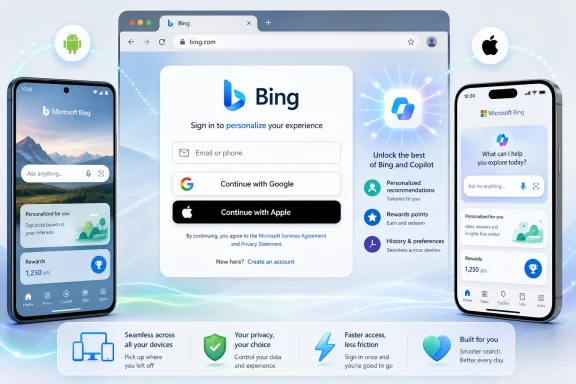
Microsoft confirmed on July 8, 2026, that Bing now lets users sign in with Google or Apple accounts, allowing access to personalized Bing features and Microsoft Rewards without requiring a new Microsoft account. The change, first spotted by Windows Latest, is small in interface terms and large in strategy. After years of treating the Microsoft account as the front door to everything, Microsoft has given Bing a side entrance through its two most important consumer rivals. That is not surrender; it is an admission that identity friction has become a bigger threat to Bing than ecosystem purity.
For most of the modern Windows era, the Microsoft account has been more than a login. It has been the connective tissue between Windows, Edge, OneDrive, Xbox, Outlook, Microsoft Store purchases, Microsoft 365, Copilot, and Bing Rewards-turned-Microsoft Rewards. Microsoft did not merely want users to search with Bing; it wanted them to become Microsoft-account users who happened to search with Bing.
That strategy made sense if the account was the beginning of a durable relationship. It made less sense when the account became the obstacle before the relationship could begin. A user who already lives inside Gmail, Android, iCloud, or Apple’s password manager does not necessarily object to trying Bing for a few searches. They may object very strongly to creating and managing yet another consumer identity.
The new Bing sign-in flow cuts directly through that problem. According to Windows Latest, Bing.com now shows “Continue with Google” and “Continue with Apple” beneath the standard email-or-phone sign-in field. Microsoft’s own framing is that this makes it easier to reach “personalized experiences,” with Microsoft Rewards specifically called out.
That wording matters. Microsoft is not describing this as a guest mode, a compatibility concession, or a temporary bridge. It is describing Google and Apple sign-in as a legitimate path into Bing’s personalized layer. The message is clear: Microsoft would rather have a signed-in Bing user attached to a rival identity provider than an unsigned Bing visitor who leaves after one search.
On Android, Google’s services are built into the gravitational field of the device. On iPhone, Apple controls the default experience and sells search placement as a premium channel. Microsoft can still distribute Bing through apps, Edge, widgets, Copilot, Windows, and aggressive prompts, but it no longer owns the phone-shaped starting point where so much search behavior begins.
That makes account friction unusually expensive. If an Android user lands on Bing and is told to create or use a Microsoft account before Rewards, personalization, or AI tools feel useful, Microsoft has inserted its weakest consumer credential into the strongest part of Google’s ecosystem. The user has already authenticated with Google. The phone already knows them. Their passwords, payments, email, calendar, and browser history may all orbit that account.
Letting that same user bring a Google account to Bing is therefore not an ideological concession. It is practical distribution engineering. Microsoft is lowering the cost of trial at the exact point where Bing has historically struggled to become a daily habit.
Apple sign-in is similarly important, though for different reasons. Apple users are trained to treat “Sign in with Apple” as the privacy-preserving, low-effort option across apps and services. If Bing wants to be taken seriously on iOS and macOS, especially beyond the subset of users already committed to Microsoft 365, meeting Apple users where they are is more useful than asking them to cross an identity moat.
Microsoft’s own support material has long described Rewards as part of the Microsoft account experience. That was logical from an accounting perspective: points, redemptions, fraud prevention, sweepstakes entries, and purchase history all need an identity anchor. But from a user-acquisition perspective, the Microsoft account requirement was also the toll booth.
Windows Latest notes that Microsoft has recently dangled high-value promotions, including a $1 million sweepstakes, to push more people toward Bing and Rewards. The irony is that a spectacular prize can still lose to a boring login screen. A user who will not create an MSA for daily searching is unlikely to change their mind because a sweepstakes exists somewhere behind the sign-in wall.
That is why this change may matter more than the promotions around it. If a Gmail user can start earning Rewards points through Bing without creating a Microsoft account, Microsoft has removed the single most predictable objection. The reward loop can begin before the ecosystem conversion happens.
The strategic bet is subtle. Microsoft no longer needs the Microsoft account to be step one. It can let Bing become step one, Rewards become step two, and Copilot, Edge, Microsoft 365, or Windows account conversion become step three. In other words, Microsoft is moving from identity-first acquisition to usage-first acquisition.
Bing is no longer simply a search engine in Redmond’s internal hierarchy. It is the distribution layer for Copilot, ads, shopping, answers, image generation, travel, maps, news, and Rewards. The public destination may be Bing.com, but the strategic destination is Microsoft’s AI-and-services bundle.
That makes the Copilot label understandable, if clumsy. Microsoft has spent the past several years trying to make Copilot the consumer-facing name for its AI ambitions. Bing Chat became Copilot. Windows gained Copilot branding. Microsoft 365 Copilot became the company’s enterprise AI spearhead. If the sign-in plumbing was built with Copilot in mind, Bing may simply be inheriting the same identity flow.
But for users, names matter. If someone clicks “Sign in” on Bing, the authentication page should not make them wonder whether they have been redirected into a different product. Microsoft has a long history of making account flows feel more confusing than they need to be, especially when personal Microsoft accounts, work or school accounts, Windows sign-in, Edge profiles, and web sessions collide.
The good news is that this particular confusion is fixable. The bad news is that it reinforces an old Microsoft habit: the company can identify a genuine friction point, remove it, and then immediately introduce a smaller but unnecessary ambiguity in the interface.
Edge is built on Chromium, but Microsoft has never wanted it to feel like Chrome with a different icon. It layers in Microsoft sync, Microsoft Search, sidebar apps, Copilot, shopping tools, security features, and enterprise controls. To get the full consumer profile experience, users traditionally had to bring a Microsoft account.
Google sign-in changes that psychology. It tells Chrome users that trying Edge does not require abandoning the identity they already use for the web. It also gives Microsoft a cleaner answer to one of Edge’s longest-running complaints: that the browser was technically compatible with the open web but commercially insistent on Microsoft identity.
The enterprise wrinkle is important too. Reports around the Edge rollout noted an administrative policy for controlling non-Microsoft account sign-in. That indicates Microsoft understands the difference between consumer convenience and managed-environment risk. A sysadmin may not want unmanaged Google identities used in a corporate browser profile, even if a home user sees the same feature as long-overdue common sense.
Bing’s new sign-in path will raise similar questions. Personal Rewards, consumer search history, Copilot features, and corporate browsers already overlap in messy ways. If Microsoft expands non-MSA identity across more surfaces, administrators will need clear controls, clear defaults, and clear documentation. Convenience for consumers should not become ambiguity for managed fleets.
That pressure has produced some rough tactics. Windows Latest has repeatedly criticized Microsoft for Bing experiences that appeared designed to intercept Google-seeking users, including pages that mimicked the look of Google’s minimalist search homepage. Microsoft has also used Windows prompts, Edge recommendations, default-browser nudges, and search integrations in ways that irritated power users who simply wanted their preferences respected.
The new Google and Apple sign-in buttons feel different because they reduce coercion rather than increase it. Instead of trying to trick a Google user into using Bing, Microsoft is saying: bring the Google account and try Bing anyway. That is a more mature competitive posture.
It is also a more dangerous one for Google. A user who refuses to create a Microsoft account is not necessarily loyal to Google search. They may simply be loyal to convenience. If Bing can remove the login penalty, offer Rewards, surface Copilot features, and work across devices without demanding an identity migration, Microsoft has a cleaner shot at the habit layer.
This is the difference between capture and absorption. Capture tries to force the user through Microsoft’s preferred funnel. Absorption lets the user arrive with whatever identity they already have, then surrounds them with Microsoft services once they are inside.
Microsoft is behaving differently because it has to. Google and Apple control the dominant mobile ecosystems. Microsoft controls the dominant desktop OS, but Windows is no longer the only place consumer computing identity is formed. The phone is the personal device; the PC is often the productivity device.
That does not make Microsoft weak. It makes Microsoft pragmatic. The company has spent the Satya Nadella era proving that it can make money by showing up on rival platforms instead of trying to replace them. Office on iPad, OneDrive on Android, Teams everywhere, Xbox services beyond consoles, and Microsoft 365 as a cross-platform subscription all came from the same strategic realization.
Bing adopting Google and Apple sign-in belongs in that lineage. The difference is that search is more symbolically loaded. Microsoft is not merely putting an app on a rival platform. It is allowing rival identity systems into the front door of a Microsoft flagship service that directly competes with Google’s core business.
That is why the move feels landmark even if the interface change is just two buttons. Microsoft has decided that the account boundary is less sacred than the signed-in session.
That means personalization can improve, Rewards can attach to a persistent identity, and Microsoft can more effectively connect search behavior to product experiences. It also means users should be careful not to confuse “no Microsoft account required” with “no Microsoft data relationship created.” The account provider changes; the service provider does not.
Apple’s sign-in option may create different user expectations than Google’s. Apple has marketed its identity system around privacy, relay addresses, and limiting cross-app tracking. If Bing supports Apple sign-in, users may reasonably expect a cleaner separation between their Apple identity and Microsoft’s service data. Microsoft will need to be explicit about what is collected, what is linked, and what can be deleted.
Google sign-in carries its own assumptions. Many users treat Google authentication as a universal web key, clicking through account pickers without thinking much about the downstream data relationship. That convenience is exactly why Microsoft wants the button. It is also why regulators and privacy-minded users will watch how Microsoft presents consent, personalization, Rewards eligibility, and account recovery.
The fairest reading is that this is not inherently anti-user. Federated sign-in can reduce password sprawl and make services easier to try. But Microsoft’s history of aggressive nudging means the company has not earned the benefit of vague explanations. If Bing is becoming account-flexible, its privacy and identity controls need to become more legible, not less.
Bing’s move does not mean Windows 11 will suddenly embrace Google or Apple sign-in at setup. The operating system has different security, recovery, device encryption, Store, OneDrive, and parental-control considerations. Microsoft has far more incentive to keep Windows identity tied to its own account system than it does for Bing search sessions.
Still, product strategy often shifts at the edges before it reaches the core. Edge accepting Google sign-in and Bing accepting Google and Apple sign-in both suggest Microsoft is reevaluating where account insistence helps and where it hurts. The company may still prefer an MSA, but preference is not the same as requirement.
For Windows users, that distinction matters. Microsoft can promote its ecosystem without making every feature feel like a hostage negotiation. It can offer OneDrive backup without turning setup into a dark pattern. It can make Copilot useful without making identity feel mandatory. The Bing decision is a reminder that Microsoft knows how to remove friction when it believes growth depends on it.
The question is whether that lesson will remain confined to services where Microsoft is chasing Google, or whether it will eventually influence Windows experiences where Microsoft already has leverage.
A user signed into Edge with one identity, Bing with another, Windows with a third, and Microsoft 365 with a work account is not an exotic scenario anymore. It is normal modern computing. Every additional sign-in option can make life easier for users and harder for support teams trying to understand where data, sync, history, Rewards, and policy boundaries actually sit.
The immediate risk is confusion rather than catastrophe. A personal Google-authenticated Bing session inside a work browser could produce unexpected personalization. Rewards prompts may appear where admins do not want consumer incentives. Copilot entry points may blur the line between personal web use and workplace productivity.
Microsoft can manage this if it gives organizations the same seriousness it appears to have given Edge’s non-Microsoft sign-in policy. Admins need toggles, documentation, and predictable behavior. They need to know whether non-MSA Bing sign-in can be blocked, whether Rewards can be suppressed, and whether consumer identity sessions interact with enterprise search or Microsoft 365 data.
For home users, “Continue with Google” is a convenience. For IT, it is another reminder that consumer identity, browser identity, and workplace identity are now layered on top of one another. The companies that make those layers need to stop pretending users experience them as separate worlds.
Bing has improved substantially over the years. Its image search, video search, shopping integrations, maps, travel features, news surfaces, and AI tools are not punchlines. Copilot gave Microsoft a rare moment where Bing felt ahead of the consumer search conversation rather than permanently behind it.
But Bing’s reputation has often been undermined by Microsoft’s distribution tactics. When users feel pushed into Bing through Windows Search, Edge prompts, or deceptive-looking pages, the product starts from a trust deficit. Even a good result page has to overcome the irritation that got the user there.
Letting people sign in with Google or Apple is the opposite gesture. It says Bing is willing to compete after the user arrives, not before. It lowers the emotional temperature. It makes the service feel more like a normal web product and less like an annex of Windows account strategy.
That may be the smartest Bing growth move Microsoft has made in years. Not because Google and Apple users were secretly waiting for Bing, but because many of them were never going to cross the Microsoft-account threshold just to find out.
But the next layer of competition is tolerance. Users may not change their default search engine immediately, but they might tolerate Bing in Edge, tolerate Bing for Rewards, tolerate Bing for Copilot image generation, tolerate Bing for shopping, or tolerate Bing when Windows Search sends them to the web. Over time, tolerated services can become habits.
That is where the Google and Apple sign-in buttons become strategically meaningful. They reduce the number of moments where a user says, “Never mind.” They make Bing more survivable as a secondary service. They let Microsoft build engagement without demanding a conversion ceremony first.
This fits the broader AI search moment. Classic search loyalty is being disrupted by answer engines, chat interfaces, browser assistants, and embedded search inside operating systems and apps. If the search box is no longer the only front door to search, the identity system behind search needs to be more flexible.
Microsoft appears to understand that. Bing does not need every user to declare allegiance. It needs more users to stay signed in long enough for Microsoft to learn what features pull them back.
Microsoft’s new Bing sign-in flow will not topple Google search by itself, and it will not make Apple users suddenly reorganize their lives around Microsoft services. But it removes a needless barrier at a moment when search, AI, browsers, and rewards programs are all being renegotiated. If Microsoft keeps choosing lower friction over louder coercion, Bing’s future may depend less on trapping users inside the Microsoft ecosystem and more on convincing them that staying there, even with a Google or Apple account, is worth it.
 Microsoft Stops Making the Account the Product
For most of the modern Windows era, the Microsoft account has been more than a login. It has been the connective tissue between Windows, Edge, OneDrive, Xbox, Outlook, Microsoft Store purchases, Microsoft 365, Copilot, and Bing Rewards-turned-Microsoft Rewards. Microsoft did not merely want users to search with Bing; it wanted them to become Microsoft-account users who happened to search with Bing.That strategy made sense if the account was the beginning of a durable relationship. It made less sense when the account became the obstacle before the relationship could begin. A user who already lives inside Gmail, Android, iCloud, or Apple’s password manager does not necessarily object to trying Bing for a few searches. They may object very strongly to creating and managing yet another consumer identity.
The new Bing sign-in flow cuts directly through that problem. According to Windows Latest, Bing.com now shows “Continue with Google” and “Continue with Apple” beneath the standard email-or-phone sign-in field. Microsoft’s own framing is that this makes it easier to reach “personalized experiences,” with Microsoft Rewards specifically called out.
That wording matters. Microsoft is not describing this as a guest mode, a compatibility concession, or a temporary bridge. It is describing Google and Apple sign-in as a legitimate path into Bing’s personalized layer. The message is clear: Microsoft would rather have a signed-in Bing user attached to a rival identity provider than an unsigned Bing visitor who leaves after one search.
Bing’s New Door Opens Where Windows Phone Closed
The most important context for this move is not the desktop browser war. It is mobile. Microsoft lost its native mobile platform years ago, and with it the cleanest way to make Bing the default search habit for hundreds of millions of users.On Android, Google’s services are built into the gravitational field of the device. On iPhone, Apple controls the default experience and sells search placement as a premium channel. Microsoft can still distribute Bing through apps, Edge, widgets, Copilot, Windows, and aggressive prompts, but it no longer owns the phone-shaped starting point where so much search behavior begins.
That makes account friction unusually expensive. If an Android user lands on Bing and is told to create or use a Microsoft account before Rewards, personalization, or AI tools feel useful, Microsoft has inserted its weakest consumer credential into the strongest part of Google’s ecosystem. The user has already authenticated with Google. The phone already knows them. Their passwords, payments, email, calendar, and browser history may all orbit that account.
Letting that same user bring a Google account to Bing is therefore not an ideological concession. It is practical distribution engineering. Microsoft is lowering the cost of trial at the exact point where Bing has historically struggled to become a daily habit.
Apple sign-in is similarly important, though for different reasons. Apple users are trained to treat “Sign in with Apple” as the privacy-preserving, low-effort option across apps and services. If Bing wants to be taken seriously on iOS and macOS, especially beyond the subset of users already committed to Microsoft 365, meeting Apple users where they are is more useful than asking them to cross an identity moat.
Rewards Was Always the Real Conversion Funnel
Microsoft Rewards is the most revealing part of this announcement. For years, Rewards has been Microsoft’s consumer-growth machine disguised as a loyalty program. Search with Bing, use Edge, complete quizzes, shop through Microsoft channels, redeem points, enter sweepstakes, and maybe turn a little habitual engagement into a durable Microsoft relationship.Microsoft’s own support material has long described Rewards as part of the Microsoft account experience. That was logical from an accounting perspective: points, redemptions, fraud prevention, sweepstakes entries, and purchase history all need an identity anchor. But from a user-acquisition perspective, the Microsoft account requirement was also the toll booth.
Windows Latest notes that Microsoft has recently dangled high-value promotions, including a $1 million sweepstakes, to push more people toward Bing and Rewards. The irony is that a spectacular prize can still lose to a boring login screen. A user who will not create an MSA for daily searching is unlikely to change their mind because a sweepstakes exists somewhere behind the sign-in wall.
That is why this change may matter more than the promotions around it. If a Gmail user can start earning Rewards points through Bing without creating a Microsoft account, Microsoft has removed the single most predictable objection. The reward loop can begin before the ecosystem conversion happens.
The strategic bet is subtle. Microsoft no longer needs the Microsoft account to be step one. It can let Bing become step one, Rewards become step two, and Copilot, Edge, Microsoft 365, or Windows account conversion become step three. In other words, Microsoft is moving from identity-first acquisition to usage-first acquisition.
The Copilot Label Gives Away the Internal Politics
The hands-on detail that the Google and Apple account pickers reportedly say “Sign in to continue using Microsoft Copilot” rather than Bing is more than a stray label. It is a window into how Microsoft now sees its consumer products.Bing is no longer simply a search engine in Redmond’s internal hierarchy. It is the distribution layer for Copilot, ads, shopping, answers, image generation, travel, maps, news, and Rewards. The public destination may be Bing.com, but the strategic destination is Microsoft’s AI-and-services bundle.
That makes the Copilot label understandable, if clumsy. Microsoft has spent the past several years trying to make Copilot the consumer-facing name for its AI ambitions. Bing Chat became Copilot. Windows gained Copilot branding. Microsoft 365 Copilot became the company’s enterprise AI spearhead. If the sign-in plumbing was built with Copilot in mind, Bing may simply be inheriting the same identity flow.
But for users, names matter. If someone clicks “Sign in” on Bing, the authentication page should not make them wonder whether they have been redirected into a different product. Microsoft has a long history of making account flows feel more confusing than they need to be, especially when personal Microsoft accounts, work or school accounts, Windows sign-in, Edge profiles, and web sessions collide.
The good news is that this particular confusion is fixable. The bad news is that it reinforces an old Microsoft habit: the company can identify a genuine friction point, remove it, and then immediately introduce a smaller but unnecessary ambiguity in the interface.
Edge Was the Warning Shot
The Bing change did not arrive in isolation. It follows Microsoft’s move to allow Google account sign-in in Edge, a shift that outlets including Windows Central, Neowin, and TechSpot tied to Microsoft’s Edge roadmap and recent release notes. That change was notable because Edge, like Bing, has long been used as a Microsoft-account funnel.Edge is built on Chromium, but Microsoft has never wanted it to feel like Chrome with a different icon. It layers in Microsoft sync, Microsoft Search, sidebar apps, Copilot, shopping tools, security features, and enterprise controls. To get the full consumer profile experience, users traditionally had to bring a Microsoft account.
Google sign-in changes that psychology. It tells Chrome users that trying Edge does not require abandoning the identity they already use for the web. It also gives Microsoft a cleaner answer to one of Edge’s longest-running complaints: that the browser was technically compatible with the open web but commercially insistent on Microsoft identity.
The enterprise wrinkle is important too. Reports around the Edge rollout noted an administrative policy for controlling non-Microsoft account sign-in. That indicates Microsoft understands the difference between consumer convenience and managed-environment risk. A sysadmin may not want unmanaged Google identities used in a corporate browser profile, even if a home user sees the same feature as long-overdue common sense.
Bing’s new sign-in path will raise similar questions. Personal Rewards, consumer search history, Copilot features, and corporate browsers already overlap in messy ways. If Microsoft expands non-MSA identity across more surfaces, administrators will need clear controls, clear defaults, and clear documentation. Convenience for consumers should not become ambiguity for managed fleets.
The Old Bing Was Built to Capture, the New Bing Is Built to Absorb
Microsoft’s relationship with Bing traffic has often looked desperate because the stakes are unusually high. Search is not just a utility; it is advertising inventory, intent data, default placement, AI training context, shopping referrals, and browser leverage. Google’s dominance has made every percentage point of search share feel strategically valuable.That pressure has produced some rough tactics. Windows Latest has repeatedly criticized Microsoft for Bing experiences that appeared designed to intercept Google-seeking users, including pages that mimicked the look of Google’s minimalist search homepage. Microsoft has also used Windows prompts, Edge recommendations, default-browser nudges, and search integrations in ways that irritated power users who simply wanted their preferences respected.
The new Google and Apple sign-in buttons feel different because they reduce coercion rather than increase it. Instead of trying to trick a Google user into using Bing, Microsoft is saying: bring the Google account and try Bing anyway. That is a more mature competitive posture.
It is also a more dangerous one for Google. A user who refuses to create a Microsoft account is not necessarily loyal to Google search. They may simply be loyal to convenience. If Bing can remove the login penalty, offer Rewards, surface Copilot features, and work across devices without demanding an identity migration, Microsoft has a cleaner shot at the habit layer.
This is the difference between capture and absorption. Capture tries to force the user through Microsoft’s preferred funnel. Absorption lets the user arrive with whatever identity they already have, then surrounds them with Microsoft services once they are inside.
Google and Apple Would Not Return the Favor
The asymmetry here is striking. It is difficult to imagine Google making YouTube broadly sign-in-friendly with Microsoft accounts, or Apple letting Apple Maps treat a Microsoft account as a first-class consumer identity. These companies may support email aliases, federated enterprise identity, or platform-specific account linking in narrow cases, but their flagship consumer services are designed to reinforce their own account systems.Microsoft is behaving differently because it has to. Google and Apple control the dominant mobile ecosystems. Microsoft controls the dominant desktop OS, but Windows is no longer the only place consumer computing identity is formed. The phone is the personal device; the PC is often the productivity device.
That does not make Microsoft weak. It makes Microsoft pragmatic. The company has spent the Satya Nadella era proving that it can make money by showing up on rival platforms instead of trying to replace them. Office on iPad, OneDrive on Android, Teams everywhere, Xbox services beyond consoles, and Microsoft 365 as a cross-platform subscription all came from the same strategic realization.
Bing adopting Google and Apple sign-in belongs in that lineage. The difference is that search is more symbolically loaded. Microsoft is not merely putting an app on a rival platform. It is allowing rival identity systems into the front door of a Microsoft flagship service that directly competes with Google’s core business.
That is why the move feels landmark even if the interface change is just two buttons. Microsoft has decided that the account boundary is less sacred than the signed-in session.
Privacy Becomes the Next Trust Test
There is a consumer-friendly version of this story: fewer accounts, easier sign-in, less friction, more choice. There is also a more complicated data story. When a user signs into Bing with Google or Apple, Microsoft still gains a signed-in Bing user.That means personalization can improve, Rewards can attach to a persistent identity, and Microsoft can more effectively connect search behavior to product experiences. It also means users should be careful not to confuse “no Microsoft account required” with “no Microsoft data relationship created.” The account provider changes; the service provider does not.
Apple’s sign-in option may create different user expectations than Google’s. Apple has marketed its identity system around privacy, relay addresses, and limiting cross-app tracking. If Bing supports Apple sign-in, users may reasonably expect a cleaner separation between their Apple identity and Microsoft’s service data. Microsoft will need to be explicit about what is collected, what is linked, and what can be deleted.
Google sign-in carries its own assumptions. Many users treat Google authentication as a universal web key, clicking through account pickers without thinking much about the downstream data relationship. That convenience is exactly why Microsoft wants the button. It is also why regulators and privacy-minded users will watch how Microsoft presents consent, personalization, Rewards eligibility, and account recovery.
The fairest reading is that this is not inherently anti-user. Federated sign-in can reduce password sprawl and make services easier to try. But Microsoft’s history of aggressive nudging means the company has not earned the benefit of vague explanations. If Bing is becoming account-flexible, its privacy and identity controls need to become more legible, not less.
Windows Users Should Read This as a Signal
For Windows enthusiasts, the obvious question is whether Bing’s softer account stance says anything about Windows itself. Microsoft has spent years pushing Windows 10 and Windows 11 users toward Microsoft accounts, especially during setup. Local accounts still exist in various forms and workarounds, but the out-of-box experience has steadily tilted toward online identity.Bing’s move does not mean Windows 11 will suddenly embrace Google or Apple sign-in at setup. The operating system has different security, recovery, device encryption, Store, OneDrive, and parental-control considerations. Microsoft has far more incentive to keep Windows identity tied to its own account system than it does for Bing search sessions.
Still, product strategy often shifts at the edges before it reaches the core. Edge accepting Google sign-in and Bing accepting Google and Apple sign-in both suggest Microsoft is reevaluating where account insistence helps and where it hurts. The company may still prefer an MSA, but preference is not the same as requirement.
For Windows users, that distinction matters. Microsoft can promote its ecosystem without making every feature feel like a hostage negotiation. It can offer OneDrive backup without turning setup into a dark pattern. It can make Copilot useful without making identity feel mandatory. The Bing decision is a reminder that Microsoft knows how to remove friction when it believes growth depends on it.
The question is whether that lesson will remain confined to services where Microsoft is chasing Google, or whether it will eventually influence Windows experiences where Microsoft already has leverage.
IT Pros Get Convenience, but Also Another Identity Edge Case
Administrators should not dismiss this as consumer search fluff. Identity choices in consumer products have a habit of bleeding into managed environments, especially when the same browser, search engine, and AI tools are used at home and at work.A user signed into Edge with one identity, Bing with another, Windows with a third, and Microsoft 365 with a work account is not an exotic scenario anymore. It is normal modern computing. Every additional sign-in option can make life easier for users and harder for support teams trying to understand where data, sync, history, Rewards, and policy boundaries actually sit.
The immediate risk is confusion rather than catastrophe. A personal Google-authenticated Bing session inside a work browser could produce unexpected personalization. Rewards prompts may appear where admins do not want consumer incentives. Copilot entry points may blur the line between personal web use and workplace productivity.
Microsoft can manage this if it gives organizations the same seriousness it appears to have given Edge’s non-Microsoft sign-in policy. Admins need toggles, documentation, and predictable behavior. They need to know whether non-MSA Bing sign-in can be blocked, whether Rewards can be suppressed, and whether consumer identity sessions interact with enterprise search or Microsoft 365 data.
For home users, “Continue with Google” is a convenience. For IT, it is another reminder that consumer identity, browser identity, and workplace identity are now layered on top of one another. The companies that make those layers need to stop pretending users experience them as separate worlds.
Bing’s Best Chance Is to Stop Acting Needy
The most promising part of this move is that it makes Bing look less needy. That may sound glib, but product posture matters. Users can smell desperation in prompts, pop-ups, fake-outs, forced defaults, and sweepstakes that seem designed to bribe them into a habit.Bing has improved substantially over the years. Its image search, video search, shopping integrations, maps, travel features, news surfaces, and AI tools are not punchlines. Copilot gave Microsoft a rare moment where Bing felt ahead of the consumer search conversation rather than permanently behind it.
But Bing’s reputation has often been undermined by Microsoft’s distribution tactics. When users feel pushed into Bing through Windows Search, Edge prompts, or deceptive-looking pages, the product starts from a trust deficit. Even a good result page has to overcome the irritation that got the user there.
Letting people sign in with Google or Apple is the opposite gesture. It says Bing is willing to compete after the user arrives, not before. It lowers the emotional temperature. It makes the service feel more like a normal web product and less like an annex of Windows account strategy.
That may be the smartest Bing growth move Microsoft has made in years. Not because Google and Apple users were secretly waiting for Bing, but because many of them were never going to cross the Microsoft-account threshold just to find out.
The Search War Moves From Defaults to Tolerance
Defaults still matter enormously. Google pays for them because they work. Microsoft fights for them because changing defaults is hard. Apple profits from them because distribution is power.But the next layer of competition is tolerance. Users may not change their default search engine immediately, but they might tolerate Bing in Edge, tolerate Bing for Rewards, tolerate Bing for Copilot image generation, tolerate Bing for shopping, or tolerate Bing when Windows Search sends them to the web. Over time, tolerated services can become habits.
That is where the Google and Apple sign-in buttons become strategically meaningful. They reduce the number of moments where a user says, “Never mind.” They make Bing more survivable as a secondary service. They let Microsoft build engagement without demanding a conversion ceremony first.
This fits the broader AI search moment. Classic search loyalty is being disrupted by answer engines, chat interfaces, browser assistants, and embedded search inside operating systems and apps. If the search box is no longer the only front door to search, the identity system behind search needs to be more flexible.
Microsoft appears to understand that. Bing does not need every user to declare allegiance. It needs more users to stay signed in long enough for Microsoft to learn what features pull them back.
The Two Buttons That Say More Than the Banner Ads
The practical change is easy to summarize, but its consequences are broader than the sign-in screen suggests.- Bing now supports Google and Apple sign-in for users who want personalized experiences without creating a new Microsoft account.
- Microsoft Rewards appears to be part of the new flow, weakening one of the oldest Microsoft-account requirements around Bing engagement.
- The change follows Edge adding Google account sign-in, suggesting a wider retreat from Microsoft-account-only consumer entry points.
- The move is especially aimed at Android, iPhone, and Gmail users who may be open to Bing but resistant to another account.
- Microsoft still benefits from the signed-in session, so users should not confuse non-MSA sign-in with an absence of Microsoft data collection.
- Administrators should watch for policy controls because consumer identity flexibility can create confusion inside managed browser and search environments.
Microsoft’s new Bing sign-in flow will not topple Google search by itself, and it will not make Apple users suddenly reorganize their lives around Microsoft services. But it removes a needless barrier at a moment when search, AI, browsers, and rewards programs are all being renegotiated. If Microsoft keeps choosing lower friction over louder coercion, Bing’s future may depend less on trapping users inside the Microsoft ecosystem and more on convincing them that staying there, even with a Google or Apple account, is worth it.
References
- Primary source: Windows Latest
Published: 2026-07-07T23:50:08.162154
Loading…
www.windowslatest.com - Related coverage: techspot.com
Microsoft reverses stance and adds Google account sign-in to Edge browser | TechSpot
Microsoft latest release of the Edge browser adds a much-requested feature for users working within Google's web ecosystem. Edge 150 finally provides a way to sign in...www.techspot.com - Official source: support.microsoft.com
Loading…
support.microsoft.com - Related coverage: windowscentral.com
Microsoft kills mandatory MSA Edge sign‑in after years of complaints, and Google login support will arrive in July | Windows Central
Microsoft Edge will soon support Google account sign‑in, ending years of frustration over forced Microsoft accounts.www.windowscentral.com - Related coverage: windowsreport.com
Microsoft Edge is Finally Getting Google Account Sign-in Support This July
Microsoft Edge will let users sign in with Google accounts starting July 2026, expanding beyond Microsoft accounts. windowsreport.com
- Related coverage: winbuzzer.com
Loading…
winbuzzer.com
- Related coverage: techdemis.com
Loading…
www.techdemis.com - Related coverage: neowin.net
Loading…
www.neowin.net - Official source: store.apple.com
- Related coverage: u3ahavelocknorth.com
Loading…
www.u3ahavelocknorth.com - Related coverage: enrapture.gg
Loading…
enrapture.gg - Official source: techcommunity.microsoft.com