

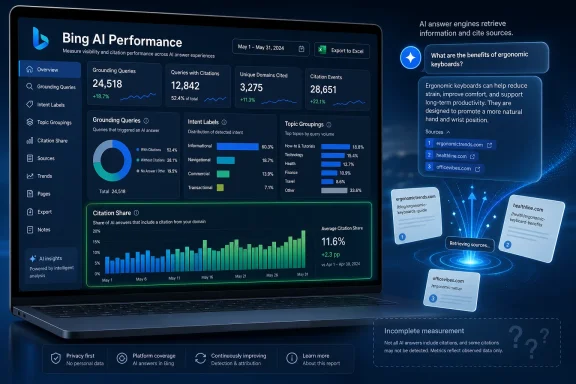
That matters because the web’s old bargain was measurable even when it was unfair. A crawler indexed your page, a ranking system placed it somewhere, and analytics told you whether the result generated impressions, clicks, or conversions. Generative AI breaks that chain by retrieving, summarizing, citing, and sometimes satisfying the user before a visit ever happens. Bing’s upgraded report is not a full accounting system for that new world, but it is the clearest admission yet from a major search platform that publishers need more than vibes to compete in AI answers.
Bing Turns the AI Black Box Into a Dimly Lit Dashboard
The new AI Performance report is still a preview-era instrument, and Microsoft is careful not to oversell it. It shows how a site’s content is cited across supported AI experiences, including Microsoft Copilot, AI-generated summaries in Bing, and unnamed partner integrations. The omission is as important as the inclusion: site owners cannot isolate Copilot from Bing summaries, nor can they identify which partners are using or displaying their content.
Even so, the report’s structure reflects a major shift in how search platforms think about visibility. Traditional webmaster reporting starts with the user’s query and the page that ranked. Bing’s AI report starts with grounding queries, the retrieval phrases an AI system used while assembling an answer. These are not necessarily the words a human typed. They are the machine’s intermediate interpretation of what evidence it needs.
That distinction is the heart of the update. In classic SEO, the optimizer studied demand by looking at search queries. In AI search, demand is partly hidden behind the system’s decomposition of the user’s request. A single conversational question may fan out into several retrieval tasks, each with its own phrasing, intent, and source competition. Bing is now showing publishers at least some of that machinery.
The old web analytics question was “Did I get the click?” The new question is “Was I considered credible enough to be cited when the answer was composed?” Bing’s report does not yet tell publishers whether the citation changed user behavior, but it tells them something many have been guessing at for the past two years: whether their pages are part of the answer layer at all.
Google’s Silence Makes Bing Look More Generous Than It Is
Bing’s move looks especially significant because the alternatives are so thin. Google’s Search Console folds AI Overview performance into broader organic search reporting, leaving publishers unable to cleanly separate traditional blue-link visibility from generative answer exposure. That makes a basic operational question — “Are AI Overviews helping or cannibalizing my search traffic?” — frustratingly hard to answer inside Google’s own tooling.
OpenAI’s approach is narrower still. ChatGPT can send meaningful referral traffic, and its answers can confer brand visibility even when they do not send traffic. But OpenAI’s publisher-facing data remains limited, with more formal metrics available only in certain content-licensing relationships. For most site owners, ChatGPT visibility is inferred from server logs, analytics referrals, third-party monitoring tools, and occasional manual testing.
That gives Microsoft room to present Bing Webmaster Tools as the practical option for AI visibility. It is not because Bing suddenly owns the whole answer-engine economy. It does not. Rather, Bing is offering the thing publishers have been asking the industry for: native reporting that acknowledges citations as a measurable event.
There is an irony here. Bing’s traditional search market share has long lagged Google’s, but Microsoft’s AI distribution footprint is broader than its search share alone suggests. Copilot is threaded through Windows, Edge, Microsoft 365, and enterprise workflows. If AI answers become a major discovery surface, Bing’s index and reporting stack may matter to publishers out of proportion to Bing.com’s old search share.
Grounding Queries Are the New Keyword, but They Are Not the Same Thing
The phrase grounding query sounds like the kind of term only a product manager could love, but it describes a real change in the search stack. When an AI assistant answers a question, it may retrieve documents to anchor the response in current or external information. The query used for that retrieval can differ from the original user prompt because the model is translating a messy human request into a set of evidence-seeking tasks.
For publishers, this is both useful and dangerous. It is useful because it reveals how Bing’s AI systems understand a page. If a Windows troubleshooting article appears for grounding queries about a specific error code, driver conflict, or update failure, the publisher gains evidence that the page is legible to the machine. If the same article appears for irrelevant or oddly broad queries, that may signal muddled structure, ambiguous terminology, or duplicate intent across the site.
It is dangerous because grounding queries can tempt optimizers into a new form of mechanical content production. The SEO industry has spent two decades proving that any metric can become a target and therefore a mess. If grounding queries become the new keyword list, the web will quickly fill with pages written not for readers but for retrieval agents: shallow, overstructured, and tuned to be cited rather than to be useful.
The better interpretation is more conservative. Grounding queries should be treated as diagnostic traces, not as marching orders. They show how an AI system reached for evidence. They do not prove search demand, user satisfaction, conversion value, or topical authority on their own.
Citation Share Gives Publishers a Rival to Ranking Position
The most consequential addition is citation share. Bing defines it as the percentage of citations attributed to a site out of all citations shown for a specific grounding query. In plain English, it is a competitive visibility metric for AI answers.
That is a big deal because AI answers do not map neatly to the familiar “position one through ten” logic of search results. A generated answer may cite several sources, cite none prominently, cite a page without sending traffic, or synthesize information in a way that leaves the source visible but secondary. Citation share gives publishers a way to ask whether they are gaining or losing presence in that evidence pool.
For commercial publishers, this becomes especially interesting. A page with low traffic but high citation share for a high-intent comparison query may be more valuable than its analytics dashboard suggests. Conversely, a page with decent organic rankings but little AI citation presence may be less influential in the answer layer than it appears in traditional search reporting.
The metric also introduces a new kind of competitive research. If a site has low citation share for a grounding query it clearly deserves to answer, the next step is not simply to add the phrase to a heading. The next step is to inspect the cited competitors and ask what they provide that the page does not: fresher data, clearer definitions, better source attribution, structured comparisons, original evidence, or less ambiguity.
This is where the report becomes actionable rather than merely interesting. Citation share turns AI visibility from a yes-or-no mystery into a relative performance problem. That is the kind of problem publishers and SEO teams know how to work on.
Intent and Topic Labels Move AI Optimization Beyond String Matching
Bing’s new intent and topic labels are less flashy than citation share, but they may be more useful for mature content operations. Intent categories such as navigational, informational, commercial, conversational, comparison, and “learn and solve” help publishers see why a page is being retrieved. Topic labels group related grounding queries into broader clusters.
This matters because AI systems are not merely matching words. They are trying to satisfy tasks. A support article, product guide, review page, and documentation page may all mention the same terms, but they serve different user needs. If Bing’s report shows that a page is being cited mostly for “learn and solve” queries, rewriting it as a sales page may damage the very signal that made it useful.
For WindowsForum.com’s audience, the analogy is familiar. A sysadmin searching for an Event ID does not want a brand narrative. A power user troubleshooting a failed cumulative update does not want a thin definition. A procurement manager comparing endpoint protection products does not want a forum thread full of anecdotes unless those anecdotes reveal operational reality. Intent is not decoration; it is the job the page is being asked to perform.
The topic layer can also expose site architecture problems. If several internal pages appear for the same grounding query cluster, that may indicate healthy coverage — or it may indicate duplication that confuses retrieval systems. Microsoft has been increasingly explicit that duplicate or overlapping content can blur intent signals for AI systems. The upgraded report gives publishers a way to see that problem where it matters: not just in crawl diagnostics, but in answer composition.
The Report Is Useful Because It Is Incomplete
The obvious criticism of Bing’s report is that it withholds the metrics publishers most want. It does not provide clean channel filtering. It does not show partner identities. It does not expose user prompts. It does not report views or clicks for individual AI citations. It does not prove that a citation was prominent, persuasive, or even noticed.
Those limits are real, but they do not make the report useless. They define what kind of tool it is. Bing has not delivered an AI equivalent of Search Console’s performance report. It has delivered something closer to an observability panel for content retrieval.
That distinction should shape expectations. A citation count is not a visit. Average cited pages are not rankings. A grounding query is not search volume. Citation share is not market share. The report shows how content participates in supported AI answer systems, not whether that participation produced business value.
Still, observability often precedes accountability. In infrastructure, the first useful dashboard rarely tells the whole story; it tells engineers where to look. Bing’s AI Performance report does the same for content. It gives publishers traces, clusters, and relative citation signals they can use to audit whether their pages are understandable, retrievable, and competitive.
The Windows Angle Is Bigger Than SEO
It would be easy to file this story under digital marketing and move on. That would miss the broader Windows ecosystem angle. Copilot is not a standalone chatbot sitting off to the side of Microsoft’s strategy. It is a user interface layer spreading across Windows, Edge, Microsoft 365, enterprise search, and developer workflows.
That means AI visibility is becoming relevant to organizations that do not think of themselves as publishers. A software vendor’s documentation, a managed service provider’s knowledge base, a hospital’s public guidance, a school district’s support pages, and a local government’s service information may all be pulled into AI-generated answers. If those pages are inaccurate, stale, blocked, duplicated, or poorly structured, the problem is not merely lower traffic. The problem is that the organization may be absent or misrepresented when users ask for help.
For IT administrators, this also intersects with governance. Many enterprises are deploying Copilot-style tools internally while also managing public-facing content that external AI systems may retrieve. The disciplines are converging: content hygiene, source authority, update freshness, schema, access controls, and telemetry all matter more when machines are reading on behalf of users.
Bing’s report should therefore be read as part of a larger Microsoft thesis. The company is arguing that grounding is infrastructure. If AI assistants are going to act on retrieved information, then the systems that crawl, classify, cite, and report that information become strategically important. Webmaster Tools may look like an old SEO utility, but in this context it becomes a control panel for participation in AI-mediated discovery.
The First-Party Data Arms Race Has Begun
The upgraded report also raises an uncomfortable competitive question: who gets to see AI visibility data, and on what terms? Google has the richest search demand data but has so far declined to separate AI Overview reporting in the way publishers want. OpenAI has enormous answer influence but limited public webmaster tooling. Microsoft, with Bing Webmaster Tools, is using transparency as a differentiator.
That does not make Microsoft altruistic. Better reporting encourages publishers to optimize for Microsoft’s AI surfaces, keep Bingbot access open, adopt IndexNow, and treat Bing as more than an afterthought. Transparency is a product strategy. If publishers believe Bing gives them actionable feedback, they are more likely to invest in being visible there.
The industry should welcome that pressure. For years, platforms have asked publishers to accept that AI-generated answers are good for users and potentially good for the web, while offering limited evidence of how content is used. If AI companies want access to the open web’s knowledge, reporting cannot remain a privilege reserved for large licensing partners.
But the pressure cuts both ways. Once Bing shows citation share, publishers will ask why it cannot show channel breakdowns. Once it shows grounding queries, publishers will ask why it cannot distinguish partner integrations. Once it shows page citation frequency, publishers will ask where impressions, clicks, and downstream engagement went. Transparency has a ratchet effect: each disclosure makes the next nondisclosure more visible.
Optimization Will Reward Clarity, Not Tricks — At Least for Now
The practical advice emerging from the report is refreshingly old-fashioned. Pages that are clear, current, specific, well-structured, and supported by evidence are easier for AI systems to retrieve and cite. That sounds like generic SEO advice because good SEO and good AI retrievability overlap more than vendors sometimes admit.
The difference is in emphasis. Traditional search optimization often rewarded pages that matched query demand and accumulated authority. AI citation optimization appears to reward pages that can be safely used as evidence inside an answer. That puts pressure on factual precision, directness, and disambiguation.
A troubleshooting page, for example, should make clear which Windows versions, build numbers, hardware conditions, error messages, and remediation steps it applies to. A comparison page should state criteria rather than burying them in marketing language. A product documentation page should separate stable reference material from promotional copy. A news article should distinguish confirmed facts from reported claims.
This is not glamorous work. It is content operations, editorial discipline, and technical hygiene. The AI Performance report does not change that. It simply gives site owners a better way to see whether those investments are making their content more visible in AI-generated answers.
The Metric That Matters May Be the One Bing Still Does Not Show
The missing piece is user impact. A citation that nobody sees is not worth much. A citation that satisfies the user without a click may still build brand trust, but measuring that trust is difficult. A citation that appears below several competitors may be technically counted while having little practical value.
This is where AI search analytics remains immature. Search Console trained publishers to think in impressions, clicks, click-through rate, and average position. AI answers require a different vocabulary: citation presence, citation prominence, answer share, sentiment, task completion, referral quality, and assisted conversion. Bing has given the market some of those ingredients, but not the full recipe.
There may be legitimate reasons for caution. User privacy, product complexity, partner contracts, and the fluid nature of AI answer generation all make reporting harder than classic SERP analytics. A generated answer may vary by user, location, context, conversation history, device, and safety settings. Measuring that consistently is not trivial.
But publishers do not need perfection to demand more. They need enough signal to decide whether to invest. Bing’s update improves that signal. It does not yet tell a CFO, editor, or IT director what AI citations are worth.
The Spreadsheet Is Back, Because the Dashboard Is Not Enough
One of the more practical improvements is exportability. Sorting inside the interface is useful, but the real work begins when teams pull grounding queries, citation share, topics, intents, and URLs into a spreadsheet or BI tool. That is where patterns become visible.
A publisher can group grounding queries by topic and compare them against its content taxonomy. A support organization can identify pages cited for troubleshooting intents and test whether those pages are up to date. A commerce site can find commercial or comparison queries where it has low citation share and inspect whether competitors provide better structured buying guidance.
This is also where duplicate intent becomes easier to spot. If three pages are all being cited for the same grounding query, that may mean the site has a strong cluster. It may also mean the site is splitting signals across pages that should be consolidated, canonicalized, or differentiated. The report will not make that judgment for you, but it will surface the pattern.
The best use of the data is iterative. Export, cluster, inspect, edit, publish, notify crawlers where appropriate, and watch whether citation patterns change. That is not magic. It is the same feedback loop that made webmaster tools valuable in the first place.
Bing’s Gift Comes With Platform Strings Attached
There is a strategic bargain hidden inside the report. Microsoft is giving publishers more visibility, but only into the parts of the AI ecosystem that Microsoft chooses to instrument and aggregate. The report’s value depends on Bing’s role as a grounding layer for Microsoft and partner experiences.
That means publishers should avoid treating Bing AI Performance as a universal AI visibility score. It is not a ChatGPT dashboard. It is not a Google AI Overview dashboard. It is not a Perplexity report. It is a Microsoft-controlled view into supported Microsoft and partner surfaces.
Still, platform-specific data can be valuable if interpreted honestly. Google Search Console never represented the whole web either; it represented Google Search. Bing’s AI report should be used the same way: as first-party data from one important ecosystem, not as a complete map of generative discovery.
The danger is that vendors and consultants will inflate the metric. “AI citation share” sounds boardroom-ready. Expect dashboards, audits, and agencies to package it as a proxy for AI authority. The more responsible reading is narrower: it is a useful indicator of how often your site is cited for specific grounding queries in supported Bing-powered AI experiences.
The Open Web Needs Reporting Before It Needs More Acronyms
The marketing industry has already produced a fog of acronyms around this shift: AEO, GEO, answer optimization, AI search optimization, generative visibility, and more. Some of those terms are useful. Many are attempts to rename familiar work before the tooling catches up.
Bing’s report is valuable because it grounds the conversation in observable behavior. A page was cited. A grounding query was used. A topic was assigned. An intent was inferred. A share was calculated. Those are imperfect signals, but they are better than speculative prompt testing and screenshots passed around as strategy.
The open web needs more of this, not because publishers deserve dashboards as a matter of sentiment, but because healthy information ecosystems require feedback. If AI systems rely on web content but provide no meaningful reporting, publishers are forced to optimize blindly or withdraw access. Neither outcome is good for users.
Microsoft’s incentives are not identical to publishers’ incentives, but they overlap here. Bing needs a web that remains crawlable, current, and structured enough to ground AI answers. Publishers need evidence that participation has value. The AI Performance report is where those interests meet, however uneasily.
The Citation Economy Finally Gets Its First Ledger
Bing’s upgraded report should not be mistaken for a finished measurement system, but it is now concrete enough to change day-to-day decisions. The most useful takeaways are operational rather than philosophical:
- Bing Webmaster Tools now gives publishers intent, topic, citation share, and comparison signals for AI citations across supported Microsoft and partner AI experiences.
- Grounding queries are retrieval phrases used by AI systems, not necessarily the original words typed by users.
- Citation share is the closest thing the report offers to a competitive AI visibility metric, but it should not be treated as traffic, ranking, or revenue.
- The inability to filter by Copilot, Bing summaries, or individual partners remains a major limitation for serious attribution.
- The best optimization targets are pages whose intent is clear, evidence is current, structure is readable, and overlap with similar internal pages is minimized.
- The report is most powerful when exported and analyzed over time, because single snapshots of AI visibility can be misleading.
The web is entering a period in which being read by machines may matter as much as being clicked by humans, and Microsoft has decided that publishers should at least get a partial receipt. Bing’s AI Performance report is partial, aggregated, and self-interested, but it is also a real step toward making generative visibility measurable. If Google and OpenAI continue to offer less, the old assumption that Bing Webmaster Tools is optional may start to look dated — not because Bing won search, but because it understood that the answer economy needs instruments before anyone can honestly claim to optimize it.
References
- Bing’s AI Performance Report Gets Better Practical Ecommerce · 2026-06-22T15:50:11.099989