

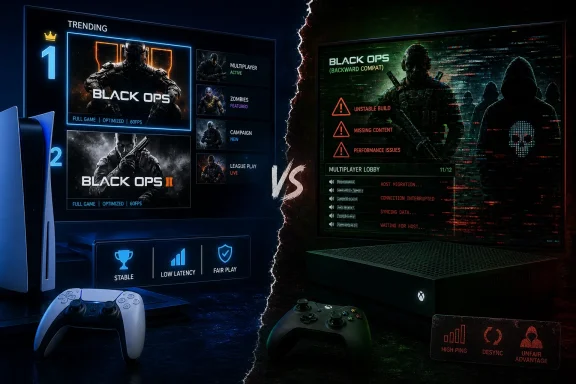
Basic PlayStation ports of Call of Duty: Black Ops and Black Ops 2 reached the PlayStation Store’s No. 1 and No. 2 trending positions, ahead of Grand Theft Auto VI, while Xbox owners still have only the older backward-compatible editions. Microsoft should respond by announcing equivalent Xbox ports or presenting a concrete maintenance plan for the legacy versions’ multiplayer services.
The result is commercially encouraging but strategically difficult to defend. Microsoft has demonstrated demand for PlayStation-only modern ports of these classics while Xbox players remain directed toward older releases in which hackers and cheaters are reportedly prevalent. Xbox did not lose access to these games; it was excluded from their restored editions.
The success of Black Ops and Black Ops 2 on PlayStation should not be surprising. These are prominent entries in a franchise whose campaigns, maps, progression systems, and multiplayer modes helped define an era of console gaming. Their names carry enough recognition that a straightforward rerelease can attract attention without the marketing burden attached to an unfamiliar product.
According to Windows Central, the two ports occupied the PlayStation Store’s No. 1 and No. 2 trending positions, placing them ahead of Grand Theft Auto VI. Trending charts are not audited sales reports, and the ranking does not prove that these older Call of Duty releases are outselling GTA VI over any broader period. It does show that the ports generated unusually visible storefront interest at that moment.
That achievement is notable because the releases are described as basic ports rather than extensive remasters. The supplied information does not establish a particular resolution increase, a complete list of technical changes, or the absence of every possible modernization feature. The defensible point is narrower: Microsoft did not need a ground-up remake to generate attention for these games.
The ports offer PlayStation users a new route into Black Ops and Black Ops 2 instead of directing them into the original Xbox 360 releases. On Xbox, the games remain accessible through backward compatibility, but the reported prevalence of hackers and cheaters complicates the practical value of that access.
That distinction—not a visual comparison—is the core of the controversy. PlayStation received a restored edition capable of becoming a fresh storefront event. Xbox retained the historical editions and their legacy multiplayer conditions.
That engineering achievement deserves credit. Backward compatibility protected a substantial portion of console history from the artificial expiration that often accompanies a new generation. It also gave Xbox a distinctive platform identity when access to older console libraries was far less consistent elsewhere.
But backward compatibility is a delivery mechanism, not a complete preservation policy. It can keep an executable available while the services, security requirements, matchmaking population, and administrative tools surrounding that executable continue to age. A game can remain technically playable while important parts of its original experience deteriorate.
Black Ops and Black Ops 2 expose that distinction with unusual clarity. On Xbox One and Xbox Series X|S, players enter the older Xbox 360 editions through backward compatibility. The modern console provides access, but it does not automatically transform those editions into newly maintained native releases.
Windows Central reports that hackers and cheaters are prevalent in the Xbox versions, with some matches becoming effectively unplayable. The available facts do not establish that Microsoft or another party “dismantled” specific security barriers, nor do they identify a single technical cause for the reported cheating. The observable problem is sufficient on its own: a multiplayer product can remain on sale and launch successfully while failing to provide the fair environment customers reasonably expect.
The PlayStation ports operate as newer, separate releases. A social-media post embedded in Windows Central’s coverage said that the PS4 and PS5 ports found matches almost instantly and that the player had not encountered a hacker. That is one player’s reported experience, not a comprehensive security audit or a guarantee that cheating will never occur. It nevertheless illustrates why a newly released edition can feel more useful than continued access to a compromised legacy population.
The table should not be read as proof that every PlayStation match is clean or every Xbox match is compromised. It reflects the narrower comparison established by the reporting: Xbox has the original backward-compatible editions, while PlayStation has received separate modern ports accompanied by a more favorable early player report.
Iron Galaxy reportedly handled the PlayStation ports. The studio has experience adapting games for additional platforms, including work connected to the Tony Hawk’s Pro Skater series. The basic nature of the Black Ops releases should therefore not automatically be interpreted as evidence of technical inadequacy.
There is also a reasonable product argument for restraint. Extensive graphical alterations can change the character of an older game, increase cost, and provoke disagreement over whether the result still feels authentic. If the objective is to reintroduce a familiar title, a straightforward port may be preferable to a remake.
The problem is not that PlayStation received basic ports. The problem is that equivalent current-generation Xbox editions were not announced alongside them.
Microsoft has demonstrated that Black Ops and Black Ops 2 can be repackaged as separate products for contemporary PlayStation hardware. That does not prove that an Xbox release would be a simple storefront upload; platform-specific certification, networking, entitlement, and compatibility questions could still require additional work. It does, however, make the absence of an Xbox plan more conspicuous.
The supplied reporting does not establish that Microsoft intentionally preserved visual parity to avoid embarrassing comparisons with Xbox. It also does not reveal a specific executive calculation that backward compatibility made an Xbox port unnecessary. Those explanations may be plausible theories, but they remain analysis rather than reported fact.
The visible outcome needs no speculative internal narrative. Microsoft approved PlayStation ports, those ports generated strong storefront attention, and no equivalent modern Xbox versions were presented in the supplied information.
That is enough to demand an explanation.
Pricing an older game at $40 is not automatically unreasonable. A publisher may consider enduring demand, included content, licensing, compatibility work, or continued operating costs when setting a price. The relevant question is whether the product still provides an experience that justifies the listing.
For Black Ops on Xbox, the reported prevalence of hackers makes that harder to assess positively. The game includes a campaign and other content, so its value is not limited to multiplayer. Even so, online competition is central to the identity and enduring appeal of the Black Ops series. Customers looking at the store page may reasonably expect more than the ability to install and launch the software.
Making the DLC free can reduce fragmentation among players who return to the game, because more users can access the same maps. It cannot by itself establish fair matchmaking or compensate for unreliable multiplayer conditions.
The PlayStation chart performance makes the contrast more visible. Players responded to basic new ports of these games; the catalog itself is not the problem. The dispute concerns which edition Xbox customers are being asked to buy and what level of ongoing responsibility Microsoft accepts when continuing to sell it.
A preserved multiplayer game that cannot preserve fair play is only partially preserved. Microsoft should treat that as the central lesson rather than dismissing the reaction as routine platform rivalry.
Call of Duty has long existed across multiple platforms. The objection is not that PlayStation users can play Black Ops. It is that PlayStation users received restored editions while Microsoft’s own current-console customers were left with older versions affected by reported cheating.
Xbox customers are asking for parity in maintenance, not exclusivity in access. They want Microsoft to apply comparable product support to the platform carrying the Xbox name.
That distinction matters for Microsoft’s broader multiplatform ambitions. The company can reasonably argue that publishing on more devices expands the audience for its franchises and supports continued investment. A multiplatform strategy does not inherently weaken Xbox if the console remains a first-class place to buy and play Microsoft-owned games.
The risk begins when other platforms receive modern editions that Xbox lacks. Under those circumstances, Xbox remains technically supported because the old version launches, yet it may no longer offer the clearest or most actively presented way to experience a Microsoft-owned title.
Black Ops is particularly sensitive because backward compatibility has been one of Xbox’s strongest platform values. Microsoft spent years establishing that older software should not disappear simply because hardware changed. That principle remains worthwhile, but this episode exposes its limits.
Backward compatibility answers whether a game can still be accessed. It does not automatically answer whether the product is being maintained to an acceptable contemporary standard.
Microsoft now controls the franchise. Platform releases, pricing, porting priorities, and maintenance decisions ultimately belong to the same corporate organization, even when responsibility is divided among Xbox, Activision, outside studios, commercial teams, and infrastructure groups.
Large companies often produce inconsistent outcomes without a single executive explicitly choosing the final contradiction. One team may approve a PlayStation port because that platform lacks a current route to the game. Another may maintain an Xbox Store listing because backward compatibility keeps the old edition available. A third may change DLC pricing without controlling networking or anti-cheat operations.
Each decision can appear locally rational. Customers still experience the combined result as one Microsoft-owned game receiving a more current release on PlayStation than on Xbox.
That gap between internal structure and external responsibility is why Windows Central’s criticism of Microsoft’s organization is relevant. The reporting does not reveal every internal process, but customers should not be expected to navigate Microsoft’s reporting lines to understand why product support differs by platform.
The PlayStation chart positions have made that inconsistency harder to ignore. If the ports had arrived without visible attention, the Xbox situation might have remained a longstanding complaint within the legacy community. Their prominence turned the issue into a direct comparison between two product strategies.
Microsoft now has evidence of interest, although a trending ranking alone cannot quantify the size of the market or guarantee that an Xbox port would produce identical results. The next step is to test that interest properly rather than treating the backward-compatible listing as a complete substitute.
That solution would introduce legitimate complications. Xbox backward compatibility connects multiple console generations around the original releases. Adding separate ports could split players by edition, ownership, matchmaking population, downloadable content, and hardware generation.
Microsoft would need to answer practical questions before release:
The reporting also does not confirm that the original source code or backend systems are frozen. Aging software can be difficult to maintain for many reasons, but assigning a specific technical limitation without evidence would turn speculation into reporting.
What can be said is that a new port creates ongoing responsibilities. Microsoft would have to decide how accounts, matchmaking, moderation, player reports, and service operations would work. Releasing an executable would begin the maintenance obligation rather than complete it.
Those complications do not excuse silence. They are the issues Microsoft should address in a product announcement or legacy-service plan.
A single-player game can remain meaningful if its executable, assets, saves, and controls continue to function. A competitive multiplayer game also needs trustworthy matchmaking, enforceable rules, service administration, and some capacity to respond when cheating becomes widespread.
Those requirements impose recurring costs. Software ages, platform conditions change, and weaknesses that were manageable during a game’s original commercial life may become more difficult to address later. Continued availability does not guarantee continued operational attention.
Backward compatibility can therefore extend a game’s commercial lifespan without extending every part of its original maintenance model. A title remains purchasable and visible on newer hardware, giving the platform credit for preserving it, while its legacy online conditions remain largely unchanged.
Microsoft should distinguish between passive compatibility and actively supported preservation. Passive compatibility means the game launches and can reach whatever legacy services remain. Actively supported preservation means the company has decided that the experience is important enough to receive a maintainable release boundary, clear service expectations, and intervention when its central features become unreliable.
The PlayStation attention surrounding Black Ops and Black Ops 2 gives Microsoft a reason to evaluate these games for the second category. It does not prove that every old multiplayer title deserves a new port, nor does it provide audited demand figures. It does show that modest rereleases of recognizable catalog games can become prominent products.
Microsoft needs a process for identifying legacy multiplayer games whose storefront price, reported online condition, community interest, and strategic significance justify renewed support. Without one, backward compatibility risks becoming an archive in which access remains open but the condition of individual exhibits varies dramatically.
The games arrived with recognition already built in. Returning players did not need a detailed introduction to their campaigns, maps, or multiplayer identity. A basic port could function as an invitation to revisit something familiar rather than as an attempt to teach an audience an entirely new product.
Multiplayer nostalgia is also collective. A campaign can be replayed alone whenever a player chooses, but an online revival depends on the perception that other people are returning at the same time. A new storefront release creates a focal point that continuous backward-compatible availability cannot always reproduce.
Microsoft should see that as a catalog opportunity. Selected legacy multiplayer games may be able to return as focused rereleases if the company combines clear platform support, credible service conditions, consolidated content, and transparent communication.
What Microsoft should not do is mistake initial attention for proof that the work is finished. A restored edition needs a maintenance plan after the launch window, just as an older backward-compatible edition needs honest disclosure when its multiplayer conditions are no longer equivalent to those of a newly released port.
But flexibility cannot become an excuse for inconsistent stewardship. If Microsoft wants Xbox to remain a meaningful platform rather than merely a publishing label, it must establish what Xbox owners can expect from Microsoft-owned catalog games.
That expectation does not have to mean permanent exclusivity. It should mean that Xbox customers are not left with an older, reportedly compromised edition while another console receives a separate restored release with no explanation of whether parity is coming.
For Black Ops and Black Ops 2, Microsoft has two defensible options.
The first is to announce Xbox One and Xbox Series X|S ports that are equivalent in purpose to the PlayStation releases. Microsoft would then need to explain pricing, ownership entitlements, multiplayer separation, downloadable content, progression, and the future of the original editions.
The second is to keep the backward-compatible versions as the primary Xbox releases while publishing a concrete legacy-service maintenance plan. That plan should identify what Microsoft can address, what it cannot reasonably change, how cheating reports are handled, and what customers should expect from multiplayer before paying the current store price.
Silence is not a third defensible option. It leaves customers to infer that backward compatibility counts as full support even when the practical condition of the experience says otherwise.
By September, Microsoft should either announce Black Ops and Black Ops 2 for Xbox One and Xbox Series X|S or explain directly why platform parity is not planned. If neither happens, the PlayStation revival will stand as evidence of a damaging limitation in Xbox’s preservation strategy: backward compatibility can preserve access without providing active support.
The result is commercially encouraging but strategically difficult to defend. Microsoft has demonstrated demand for PlayStation-only modern ports of these classics while Xbox players remain directed toward older releases in which hackers and cheaters are reportedly prevalent. Xbox did not lose access to these games; it was excluded from their restored editions.
Windows Central characterized the situation as a failure of organization and forethought inside Microsoft’s gaming operation. That assessment fits the visible outcome, although the reporting does not establish the exact internal decisions that produced it. What can be said with confidence is that Microsoft is selling newly packaged versions on PlayStation while continuing to rely on backward compatibility for Xbox.What Xbox owners should do now
- Do not assume the $40 backward-compatible Black Ops listing is equivalent to the newer PlayStation release.
- Before organizing multiplayer sessions, verify which edition and platform your friends own.
- Treat multiplayer on the current Xbox editions as a legacy-service experience subject to reported cheating and service-quality caveats.
- Do not make a purchase decision based on an assumed Xbox port. Wait until pricing, availability, and Microsoft’s Xbox plans are independently confirmed.
 PlayStation Gets the Reunion Xbox Was Built to Deliver
The success of Black Ops and Black Ops 2 on PlayStation should not be surprising. These are prominent entries in a franchise whose campaigns, maps, progression systems, and multiplayer modes helped define an era of console gaming. Their names carry enough recognition that a straightforward rerelease can attract attention without the marketing burden attached to an unfamiliar product.According to Windows Central, the two ports occupied the PlayStation Store’s No. 1 and No. 2 trending positions, placing them ahead of Grand Theft Auto VI. Trending charts are not audited sales reports, and the ranking does not prove that these older Call of Duty releases are outselling GTA VI over any broader period. It does show that the ports generated unusually visible storefront interest at that moment.
That achievement is notable because the releases are described as basic ports rather than extensive remasters. The supplied information does not establish a particular resolution increase, a complete list of technical changes, or the absence of every possible modernization feature. The defensible point is narrower: Microsoft did not need a ground-up remake to generate attention for these games.
The ports offer PlayStation users a new route into Black Ops and Black Ops 2 instead of directing them into the original Xbox 360 releases. On Xbox, the games remain accessible through backward compatibility, but the reported prevalence of hackers and cheaters complicates the practical value of that access.
That distinction—not a visual comparison—is the core of the controversy. PlayStation received a restored edition capable of becoming a fresh storefront event. Xbox retained the historical editions and their legacy multiplayer conditions.
Backward Compatibility Preserved Access, Not Every Condition
Xbox’s backward compatibility program remains one of the strongest features Microsoft has built for its modern consoles. Xbox One and Xbox Series X|S can run a wide selection of games originating on Xbox 360 and the original Xbox, allowing older software to survive hardware transitions that might otherwise have made it inaccessible.That engineering achievement deserves credit. Backward compatibility protected a substantial portion of console history from the artificial expiration that often accompanies a new generation. It also gave Xbox a distinctive platform identity when access to older console libraries was far less consistent elsewhere.
But backward compatibility is a delivery mechanism, not a complete preservation policy. It can keep an executable available while the services, security requirements, matchmaking population, and administrative tools surrounding that executable continue to age. A game can remain technically playable while important parts of its original experience deteriorate.
Black Ops and Black Ops 2 expose that distinction with unusual clarity. On Xbox One and Xbox Series X|S, players enter the older Xbox 360 editions through backward compatibility. The modern console provides access, but it does not automatically transform those editions into newly maintained native releases.
Windows Central reports that hackers and cheaters are prevalent in the Xbox versions, with some matches becoming effectively unplayable. The available facts do not establish that Microsoft or another party “dismantled” specific security barriers, nor do they identify a single technical cause for the reported cheating. The observable problem is sufficient on its own: a multiplayer product can remain on sale and launch successfully while failing to provide the fair environment customers reasonably expect.
The PlayStation ports operate as newer, separate releases. A social-media post embedded in Windows Central’s coverage said that the PS4 and PS5 ports found matches almost instantly and that the player had not encountered a hacker. That is one player’s reported experience, not a comprehensive security audit or a guarantee that cheating will never occur. It nevertheless illustrates why a newly released edition can feel more useful than continued access to a compromised legacy population.
| Dimension | Xbox backward-compatible editions | New PlayStation ports |
|---|---|---|
| Games | Black Ops and Black Ops 2 | Black Ops and Black Ops 2 |
| Delivery model | Original Xbox 360 editions running through backward compatibility | Basic newer ports |
| Current consoles cited | Xbox One and Xbox Series X|S | PS5 in the coverage; the quoted player refers to PS4 and PS5 |
| Online condition reported | Hackers and cheaters are prevalent | One quoted player reported fast matchmaking and no hacker encounters |
| Commercial position | Black Ops base game listed at $40; downloadable content made free | Price not established in the supplied facts |
| Strategic result | Continued access under legacy conditions | PlayStation-exclusive restored editions presented as new releases |
Microsoft Solved a Packaging Problem but Left Xbox Behind
Porting an older game is rarely effortless. Even a basic release can require work across platform APIs, certification, networking, storage, controller behavior, account integration, and storefront packaging. A product that looks similar to the original may still require substantial engineering beneath the surface.Iron Galaxy reportedly handled the PlayStation ports. The studio has experience adapting games for additional platforms, including work connected to the Tony Hawk’s Pro Skater series. The basic nature of the Black Ops releases should therefore not automatically be interpreted as evidence of technical inadequacy.
There is also a reasonable product argument for restraint. Extensive graphical alterations can change the character of an older game, increase cost, and provoke disagreement over whether the result still feels authentic. If the objective is to reintroduce a familiar title, a straightforward port may be preferable to a remake.
The problem is not that PlayStation received basic ports. The problem is that equivalent current-generation Xbox editions were not announced alongside them.
Microsoft has demonstrated that Black Ops and Black Ops 2 can be repackaged as separate products for contemporary PlayStation hardware. That does not prove that an Xbox release would be a simple storefront upload; platform-specific certification, networking, entitlement, and compatibility questions could still require additional work. It does, however, make the absence of an Xbox plan more conspicuous.
The supplied reporting does not establish that Microsoft intentionally preserved visual parity to avoid embarrassing comparisons with Xbox. It also does not reveal a specific executive calculation that backward compatibility made an Xbox port unnecessary. Those explanations may be plausible theories, but they remain analysis rather than reported fact.
The visible outcome needs no speculative internal narrative. Microsoft approved PlayStation ports, those ports generated strong storefront attention, and no equivalent modern Xbox versions were presented in the supplied information.
That is enough to demand an explanation.
The $40 Listing Turns Neglect Into a Price Proposition
The Xbox Store listing sharpens the criticism. Windows Central reports that the backward-compatible Black Ops base game remains priced at $40 even after its downloadable content was made free. Free DLC is a welcome gesture, but it does not resolve the reported cheating problem inside multiplayer matches.Pricing an older game at $40 is not automatically unreasonable. A publisher may consider enduring demand, included content, licensing, compatibility work, or continued operating costs when setting a price. The relevant question is whether the product still provides an experience that justifies the listing.
For Black Ops on Xbox, the reported prevalence of hackers makes that harder to assess positively. The game includes a campaign and other content, so its value is not limited to multiplayer. Even so, online competition is central to the identity and enduring appeal of the Black Ops series. Customers looking at the store page may reasonably expect more than the ability to install and launch the software.
Making the DLC free can reduce fragmentation among players who return to the game, because more users can access the same maps. It cannot by itself establish fair matchmaking or compensate for unreliable multiplayer conditions.
The PlayStation chart performance makes the contrast more visible. Players responded to basic new ports of these games; the catalog itself is not the problem. The dispute concerns which edition Xbox customers are being asked to buy and what level of ongoing responsibility Microsoft accepts when continuing to sell it.
A preserved multiplayer game that cannot preserve fair play is only partially preserved. Microsoft should treat that as the central lesson rather than dismissing the reaction as routine platform rivalry.
This Is Not Gatekeeping; It Is a Demand for Equal Maintenance
There is an easy but shallow interpretation of the reaction: Xbox fans are upset because PlayStation received something they wanted to keep exclusive. That explanation fits the traditional console-war script, but it does not fit the specific complaint.Call of Duty has long existed across multiple platforms. The objection is not that PlayStation users can play Black Ops. It is that PlayStation users received restored editions while Microsoft’s own current-console customers were left with older versions affected by reported cheating.
Xbox customers are asking for parity in maintenance, not exclusivity in access. They want Microsoft to apply comparable product support to the platform carrying the Xbox name.
That distinction matters for Microsoft’s broader multiplatform ambitions. The company can reasonably argue that publishing on more devices expands the audience for its franchises and supports continued investment. A multiplatform strategy does not inherently weaken Xbox if the console remains a first-class place to buy and play Microsoft-owned games.
The risk begins when other platforms receive modern editions that Xbox lacks. Under those circumstances, Xbox remains technically supported because the old version launches, yet it may no longer offer the clearest or most actively presented way to experience a Microsoft-owned title.
Black Ops is particularly sensitive because backward compatibility has been one of Xbox’s strongest platform values. Microsoft spent years establishing that older software should not disappear simply because hardware changed. That principle remains worthwhile, but this episode exposes its limits.
Backward compatibility answers whether a game can still be accessed. It does not automatically answer whether the product is being maintained to an acceptable contemporary standard.
Microsoft’s Ownership Makes Every Omission Microsoft’s Responsibility
Before Microsoft purchased Activision Blizzard, the condition of older Call of Duty releases could be attributed to the priorities of an independent publisher. Activision could decide that annual releases deserved more resources, that legacy populations were too difficult to overhaul, or that Xbox backward compatibility already met the minimum requirement.Microsoft now controls the franchise. Platform releases, pricing, porting priorities, and maintenance decisions ultimately belong to the same corporate organization, even when responsibility is divided among Xbox, Activision, outside studios, commercial teams, and infrastructure groups.
Large companies often produce inconsistent outcomes without a single executive explicitly choosing the final contradiction. One team may approve a PlayStation port because that platform lacks a current route to the game. Another may maintain an Xbox Store listing because backward compatibility keeps the old edition available. A third may change DLC pricing without controlling networking or anti-cheat operations.
Each decision can appear locally rational. Customers still experience the combined result as one Microsoft-owned game receiving a more current release on PlayStation than on Xbox.
That gap between internal structure and external responsibility is why Windows Central’s criticism of Microsoft’s organization is relevant. The reporting does not reveal every internal process, but customers should not be expected to navigate Microsoft’s reporting lines to understand why product support differs by platform.
The PlayStation chart positions have made that inconsistency harder to ignore. If the ports had arrived without visible attention, the Xbox situation might have remained a longstanding complaint within the legacy community. Their prominence turned the issue into a direct comparison between two product strategies.
Microsoft now has evidence of interest, although a trending ranking alone cannot quantify the size of the market or guarantee that an Xbox port would produce identical results. The next step is to test that interest properly rather than treating the backward-compatible listing as a complete substitute.
A Clean Xbox Port Would Create Real Compatibility Questions
The obvious remedy is for Microsoft to release new Black Ops and Black Ops 2 ports on Xbox One and Xbox Series X|S. Those editions could be separated from the older Xbox 360 versions and maintained as contemporary products, giving current-console players an alternative to the reported conditions of the legacy environment.That solution would introduce legitimate complications. Xbox backward compatibility connects multiple console generations around the original releases. Adding separate ports could split players by edition, ownership, matchmaking population, downloadable content, and hardware generation.
Microsoft would need to answer practical questions before release:
- Would owners of the Xbox 360 editions receive the ports automatically, receive an upgrade discount, or need to buy them separately?
- Would the new versions share matchmaking with the old editions or establish isolated populations?
- Would existing downloadable-content entitlements carry forward?
- Would statistics, classes, unlocks, and progression transfer?
- Could Xbox One and Xbox Series X|S players easily distinguish the new editions from the backward-compatible listings?
- How long would the legacy multiplayer services remain available?
- What protections and reporting tools would apply to the new environment?
The reporting also does not confirm that the original source code or backend systems are frozen. Aging software can be difficult to maintain for many reasons, but assigning a specific technical limitation without evidence would turn speculation into reporting.
What can be said is that a new port creates ongoing responsibilities. Microsoft would have to decide how accounts, matchmaking, moderation, player reports, and service operations would work. Releasing an executable would begin the maintenance obligation rather than complete it.
Those complications do not excuse silence. They are the issues Microsoft should address in a product announcement or legacy-service plan.
Preservation Needs a Security Budget, Not Just Compatibility
The larger lesson extends beyond Call of Duty. Xbox’s backward compatibility program was designed around an admirable promise: software purchased for one generation should not become inaccessible merely because a new console arrives. Multiplayer games complicate that promise because their preservation depends on systems less visible than rendering, installation, and controller support.A single-player game can remain meaningful if its executable, assets, saves, and controls continue to function. A competitive multiplayer game also needs trustworthy matchmaking, enforceable rules, service administration, and some capacity to respond when cheating becomes widespread.
Those requirements impose recurring costs. Software ages, platform conditions change, and weaknesses that were manageable during a game’s original commercial life may become more difficult to address later. Continued availability does not guarantee continued operational attention.
Backward compatibility can therefore extend a game’s commercial lifespan without extending every part of its original maintenance model. A title remains purchasable and visible on newer hardware, giving the platform credit for preserving it, while its legacy online conditions remain largely unchanged.
Microsoft should distinguish between passive compatibility and actively supported preservation. Passive compatibility means the game launches and can reach whatever legacy services remain. Actively supported preservation means the company has decided that the experience is important enough to receive a maintainable release boundary, clear service expectations, and intervention when its central features become unreliable.
The PlayStation attention surrounding Black Ops and Black Ops 2 gives Microsoft a reason to evaluate these games for the second category. It does not prove that every old multiplayer title deserves a new port, nor does it provide audited demand figures. It does show that modest rereleases of recognizable catalog games can become prominent products.
Microsoft needs a process for identifying legacy multiplayer games whose storefront price, reported online condition, community interest, and strategic significance justify renewed support. Without one, backward compatibility risks becoming an archive in which access remains open but the condition of individual exhibits varies dramatically.
September’s Release Rush Gives Microsoft a Deadline
Windows Central framed the ports’ success against the quieter period before the expected September rush of major releases. That context may have helped familiar games attract attention before the calendar became more crowded, but timing alone does not explain their top trending positions.The games arrived with recognition already built in. Returning players did not need a detailed introduction to their campaigns, maps, or multiplayer identity. A basic port could function as an invitation to revisit something familiar rather than as an attempt to teach an audience an entirely new product.
Multiplayer nostalgia is also collective. A campaign can be replayed alone whenever a player chooses, but an online revival depends on the perception that other people are returning at the same time. A new storefront release creates a focal point that continuous backward-compatible availability cannot always reproduce.
Microsoft should see that as a catalog opportunity. Selected legacy multiplayer games may be able to return as focused rereleases if the company combines clear platform support, credible service conditions, consolidated content, and transparent communication.
What Microsoft should not do is mistake initial attention for proof that the work is finished. A restored edition needs a maintenance plan after the launch window, just as an older backward-compatible edition needs honest disclosure when its multiplayer conditions are no longer equivalent to those of a newly released port.
Xbox Must Decide What First-Class Support Means
Microsoft’s multiplatform strategy has made the definition of an “Xbox game” increasingly flexible. A Microsoft-owned title may appear on Xbox consoles, Windows PCs, cloud services, PlayStation hardware, Nintendo systems, or several of those destinations at once. That reach can be commercially rational and beneficial to players.But flexibility cannot become an excuse for inconsistent stewardship. If Microsoft wants Xbox to remain a meaningful platform rather than merely a publishing label, it must establish what Xbox owners can expect from Microsoft-owned catalog games.
That expectation does not have to mean permanent exclusivity. It should mean that Xbox customers are not left with an older, reportedly compromised edition while another console receives a separate restored release with no explanation of whether parity is coming.
For Black Ops and Black Ops 2, Microsoft has two defensible options.
The first is to announce Xbox One and Xbox Series X|S ports that are equivalent in purpose to the PlayStation releases. Microsoft would then need to explain pricing, ownership entitlements, multiplayer separation, downloadable content, progression, and the future of the original editions.
The second is to keep the backward-compatible versions as the primary Xbox releases while publishing a concrete legacy-service maintenance plan. That plan should identify what Microsoft can address, what it cannot reasonably change, how cheating reports are handled, and what customers should expect from multiplayer before paying the current store price.
Silence is not a third defensible option. It leaves customers to infer that backward compatibility counts as full support even when the practical condition of the experience says otherwise.
By September, Microsoft should either announce Black Ops and Black Ops 2 for Xbox One and Xbox Series X|S or explain directly why platform parity is not planned. If neither happens, the PlayStation revival will stand as evidence of a damaging limitation in Xbox’s preservation strategy: backward compatibility can preserve access without providing active support.
References
- Primary source: Windows Central
Published: 2026-07-12T10:20:08.537132
Loading…
www.windowscentral.com - Related coverage: news.xbox.com
Loading…
news.xbox.com - Related coverage: xbox.com
Loading…
www.xbox.com - Official source: blogs.microsoft.com
Loading…
blogs.microsoft.com - Official source: news.microsoft.com
Loading…
news.microsoft.com