

Call of Duty: Black Ops 6 is available through the Xbox and Microsoft Store ecosystem for Xbox consoles, Windows PCs, and supported Game Pass access, with Microsoft’s listing describing Treyarch and Raven’s 2024 spy thriller campaign, multiplayer suite, and expanded round-based Zombies offering. The store page is doing more than selling another annual shooter. It is a snapshot of Microsoft’s post-Activision strategy: make the biggest boxed-game franchise in the world feel native to Xbox without making it exclusive.
That tension has defined Black Ops 6 since launch. As Microsoft and Xbox Wire detailed around the October 25, 2024 release, Black Ops 6 was the first mainline Call of Duty to arrive day one on Game Pass after Microsoft closed its Activision Blizzard acquisition. The Microsoft Store listing now reads like a mature live-service product rather than a launch pitch, bundling the campaign, multiplayer, six Zombies maps, Directed Mode, Grief, account requirements, storage warnings, and the usual caveat that online services can change or disappear.
The plain-language sales pitch is familiar: “Forced to go rogue. Hunted from within.” Black Ops has always sold paranoia, betrayal, and shadow-state spectacle better than it sells geopolitical subtlety. Setting Black Ops 6 in the early 1990s gives Treyarch and Raven a usable historical hinge: the Cold War has ended, the United States is ascendant, and the intelligence machinery built for one world order is looking for a new purpose.
But on Xbox, the more interesting setting is not 1991. It is the Microsoft Store in 2026, where a Call of Duty listing is also a promise about subscriptions, cloud access, cross-generation support, and persistent account infrastructure. Microsoft is not merely hosting Activision’s blockbuster; it is absorbing the franchise into the same storefront logic that governs Windows apps, Xbox Play Anywhere expectations, Game Pass discovery, and account-bound entitlements.
That is why the listing’s small print matters. A mobile phone number linked to an Activision account may be required. Online services may be modified or discontinued. Mandatory updates may require additional storage. Those are routine live-service warnings, but in a post-acquisition world they also define the practical terms of Microsoft’s biggest gaming bet.
For WindowsForum readers, this is the part worth watching. Call of Duty is no longer just a console-war trophy or a yearly shooter release. It is a stress test for Microsoft’s ability to run a giant consumer service across Xbox, Windows, cloud streaming, third-party platforms, Activision accounts, anti-cheat systems, and regional storefronts without making the whole thing feel like an enterprise identity migration accidentally aimed at teenagers.
The irony is that the product around that fantasy is intensely institutional. To play the modern Call of Duty, you are not simply buying a disc or clicking install. You are entering a mesh of Xbox identity, Activision identity, phone verification, update delivery, content licensing, anti-cheat enforcement, and platform-specific entitlement checks. The fantasy says “go rogue”; the infrastructure says “please verify your account.”
That is not automatically a bad thing. Call of Duty’s scale makes some friction inevitable, and account systems are part of how Activision manages progression, bans, cross-platform play, and monetization. The problem is that every additional requirement narrows the gap between a game and an administered service. For casual players, it can feel like nuisance; for IT-minded users, it looks like the consumer version of zero-trust access control.
The campaign is therefore the least controversial part of the package. It is finite, authored, and understandable. You install the game, you play the missions, you judge the spectacle. The bigger argument happens around everything that remains after the credits: multiplayer queues, Zombies seasons, store bundles, subscription access, and whether “ownership” means anything more than continued permission to authenticate.
For Microsoft, the appeal was more complicated. Call of Duty has historically printed money through premium sales, battle passes, cosmetics, and platform-wide reach. Putting the newest entry into a subscription service may drive sign-ups, but it also risks converting full-price buyers into renters. Later reporting from Bloomberg, echoed by PC Gamer, said Microsoft internally estimated substantial lost sales from Black Ops 6’s Game Pass availability, though that figure should be treated as reported internal analysis rather than a public accounting.
The point is not whether one number settles the debate. It does not. The point is that Black Ops 6 made the trade-off impossible to hide. Game Pass is most persuasive when it includes games people would otherwise buy; it is most expensive for Microsoft for exactly the same reason.
That is the subscription paradox in its cleanest form. A catalog full of old games is safe but uninspiring. A catalog full of brand-new blockbusters is exciting but financially punishing unless the subscriber base grows, retention improves, and add-on spending follows. Black Ops 6 was Microsoft choosing the hard version of the model in public.
That leaves Microsoft with a subtler strategy. Xbox does not need to be the only place to play Call of Duty if it can become the easiest place to start, the cheapest place for subscribers, and the most integrated place for people already living in Microsoft’s gaming ecosystem. The Microsoft Store listing is part of that strategy. So are Game Pass placement, Xbox Cloud Gaming support, cross-platform progression, and the branding that keeps “Xbox” attached to the Call of Duty conversation even when millions of players are on PlayStation.
This is where the Windows angle matters. On PC, Call of Duty is not merely competing against other shooters; it is competing against launchers, libraries, anti-cheat concerns, storage constraints, and user patience. The Microsoft Store has historically struggled to match Steam’s trust and usability among core PC gamers. Call of Duty gives Microsoft a reason to improve that experience, but it also gives players a reason to notice every weakness.
A giant franchise can pull users into a platform. It can also expose the platform’s seams. If downloads fail, updates balloon, entitlements break, or account linking becomes confusing, the complaint will not be abstractly about Microsoft’s store architecture. It will be, “I can’t play Call of Duty.”
That evolution is central to how modern Call of Duty is sold. The launch version is only the opening argument. The product becomes itself over months of playlists, maps, patches, seasonal events, weapon tuning, and mode additions. By the time a late buyer sees the store page, they are not buying the launch discourse; they are buying the patched, expanded, content-rich version that survived it.
Directed Mode is especially revealing. Zombies has long thrived on opaque Easter eggs, community decoding, and the thrill of not quite knowing what the map wants from you. Directed Mode formalizes a guided path through that mystery, making the narrative more accessible to players who do not want to keep a wiki, a YouTube guide, and three friends on standby. Purists may see that as dilution, but it is also a rational adaptation for a mass subscription audience.
Grief pulls in the opposite direction. Its return brings competitive pressure back into Zombies, pitting teams against each other indirectly while the undead remain the common threat. It is a reminder that Treyarch’s best Zombies work has often come from tension between cooperation and chaos. The broader Black Ops 6 package now tries to serve both the guided tourist and the sweaty veteran, which is exactly what a Game Pass-era tentpole has to do.
Activision has strong incentives here. Competitive shooters are magnets for cheating, ban evasion, smurfing, harassment, and account abuse. A phone requirement can raise the cost of bad behavior, especially when paired with anti-cheat systems and account enforcement. From a platform-holder perspective, it can also help protect matchmaking quality, which is one of the invisible pillars of player retention.
The downside is exclusion and brittleness. Not everyone has a reliable mobile number that works cleanly with a given verification system. Families, younger players, prepaid users, privacy-conscious players, and people moving across regions can all run into edge cases. What looks like a minor anti-abuse measure at scale can become a customer-support trap at the margins.
For IT pros, none of this is surprising. Identity systems always trade convenience, security, privacy, and recoverability against one another. What is new is the audience. The same design problems that haunt enterprise login flows now shape whether someone can unwind after work with Zombies.
On Xbox Series X and Series S, the issue is not simply raw capacity. Expansion storage is more expensive than commodity external drives, and current-generation games often need fast internal or expansion-card storage to run properly. On PC, the problem becomes a mix of SSD space, download caps, patching behavior, and whether the user wants one game occupying a comically large share of a drive.
Microsoft and Activision have improved content management compared with the worst days of the Call of Duty HQ sprawl, but the underlying tension remains. A live-service shooter wants to be always current, always event-ready, and always visually competitive. A user’s storage budget wants the opposite: modular installs, predictable updates, and the ability to remove what they do not play.
This is where the Microsoft Store page’s bland language undersells the real-world impact. Mandatory updates are not a footnote when a game is part of a social routine. If a Friday-night squad session begins with a surprise download, the platform has failed in a way that no marketing beat can fix.
Experientially, the results have been mixed. Players often want the directness of choosing a game and pressing play. Publishers want a persistent engagement layer that can route attention across modes, promote new content, surface bundles, and keep the ecosystem coherent. Those goals overlap, but they are not identical.
For Microsoft, inheriting Call of Duty HQ means inheriting a product philosophy that can clash with Xbox’s promise of simplicity. Console players have traditionally tolerated some launcher-like behavior inside games, but PC players are less forgiving because they already navigate Steam, Battle.net, the Xbox app, the Microsoft Store, GPU drivers, overlays, and anti-cheat prompts. Every extra layer feels heavier on Windows.
The best version of this strategy is invisible. The hub knows what you own, what you installed, what your friends are playing, and how to get you into a match quickly. The worst version feels like airport signage designed by a committee. Black Ops 6 sits somewhere in the middle, improved by consolidation but still carrying the cognitive weight of a franchise that wants to be a platform.
That is fertile ground for Black Ops melodrama. The series has never been a sober history lesson, and it is better when it does not pretend otherwise. Its version of history is conspiratorial pulp, built from classified files, unreliable memories, black sites, and the suspicion that every official story is missing the important part.
What makes Black Ops 6 interesting in Microsoft’s hands is the accidental resonance between narrative and business. The campaign dramatizes institutions losing control of the machinery they built. Microsoft’s gaming division is trying to prove that it can control a machinery of its own: studios, subscriptions, storefronts, cloud infrastructure, cross-platform promises, and regulatory commitments.
That does not mean the game is secretly about Game Pass. It means blockbuster products often reveal the anxieties of the companies that sell them. Black Ops 6 is a story about rogue operators inside a giant system, delivered by one of the largest technology companies on Earth through one of the most complex consumer entertainment pipelines ever built.
The Microsoft Store description calls the multiplayer experience “best-in-class,” which is marketing language, but not meaningless marketing language. Call of Duty’s core gunplay remains one of the most polished feedback loops in mainstream games. Even critics of the series often concede that movement, aiming, hit confirmation, weapon leveling, and match pacing are tuned with extraordinary commercial intelligence.
Black Ops 6’s challenge was to make that familiarity feel renewed. Treyarch’s design identity has traditionally sat apart from Infinity Ward and Sledgehammer, favoring a particular rhythm and readability. For lapsed players arriving through Game Pass, the question was not whether Call of Duty could reinvent the shooter. It was whether the subscription made jumping back in feel low-risk enough to overcome fatigue.
That may be Game Pass’s strongest contribution to multiplayer: not permanent ownership, but reduced hesitation. A player who would never pay full price for another annual Call of Duty may still install it because it is in the library. Once installed, the old machinery of progression, unlocks, friends, and limited-time events can do the rest.
Regional storefronts are often where the abstract promises of digital ownership meet the reality of law, licensing, and infrastructure. Text may vary. Offers may differ. Age ratings, payment methods, refund rules, and subscription availability can change by market. A user sees one product page; Microsoft sees a matrix of compliance and entitlement conditions.
That matters more as Game Pass becomes a primary access path. A full-price game purchase is relatively easy to understand across regions, even when prices differ. Subscription access adds moving parts: tier eligibility, cloud availability, local catalog rights, recurring billing rules, and family or child account restrictions. Call of Duty’s scale forces all of those systems to operate under maximum visibility.
For administrators managing shared devices, school networks, household consoles, or small-business environments where gaming PCs double as workstations, the practical advice is simple: assume Call of Duty will behave like a large, constantly updating online service, not like a static game. That means bandwidth planning, storage headroom, account clarity, and parental or organizational controls matter before launch night.
But reach comes with responsibility. When Call of Duty has account problems, update problems, matchmaking problems, monetization controversies, or anti-cheat false positives, those issues now reflect on Microsoft in a way they did not before. The corporate distinction between Activision Publishing, Treyarch, Raven, Demonware, Xbox, and Microsoft may be meaningful internally. To users, it is all one stack.
This is especially true because Microsoft has spent years arguing that its ecosystem is an advantage. If the pitch is seamless access across devices, then fragmented support experiences become harder to excuse. If the pitch is value through Game Pass, then price increases or tier restrictions will be measured against Call of Duty access. If the pitch is player-first openness, then account requirements and service discontinuation language deserve scrutiny.
None of that means Microsoft made the wrong bet. It means the bet is now operational, not theoretical. Black Ops 6 was not the end of the acquisition story; it was the first large-scale customer test of whether Microsoft could turn ownership into everyday advantage.
That arrangement complicates simplistic console-war narratives. Microsoft can use Call of Duty to strengthen Game Pass while still selling the game on rival platforms. Sony can criticize Microsoft’s platform power while still profiting from PlayStation engagement. Players can ignore the corporate chessboard and simply play where their friends are.
The practical result is that Call of Duty has become less a weapon of exclusivity than a weapon of optionality. Microsoft’s advantage is not that it can deny access, but that it can package access in more ways. Buy it outright. Play through Game Pass. Stream it where supported. Install it on Xbox or PC. Carry progression through an Activision account.
That optionality is powerful, but it is not free. Every additional path creates another support path, another edge case, and another opportunity for user confusion. Microsoft’s real challenge is to make optionality feel like convenience rather than paperwork.
Players have grown used to this bargain, but they have not fully made peace with it. A modern shooter can be sold like a product, updated like a service, governed like a platform, and retired like a liability. The result is a form of ownership that depends on continued authentication, server support, and corporate prioritization.
For Black Ops 6, the risk is not immediate disappearance. Call of Duty games tend to remain playable for a long time, and the franchise’s popularity gives Activision reason to maintain core services. The more relevant issue is gradual change: playlists rotate, modes lose population, seasonal focus moves on, and support shifts toward the next annual release.
That is why the store page’s expanded Zombies language cuts both ways. It shows that Black Ops 6 grew after launch, but it also reminds players that the best time to experience a live-service game is often during its supported window. Content may persist, but the social density, developer attention, and event cadence inevitably move forward.
The benchmark is not whether the Xbox app is usable. It is whether it is boring. Steam succeeds partly because it has trained PC gamers to expect downloads, updates, cloud saves, invites, refunds, and library management to work without drama. Microsoft does not need to out-Steam Steam for every user, but it does need Game Pass installs of blockbuster titles to feel dependable.
That is harder with Call of Duty than with a smaller single-player game. The install is large. The updates are frequent. The account linking matters. Anti-cheat and security components can be sensitive. Players may move between PC and console. Some will try cloud streaming. Some will own add-ons while accessing the base game through a subscription.
If Microsoft can make that feel simple, Game Pass gains credibility on Windows. If not, Black Ops 6 becomes another example of Microsoft having the content but not quite the consumer experience to match it.
That does not make the game unusually predatory or uniquely fragile. It makes it typical of the highest end of modern blockbuster gaming. The difference is scale. When a smaller live-service title imposes friction, it annoys a niche. When Call of Duty does it, the friction becomes part of mainstream gaming culture.
The smart buyer reads the listing as a contract of expectations. If you are here for the campaign, the calculus is straightforward: install, play, uninstall if storage is tight. If you are here for multiplayer or Zombies, you are entering a longer relationship with patches, balance changes, account systems, and seasonal population shifts.
That distinction matters because Game Pass can blur it. Subscription access makes trying the game easier, but it does not remove the operational reality of playing it. The price of entry may be lower; the complexity of participation remains.
That tension has defined Black Ops 6 since launch. As Microsoft and Xbox Wire detailed around the October 25, 2024 release, Black Ops 6 was the first mainline Call of Duty to arrive day one on Game Pass after Microsoft closed its Activision Blizzard acquisition. The Microsoft Store listing now reads like a mature live-service product rather than a launch pitch, bundling the campaign, multiplayer, six Zombies maps, Directed Mode, Grief, account requirements, storage warnings, and the usual caveat that online services can change or disappear.
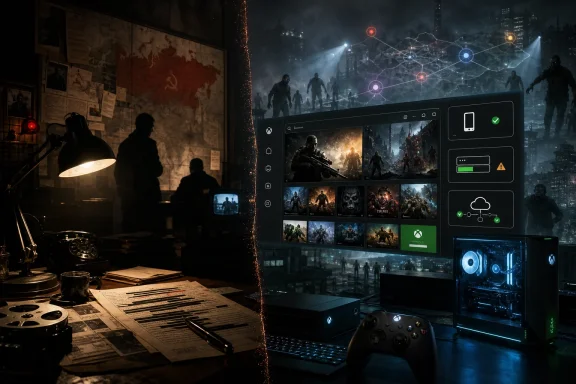 Microsoft’s Store Page Is Really a Platform Statement
The plain-language sales pitch is familiar: “Forced to go rogue. Hunted from within.” Black Ops has always sold paranoia, betrayal, and shadow-state spectacle better than it sells geopolitical subtlety. Setting Black Ops 6 in the early 1990s gives Treyarch and Raven a usable historical hinge: the Cold War has ended, the United States is ascendant, and the intelligence machinery built for one world order is looking for a new purpose.But on Xbox, the more interesting setting is not 1991. It is the Microsoft Store in 2026, where a Call of Duty listing is also a promise about subscriptions, cloud access, cross-generation support, and persistent account infrastructure. Microsoft is not merely hosting Activision’s blockbuster; it is absorbing the franchise into the same storefront logic that governs Windows apps, Xbox Play Anywhere expectations, Game Pass discovery, and account-bound entitlements.
That is why the listing’s small print matters. A mobile phone number linked to an Activision account may be required. Online services may be modified or discontinued. Mandatory updates may require additional storage. Those are routine live-service warnings, but in a post-acquisition world they also define the practical terms of Microsoft’s biggest gaming bet.
For WindowsForum readers, this is the part worth watching. Call of Duty is no longer just a console-war trophy or a yearly shooter release. It is a stress test for Microsoft’s ability to run a giant consumer service across Xbox, Windows, cloud streaming, third-party platforms, Activision accounts, anti-cheat systems, and regional storefronts without making the whole thing feel like an enterprise identity migration accidentally aimed at teenagers.
The Campaign Sells Rogue Fantasy, While the Business Model Demands Discipline
Black Ops 6’s campaign pitch leans into institutional distrust. The player is hunted from within, operating outside the rules, moving through high-stakes heists, covert operations, and blockbuster set pieces. That is very Black Ops: history as fever dream, bureaucracy as villain, and the CIA-adjacent safehouse as both home base and haunted house.The irony is that the product around that fantasy is intensely institutional. To play the modern Call of Duty, you are not simply buying a disc or clicking install. You are entering a mesh of Xbox identity, Activision identity, phone verification, update delivery, content licensing, anti-cheat enforcement, and platform-specific entitlement checks. The fantasy says “go rogue”; the infrastructure says “please verify your account.”
That is not automatically a bad thing. Call of Duty’s scale makes some friction inevitable, and account systems are part of how Activision manages progression, bans, cross-platform play, and monetization. The problem is that every additional requirement narrows the gap between a game and an administered service. For casual players, it can feel like nuisance; for IT-minded users, it looks like the consumer version of zero-trust access control.
The campaign is therefore the least controversial part of the package. It is finite, authored, and understandable. You install the game, you play the missions, you judge the spectacle. The bigger argument happens around everything that remains after the credits: multiplayer queues, Zombies seasons, store bundles, subscription access, and whether “ownership” means anything more than continued permission to authenticate.
Game Pass Turned Black Ops 6 Into a Referendum on Microsoft’s Math
When Microsoft confirmed Black Ops 6 for Game Pass on day one, the decision was framed as a major benefit for subscribers. Xbox Wire promoted the launch across console, PC, and cloud access for Game Pass Ultimate members, while Microsoft’s gaming leadership treated the release as proof that the Activision acquisition could make Game Pass feel essential. For players already paying monthly, it was easy to understand the appeal: the year’s biggest shooter did not require another $70 purchase.For Microsoft, the appeal was more complicated. Call of Duty has historically printed money through premium sales, battle passes, cosmetics, and platform-wide reach. Putting the newest entry into a subscription service may drive sign-ups, but it also risks converting full-price buyers into renters. Later reporting from Bloomberg, echoed by PC Gamer, said Microsoft internally estimated substantial lost sales from Black Ops 6’s Game Pass availability, though that figure should be treated as reported internal analysis rather than a public accounting.
The point is not whether one number settles the debate. It does not. The point is that Black Ops 6 made the trade-off impossible to hide. Game Pass is most persuasive when it includes games people would otherwise buy; it is most expensive for Microsoft for exactly the same reason.
That is the subscription paradox in its cleanest form. A catalog full of old games is safe but uninspiring. A catalog full of brand-new blockbusters is exciting but financially punishing unless the subscriber base grows, retention improves, and add-on spending follows. Black Ops 6 was Microsoft choosing the hard version of the model in public.
The Xbox Advantage Is Access, Not Exclusivity
Microsoft did not make Black Ops 6 an Xbox exclusive, and it was never realistically going to do so. Regulatory scrutiny around the Activision Blizzard deal turned Call of Duty into the central exhibit in debates over competition, platform foreclosure, and subscription leverage. Keeping the franchise on PlayStation and PC storefronts was not just diplomatic; it was structurally necessary.That leaves Microsoft with a subtler strategy. Xbox does not need to be the only place to play Call of Duty if it can become the easiest place to start, the cheapest place for subscribers, and the most integrated place for people already living in Microsoft’s gaming ecosystem. The Microsoft Store listing is part of that strategy. So are Game Pass placement, Xbox Cloud Gaming support, cross-platform progression, and the branding that keeps “Xbox” attached to the Call of Duty conversation even when millions of players are on PlayStation.
This is where the Windows angle matters. On PC, Call of Duty is not merely competing against other shooters; it is competing against launchers, libraries, anti-cheat concerns, storage constraints, and user patience. The Microsoft Store has historically struggled to match Steam’s trust and usability among core PC gamers. Call of Duty gives Microsoft a reason to improve that experience, but it also gives players a reason to notice every weakness.
A giant franchise can pull users into a platform. It can also expose the platform’s seams. If downloads fail, updates balloon, entitlements break, or account linking becomes confusing, the complaint will not be abstractly about Microsoft’s store architecture. It will be, “I can’t play Call of Duty.”
Zombies Became the Proof That Post-Launch Support Was the Product
The Microsoft Store description’s mention of six Zombies maps is notable because Black Ops 6 did not launch with six. At release, Treyarch’s round-based Zombies revival began with Liberty Falls and Terminus, leaning hard into the promise that the studio understood what long-time Zombies players wanted after years of experiments. The current description reflects the accumulated live-service arc: more maps, Directed Mode, and Grief.That evolution is central to how modern Call of Duty is sold. The launch version is only the opening argument. The product becomes itself over months of playlists, maps, patches, seasonal events, weapon tuning, and mode additions. By the time a late buyer sees the store page, they are not buying the launch discourse; they are buying the patched, expanded, content-rich version that survived it.
Directed Mode is especially revealing. Zombies has long thrived on opaque Easter eggs, community decoding, and the thrill of not quite knowing what the map wants from you. Directed Mode formalizes a guided path through that mystery, making the narrative more accessible to players who do not want to keep a wiki, a YouTube guide, and three friends on standby. Purists may see that as dilution, but it is also a rational adaptation for a mass subscription audience.
Grief pulls in the opposite direction. Its return brings competitive pressure back into Zombies, pitting teams against each other indirectly while the undead remain the common threat. It is a reminder that Treyarch’s best Zombies work has often come from tension between cooperation and chaos. The broader Black Ops 6 package now tries to serve both the guided tourist and the sweaty veteran, which is exactly what a Game Pass-era tentpole has to do.
The Phone Number Warning Is Small Text With Big Implications
The store page’s notice that a mobile phone number linked to an Activision account may be required will look mundane to anyone used to modern multiplayer. It should not be dismissed. Phone verification is one of those friction points that tells us how far mainstream games have moved toward identity-managed access.Activision has strong incentives here. Competitive shooters are magnets for cheating, ban evasion, smurfing, harassment, and account abuse. A phone requirement can raise the cost of bad behavior, especially when paired with anti-cheat systems and account enforcement. From a platform-holder perspective, it can also help protect matchmaking quality, which is one of the invisible pillars of player retention.
The downside is exclusion and brittleness. Not everyone has a reliable mobile number that works cleanly with a given verification system. Families, younger players, prepaid users, privacy-conscious players, and people moving across regions can all run into edge cases. What looks like a minor anti-abuse measure at scale can become a customer-support trap at the margins.
For IT pros, none of this is surprising. Identity systems always trade convenience, security, privacy, and recoverability against one another. What is new is the audience. The same design problems that haunt enterprise login flows now shape whether someone can unwind after work with Zombies.
Storage Is the Other Boss Fight
The listing also warns that additional storage may be required for mandatory updates. That line has become boilerplate for large games, but Call of Duty has made storage anxiety part of its brand identity. Between campaign packs, multiplayer content, Warzone integration, high-resolution assets, and seasonal updates, the franchise has repeatedly forced players to think like storage administrators.On Xbox Series X and Series S, the issue is not simply raw capacity. Expansion storage is more expensive than commodity external drives, and current-generation games often need fast internal or expansion-card storage to run properly. On PC, the problem becomes a mix of SSD space, download caps, patching behavior, and whether the user wants one game occupying a comically large share of a drive.
Microsoft and Activision have improved content management compared with the worst days of the Call of Duty HQ sprawl, but the underlying tension remains. A live-service shooter wants to be always current, always event-ready, and always visually competitive. A user’s storage budget wants the opposite: modular installs, predictable updates, and the ability to remove what they do not play.
This is where the Microsoft Store page’s bland language undersells the real-world impact. Mandatory updates are not a footnote when a game is part of a social routine. If a Friday-night squad session begins with a surprise download, the platform has failed in a way that no marketing beat can fix.
Call of Duty HQ Still Feels Like a Launcher Inside a Launcher
Black Ops 6 also exists inside the larger Call of Duty HQ approach, Activision’s attempt to make the franchise feel like a unified hub rather than a pile of separate annual executables. Strategically, that makes sense. Warzone, premium Call of Duty, shared progression, store content, and seasonal events all benefit from a central front door.Experientially, the results have been mixed. Players often want the directness of choosing a game and pressing play. Publishers want a persistent engagement layer that can route attention across modes, promote new content, surface bundles, and keep the ecosystem coherent. Those goals overlap, but they are not identical.
For Microsoft, inheriting Call of Duty HQ means inheriting a product philosophy that can clash with Xbox’s promise of simplicity. Console players have traditionally tolerated some launcher-like behavior inside games, but PC players are less forgiving because they already navigate Steam, Battle.net, the Xbox app, the Microsoft Store, GPU drivers, overlays, and anti-cheat prompts. Every extra layer feels heavier on Windows.
The best version of this strategy is invisible. The hub knows what you own, what you installed, what your friends are playing, and how to get you into a match quickly. The worst version feels like airport signage designed by a committee. Black Ops 6 sits somewhere in the middle, improved by consolidation but still carrying the cognitive weight of a franchise that wants to be a platform.
The Early-’90s Setting Works Because Black Ops Was Always About Systems Breaking
Creatively, Black Ops 6’s early-1990s setting is more than nostalgia bait. The end of the Cold War is a useful backdrop because it lets the story operate in a world where the old enemy map has stopped making sense. Intelligence agencies, military contractors, political operators, and covert networks suddenly have to justify themselves in a new order.That is fertile ground for Black Ops melodrama. The series has never been a sober history lesson, and it is better when it does not pretend otherwise. Its version of history is conspiratorial pulp, built from classified files, unreliable memories, black sites, and the suspicion that every official story is missing the important part.
What makes Black Ops 6 interesting in Microsoft’s hands is the accidental resonance between narrative and business. The campaign dramatizes institutions losing control of the machinery they built. Microsoft’s gaming division is trying to prove that it can control a machinery of its own: studios, subscriptions, storefronts, cloud infrastructure, cross-platform promises, and regulatory commitments.
That does not mean the game is secretly about Game Pass. It means blockbuster products often reveal the anxieties of the companies that sell them. Black Ops 6 is a story about rogue operators inside a giant system, delivered by one of the largest technology companies on Earth through one of the most complex consumer entertainment pipelines ever built.
Multiplayer Remains the Franchise’s Real Operating System
The campaign may provide the trailer moments and Zombies may provide the mythology, but multiplayer remains Call of Duty’s operating system. It is where weapon feel, map flow, latency, progression, matchmaking, monetization, and social pressure all collide. It is also where the franchise’s yearly cadence is judged most brutally.The Microsoft Store description calls the multiplayer experience “best-in-class,” which is marketing language, but not meaningless marketing language. Call of Duty’s core gunplay remains one of the most polished feedback loops in mainstream games. Even critics of the series often concede that movement, aiming, hit confirmation, weapon leveling, and match pacing are tuned with extraordinary commercial intelligence.
Black Ops 6’s challenge was to make that familiarity feel renewed. Treyarch’s design identity has traditionally sat apart from Infinity Ward and Sledgehammer, favoring a particular rhythm and readability. For lapsed players arriving through Game Pass, the question was not whether Call of Duty could reinvent the shooter. It was whether the subscription made jumping back in feel low-risk enough to overcome fatigue.
That may be Game Pass’s strongest contribution to multiplayer: not permanent ownership, but reduced hesitation. A player who would never pay full price for another annual Call of Duty may still install it because it is in the library. Once installed, the old machinery of progression, unlocks, friends, and limited-time events can do the rest.
The Regional Storefront Detail Is a Reminder That Xbox Is Global Plumbing
The submitted source comes from Microsoft’s Bulgarian store page, which is a small but useful reminder that Xbox is not just a U.S. console brand. It is a global commerce system with localized listings, regional pricing, legal text, language variations, and availability differences. For a franchise as large as Call of Duty, that localization is not cosmetic; it is part of the distribution machine.Regional storefronts are often where the abstract promises of digital ownership meet the reality of law, licensing, and infrastructure. Text may vary. Offers may differ. Age ratings, payment methods, refund rules, and subscription availability can change by market. A user sees one product page; Microsoft sees a matrix of compliance and entitlement conditions.
That matters more as Game Pass becomes a primary access path. A full-price game purchase is relatively easy to understand across regions, even when prices differ. Subscription access adds moving parts: tier eligibility, cloud availability, local catalog rights, recurring billing rules, and family or child account restrictions. Call of Duty’s scale forces all of those systems to operate under maximum visibility.
For administrators managing shared devices, school networks, household consoles, or small-business environments where gaming PCs double as workstations, the practical advice is simple: assume Call of Duty will behave like a large, constantly updating online service, not like a static game. That means bandwidth planning, storage headroom, account clarity, and parental or organizational controls matter before launch night.
Microsoft Bought Reach, But It Also Bought Responsibility
The Activision Blizzard acquisition gave Microsoft reach that Xbox alone had struggled to generate. Call of Duty is one of the few franchises that can command attention across console, PC, streaming, esports-adjacent culture, and mainstream retail all at once. Owning it changes the gravitational field around Game Pass.But reach comes with responsibility. When Call of Duty has account problems, update problems, matchmaking problems, monetization controversies, or anti-cheat false positives, those issues now reflect on Microsoft in a way they did not before. The corporate distinction between Activision Publishing, Treyarch, Raven, Demonware, Xbox, and Microsoft may be meaningful internally. To users, it is all one stack.
This is especially true because Microsoft has spent years arguing that its ecosystem is an advantage. If the pitch is seamless access across devices, then fragmented support experiences become harder to excuse. If the pitch is value through Game Pass, then price increases or tier restrictions will be measured against Call of Duty access. If the pitch is player-first openness, then account requirements and service discontinuation language deserve scrutiny.
None of that means Microsoft made the wrong bet. It means the bet is now operational, not theoretical. Black Ops 6 was not the end of the acquisition story; it was the first large-scale customer test of whether Microsoft could turn ownership into everyday advantage.
Sony Still Benefits From Microsoft’s Biggest Franchise
One of the stranger outcomes of the acquisition saga is that PlayStation remains a central beneficiary of Call of Duty’s strength. Black Ops 6 released on PlayStation platforms as well as Xbox and PC, and that continued availability preserved the franchise’s commercial reach. Microsoft owns the revenue stream, but Sony still hosts a huge portion of the audience.That arrangement complicates simplistic console-war narratives. Microsoft can use Call of Duty to strengthen Game Pass while still selling the game on rival platforms. Sony can criticize Microsoft’s platform power while still profiting from PlayStation engagement. Players can ignore the corporate chessboard and simply play where their friends are.
The practical result is that Call of Duty has become less a weapon of exclusivity than a weapon of optionality. Microsoft’s advantage is not that it can deny access, but that it can package access in more ways. Buy it outright. Play through Game Pass. Stream it where supported. Install it on Xbox or PC. Carry progression through an Activision account.
That optionality is powerful, but it is not free. Every additional path creates another support path, another edge case, and another opportunity for user confusion. Microsoft’s real challenge is to make optionality feel like convenience rather than paperwork.
The Fine Print Tells Players How the Future Will Work
The most honest part of the Microsoft Store listing is not the campaign description or the multiplayer boast. It is the warning that Activision may modify or discontinue online service in the future, affecting online gameplay. That sentence is the legal skeleton under the live-service body.Players have grown used to this bargain, but they have not fully made peace with it. A modern shooter can be sold like a product, updated like a service, governed like a platform, and retired like a liability. The result is a form of ownership that depends on continued authentication, server support, and corporate prioritization.
For Black Ops 6, the risk is not immediate disappearance. Call of Duty games tend to remain playable for a long time, and the franchise’s popularity gives Activision reason to maintain core services. The more relevant issue is gradual change: playlists rotate, modes lose population, seasonal focus moves on, and support shifts toward the next annual release.
That is why the store page’s expanded Zombies language cuts both ways. It shows that Black Ops 6 grew after launch, but it also reminds players that the best time to experience a live-service game is often during its supported window. Content may persist, but the social density, developer attention, and event cadence inevitably move forward.
For Windows Users, the Real Test Is the Xbox App
On Windows, Black Ops 6 is also a referendum on the Xbox app and Microsoft Store delivery stack. Microsoft has improved PC gaming support over the years, but it still carries reputational baggage from locked-down install folders, awkward game services dependencies, slow downloads, and confusing entitlement behavior. A franchise like Call of Duty gives Microsoft a chance to prove the old complaints are outdated.The benchmark is not whether the Xbox app is usable. It is whether it is boring. Steam succeeds partly because it has trained PC gamers to expect downloads, updates, cloud saves, invites, refunds, and library management to work without drama. Microsoft does not need to out-Steam Steam for every user, but it does need Game Pass installs of blockbuster titles to feel dependable.
That is harder with Call of Duty than with a smaller single-player game. The install is large. The updates are frequent. The account linking matters. Anti-cheat and security components can be sensitive. Players may move between PC and console. Some will try cloud streaming. Some will own add-ons while accessing the base game through a subscription.
If Microsoft can make that feel simple, Game Pass gains credibility on Windows. If not, Black Ops 6 becomes another example of Microsoft having the content but not quite the consumer experience to match it.
The Store Listing Is a Better Buyer’s Guide Than the Trailer
Trailers sell mood. Store pages reveal obligations. The Black Ops 6 listing tells prospective players what the game wants to be, but also what it will demand: an Activision account, possible phone verification, storage space, online connectivity for key modes, tolerance for mandatory updates, and acceptance that the service layer can change.That does not make the game unusually predatory or uniquely fragile. It makes it typical of the highest end of modern blockbuster gaming. The difference is scale. When a smaller live-service title imposes friction, it annoys a niche. When Call of Duty does it, the friction becomes part of mainstream gaming culture.
The smart buyer reads the listing as a contract of expectations. If you are here for the campaign, the calculus is straightforward: install, play, uninstall if storage is tight. If you are here for multiplayer or Zombies, you are entering a longer relationship with patches, balance changes, account systems, and seasonal population shifts.
That distinction matters because Game Pass can blur it. Subscription access makes trying the game easier, but it does not remove the operational reality of playing it. The price of entry may be lower; the complexity of participation remains.
The Black Ops 6 Bargain Is Bigger Than One Download
Black Ops 6 on Xbox is best understood as a bargain between convenience and control. Microsoft and Activision offer enormous access, a mature content package, and multiple ways to play. In return, players accept the infrastructure of modern gaming: accounts, verification, storage demands, online dependencies, and the possibility that the experience will keep changing.- Black Ops 6 is not just a 2024 shooter on the Xbox store; it is Microsoft’s first major proof point for Call of Duty as a Game Pass-era franchise.
- The current store description reflects a post-launch product with expanded Zombies content, including six maps, Directed Mode, and Grief.
- The Activision account and possible phone-number requirement show how identity management has become a normal part of mainstream multiplayer.
- Mandatory updates and storage warnings should be treated as practical requirements, especially on Xbox Series S, shared consoles, and SSD-constrained PCs.
- Game Pass lowers the cost of trying Black Ops 6, but it does not eliminate the account, storage, update, and service-dependency trade-offs.
- Microsoft’s advantage is no longer exclusivity; it is making Call of Duty easier to access across Xbox, PC, and cloud without making the platform stack feel heavier.
References
- Primary source: Microsoft
Published: 2026-07-07T17:12:11.018441
Loading…
www.microsoft.com - Related coverage: news.xbox.com
Loading…
news.xbox.com - Related coverage: xbox.com
Call of Duty: Black Ops 6 | XBOX
Call of Duty®: Black Ops 6 is now available on PC and XBOX Series X|S. Experience best-in-class multi and single player with Game Pass.www.xbox.com - Related coverage: gamespot.com
Here's How Call of Duty: Black Ops 6 Works On Game Pass - GameSpot
Call of Duty: Black Ops 6 will be available on Xbox Game Pass Ultimate at launch.www.gamespot.com - Related coverage: windowscentral.com
Call of Duty: Black Ops 6 launches day one on Xbox Game Pass | Windows Central
The live-action trailer for Call of Duty: Black Ops 6 teases lies throughout history as Microsoft and Activision confirm the game will launch day one in Xbox Game Pass.www.windowscentral.com - Official source: news.microsoft.com
- Related coverage: canaltech.com.br
Call of Duty Black Ops 6 virá ao Xbox Game Pass no fim de outubro - Canaltech
A Microsoft anunciou nesta terça-feira (15) que Call of Duty Black Ops 6 chegará no Xbox Game Pass como um lançamento “day one”canaltech.com.br - Related coverage: videogameschronicle.com
Activision confirms which Black Ops 6 content is available with each Game Pass tier | VGC
The new Call of Duty will be available on Microsoft’s subscription service on day one…www.videogameschronicle.com - Related coverage: pcgamer.com
Call of Duty: Black Ops 6 is coming to Game Pass on day one | PC Gamer
Microsoft is making the big bet.www.pcgamer.com - Related coverage: purexbox.com
- Related coverage: gameinformer.com
Call of Duty: Black Ops 6 Will Launch Day One On Game Pass
The game will be fully revealed at Xbox's summer showcase.gameinformer.com - Related coverage: techradar.com
Call of Duty games coming to Xbox Game Pass on day one lasted all of two releases as Microsoft announces big changes and a welcome price cut | TechRadar
Xbox is decreasing the cost of Game Pass Ultimate and PC Game Pass, though it comes at the cost of day one Call of Duty games.www.techradar.com - Related coverage: as.com
Cuándo sale Call of Duty: Black Ops 6: Game Pass, fecha de salida y ediciones - Meristation
Lo nuevo de la franquicia apunta a ser todo un éxito desde el primer día.as.com - Related coverage: tomshardware.com
Microsoft announces surprise Xbox Game Pass price cuts, ends day one Call of Duty inclusion — Ultimate down to $22.99 while PC Game Pass drops to $13.99 | Tom's Hardware
A much-needed shot in the arm for the embattled brandwww.tomshardware.com - Related coverage: callofduty.com
Call of Duty | Guides - Black Ops 6 Zombies Mode Guide — Grief
www.callofduty.com
- Related coverage: dexerto.com
Black Ops 6 Zombies Grief mode explained - Dexerto
The fan-favorite Grief mode returns to Call of Duty Zombies in Black Ops 6 Season 4, so here’s everything you need to know about it.www.dexerto.com - Related coverage: strafe.com
What's the difference between "Standard" and "Directed" mode in Call of Duty: Black Ops 6 Zombies? [Updated 2025]
Black Ops 6 Zombies have two distinct modes: Standard and Directed. Find out more about what are their differences here!www.strafe.com
- Related coverage: bo3.gg
- Related coverage: pcgamesn.com
Black Ops 6 Season 4 features a classic BO3 map and a long-lost Zombies mode
Call of Duty Black Ops 6 Season 4 may not have a new round-based Zombies map, but it does resurrect a game mode we haven't seen since BO2.www.pcgamesn.com - Related coverage: talkesport.com
What Is Black Ops 6 Zombies Grief Mode?
Grief mode is back in Black Ops 6 Zombies Season 4. Discover how this 4v4 competitive twist reshapes classic undead survival in Call of Duty 2025.www.talkesport.com - Related coverage: ginx.tv
Call of Duty: Black Ops 6 - GINX TV
Developed by Treyarch and Raven Software, Call of Duty: Black Ops 6 is a spy action thriller set in the early 1990s www.ginx.tv
- Related coverage: callofduty.fandom.com
Call of Duty: Black Ops 6 | Call of Duty Wiki | Fandom
For other uses, see Black Ops. "The Truth Lies." — Tagline Call of Duty: Black Ops 6 is a first-person shooter video game developed by Treyarch and Raven Software for PlayStation 4, PlayStation 5, Xbox One, Xbox Series X/S and Microsoft Windows. It is set in the early 1990s, following...callofduty.fandom.com