

Block’s AI push in 2026 is no longer just a product story: the company is using Builderbot, Moneybot and Managerbot to automate software development, customer guidance and seller operations while reporting sharply higher engineering velocity and a 25 percent adjusted operating income margin in the first quarter. The open question is whether that makes Block a better fintech operator or simply a more convincing AI-era stock narrative. The evidence points to a real execution advantage, but one that will matter only if Block can convert automation into durable customer behavior rather than a temporary productivity headline. As Zacks framed it in its latest analysis, the company’s AI effort has moved from feature polish to operating system.
The most important thing about Block’s AI strategy is not that Cash App users get a smarter assistant or that Square sellers get prettier analytics. It is that the company is trying to make AI a layer through which work gets done inside Block itself. That is a more ambitious bet than adding a chatbot to a financial app, and it is also a more dangerous one.
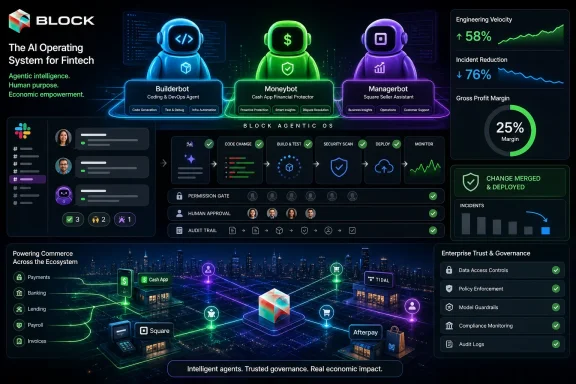
Builderbot is the clearest expression of that shift. According to Block’s first-quarter 2026 shareholder letter, the internal AI platform is being used to evaluate, modify and troubleshoot production code at meaningful scale. Block said Builderbot and other AI tools reviewed more than 90 percent of production code change requests during the first two weeks of April, while Builderbot was executing more than 200,000 operations per day and making roughly 15 percent of production code changes nearly autonomously.
That is not the usual “AI helps engineers write boilerplate” story. It is closer to a controlled experiment in whether a large fintech codebase can be made more malleable without becoming more fragile. In Block’s telling, production code changes per engineer were up more than 2.5 times compared with January, while incident rates after code changes were down more than 70 percent year over year in the first quarter.
Those numbers matter because fintech software is not a consumer toy. Payments, banking-like balances, seller operations, lending, fraud monitoring and regulatory workflows all punish sloppy automation. A company can impress investors by shipping faster for a quarter; it earns a lasting edge only if it can ship faster without increasing operational, compliance or security risk.
For years, Block’s challenge has been organizational sprawl. Square, Cash App, Afterpay, Bitcoin initiatives and a widening set of financial services have given the company optionality, but also complexity. The more products Block runs, the harder it becomes to coordinate engineering work across shared infrastructure, risk systems and customer surfaces.
Builderbot is designed to attack that problem at the codebase level. If a Cash App engineer can safely make changes in a Square service they have not previously worked on because an internal AI system understands dependencies, conventions and test requirements, Block can reduce one of the most stubborn taxes in software development: waiting for the right team to become available.
That is why the platform’s Slack-based interface matters. Slack is not glamorous, but it is where operational work happens in many tech companies. By placing Builderbot in the workflow employees already use, Block is making AI less like a separate application and more like a command layer for the company.
There is an obvious risk here. Internal AI agents can become a new form of technical debt if teams trust them too much, if generated changes are poorly understood, or if review processes degrade into rubber-stamping. Block’s claim that incident rates fell while AI involvement rose is therefore the crucial counterweight. The stronger argument is not “AI writes code”; it is “AI changes the economics of safe change.”
Cash App has long been more than peer-to-peer payments, but the company’s problem has been turning that broad menu into coherent financial behavior. A customer may use Cash App Card, direct deposit, investing, savings, tax tools or bitcoin features, but the app still has to nudge them across products without feeling like a billboard. Moneybot is Block’s attempt to make those nudges contextual.
The product is framed less as a passive assistant and more as what Block calls a protector. That language is revealing. A normal assistant waits for a question; a protector watches for patterns, flags problems and prompts action before the user asks. Forgotten subscriptions, spending drift and timing gaps between income and bills are mundane problems, but they are exactly the kinds of problems that make consumer finance sticky if handled well.
This is where Block’s advantage could emerge. Banks have customer data, but many legacy bank apps still feel like digital filing cabinets. Consumer fintechs have slick interfaces, but they often lack a broad enough product suite to respond meaningfully when a customer’s financial pattern changes. Cash App sits somewhere in between: enough data, enough product surface and enough consumer habit to make proactive AI commercially useful.
The danger is that “proactive” becomes intrusive. Financial nudges can help users avoid fees, manage cash flow or discover useful features. They can also become growth hacks dressed up as advice. For Block, the credibility of Moneybot will depend on whether customers feel protected or targeted.
Block says Managerbot has been made available to more than one million sellers, with broader U.S. availability expected in June 2026. The product uses specialized agents to answer questions and surface insights from sales, catalog, customer and reporting data. In plain English, it aims to tell a seller what is selling, what is changing, what is likely to happen next and what should be done about it.
That could be genuinely useful for small businesses. A restaurant operator does not need a generic chatbot explaining gross margin. They need early warning that food costs are creeping up faster than revenue, that staffing patterns are out of sync with demand, or that a menu item that looks popular is quietly dragging down profitability.
Square has always sold simplicity. Its original disruption was making card acceptance easy for smaller sellers who were poorly served by traditional merchant acquirers. Managerbot extends that same argument from payments into management: the seller should not need a business analyst, a spreadsheet expert or a software integrator to understand what is happening.
This is also where Block has a defensible data position. AI models may become widely available, but the context inside a seller’s transaction history, catalog, customer patterns and reporting stack is not interchangeable. If Managerbot becomes the interface through which sellers understand and act on their business, Square’s value proposition moves from “we process your transactions” to “we help run your operation.”
This is the part of the story Wall Street wants to believe. The past two years have punished software and fintech companies that could not explain how AI spending would translate into operating leverage. Block is offering a cleaner pitch: AI helps employees ship more, reduces friction in engineering, supports customer-facing products and expands margins.
But operating leverage can be flattered by timing. Hiring restraint, reorganization, cost cuts, marketing cadence and accounting definitions can all influence adjusted margins. The company’s own shareholder materials distinguish GAAP losses from adjusted profitability, and investors should not collapse those measures into one simple AI triumph.
The stronger interpretation is that AI is part of a broader management reset. Jack Dorsey’s return to a more direct operating role at Block has been accompanied by a push for smaller teams, faster decision-making and fewer bureaucratic layers. Builderbot fits that management philosophy because it turns code changes into a faster, more measurable production system.
That also means AI will be judged harshly if growth disappoints. Productivity gains are valuable, but they do not automatically create demand. Block still has to grow Cash App monetization, defend Square’s seller franchise, manage credit and compliance risk, and prove that its ecosystem can hold attention in an increasingly crowded fintech market.
That context matters because Block is not merely adding AI to old payment flows. The interface for commerce itself is beginning to move. If consumers increasingly ask ChatGPT, Copilot, Gemini or Claude what to buy — and then complete a transaction inside that environment — payment and merchant platforms will compete to become the trusted pipes underneath AI-mediated commerce.
Square’s ChatGPT app and Claude plugin fit that world. The point is not just to let businesses look modern. It is to make Square sellers legible to AI shopping systems, recommendation engines and conversational buying flows. In the old web, merchants competed for search placement and ad clicks. In the AI-commerce world, they may compete to be the answer an agent chooses.
PayPal’s advantage is obvious: a giant two-sided payments network and consumer trust around checkout. Shopify’s advantage is also obvious: millions of merchants and deep e-commerce infrastructure. Block’s advantage is more specific. It owns a merchant operating layer through Square and a consumer finance surface through Cash App, with the potential to connect local commerce, payments, loyalty and personal finance.
That is not the same as winning. Agentic commerce could consolidate around the largest model platforms, leaving payment providers and merchant software companies fighting for margin underneath. But Block is at least positioning itself for that transition rather than pretending commerce will remain a browser-and-checkout-button business forever.
Shopify’s strategy is merchant-infrastructure-first. Its work with Google on Universal Commerce Protocol is designed to make merchant catalogs, checkout requirements and product data understandable to AI agents. Shopify wants the merchant’s store to remain programmable and reachable even when the buyer never visits the storefront in the traditional sense.
Block sits between those models. Square gives it seller infrastructure, while Cash App gives it consumer reach. That hybrid position is attractive but complicated. PayPal can focus on being the wallet; Shopify can focus on being the merchant backbone. Block has to make the bridge work without becoming strategically unfocused.
This is why Managerbot and Moneybot are more important than they initially appear. Managerbot can make Square sellers more capable and better prepared for AI-driven demand. Moneybot can steer Cash App users toward financial and purchasing actions. If those two surfaces eventually reinforce each other, Block gets something closer to a closed-loop ecosystem.
The risk is that the loop remains more theoretical than real. Cash App users are not automatically Square customers, and Square sellers are not automatically plugged into Cash App demand. Block has tried many ecosystem connections before; some have worked, some have felt more like investor-slide architecture than daily customer behavior.
A discounted multiple can mean investors are missing the story. It can also mean investors are properly pricing complexity. Block is still a company with multiple business lines, exposure to consumer spending, merchant health, credit cycles, crypto sentiment, regulatory scrutiny and intense competition from both fintech specialists and platform giants.
The bullish case is that AI improves execution across all of those fronts. Faster product development helps Block respond to competitors. Better internal tooling lowers operating friction. Moneybot and Managerbot increase product adoption and seller retention. Agentic commerce integrations keep Square relevant as buying behavior shifts.
The bearish case is that AI becomes another narrative layer over a sprawling company. Productivity statistics may look impressive while customer acquisition costs, seller churn, compliance costs or macro pressures do the real work of determining earnings power. A fintech can automate engineering and still struggle if its core markets slow.
The most sensible view is conditional optimism. Block has offered more concrete AI operating metrics than many peers, and those metrics are directly tied to speed, quality and margin. But the next test is not whether Builderbot can review code or whether Managerbot can answer seller questions. It is whether those systems change retention, gross profit growth and product adoption over several quarters.
Builderbot’s Slack-based workflow has an obvious analogue in Microsoft-heavy environments. Many enterprises live inside Teams, Azure DevOps, GitHub, Microsoft 365, Power Platform and security tooling. The Block model suggests that the next productivity wave will not come from employees opening a separate AI app, but from agents embedded into collaboration, code review, incident management and line-of-business systems.
That has consequences for IT administrators. Identity, permissions, audit logs, data boundaries and approval flows become central. If an AI agent can modify code, query customer records, generate forecasts or trigger operational reminders, it must be governed like a privileged user, not treated like a search box.
It also has consequences for software teams. The old separation between developer productivity tools and production reliability tools is beginning to blur. AI systems that propose code changes may also need to understand telemetry, dependency graphs, security policies and incident history. The companies that gain an edge will be the ones that connect these systems without losing accountability.
Block’s reported decline in post-change incident rates is therefore the number IT pros should pay attention to. Faster development is easy to market. Faster development with fewer incidents is the thing every CIO actually wants. Whether Block can sustain that pattern is the part worth tracking.
Block appears to understand this, at least in its framing. Builderbot is described as making some production changes nearly autonomously while humans still make final decisions to push to production. That distinction matters. The future of AI in serious systems is less likely to be “the bot did it” and more likely to be “the bot prepared, checked, recommended and executed under governed human authority.”
The same logic applies to Moneybot and Managerbot. A bot can identify a subscription pattern, warn about cash-flow timing or forecast revenue. But the user or seller still needs to trust the recommendation, understand the action and retain control. Financial software becomes dangerous when convenience outruns comprehension.
This is where Block’s design choices will matter. If Moneybot becomes a transparent guide that helps users make better financial decisions, it can deepen trust. If Managerbot gives sellers explainable insights grounded in their own data, it can become indispensable. If either product becomes a black-box sales funnel, the trust advantage erodes quickly.
AI does not remove the need for product judgment. It increases the penalty for bad judgment because automated systems can scale both good and bad decisions faster than human teams can.
But each link has to hold. Engineering productivity must remain tied to reliability. Consumer AI must create durable product adoption, not one-time curiosity. Seller AI must solve daily problems well enough to become part of the operating rhythm. Commerce integrations must produce actual demand for merchants, not just press-release compatibility.
The investor narrative is ahead of the proof, but not wildly ahead. Block’s first-quarter figures give believers something measurable: higher adjusted margin, faster code velocity, lower post-change incident rates and early cross-sell signals from Moneybot. Those are not vague claims about transformation. They are operating metrics.
The reason to remain cautious is that fintech history is littered with elegant product visions that ran into messy realities: compliance, fraud, consumer credit quality, merchant churn, platform dependency and macro sensitivity. AI can improve Block’s execution, but it does not repeal those constraints.
The best case for Block is not that AI magically makes the company worth more. It is that AI helps Block become the company it has long promised to be: faster, more integrated, more useful to consumers and sellers, and more disciplined in turning product breadth into profit.
 Block Is Turning AI From Feature Dust Into Management Infrastructure
The most important thing about Block’s AI strategy is not that Cash App users get a smarter assistant or that Square sellers get prettier analytics. It is that the company is trying to make AI a layer through which work gets done inside Block itself. That is a more ambitious bet than adding a chatbot to a financial app, and it is also a more dangerous one.Builderbot is the clearest expression of that shift. According to Block’s first-quarter 2026 shareholder letter, the internal AI platform is being used to evaluate, modify and troubleshoot production code at meaningful scale. Block said Builderbot and other AI tools reviewed more than 90 percent of production code change requests during the first two weeks of April, while Builderbot was executing more than 200,000 operations per day and making roughly 15 percent of production code changes nearly autonomously.
That is not the usual “AI helps engineers write boilerplate” story. It is closer to a controlled experiment in whether a large fintech codebase can be made more malleable without becoming more fragile. In Block’s telling, production code changes per engineer were up more than 2.5 times compared with January, while incident rates after code changes were down more than 70 percent year over year in the first quarter.
Those numbers matter because fintech software is not a consumer toy. Payments, banking-like balances, seller operations, lending, fraud monitoring and regulatory workflows all punish sloppy automation. A company can impress investors by shipping faster for a quarter; it earns a lasting edge only if it can ship faster without increasing operational, compliance or security risk.
Builderbot Is the Real Product, Even When Customers Never See It
The temptation is to treat Moneybot and Managerbot as Block’s main AI products because customers can touch them. That misses the deeper strategic move. Builderbot is not just a developer tool; it is Block’s attempt to compress the distance between idea, implementation and deployment.For years, Block’s challenge has been organizational sprawl. Square, Cash App, Afterpay, Bitcoin initiatives and a widening set of financial services have given the company optionality, but also complexity. The more products Block runs, the harder it becomes to coordinate engineering work across shared infrastructure, risk systems and customer surfaces.
Builderbot is designed to attack that problem at the codebase level. If a Cash App engineer can safely make changes in a Square service they have not previously worked on because an internal AI system understands dependencies, conventions and test requirements, Block can reduce one of the most stubborn taxes in software development: waiting for the right team to become available.
That is why the platform’s Slack-based interface matters. Slack is not glamorous, but it is where operational work happens in many tech companies. By placing Builderbot in the workflow employees already use, Block is making AI less like a separate application and more like a command layer for the company.
There is an obvious risk here. Internal AI agents can become a new form of technical debt if teams trust them too much, if generated changes are poorly understood, or if review processes degrade into rubber-stamping. Block’s claim that incident rates fell while AI involvement rose is therefore the crucial counterweight. The stronger argument is not “AI writes code”; it is “AI changes the economics of safe change.”
Moneybot Shows Why Cash App Wants to Become a Financial Companion
Moneybot is Block’s consumer-facing proof point. It is now live across Cash App, and Block says more than one-third of customers using Moneybot for money movement have adopted an additional Cash App product. That is the kind of metric investors notice because it connects AI engagement to cross-selling, not just novelty.Cash App has long been more than peer-to-peer payments, but the company’s problem has been turning that broad menu into coherent financial behavior. A customer may use Cash App Card, direct deposit, investing, savings, tax tools or bitcoin features, but the app still has to nudge them across products without feeling like a billboard. Moneybot is Block’s attempt to make those nudges contextual.
The product is framed less as a passive assistant and more as what Block calls a protector. That language is revealing. A normal assistant waits for a question; a protector watches for patterns, flags problems and prompts action before the user asks. Forgotten subscriptions, spending drift and timing gaps between income and bills are mundane problems, but they are exactly the kinds of problems that make consumer finance sticky if handled well.
This is where Block’s advantage could emerge. Banks have customer data, but many legacy bank apps still feel like digital filing cabinets. Consumer fintechs have slick interfaces, but they often lack a broad enough product suite to respond meaningfully when a customer’s financial pattern changes. Cash App sits somewhere in between: enough data, enough product surface and enough consumer habit to make proactive AI commercially useful.
The danger is that “proactive” becomes intrusive. Financial nudges can help users avoid fees, manage cash flow or discover useful features. They can also become growth hacks dressed up as advice. For Block, the credibility of Moneybot will depend on whether customers feel protected or targeted.
Managerbot Turns Square’s Data Into a Seller Operating System
Managerbot may be the more important product over the long run because Square’s merchant business is built on workflow, not just payment acceptance. The seller who uses Square for point of sale, catalog, customer records, invoices, payroll or reporting is already generating operational data. Managerbot’s promise is to turn that data into practical decisions.Block says Managerbot has been made available to more than one million sellers, with broader U.S. availability expected in June 2026. The product uses specialized agents to answer questions and surface insights from sales, catalog, customer and reporting data. In plain English, it aims to tell a seller what is selling, what is changing, what is likely to happen next and what should be done about it.
That could be genuinely useful for small businesses. A restaurant operator does not need a generic chatbot explaining gross margin. They need early warning that food costs are creeping up faster than revenue, that staffing patterns are out of sync with demand, or that a menu item that looks popular is quietly dragging down profitability.
Square has always sold simplicity. Its original disruption was making card acceptance easy for smaller sellers who were poorly served by traditional merchant acquirers. Managerbot extends that same argument from payments into management: the seller should not need a business analyst, a spreadsheet expert or a software integrator to understand what is happening.
This is also where Block has a defensible data position. AI models may become widely available, but the context inside a seller’s transaction history, catalog, customer patterns and reporting stack is not interchangeable. If Managerbot becomes the interface through which sellers understand and act on their business, Square’s value proposition moves from “we process your transactions” to “we help run your operation.”
The Margin Story Is Powerful, But It Needs Discipline
Block’s first-quarter numbers give the AI narrative teeth. The company reported adjusted operating income of $728 million and a 25 percent margin, up from 20 percent in the first quarter of 2025 on the same adjusted basis cited by Zacks. Management also pointed to higher velocity, lower incident rates and expanded AI review of production code as evidence that automation is affecting the cost structure.This is the part of the story Wall Street wants to believe. The past two years have punished software and fintech companies that could not explain how AI spending would translate into operating leverage. Block is offering a cleaner pitch: AI helps employees ship more, reduces friction in engineering, supports customer-facing products and expands margins.
But operating leverage can be flattered by timing. Hiring restraint, reorganization, cost cuts, marketing cadence and accounting definitions can all influence adjusted margins. The company’s own shareholder materials distinguish GAAP losses from adjusted profitability, and investors should not collapse those measures into one simple AI triumph.
The stronger interpretation is that AI is part of a broader management reset. Jack Dorsey’s return to a more direct operating role at Block has been accompanied by a push for smaller teams, faster decision-making and fewer bureaucratic layers. Builderbot fits that management philosophy because it turns code changes into a faster, more measurable production system.
That also means AI will be judged harshly if growth disappoints. Productivity gains are valuable, but they do not automatically create demand. Block still has to grow Cash App monetization, defend Square’s seller franchise, manage credit and compliance risk, and prove that its ecosystem can hold attention in an increasingly crowded fintech market.
Agentic Commerce Makes Block’s Timing Better Than It Looks
The competitive context is changing quickly. PayPal has been pushing into agentic commerce through its OpenAI partnership, which is designed to support PayPal-powered transactions inside ChatGPT, and through work with Microsoft around Copilot Checkout. Shopify, meanwhile, has worked with Google on the Universal Commerce Protocol, a standard intended to help AI agents discover products and complete transactions with merchants.That context matters because Block is not merely adding AI to old payment flows. The interface for commerce itself is beginning to move. If consumers increasingly ask ChatGPT, Copilot, Gemini or Claude what to buy — and then complete a transaction inside that environment — payment and merchant platforms will compete to become the trusted pipes underneath AI-mediated commerce.
Square’s ChatGPT app and Claude plugin fit that world. The point is not just to let businesses look modern. It is to make Square sellers legible to AI shopping systems, recommendation engines and conversational buying flows. In the old web, merchants competed for search placement and ad clicks. In the AI-commerce world, they may compete to be the answer an agent chooses.
PayPal’s advantage is obvious: a giant two-sided payments network and consumer trust around checkout. Shopify’s advantage is also obvious: millions of merchants and deep e-commerce infrastructure. Block’s advantage is more specific. It owns a merchant operating layer through Square and a consumer finance surface through Cash App, with the potential to connect local commerce, payments, loyalty and personal finance.
That is not the same as winning. Agentic commerce could consolidate around the largest model platforms, leaving payment providers and merchant software companies fighting for margin underneath. But Block is at least positioning itself for that transition rather than pretending commerce will remain a browser-and-checkout-button business forever.
PayPal and Shopify Are Chasing the Same Door From Different Hallways
PayPal’s strategy is payments-first. Its OpenAI arrangement aims to make PayPal a default transaction layer inside ChatGPT commerce, while Microsoft’s Copilot Checkout work points to the same idea in another conversational environment. PayPal does not need to own the merchant’s entire operating system if it can own trust, credentials, risk controls and the moment of payment.Shopify’s strategy is merchant-infrastructure-first. Its work with Google on Universal Commerce Protocol is designed to make merchant catalogs, checkout requirements and product data understandable to AI agents. Shopify wants the merchant’s store to remain programmable and reachable even when the buyer never visits the storefront in the traditional sense.
Block sits between those models. Square gives it seller infrastructure, while Cash App gives it consumer reach. That hybrid position is attractive but complicated. PayPal can focus on being the wallet; Shopify can focus on being the merchant backbone. Block has to make the bridge work without becoming strategically unfocused.
This is why Managerbot and Moneybot are more important than they initially appear. Managerbot can make Square sellers more capable and better prepared for AI-driven demand. Moneybot can steer Cash App users toward financial and purchasing actions. If those two surfaces eventually reinforce each other, Block gets something closer to a closed-loop ecosystem.
The risk is that the loop remains more theoretical than real. Cash App users are not automatically Square customers, and Square sellers are not automatically plugged into Cash App demand. Block has tried many ecosystem connections before; some have worked, some have felt more like investor-slide architecture than daily customer behavior.
The Stock Case Depends on Execution, Not Just Multiple Expansion
Zacks notes that Block shares have rallied sharply over the past three months and that the stock trades at a discount to the broader Zacks Internet Software industry on forward earnings. It also points to positive estimate revisions and a Strong Buy rank. That is useful market context, but it should not be confused with a settled business verdict.A discounted multiple can mean investors are missing the story. It can also mean investors are properly pricing complexity. Block is still a company with multiple business lines, exposure to consumer spending, merchant health, credit cycles, crypto sentiment, regulatory scrutiny and intense competition from both fintech specialists and platform giants.
The bullish case is that AI improves execution across all of those fronts. Faster product development helps Block respond to competitors. Better internal tooling lowers operating friction. Moneybot and Managerbot increase product adoption and seller retention. Agentic commerce integrations keep Square relevant as buying behavior shifts.
The bearish case is that AI becomes another narrative layer over a sprawling company. Productivity statistics may look impressive while customer acquisition costs, seller churn, compliance costs or macro pressures do the real work of determining earnings power. A fintech can automate engineering and still struggle if its core markets slow.
The most sensible view is conditional optimism. Block has offered more concrete AI operating metrics than many peers, and those metrics are directly tied to speed, quality and margin. But the next test is not whether Builderbot can review code or whether Managerbot can answer seller questions. It is whether those systems change retention, gross profit growth and product adoption over several quarters.
Windows Shops Should Watch This as an Automation Case Study
For WindowsForum readers, Block’s story is not just a stock-market item. It is a preview of how large organizations may operationalize AI across internal software delivery, customer support, analytics and business workflows. The interesting lesson is not “use AI”; it is “put AI where decisions and handoffs already happen.”Builderbot’s Slack-based workflow has an obvious analogue in Microsoft-heavy environments. Many enterprises live inside Teams, Azure DevOps, GitHub, Microsoft 365, Power Platform and security tooling. The Block model suggests that the next productivity wave will not come from employees opening a separate AI app, but from agents embedded into collaboration, code review, incident management and line-of-business systems.
That has consequences for IT administrators. Identity, permissions, audit logs, data boundaries and approval flows become central. If an AI agent can modify code, query customer records, generate forecasts or trigger operational reminders, it must be governed like a privileged user, not treated like a search box.
It also has consequences for software teams. The old separation between developer productivity tools and production reliability tools is beginning to blur. AI systems that propose code changes may also need to understand telemetry, dependency graphs, security policies and incident history. The companies that gain an edge will be the ones that connect these systems without losing accountability.
Block’s reported decline in post-change incident rates is therefore the number IT pros should pay attention to. Faster development is easy to market. Faster development with fewer incidents is the thing every CIO actually wants. Whether Block can sustain that pattern is the part worth tracking.
The Automation Dividend Will Belong to Companies That Keep Humans Accountable
The phrase agentic AI invites overstatement. Vendors talk as if agents will soon run whole workflows independently, and investors often reward the companies with the boldest version of that story. In regulated finance and payments, however, autonomy without accountability is a liability.Block appears to understand this, at least in its framing. Builderbot is described as making some production changes nearly autonomously while humans still make final decisions to push to production. That distinction matters. The future of AI in serious systems is less likely to be “the bot did it” and more likely to be “the bot prepared, checked, recommended and executed under governed human authority.”
The same logic applies to Moneybot and Managerbot. A bot can identify a subscription pattern, warn about cash-flow timing or forecast revenue. But the user or seller still needs to trust the recommendation, understand the action and retain control. Financial software becomes dangerous when convenience outruns comprehension.
This is where Block’s design choices will matter. If Moneybot becomes a transparent guide that helps users make better financial decisions, it can deepen trust. If Managerbot gives sellers explainable insights grounded in their own data, it can become indispensable. If either product becomes a black-box sales funnel, the trust advantage erodes quickly.
AI does not remove the need for product judgment. It increases the penalty for bad judgment because automated systems can scale both good and bad decisions faster than human teams can.
Block’s Edge Is Real Only If the Bots Change Habits
The most concrete version of the Block thesis is simple: Builderbot speeds the company up, Moneybot expands Cash App engagement, Managerbot makes Square stickier, and AI-commerce integrations keep merchants visible in the next interface shift. That is a credible chain, and it is stronger than the generic AI stories many companies are telling.But each link has to hold. Engineering productivity must remain tied to reliability. Consumer AI must create durable product adoption, not one-time curiosity. Seller AI must solve daily problems well enough to become part of the operating rhythm. Commerce integrations must produce actual demand for merchants, not just press-release compatibility.
The investor narrative is ahead of the proof, but not wildly ahead. Block’s first-quarter figures give believers something measurable: higher adjusted margin, faster code velocity, lower post-change incident rates and early cross-sell signals from Moneybot. Those are not vague claims about transformation. They are operating metrics.
The reason to remain cautious is that fintech history is littered with elegant product visions that ran into messy realities: compliance, fraud, consumer credit quality, merchant churn, platform dependency and macro sensitivity. AI can improve Block’s execution, but it does not repeal those constraints.
The best case for Block is not that AI magically makes the company worth more. It is that AI helps Block become the company it has long promised to be: faster, more integrated, more useful to consumers and sellers, and more disciplined in turning product breadth into profit.
The Numbers to Watch After the First AI Quarter
Block has given the market a set of signals that are unusually specific for an AI operating story. The next several quarters will determine whether those signals form a trend or a one-quarter showcase. For investors, administrators and product leaders watching from the outside, the useful test is whether automation improves the boring metrics that actually compound.- Block’s strongest AI proof point is Builderbot because it connects automation directly to code velocity, production review and incident reduction.
- Moneybot’s early cross-selling signal matters because AI engagement is valuable only if it changes customer behavior beyond the chat session.
- Managerbot could strengthen Square’s seller retention if it becomes a practical operating assistant rather than a dashboard with conversational paint.
- PayPal and Shopify are credible threats because they are attacking agentic commerce through payments infrastructure and merchant infrastructure, respectively.
- Block’s 25 percent adjusted operating income margin is encouraging, but investors should separate durable AI-driven leverage from temporary cost and timing effects.
- The real execution edge will show up in sustained gross profit growth, retention, reliability and product adoption, not in the number of times management says “AI.”
References
- Primary source: TradingView
Published: 2026-07-06T14:50:12.284320
Block's AI Automation Push: Will It Strengthen XYZ's Execution Edge? — TradingView News
Block Inc. XYZ is expanding its artificial intelligence strategy beyond product innovation, making AI a core driver of execution across its business. The company is using AI to accelerate product development, streamline decision-making, improve engineering productivity and deliver smarter customer…www.tradingview.com
- Related coverage: s29.q4cdn.com
- Related coverage: fool.com
Block (XYZ) Q1 2026 Earnings Transcript | The Motley Fool
Block (XYZ) Q1 2026 Earnings Transcriptwww.fool.com - Related coverage: kucoin.com
Block Launches AI Tool Builderbot to Handle 15% of Production Code Changes | KuCoin
Odaily Planet Daily reports that Bitcoin financial company Block (formerly Square) has launched Builderbot, an AI-native developer toolkit capable of handling awww.kucoin.com - Related coverage: uk.investing.com
Block launches AI tool to speed code development By Investing.com
Block launches AI tool to speed code developmentuk.investing.com - Related coverage: venturebeat.com
Block introduces Managerbot, a proactive Square AI agent and the clearest proof point yet for Jack Dorsey’s AI bet | VentureBeat
Block introduces Managerbot, a proactive AI agent for Square that helps small businesses forecast inventory, optimize staff schedules, and automate marketing as Jack Dorsey pushes Block deeper into AI.venturebeat.com
- Related coverage: quartr.com
Block (XYZ) Q1 2026 Summary | Quartr
Summary of Block (XYZ) Q1 2026, combining transcript, slides, and related documents.quartr.com - Related coverage: stocktitan.net
Block (NYSE: XYZ) hikes 2026 profit outlook after strong Q1 beat
Block’s Q1 2026 gross profit jumped 27% to $2.91B as Cash App and Square grew, while raised 2026 guidance targets $12.33B gross profit and $3.85 adjusted EPS.www.stocktitan.net - Related coverage: druckfin.com
Block Delivers All-Time High Margins and Raises Full-Year Outlook as AI-Driven Velocity Reshapes the Business
Block entered 2026 with momentum and Q1 confirmed it. Gross profit grew 27% year-over-year to $2.91 billion, adjusted operating income surged 56% to $728 million representing a 25% margin, adjusted... www.druckfin.com
- Related coverage: techradar.com
PayPal users will soon be able to buy and sell through ChatGPT | TechRadar
Go from chat to checkout in just a few tapswww.techradar.com