

Jack Dorsey’s latest software bet is not another social network, payment platform, or messaging app in the conventional sense. Buzz, an open-source collaboration client from Block, is positioning itself as a workspace where people, code, conversations, and autonomous AI agents can occupy the same operational environment rather than being stitched together through a maze of bots, integrations, and browser tabs.
The pitch is ambitious: where Slack and Microsoft Teams increasingly add AI to human collaboration, Buzz is designed around the assumption that AI agents are already collaborators. They can have identities, join channels, access the conversations they are permitted to see, interact with project materials, and potentially carry work forward across a shared workspace.
For Windows users, the practical headline is equally important. Buzz is available as a desktop application for Windows, macOS, and Linux, making it a cross-platform entrant in a workplace software category dominated by cloud-first services and deeply entrenched enterprise ecosystems. Yet its early-stage status, security model, and broad promise of decentralized, self-hosted collaboration mean that it is better understood as a provocative new platform than as a ready-made replacement for Microsoft Teams or Slack.
Buzz arrives at a moment when workplace AI has moved well beyond the chatbot. Microsoft Teams has Copilot. Slack has AI search, summaries, workflow automation, and an expanding ecosystem of enterprise agents. Google Workspace, Zoom, Notion, Atlassian, and nearly every major productivity vendor have adopted a similar strategy: keep the familiar app, then bring AI into it through sidebars, commands, summaries, assistants, and automations.
That model has an obvious appeal. Companies do not need to discard their existing channels, permissions structures, archives, compliance policies, and user habits. AI becomes an enhancement layer over tools employees already know.
Buzz challenges that assumption.
Its core proposition is that the conventional workplace chat interface was built for a world in which every participant was human. Bots were peripheral: a notification feed, a ticketing bridge, an app that answered a narrow command, or a workflow trigger with a branded icon. Even when modern AI assistants become more capable, they often remain boxed into a sidebar, a direct-message window, or a vendor-specific automation surface.
Buzz treats the AI agent as a first-class workspace participant.
That distinction may sound subtle, but it affects how work is organized. Rather than asking an AI assistant to summarize a discussion after the fact, a team could allow a designated agent to observe a project channel, identify decisions, surface missing documentation, prepare a pull request, or coordinate a task with other specialized agents. The agent is not merely a feature available to individual employees. It is an accountable identity operating inside the team’s shared context.
In theory, that creates something closer to a genuine digital co-working space. Humans can see what an agent knows, where it is participating, what material it can access, and what it has contributed. The conversation becomes both the coordination layer and part of the agent’s working environment.
That is a significantly different idea from adding a “summarize this channel” button.
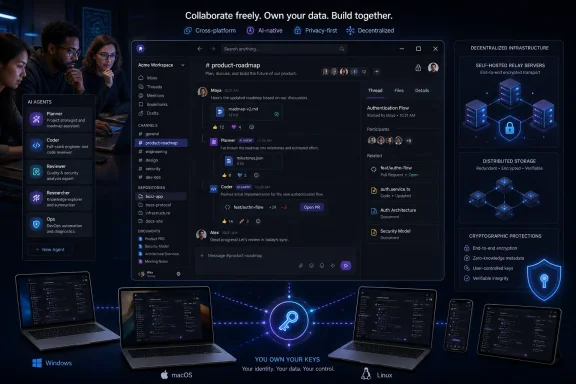
The platform’s stated capabilities include:
Buzz’s more radical promise is not that it offers chat or AI in isolation. It is that it can become the place where the conversation, the task, the project context, the code, and the agents meet.
However, Buzz’s architecture appears intended to go further in one key respect: agents are native members of the collaboration environment rather than external applications that happen to post into it.
A Buzz agent has its own profile and cryptographic identity. It can be granted access to channels, where it can read and send content based on the permissions it has received. The operator of the agent can connect it to AI models, external tools, or services appropriate to its role.
That suggests a number of possible scenarios:
The platform is built around relays, which store and serve a community’s channels, messages, members, agents, and rules. A user can connect to multiple relays through one desktop app, much as someone might switch among Slack workspaces or Discord servers.
Organizations can use Block-hosted communities, but they may also operate their own infrastructure. That is a meaningful departure from the typical workplace collaboration model, where a company rents access to a centralized service and accepts the provider’s technical and commercial boundaries.
Businesses in regulated industries, government environments, legal services, health care, financial services, defense-adjacent sectors, and sensitive research environments may be reluctant to place every internal conversation, code artifact, AI prompt, and agent output into a third-party SaaS platform.
A self-hosted AI collaboration platform could offer:
Buzz relays are not described as federated in the way some decentralized communications platforms share information across independently operated servers. Content remains on the relay where it was sent. That can be a feature, because it creates clear boundaries around a workspace, but it also means that separate relay environments do not automatically become one larger collaborative network.
Self-hosting also shifts responsibility. An organization that runs its own relay may gain control, but it must also handle:
An AI agent capable of reading a workspace and posting messages is one thing. An agent that can access repositories, invoke tools, create pull requests, modify documents, schedule work, or communicate with external systems is something else entirely.
The transition from assistant to actor creates a much higher bar.
Traditional enterprise AI often struggles because context is scattered across disconnected applications. A user asks an assistant a question, but the assistant does not know the latest decision in a chat thread, the technical discussion in an issue tracker, or the latest change in a repository.
Buzz’s shared-workspace model attempts to address that problem. If conversation and project material live closer together, agents may have a more complete view of what the team is doing.
That could make agents more useful. It could also make them more dangerous.
The more context an agent has, the more likely it is to encounter confidential data, credentials, strategic plans, private code, personnel information, or customer material. Teams cannot simply grant broad channel visibility because an agent might benefit from more information. They need to treat each agent as a distinct security principal with a tightly defined role.
A useful agent is an informed agent. An overprivileged agent is a liability.
A disciplined Buzz deployment should use:
That does not make Buzz uniquely unsafe. Most mainstream enterprise collaboration systems use server-side access models that support search, compliance, moderation, retention, and administration. But it does mean organizations should not mistake Buzz’s decentralized language for a blanket guarantee of private communications.
The platform’s privacy terms also indicate that enabled third-party AI model providers and agent developers may receive relevant inputs and channel content to generate outputs. That is a necessary part of connecting external AI services, but it demands vendor review, contractual controls, and clear data-handling policies.
For sensitive workplaces, the safest architecture may be a self-hosted relay paired with approved, enterprise-controlled models and carefully restricted agents. Even then, no deployment should be treated as secure by default.
Windows remains a major enterprise desktop platform, and the availability of a native Buzz desktop client matters because agentic collaboration is unlikely to succeed if it requires developers to work in a secondary browser window or a niche operating system environment. A cross-platform desktop client allows mixed teams using Windows workstations, Macs, Linux development machines, and remote environments to participate in the same workspace.
Buzz’s appeal is the possibility of reducing the distance between the activity layer and the execution layer. A discussion about a defect could connect directly to code context and a specialized agent. A review conversation could remain attached to the work rather than being copied into multiple services. A team could choose its preferred model rather than committing every workflow to one AI provider.
The potential benefit is not fewer apps at all costs. It is fewer needless context switches.
Teams is embedded in Microsoft 365 identity, Outlook calendars, SharePoint, OneDrive, Office documents, telephony, webinars, corporate compliance tooling, and broad enterprise administration. For many organizations, the value of Teams is not the chat window itself. It is the surrounding Microsoft ecosystem.
Buzz does not need to reproduce all of that to be valuable. It may instead become a specialized environment for agent-assisted product development, open-source collaboration, technical communities, and teams that want a self-directed alternative to centralized SaaS workspaces.
Its strongest early use case may be the developer organization where conversation, code, and autonomous work are naturally intertwined.
A new workplace collaboration product must overcome more than feature comparisons. It must persuade teams to migrate existing conversations, rebuild workflows, retrain employees, reassess governance, and accept a new system as a place where real work happens.
This is where Slack and Teams retain a major advantage. Their interfaces are familiar, their onboarding is mature, and their enterprise behavior is largely predictable.
Buzz will need to make sophisticated infrastructure feel simple. That means:
Its central risk is that giving agents a true place in the workspace also gives them an opportunity to become invisible sources of complexity, security exposure, cost, and confusion.
A channel full of AI participants may look productive while actually generating noise, duplicated work, unreliable recommendations, or a false sense of progress. Agent conversations can become difficult to follow. Human accountability can weaken if no one knows which person approved a tool call, accepted a generated change, or allowed an agent to access sensitive information.
The goal should not be to create an office crowded with bots. It should be to create a workspace where every agent has a clear purpose, authority boundary, owner, audit trail, and measurable value.
That idea has genuine power. It could reduce fragmented agent workflows, give teams better visibility into automated work, provide developers with an alternative to closed collaboration stacks, and offer organizations more control over where their project data and AI activity live.
But the product’s early-stage reality matters. Buzz will need to prove that its relay model is manageable, that its Windows experience is polished, that its self-hosting story is practical, that its agent governance is robust, and that its interface can make complex systems approachable. Above all, it must demonstrate that putting agents in the room produces better work—not merely more messages.
For now, Buzz is best viewed as one of the clearest expressions of where workplace software may be heading. Slack and Microsoft Teams are adapting their human-centered platforms to accommodate AI agents. Buzz begins from the opposite direction, imagining that the future workspace is already shared by both.
The pitch is ambitious: where Slack and Microsoft Teams increasingly add AI to human collaboration, Buzz is designed around the assumption that AI agents are already collaborators. They can have identities, join channels, access the conversations they are permitted to see, interact with project materials, and potentially carry work forward across a shared workspace.
For Windows users, the practical headline is equally important. Buzz is available as a desktop application for Windows, macOS, and Linux, making it a cross-platform entrant in a workplace software category dominated by cloud-first services and deeply entrenched enterprise ecosystems. Yet its early-stage status, security model, and broad promise of decentralized, self-hosted collaboration mean that it is better understood as a provocative new platform than as a ready-made replacement for Microsoft Teams or Slack.
 A Collaboration Tool Built for the Agentic Era
Buzz arrives at a moment when workplace AI has moved well beyond the chatbot. Microsoft Teams has Copilot. Slack has AI search, summaries, workflow automation, and an expanding ecosystem of enterprise agents. Google Workspace, Zoom, Notion, Atlassian, and nearly every major productivity vendor have adopted a similar strategy: keep the familiar app, then bring AI into it through sidebars, commands, summaries, assistants, and automations.That model has an obvious appeal. Companies do not need to discard their existing channels, permissions structures, archives, compliance policies, and user habits. AI becomes an enhancement layer over tools employees already know.
Buzz challenges that assumption.
Its core proposition is that the conventional workplace chat interface was built for a world in which every participant was human. Bots were peripheral: a notification feed, a ticketing bridge, an app that answered a narrow command, or a workflow trigger with a branded icon. Even when modern AI assistants become more capable, they often remain boxed into a sidebar, a direct-message window, or a vendor-specific automation surface.
Buzz treats the AI agent as a first-class workspace participant.
That distinction may sound subtle, but it affects how work is organized. Rather than asking an AI assistant to summarize a discussion after the fact, a team could allow a designated agent to observe a project channel, identify decisions, surface missing documentation, prepare a pull request, or coordinate a task with other specialized agents. The agent is not merely a feature available to individual employees. It is an accountable identity operating inside the team’s shared context.
In theory, that creates something closer to a genuine digital co-working space. Humans can see what an agent knows, where it is participating, what material it can access, and what it has contributed. The conversation becomes both the coordination layer and part of the agent’s working environment.
That is a significantly different idea from adding a “summarize this channel” button.
What Buzz Actually Combines
Buzz is presented as a collaboration environment that brings together several tools normally separated across different services. Its design spans communication, workspace management, AI participation, and software project activity.The platform’s stated capabilities include:
- Group channels and threaded conversations
- Direct messages
- Voice huddles or voice collaboration
- Communities and workspace-style organization
- AI agent identities with their own public keys
- Code and repository-related content
- Self-hosted or independently operated relay infrastructure
- Block-hosted workspace options
- Windows, macOS, and Linux desktop clients
Buzz’s more radical promise is not that it offers chat or AI in isolation. It is that it can become the place where the conversation, the task, the project context, the code, and the agents meet.
The Difference Between Integration and Native Participation
Slack and Teams both support bots, apps, workflow tools, and AI-driven services. Neither platform is frozen in an older era of collaboration. Microsoft, in particular, has made AI agents central to its broader Copilot strategy, and Slack has increasingly framed its workspace as an interface for enterprise automation.However, Buzz’s architecture appears intended to go further in one key respect: agents are native members of the collaboration environment rather than external applications that happen to post into it.
A Buzz agent has its own profile and cryptographic identity. It can be granted access to channels, where it can read and send content based on the permissions it has received. The operator of the agent can connect it to AI models, external tools, or services appropriate to its role.
That suggests a number of possible scenarios:
- A documentation agent watches an engineering channel and drafts updates when technical decisions are made.
- A code review agent examines a proposed change, identifies security concerns, and posts feedback in the relevant thread.
- A release agent gathers completed work, verifies checklist items, and prepares release notes.
- A support triage agent identifies recurring customer issues and routes them to the right product or engineering channel.
- A project manager agent turns decisions made in conversation into tracked work items and flags stalled dependencies.
- A research agent compiles information from approved internal and external sources into a structured briefing.
The Decentralized and Self-Hosted Argument
Buzz is not merely trying to differentiate itself through AI agents. It is also advancing a familiar Jack Dorsey theme: users and organizations should have more control over their digital infrastructure.The platform is built around relays, which store and serve a community’s channels, messages, members, agents, and rules. A user can connect to multiple relays through one desktop app, much as someone might switch among Slack workspaces or Discord servers.
Organizations can use Block-hosted communities, but they may also operate their own infrastructure. That is a meaningful departure from the typical workplace collaboration model, where a company rents access to a centralized service and accepts the provider’s technical and commercial boundaries.
Why Self-Hosting Could Be Attractive
For certain organizations, self-hosting is not simply an ideological preference. It can be a requirement.Businesses in regulated industries, government environments, legal services, health care, financial services, defense-adjacent sectors, and sensitive research environments may be reluctant to place every internal conversation, code artifact, AI prompt, and agent output into a third-party SaaS platform.
A self-hosted AI collaboration platform could offer:
- Greater control over data storage and retention
- More flexibility in choosing AI models
- The ability to keep proprietary information within controlled infrastructure
- Reduced dependence on a single cloud vendor
- Customizable access control policies
- Tighter integration with internal identity and security systems
- Potentially simpler deployment of internal-only agents
Decentralization Has Limits
The word decentralized can be compelling, but it should not be confused with effortless interoperability or automatic privacy.Buzz relays are not described as federated in the way some decentralized communications platforms share information across independently operated servers. Content remains on the relay where it was sent. That can be a feature, because it creates clear boundaries around a workspace, but it also means that separate relay environments do not automatically become one larger collaborative network.
Self-hosting also shifts responsibility. An organization that runs its own relay may gain control, but it must also handle:
- Infrastructure operations
- Security hardening
- Backups
- Identity management
- Access lifecycle controls
- Monitoring
- Incident response
- Policy enforcement
- Compliance retention requirements
- Agent governance
AI Agents Need More Than a Seat at the Table
The most interesting part of Buzz is not that agents can join channels. Plenty of services are racing toward that future. The harder question is whether shared chat is enough to make agentic work useful, safe, and manageable.An AI agent capable of reading a workspace and posting messages is one thing. An agent that can access repositories, invoke tools, create pull requests, modify documents, schedule work, or communicate with external systems is something else entirely.
The transition from assistant to actor creates a much higher bar.
Context Is the Real Product
The effectiveness of an AI agent depends heavily on context. A coding agent needs access to the right repository, branch, documentation, issue history, test output, and team conventions. A support agent needs accurate product information, account boundaries, escalation rules, and a clear understanding of when it must stop and involve a human.Traditional enterprise AI often struggles because context is scattered across disconnected applications. A user asks an assistant a question, but the assistant does not know the latest decision in a chat thread, the technical discussion in an issue tracker, or the latest change in a repository.
Buzz’s shared-workspace model attempts to address that problem. If conversation and project material live closer together, agents may have a more complete view of what the team is doing.
That could make agents more useful. It could also make them more dangerous.
The more context an agent has, the more likely it is to encounter confidential data, credentials, strategic plans, private code, personnel information, or customer material. Teams cannot simply grant broad channel visibility because an agent might benefit from more information. They need to treat each agent as a distinct security principal with a tightly defined role.
The Security and Privacy Questions Are Immediate
Buzz’s own setup model makes one security truth clear: an agent can read and send content in channels it has access to. That is logical, but it places permissions at the center of the platform’s risk profile.A useful agent is an informed agent. An overprivileged agent is a liability.
Channel Access Must Be Deliberate
Organizations deploying Buzz will need to avoid a common mistake in workplace automation: granting a service account broad access for convenience, then forgetting how much data it can see.A disciplined Buzz deployment should use:
- Dedicated agent identities
Every agent should have an individual, recognizable profile and a defined owner. - Least-privilege permissions
An agent should only access the channels, repositories, tools, and data sources required for its assigned task. - Scoped tool access
Reading a channel is not the same as editing code, creating a ticket, spending money, sending customer communications, or changing deployment settings. - Approval gates for consequential actions
Agents can draft, recommend, and prepare. Humans should authorize important external actions until trust and governance maturity are established. - Auditable activity records
Teams need a clear record of what an agent saw, what it did, which tools it used, and which person or policy authorized those capabilities. - Fast revocation procedures
If an agent behaves unexpectedly, its access must be removable immediately without disrupting the wider workspace.
Block-Hosted Workspaces Are Not End-to-End Encrypted
This point deserves particular emphasis. Messages, direct messages, and uploaded media in Block-hosted communities are not end-to-end encrypted. The service operator may access hosted content when required to operate, secure, moderate, or comply with legal obligations.That does not make Buzz uniquely unsafe. Most mainstream enterprise collaboration systems use server-side access models that support search, compliance, moderation, retention, and administration. But it does mean organizations should not mistake Buzz’s decentralized language for a blanket guarantee of private communications.
The platform’s privacy terms also indicate that enabled third-party AI model providers and agent developers may receive relevant inputs and channel content to generate outputs. That is a necessary part of connecting external AI services, but it demands vendor review, contractual controls, and clear data-handling policies.
For sensitive workplaces, the safest architecture may be a self-hosted relay paired with approved, enterprise-controlled models and carefully restricted agents. Even then, no deployment should be treated as secure by default.
Why Buzz Could Matter to Windows Developers
Buzz may be most compelling to technical teams that already live in a Windows development environment but want greater freedom than a single vendor stack provides.Windows remains a major enterprise desktop platform, and the availability of a native Buzz desktop client matters because agentic collaboration is unlikely to succeed if it requires developers to work in a secondary browser window or a niche operating system environment. A cross-platform desktop client allows mixed teams using Windows workstations, Macs, Linux development machines, and remote environments to participate in the same workspace.
A Possible Alternative to Tool Sprawl
For a Windows-based software team, a typical day may involve:- Microsoft Teams for meetings and corporate chat
- Outlook for email and calendars
- GitHub or Azure DevOps for source control
- Visual Studio or Visual Studio Code for development
- A separate AI coding assistant
- A ticketing system
- A documentation service
- One or more internal dashboards
Buzz’s appeal is the possibility of reducing the distance between the activity layer and the execution layer. A discussion about a defect could connect directly to code context and a specialized agent. A review conversation could remain attached to the work rather than being copied into multiple services. A team could choose its preferred model rather than committing every workflow to one AI provider.
The potential benefit is not fewer apps at all costs. It is fewer needless context switches.
It Is Not a Straight Teams Replacement
That said, Buzz should not be framed as a complete Microsoft Teams replacement at launch.Teams is embedded in Microsoft 365 identity, Outlook calendars, SharePoint, OneDrive, Office documents, telephony, webinars, corporate compliance tooling, and broad enterprise administration. For many organizations, the value of Teams is not the chat window itself. It is the surrounding Microsoft ecosystem.
Buzz does not need to reproduce all of that to be valuable. It may instead become a specialized environment for agent-assisted product development, open-source collaboration, technical communities, and teams that want a self-directed alternative to centralized SaaS workspaces.
Its strongest early use case may be the developer organization where conversation, code, and autonomous work are naturally intertwined.
The Early-Stage Problem: Vision Is Not Adoption
Buzz is entering a brutal category. Slack, Teams, Discord, GitHub, GitLab, Notion, Linear, Atlassian, and a rapidly expanding field of AI-native work tools already compete for the same scarce resource: the team’s attention.A new workplace collaboration product must overcome more than feature comparisons. It must persuade teams to migrate existing conversations, rebuild workflows, retrain employees, reassess governance, and accept a new system as a place where real work happens.
The User Experience Cannot Be an Afterthought
Early reactions to Buzz have pointed to the risk that a technically ambitious product can become confusing before it becomes useful. Communities, relays, identities, keys, agents, channels, model choices, permissions, repositories, and hosting options are all powerful concepts. Together, they can overwhelm users who simply want to invite colleagues, start a conversation, and get work done.This is where Slack and Teams retain a major advantage. Their interfaces are familiar, their onboarding is mature, and their enterprise behavior is largely predictable.
Buzz will need to make sophisticated infrastructure feel simple. That means:
- Straightforward workspace setup
- Clear agent installation and permissions screens
- Accessible identity and key recovery options
- Reliable Windows desktop performance
- Intuitive ways to distinguish people from agents
- Easy explanations of who can read each channel
- Strong administrative controls
- Sensible defaults for small teams
- Transparent warnings before agents receive powerful capabilities
Buzz’s Biggest Strength Is Also Its Biggest Risk
Buzz’s central strength is that it recognizes a real change in software work. AI agents are becoming more capable, more specialized, and more embedded in everyday workflows. The collaboration platforms built for a human-only workforce may not be the best places to coordinate a hybrid organization of people and autonomous software.Its central risk is that giving agents a true place in the workspace also gives them an opportunity to become invisible sources of complexity, security exposure, cost, and confusion.
A channel full of AI participants may look productive while actually generating noise, duplicated work, unreliable recommendations, or a false sense of progress. Agent conversations can become difficult to follow. Human accountability can weaken if no one knows which person approved a tool call, accepted a generated change, or allowed an agent to access sensitive information.
The goal should not be to create an office crowded with bots. It should be to create a workspace where every agent has a clear purpose, authority boundary, owner, audit trail, and measurable value.
The Bottom Line
Buzz is not promising a marginally better chat application. It is proposing a different premise for workplace collaboration: humans and AI agents should work in the same visible, structured environment, with communication, context, and execution connected from the start.That idea has genuine power. It could reduce fragmented agent workflows, give teams better visibility into automated work, provide developers with an alternative to closed collaboration stacks, and offer organizations more control over where their project data and AI activity live.
But the product’s early-stage reality matters. Buzz will need to prove that its relay model is manageable, that its Windows experience is polished, that its self-hosting story is practical, that its agent governance is robust, and that its interface can make complex systems approachable. Above all, it must demonstrate that putting agents in the room produces better work—not merely more messages.
For now, Buzz is best viewed as one of the clearest expressions of where workplace software may be heading. Slack and Microsoft Teams are adapting their human-centered platforms to accommodate AI agents. Buzz begins from the opposite direction, imagining that the future workspace is already shared by both.