

BlueVoyant launched its Microsoft Agent 365 Security Deployment Service on July 1, 2026, offering a roughly 90-day professional services engagement for enterprises that want to discover, govern, and secure AI agents running across Microsoft 365, Entra, Defender, Purview, and related Microsoft environments. The announcement is less about one more consulting package than about a larger shift in enterprise security: AI agents are being treated as identities, not merely as software features. That distinction matters because agents can read mail, search files, call tools, trigger workflows, and act with delegated authority. The governance problem is arriving faster than many Microsoft shops have built the muscle to manage it.
BlueVoyant’s new service lands in a market that Microsoft has spent the past year trying to define. Agent 365 is Microsoft’s control plane for AI agents, designed to bring discovery, lifecycle management, identity controls, security monitoring, and data governance into the same orbit as the rest of Microsoft 365 administration. BlueVoyant is not replacing that stack; it is offering to make it usable inside a real tenant, with real agents, real permissions, and real organizational mess.
That is a familiar enterprise software pattern. Microsoft introduces a broad platform, the licensing and architecture move quickly, and customers eventually discover that turning on the product is not the same thing as operating it. The gap between feature availability and production governance is where systems integrators, managed security providers, and deployment specialists make their living.
The BlueVoyant pitch is straightforward: most organizations are already running agents, but many do not know how many they have, who owns them, what data they can reach, or what happens if one is compromised. That is not alarmism so much as the logical consequence of generative AI moving from chat windows into workflow automation. Once an assistant becomes an actor, inventory becomes a security control.
The company’s 90-day engagement is built around that first-order need for visibility. It promises to create an agent inventory and registry, identify owners, map data access, document the tools agents can invoke, and detect shadow agents that have appeared outside normal IT governance. In security terms, this is asset management wearing an AI badge, but asset management has always been the first thing enterprises rediscover after a breach.
A conventional service account usually does what a developer scripted it to do. It may be overprivileged, forgotten, or poorly rotated, but its behavior is at least bounded by deterministic code. An AI agent can interpret prompts, choose tools, summarize data, and decide which workflow step comes next, depending on how it was designed and what it can access.
That does not make agents magical or sentient. It makes them operationally awkward. They sit somewhere between application, user, bot, workflow, and data processor, which means every existing control plane sees only part of the elephant.
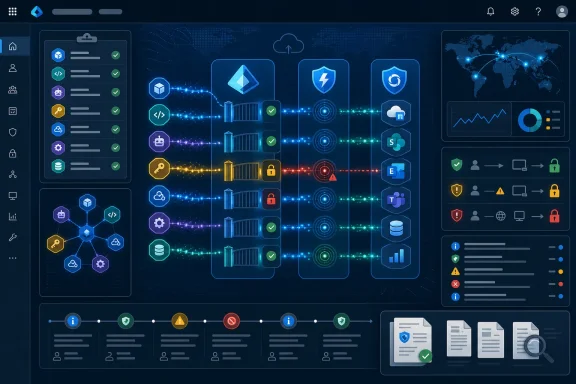
Microsoft’s answer is to extend the familiar enterprise management model to agents. Entra provides identity and access policy. Defender provides detection, posture assessment, and response signals. Purview provides data protection, compliance, auditing, and DLP. Agent 365 is the management layer meant to stitch those disciplines together.
BlueVoyant’s service is betting that enterprises will not want to assemble that model from documentation alone. That is probably a safe bet. Even mature Microsoft customers often have sprawling Conditional Access policies, uneven Purview adoption, noisy Defender queues, and a backlog of identity governance cleanup that predates the AI boom.
That is why Agent 365 matters beyond its branding. Microsoft is trying to make agent governance a native administrative function rather than an afterthought bolted onto individual AI tools. For Windows and Microsoft 365 administrators, that means AI governance is likely to show up less as a standalone discipline and more as another layer of tenant hygiene.
This is both powerful and risky. It is powerful because enterprises do not want a separate security universe for every class of automation. If agents can be governed through Entra, monitored through Defender, audited through Purview, and surfaced in the Microsoft 365 admin center, security teams have a fighting chance of bringing them into existing workflows.
It is risky because Microsoft’s security stack is already dense. A customer that has not fully rationalized Entra roles, sensitivity labels, DLP policies, endpoint posture, privileged access, and Defender alert triage may struggle to add agents without multiplying complexity. Agent 365 promises a control plane, but a control plane does not automatically simplify the estate underneath it.
BlueVoyant’s service appears designed for exactly this tension. It does not promise a new AI security product that floats above Microsoft’s stack. It promises to configure the stack customers are already buying, or are being encouraged to buy, so that agent governance becomes part of the same operational fabric as identity, threat detection, and data protection.
That baseline includes inventory, ownership, access policy, detection, response integration, and data governance. In other words, BlueVoyant is packaging the foundational work enterprises often postpone because it is politically and technically tedious. Someone has to decide who owns an agent, what it is allowed to access, what business process it supports, and what security telemetry counts as abnormal.
The value here is not only technical configuration. It is forcing a set of decisions that organizations can otherwise avoid. Agent governance cuts across security, IT, legal, compliance, business operations, and application teams. A sales operations group may build an agent in Copilot Studio; a developer team may deploy one through Azure AI Foundry; a department may connect a third-party agent to Microsoft 365 data. Each of those choices creates a governance obligation.
The awkward truth is that many enterprises have learned to live with SaaS sprawl, shadow IT, and unmanaged integrations. AI agents raise the cost of that tolerance. A shadow SaaS app may store sensitive data; a shadow agent may retrieve it, transform it, send it elsewhere, and do so under the apparent authority of a legitimate user or workflow.
That is why BlueVoyant’s emphasis on ownership matters. An agent with no owner is not an innovation asset. It is an orphaned permission set with a natural-language interface.
The challenge is that agents do not behave like humans. They may act continuously, operate on behalf of users, call APIs, invoke tools, or run in contexts that do not map neatly to a keyboard-and-screen session. Applying human-style access controls to them requires careful interpretation, not a blind copy of existing policies.
Still, the principle is sound. Agents should not become privileged back doors simply because they are new. If an organization would not allow a contractor to access sensitive SharePoint sites without governance, it should not allow an agent to do the same because someone built a clever workflow demo.
This is where least privilege becomes more than a slogan. Agents should have narrowly scoped permissions, clear sponsors, lifecycle controls, and access reviews. They should be subject to risk-based restrictions when their behavior deviates from expectations. They should not inherit broad user access without scrutiny simply because the user clicked “allow.”
For administrators, the operational burden will be deciding what normal looks like. A finance reconciliation agent that touches spreadsheets, ERP exports, and internal mailboxes may need access that would look alarming in another context. A meeting-summary agent probably does not need the same reach. The security model has to understand the job the agent is meant to perform.
The threat scenarios are not hypothetical. Agents can be manipulated through prompt injection, tricked into using tools in unintended ways, exposed to malicious content, or abused after an identity or token compromise. They can also amplify ordinary misconfiguration. An overprivileged agent that obediently follows a bad instruction may not look like malware, but it can still leak data or trigger harmful workflows.
Defender’s role is to make those behaviors visible enough to investigate. That means surfacing agent inventory, configuration posture, suspicious activity, and relationships among agents, users, devices, and tools. It also means fitting agent incidents into Defender XDR rather than asking security teams to monitor a separate AI console that no one checks during a real incident.
Purview addresses the other half of the problem: data. Agents are only useful because they can work with business information, and they are dangerous for the same reason. Data loss prevention, sensitivity labels, insider risk management, auditing, eDiscovery, and lifecycle policies all become more complicated when the actor is not a person but a delegated system operating at machine speed.
Extending Purview policies to agents is therefore not just a compliance checkbox. It is the mechanism by which organizations try to prevent agents from oversharing, mishandling labeled content, or creating data trails that cannot be searched later. If AI-generated work becomes part of business records, Purview has to see it.
Microsoft 365 E7, introduced as Microsoft’s premium AI-and-security bundle, includes Microsoft 365 E5, Copilot, Agent 365, Entra Suite, and advanced security and compliance capabilities. Agent 365 is also available as a standalone subscription for eligible Microsoft 365 customers. The commercial logic is clear: Microsoft wants AI governance to reinforce the value of its highest-end licensing tiers.
That will irritate some customers. Agent governance feels like a safety requirement, not a luxury feature. Yet the controls that make it work depend on premium identity, security, and compliance capabilities that Microsoft has historically monetized through E5-style packaging.
BlueVoyant’s service sits on top of that commercial reality. It is not trying to democratize agent security for every tenant; it is trying to help well-licensed enterprises extract operational value from the tools they already have. That is a narrower but more realistic business.
For WindowsForum readers in smaller environments, the lesson is still relevant. Even if Agent 365 and a 90-day deployment engagement are out of reach, the underlying governance questions are not. If an AI agent can access company data, someone needs to know what it is, who owns it, what permissions it has, and how it can be disabled.
A department-created agent can start as a productivity experiment and become a production dependency before anyone writes down a control. A developer can connect an internal tool to an AI workflow. A business user can authorize a third-party service. A team can build a Copilot Studio agent to answer questions from SharePoint content and then forget to revisit its permissions when the underlying site changes.
The danger is not that every shadow agent is malicious. It is that unmanaged agents create an inventory gap, and attackers love inventory gaps. Defenders cannot protect what they cannot see, cannot tune alerts for what they do not understand, and cannot revoke access from identities they did not know existed.
BlueVoyant’s discovery work is therefore central, not preliminary. The company’s service is not merely about enabling Microsoft features; it is about reconciling the customer’s imagined environment with the actual one. In enterprise security, that comparison is often humbling.
The hard part will be coverage. No single platform sees every possible agent across every SaaS app, endpoint, browser extension, custom workflow, and developer environment. Microsoft can provide strong visibility inside its ecosystem and supported integrations, but organizations should be wary of assuming that Agent 365 magically discovers every AI actor everywhere. Governance still requires process, policy, and cross-platform awareness.
That shift favors companies that can speak identity, data governance, detection engineering, and Microsoft tenant architecture rather than only AI theory. The agent problem is not solved by one clever scanner. It requires joining administrative controls, business ownership, telemetry, incident response, and compliance evidence.
This is why the service is framed as professional services rather than a standalone product. Agent security is partly configuration, partly governance design, partly organizational change, and partly training. Enterprises need to decide whether agents are treated like applications, users, service principals, records creators, or some new hybrid category. The answer will usually be “all of the above,” which is precisely why the work is messy.
BlueVoyant’s Microsoft focus is commercially sensible. The company has existing Microsoft security services, and Microsoft’s own agent strategy gives partners a platform around which to build repeatable deployment motions. The AI Cloud Partner Program incentives mentioned in the launch also signal that Microsoft wants partners to accelerate adoption, not simply wait for customers to self-implement.
There is a potential conflict here. Vendors and partners have an incentive to normalize agent deployment while selling governance around it. Customers should welcome the operational help but remain clear-eyed about the premise: the safest agent is not the one with the most dashboards; it is the one with a justified business purpose, minimal access, and a lifecycle owner.
Those questions sound basic because they are. The history of enterprise security is full of advanced tooling deployed before basic accountability. Agents will not be different unless IT teams insist on making them different.
Security leaders should also resist the temptation to treat agent governance as an AI project owned solely by an innovation team. The controls live in identity, data, endpoint, cloud, and security operations. The risk lands in compliance, legal, procurement, HR, finance, engineering, and customer operations. A serious program needs all of those stakeholders, even if Microsoft 365 admins end up doing much of the implementation work.
BlueVoyant’s service may be most useful as a forcing function. A 90-day engagement creates a window in which dormant policy debates must become configuration choices. That can expose governance gaps that predate AI agents: inconsistent labeling, unmanaged service principals, stale access groups, vague data ownership, and weak incident playbooks.
In that sense, Agent 365 security is not only about agents. It is a diagnostic for the maturity of the Microsoft estate. If an organization cannot explain who owns its agents, it may also struggle to explain who owns its data, its permissions, and its automation.
 BlueVoyant Is Selling the Missing Operating Model Around Agent 365
BlueVoyant’s new service lands in a market that Microsoft has spent the past year trying to define. Agent 365 is Microsoft’s control plane for AI agents, designed to bring discovery, lifecycle management, identity controls, security monitoring, and data governance into the same orbit as the rest of Microsoft 365 administration. BlueVoyant is not replacing that stack; it is offering to make it usable inside a real tenant, with real agents, real permissions, and real organizational mess.That is a familiar enterprise software pattern. Microsoft introduces a broad platform, the licensing and architecture move quickly, and customers eventually discover that turning on the product is not the same thing as operating it. The gap between feature availability and production governance is where systems integrators, managed security providers, and deployment specialists make their living.
The BlueVoyant pitch is straightforward: most organizations are already running agents, but many do not know how many they have, who owns them, what data they can reach, or what happens if one is compromised. That is not alarmism so much as the logical consequence of generative AI moving from chat windows into workflow automation. Once an assistant becomes an actor, inventory becomes a security control.
The company’s 90-day engagement is built around that first-order need for visibility. It promises to create an agent inventory and registry, identify owners, map data access, document the tools agents can invoke, and detect shadow agents that have appeared outside normal IT governance. In security terms, this is asset management wearing an AI badge, but asset management has always been the first thing enterprises rediscover after a breach.
The Agent Is Now a Security Principal
The most important idea in the announcement is BlueVoyant’s framing of AI agents as non-human identities. That phrase has been floating around identity and access management for years, usually applied to service accounts, workload identities, API keys, bots, and automation scripts. AI agents make the category more volatile because they combine delegated authority with probabilistic behavior and natural-language interfaces.A conventional service account usually does what a developer scripted it to do. It may be overprivileged, forgotten, or poorly rotated, but its behavior is at least bounded by deterministic code. An AI agent can interpret prompts, choose tools, summarize data, and decide which workflow step comes next, depending on how it was designed and what it can access.
That does not make agents magical or sentient. It makes them operationally awkward. They sit somewhere between application, user, bot, workflow, and data processor, which means every existing control plane sees only part of the elephant.
Microsoft’s answer is to extend the familiar enterprise management model to agents. Entra provides identity and access policy. Defender provides detection, posture assessment, and response signals. Purview provides data protection, compliance, auditing, and DLP. Agent 365 is the management layer meant to stitch those disciplines together.
BlueVoyant’s service is betting that enterprises will not want to assemble that model from documentation alone. That is probably a safe bet. Even mature Microsoft customers often have sprawling Conditional Access policies, uneven Purview adoption, noisy Defender queues, and a backlog of identity governance cleanup that predates the AI boom.
Microsoft’s Stack Is Becoming the Default Battlefield
The launch is also a reminder that Microsoft environments are where much of the practical AI governance fight will happen. Copilot, Copilot Studio, Azure AI Foundry, Teams, SharePoint, Exchange, OneDrive, and Microsoft Graph form a uniquely tempting substrate for workplace agents. The data is there, the permissions are there, and the users are already there.That is why Agent 365 matters beyond its branding. Microsoft is trying to make agent governance a native administrative function rather than an afterthought bolted onto individual AI tools. For Windows and Microsoft 365 administrators, that means AI governance is likely to show up less as a standalone discipline and more as another layer of tenant hygiene.
This is both powerful and risky. It is powerful because enterprises do not want a separate security universe for every class of automation. If agents can be governed through Entra, monitored through Defender, audited through Purview, and surfaced in the Microsoft 365 admin center, security teams have a fighting chance of bringing them into existing workflows.
It is risky because Microsoft’s security stack is already dense. A customer that has not fully rationalized Entra roles, sensitivity labels, DLP policies, endpoint posture, privileged access, and Defender alert triage may struggle to add agents without multiplying complexity. Agent 365 promises a control plane, but a control plane does not automatically simplify the estate underneath it.
BlueVoyant’s service appears designed for exactly this tension. It does not promise a new AI security product that floats above Microsoft’s stack. It promises to configure the stack customers are already buying, or are being encouraged to buy, so that agent governance becomes part of the same operational fabric as identity, threat detection, and data protection.
The 90-Day Engagement Says the Quiet Part Out Loud
The 90-day shape of the offering is revealing. This is not a one-day assessment or a lightweight workshop; it is also not an endless managed service commitment, at least as described. It is a deployment program meant to move a customer from uncertainty to an initial operating baseline.That baseline includes inventory, ownership, access policy, detection, response integration, and data governance. In other words, BlueVoyant is packaging the foundational work enterprises often postpone because it is politically and technically tedious. Someone has to decide who owns an agent, what it is allowed to access, what business process it supports, and what security telemetry counts as abnormal.
The value here is not only technical configuration. It is forcing a set of decisions that organizations can otherwise avoid. Agent governance cuts across security, IT, legal, compliance, business operations, and application teams. A sales operations group may build an agent in Copilot Studio; a developer team may deploy one through Azure AI Foundry; a department may connect a third-party agent to Microsoft 365 data. Each of those choices creates a governance obligation.
The awkward truth is that many enterprises have learned to live with SaaS sprawl, shadow IT, and unmanaged integrations. AI agents raise the cost of that tolerance. A shadow SaaS app may store sensitive data; a shadow agent may retrieve it, transform it, send it elsewhere, and do so under the apparent authority of a legitimate user or workflow.
That is why BlueVoyant’s emphasis on ownership matters. An agent with no owner is not an innovation asset. It is an orphaned permission set with a natural-language interface.
Conditional Access Comes for the Bots
One of the most consequential parts of the service is the plan to configure Microsoft Entra Conditional Access and Identity Protection policies for agents. Conditional Access has long been one of the central enforcement tools in Microsoft cloud security, tying access decisions to signals such as user identity, device compliance, location, risk, and authentication strength. Extending that mindset to agents is the natural next step.The challenge is that agents do not behave like humans. They may act continuously, operate on behalf of users, call APIs, invoke tools, or run in contexts that do not map neatly to a keyboard-and-screen session. Applying human-style access controls to them requires careful interpretation, not a blind copy of existing policies.
Still, the principle is sound. Agents should not become privileged back doors simply because they are new. If an organization would not allow a contractor to access sensitive SharePoint sites without governance, it should not allow an agent to do the same because someone built a clever workflow demo.
This is where least privilege becomes more than a slogan. Agents should have narrowly scoped permissions, clear sponsors, lifecycle controls, and access reviews. They should be subject to risk-based restrictions when their behavior deviates from expectations. They should not inherit broad user access without scrutiny simply because the user clicked “allow.”
For administrators, the operational burden will be deciding what normal looks like. A finance reconciliation agent that touches spreadsheets, ERP exports, and internal mailboxes may need access that would look alarming in another context. A meeting-summary agent probably does not need the same reach. The security model has to understand the job the agent is meant to perform.
Defender and Purview Turn Agent Behavior Into Evidence
BlueVoyant also says the service enables Microsoft Defender Security for AI and integrates it with Defender XDR for detection and response. That is crucial because prevention-only approaches are not realistic when agents are expected to act dynamically. Security teams need telemetry, alerts, investigation paths, and response actions when an agent does something suspicious.The threat scenarios are not hypothetical. Agents can be manipulated through prompt injection, tricked into using tools in unintended ways, exposed to malicious content, or abused after an identity or token compromise. They can also amplify ordinary misconfiguration. An overprivileged agent that obediently follows a bad instruction may not look like malware, but it can still leak data or trigger harmful workflows.
Defender’s role is to make those behaviors visible enough to investigate. That means surfacing agent inventory, configuration posture, suspicious activity, and relationships among agents, users, devices, and tools. It also means fitting agent incidents into Defender XDR rather than asking security teams to monitor a separate AI console that no one checks during a real incident.
Purview addresses the other half of the problem: data. Agents are only useful because they can work with business information, and they are dangerous for the same reason. Data loss prevention, sensitivity labels, insider risk management, auditing, eDiscovery, and lifecycle policies all become more complicated when the actor is not a person but a delegated system operating at machine speed.
Extending Purview policies to agents is therefore not just a compliance checkbox. It is the mechanism by which organizations try to prevent agents from oversharing, mishandling labeled content, or creating data trails that cannot be searched later. If AI-generated work becomes part of business records, Purview has to see it.
The Licensing Filter Narrows the Audience
BlueVoyant’s offer is aimed at organizations with Microsoft 365 E7 and Agent 365 deployments, with Microsoft E5 or E7 licensing and the Agent 365 add-on required to qualify. That tells us the initial market is not the average small business dabbling with Copilot. It is the enterprise customer already deep enough into Microsoft’s premium stack to care about agent governance at scale.Microsoft 365 E7, introduced as Microsoft’s premium AI-and-security bundle, includes Microsoft 365 E5, Copilot, Agent 365, Entra Suite, and advanced security and compliance capabilities. Agent 365 is also available as a standalone subscription for eligible Microsoft 365 customers. The commercial logic is clear: Microsoft wants AI governance to reinforce the value of its highest-end licensing tiers.
That will irritate some customers. Agent governance feels like a safety requirement, not a luxury feature. Yet the controls that make it work depend on premium identity, security, and compliance capabilities that Microsoft has historically monetized through E5-style packaging.
BlueVoyant’s service sits on top of that commercial reality. It is not trying to democratize agent security for every tenant; it is trying to help well-licensed enterprises extract operational value from the tools they already have. That is a narrower but more realistic business.
For WindowsForum readers in smaller environments, the lesson is still relevant. Even if Agent 365 and a 90-day deployment engagement are out of reach, the underlying governance questions are not. If an AI agent can access company data, someone needs to know what it is, who owns it, what permissions it has, and how it can be disabled.
“Shadow AI” Is the New Shadow IT, but Faster
The phrase “shadow AI agents” may sound like vendor theater, but the problem it describes is real. Employees and business units have always adopted technology faster than central IT can approve it. The difference now is that AI tools often ask for access to data, calendars, documents, messaging systems, repositories, and workflow platforms as part of their basic usefulness.A department-created agent can start as a productivity experiment and become a production dependency before anyone writes down a control. A developer can connect an internal tool to an AI workflow. A business user can authorize a third-party service. A team can build a Copilot Studio agent to answer questions from SharePoint content and then forget to revisit its permissions when the underlying site changes.
The danger is not that every shadow agent is malicious. It is that unmanaged agents create an inventory gap, and attackers love inventory gaps. Defenders cannot protect what they cannot see, cannot tune alerts for what they do not understand, and cannot revoke access from identities they did not know existed.
BlueVoyant’s discovery work is therefore central, not preliminary. The company’s service is not merely about enabling Microsoft features; it is about reconciling the customer’s imagined environment with the actual one. In enterprise security, that comparison is often humbling.
The hard part will be coverage. No single platform sees every possible agent across every SaaS app, endpoint, browser extension, custom workflow, and developer environment. Microsoft can provide strong visibility inside its ecosystem and supported integrations, but organizations should be wary of assuming that Agent 365 magically discovers every AI actor everywhere. Governance still requires process, policy, and cross-platform awareness.
The Security Industry Is Repackaging AI Risk Around Operations
BlueVoyant’s announcement reflects a broader movement in cybersecurity. The first wave of AI security marketing focused heavily on model risk, prompt injection, data leakage, and securing large language model applications. Those issues still matter, but enterprises are now confronting a more mundane and more durable problem: how to operate AI systems responsibly at scale.That shift favors companies that can speak identity, data governance, detection engineering, and Microsoft tenant architecture rather than only AI theory. The agent problem is not solved by one clever scanner. It requires joining administrative controls, business ownership, telemetry, incident response, and compliance evidence.
This is why the service is framed as professional services rather than a standalone product. Agent security is partly configuration, partly governance design, partly organizational change, and partly training. Enterprises need to decide whether agents are treated like applications, users, service principals, records creators, or some new hybrid category. The answer will usually be “all of the above,” which is precisely why the work is messy.
BlueVoyant’s Microsoft focus is commercially sensible. The company has existing Microsoft security services, and Microsoft’s own agent strategy gives partners a platform around which to build repeatable deployment motions. The AI Cloud Partner Program incentives mentioned in the launch also signal that Microsoft wants partners to accelerate adoption, not simply wait for customers to self-implement.
There is a potential conflict here. Vendors and partners have an incentive to normalize agent deployment while selling governance around it. Customers should welcome the operational help but remain clear-eyed about the premise: the safest agent is not the one with the most dashboards; it is the one with a justified business purpose, minimal access, and a lifecycle owner.
Enterprise IT Should Treat This as an Audit Moment
The launch should prompt Microsoft customers to ask uncomfortable questions before they buy anything. How many agents are already deployed? Which ones act on behalf of users? Which ones have access to sensitive repositories? Which ones can call external tools? Which ones are still owned by someone who left the company?Those questions sound basic because they are. The history of enterprise security is full of advanced tooling deployed before basic accountability. Agents will not be different unless IT teams insist on making them different.
Security leaders should also resist the temptation to treat agent governance as an AI project owned solely by an innovation team. The controls live in identity, data, endpoint, cloud, and security operations. The risk lands in compliance, legal, procurement, HR, finance, engineering, and customer operations. A serious program needs all of those stakeholders, even if Microsoft 365 admins end up doing much of the implementation work.
BlueVoyant’s service may be most useful as a forcing function. A 90-day engagement creates a window in which dormant policy debates must become configuration choices. That can expose governance gaps that predate AI agents: inconsistent labeling, unmanaged service principals, stale access groups, vague data ownership, and weak incident playbooks.
In that sense, Agent 365 security is not only about agents. It is a diagnostic for the maturity of the Microsoft estate. If an organization cannot explain who owns its agents, it may also struggle to explain who owns its data, its permissions, and its automation.
The Agent 365 Moment Has a Few Hard Edges
The practical message for Microsoft-heavy enterprises is clear: agent governance is moving from concept to deployment work, and the organizations that wait for perfect maturity will be overtaken by their own users. BlueVoyant’s launch is one vendor’s package, but it captures the direction of travel.- AI agents should be inventoried and governed as non-human identities, not treated as harmless extensions of chatbots or productivity tools.
- Microsoft Agent 365 is becoming the administrative center of gravity for agent governance in Microsoft environments, especially when paired with Entra, Defender, Purview, and Intune.
- BlueVoyant’s 90-day service is aimed at enterprises that already have, or are moving toward, premium Microsoft licensing such as E5, E7, and Agent 365.
- Shadow agents are a visibility and accountability problem before they are a malware problem, which makes discovery and ownership the first controls to establish.
- Conditional Access, DLP, insider risk, auditing, and XDR workflows need to be adapted for agents because agents can act with delegated authority across sensitive systems.
- Customers should treat deployment services as a way to build an operating model, not as a substitute for internal ownership of AI governance.
References
- Primary source: SecurityBrief UK
Published: 2026-07-03T08:12:07.694505
BlueVoyant launches Microsoft Agent 365 security service
Security teams face a new governance gap as AI agents spread across Microsoft systems, with many lacking inventories, controls or monitoring. securitybrief.co.uk
- Related coverage: bluevoyant.com
BlueVoyant Launches First Microsoft AI Agent Security… | BlueVoyant
BlueVoyant today announced the first security service built to discover, govern, and secure AI agents running across Microsoft 365 and Azure environments.www.bluevoyant.com
- Official source: learn.microsoft.com
Use Microsoft Purview to manage data security & compliance for AI agents | Microsoft Learn
Use Microsoft Purview to help you protect and manage data security and compliance protections for AI agents.learn.microsoft.com - Official source: microsoft.com
Microsoft Agent 365: The Control Plane for Agents
Observe, govern, and secure AI agents confidently with Agent 365. Extend Microsoft 365 and Microsoft Security controls to manage agentic AI at scale.www.microsoft.com
- Official source: techcommunity.microsoft.com
- Related coverage: techtarget.com
Microsoft 365 E7 adds AI governance; prices draw critiques | TechTarget
Microsoft plans to add Agent 365's AI governance to Microsoft 365 E7 in May, prompting analysts to question its pricing strategy.www.techtarget.com
- Official source: marketplace.microsoft.com
Microsoft 365 Defender Enterprise Deployment: 6-Week Implementation
<p>Manage and Investigate Risk and Threat Protection</p>marketplace.microsoft.com
- Related coverage: techradar.com
Microsoft reveals Agent 365 - the new and (hopefully) easy way to get a handle on all these new AI agents at work | TechRadar
Say hello to Agent 365www.techradar.com - Related coverage: windowscentral.com
Microsoft doubles down on agentic AI — Agent 365 prepares for a future with over 1 billion agents | Windows Central
Microsoft kicked off Ignite with a major push into agentic AI, unveiling Agent 365 as its newest tool for automating workflows.www.windowscentral.com - Related coverage: itpro.com
Microsoft's new Agent 365 platform is a one-stop shop for deploying, securing, and keeping tabs on AI agents | IT Pro
The new platform looks to shore up visibility and security for enterprises using AI agentswww.itpro.com - Official source: cdn-dynmedia-1.microsoft.com
- Related coverage: licensingschool.co.uk
- Official source: adoption.microsoft.com
Get started With Microsoft Agent 365 in Microsoft 365 admin center
PDF documentadoption.microsoft.com
- Official source: download.microsoft.com
- Related coverage: softwareone.com
