

Microsoft and Boeing’s new pilot-training partnership flips a familiar headline into a substantive shift: consumer-grade simulation technology — specifically Microsoft Flight Simulator running on Microsoft Azure — is being packaged and validated as a scaled, procedures-first training tool that aims to reduce the time novice pilots spend getting familiar with real, certified simulators and aircraft cockpits. The centerpiece product, Virtual Airplane Procedures Trainer (VAPT), was introduced at the European Aviation Training Summit and positions itself not as a replacement for certified Flight Training Devices or Full Flight Simulators, but as a widely accessible, customizable layer of pre-simulator preparation that could reshape how flight schools, airlines, and cadet programs sequence early training.
Microsoft Flight Simulator has long been the reference consumer platform for photorealistic flying on PCs and consoles; Boeing’s announcement ties that platform into an enterprise-grade pipeline — cloud services, content-authoring tools, and Boeing-validated procedure lessons — to create a product aimed explicitly at novice and early-stage pilot training. The move was framed publicly as a collaboration: Boeing supplies the training design, aircraft procedural fidelity, and distribution; Microsoft supplies the simulation engine, graphics and dev tools, and cloud infrastructure through Microsoft Azure. Boeing presented VAPT as part of a broader Virtual Airplane suite, with initial capability focused on the Boeing 737 MAX accessible from computers and iPad devices. This announcement arrives at a time when regulators and training vendors are already experimenting with non-traditional training technologies (XR, mobile, and desktop simulators) to reduce costs, expand access, and introduce new forms of procedural practice outside of expensive, schedule-constrained physical sim time. Research and regulatory activity over the last several years show both enthusiasm and caution: extended reality and consumer-grade simulators can provide effective adjunct training for procedure rehearsal and cockpit familiarization, yet they are generally not recognized as qualified Flight Simulation Training Devices (FSTDs) for official credit unless they meet strict certification requirements.
However, effective adoption will depend on three things: rigorous instructional design that respects human-factors limits, clear regulatory pathways for any credited use, and contractual controls that protect operator data and preserve content portability. The most immediate, realistic impact is operational: VAPT can reduce familiarization friction and help trainees arrive at certified simulators better prepared, thereby improving throughput and potentially lowering training cost per candidate. The more audacious claims — that the product will replace certified simulators or be used for licensing credit without further qualification — remain speculative until regulators or vendors demonstrate controlled, validated qualification pathways. Watch for the following signals over the coming months:
Source: Softonic Microsoft Flight Simulator will be the tool that novice pilots will use from now on for training - Softonic
 Background
Microsoft Flight Simulator has long been the reference consumer platform for photorealistic flying on PCs and consoles; Boeing’s announcement ties that platform into an enterprise-grade pipeline — cloud services, content-authoring tools, and Boeing-validated procedure lessons — to create a product aimed explicitly at novice and early-stage pilot training. The move was framed publicly as a collaboration: Boeing supplies the training design, aircraft procedural fidelity, and distribution; Microsoft supplies the simulation engine, graphics and dev tools, and cloud infrastructure through Microsoft Azure. Boeing presented VAPT as part of a broader Virtual Airplane suite, with initial capability focused on the Boeing 737 MAX accessible from computers and iPad devices. This announcement arrives at a time when regulators and training vendors are already experimenting with non-traditional training technologies (XR, mobile, and desktop simulators) to reduce costs, expand access, and introduce new forms of procedural practice outside of expensive, schedule-constrained physical sim time. Research and regulatory activity over the last several years show both enthusiasm and caution: extended reality and consumer-grade simulators can provide effective adjunct training for procedure rehearsal and cockpit familiarization, yet they are generally not recognized as qualified Flight Simulation Training Devices (FSTDs) for official credit unless they meet strict certification requirements. What Boeing and Microsoft Announced
The product and how Boeing frames it
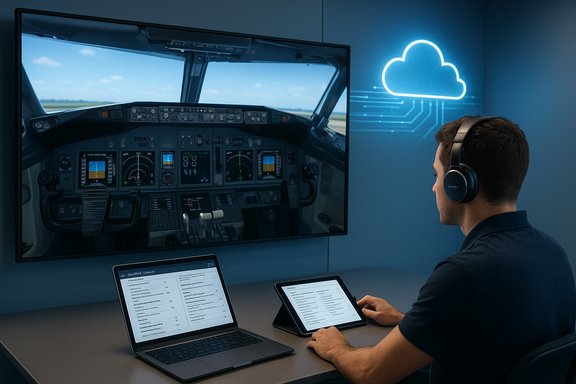
Boeing calls the first app the Virtual Airplane Procedures Trainer (VAPT). Key features highlighted in Boeing’s release and simultaneous reporting include:- High-fidelity 3D simulations tailored to airline procedures to let pilots practice flows, checklists, and non-handling procedures on lightweight devices.
- A self-service authoring tool that allows training operators to create, customize, and distribute procedure lessons at scale — a point Boeing emphasizes as a way to standardize operator-specific SOPs quickly across pilot groups.
- Multi-platform access including native Windows and iPad apps, and online streaming capabilities for regions and setups where offline use is restricted.
Microsoft’s role and corporate messaging
Microsoft’s public comments (quoted in Boeing’s release) emphasize learning acceleration and safety-first deployment, calling out Azure’s enterprise features (scalability, identity, and security) as material enablers of large-scale instructor workflows. Dayan Rodriguez, Microsoft Corporate VP for Manufacturing and Mobility, appears in Boeing’s statement praising the partnership’s potential to “advance the future of flight” while keeping safety central.Why this matters: benefits for training programs
1. Accessibility and scale
VAPT promises to put high-fidelity procedure training into the hands of trainees on devices they already own — laptops, tablets, and potentially streamed web clients. This expands access beyond training centers with costly simulator racks and enables decentralized, just-in-time refresher training before flights or simulator sessions. For cadet programs and remote ATOs (Approved Training Organizations), that moves the needle on training throughput and reduces the simulator scheduling bottleneck.2. Cost and scheduling efficiency
Certified FTDs and Full Flight Simulators (FFSs) are capacity-limited and expensive to operate. If VAPT can reliably take small, non-qualification rehearsal tasks off the calendar, operators could reserve expensive sim time for credit-bearing sessions that require certified devices. Boeing and industry reporting explicitly tie VAPT to the goal of reducing familiarization time in physical sims. That represents a potential pathway to reduce per-pilot training costs and improve utilization of central sim assets.3. Customization and procedural standardization
Authoring tools that let airlines encode company SOPs, briefings, and variant-specific checklists promise to reduce inconsistency between training instructors and line operations. This is especially useful for airlines with rapid fleet changes, emergent bulletin updates, or geographically distributed pilot bases. Boeing’s stated design explicitly supports operator-customized lessons.4. Low-pressure rehearsal and repetition
Research into XR-enhanced training indicates that lower-cost, lower-pressure practice environments can improve procedural memory and reduce cognitive load when students first enter certified devices or aircraft. Several industry case studies (pilots using MSFS for pre-briefing on A350 layouts, RAF VR rigs for rare types) show how consumer-grade tools can add value when framed as adjunct practice, not as accredited replacements.Technical and regulatory realities: what VAPT cannot (yet) do
Consumer sim vs. certified FSTD — the regulatory line
Regulators (EASA, FAA, ICAO) draw a clear line between commercial/approved Flight Simulation Training Devices (FSTD, FTD, FNPT, FFS) and consumer or non-qualified training tools. Qualification requires detailed documentation of fidelity, flight data, systems modeling, and often on-site inspection; only qualified devices may be credited toward licensing, type rating, or proficiency checks under current rules. Consumer products — no matter how realistic — do not automatically count for regulatory training credits unless they have undergone qualification and certification. That means VAPT’s value will be in preparation and familiarization, not in substituting for official simulator hours unless specific jurisdictions change policy or Boeing pursues formal qualification steps for the product.Fidelity, motion, and handling limits
Full Flight Simulators provide validated motion cueing, high-fidelity aerodynamic modeling, and certified visual systems that replicate instrument and external visual cues to levels regulators require for credits. Microsoft Flight Simulator — even with Boeing’s validation overlay — is primarily a visual and systems simulation environment optimized for broad realism, not for certifying handling fidelity across the flight envelope. That gap matters across areas like upset recovery, high-workload single-pilot handling, and advanced failures where motion cueing and validated control loading materially affect training outcomes. Until a system like VAPT is formally qualified at FTD/FFS/FTD levels, these handling and motion limitations remain a structural constraint.Human factors and simulator sickness
Extended reality and highly immersive visuals can increase the incidence of simulator or cybersickness for some trainees. The academic literature and systematic reviews caution that XR-based and non-certified systems need careful instructional design and adaptive scheduling to avoid adverse effects that undermine learning. VAPT’s device footprint (laptops and iPads) avoids some VR-specific sickness risks but does not eliminate the need for human-factors-aware lesson design.Security, data, and vendor-control considerations
Boeing and Microsoft emphasize Azure as the backbone for distribution and authoring. That raises several practical questions training operators must weigh:- Data sovereignty and privacy: Flight training organizations may want control over trainee performance data and need clarity on how Azure-hosted content is stored, transferred, or used for analytics. Enterprise tools typically provide tenancy options, but operators should verify regional data residency guarantees and contractual terms.
- Operational security and software assurance: Any cloud-connected tool used in regulated aviation must meet organizational cybersecurity standards; operators should require security attestation (e.g., SOC2, ISO 27001, FedRAMP where relevant) for cloud components and CI/CD pipelines used to push training content.
- Vendor lock-in and content portability: Boeing’s authoring and distribution layer may offer speed, but operators will favor content portability and exportable lesson packages so lessons and SOPs are not locked to an ecosystem without fallback. This is part procurement teams must negotiate during adoption.
Cross-checking the central claims
The central claims made in Boeing’s launch materials and early reporting have been corroborated across multiple independent outlets. Boeing’s own press release states VAPT is powered by Microsoft Azure and Microsoft Flight Simulator and targets the 737 MAX on computers and iPad devices. Independent coverage by aviation trade outlets and industry press reiterates the product features — authoring tools, 3D high-fidelity experiences, and an initial aircraft scope — and notes plans to expand to additional Boeing models. Military and civil training publishers also reported that the first module is scheduled for broader release and deployment cycles into 2026. These multiple, independent reports confirm the existence and vendor positioning of VAPT while clarifying that the initiative is being rolled out in phases.Practical implications for ATOs, airlines, and cadet programs
Implementation checklist for training managers
- Define learning objectives: separate procedural rehearsal from handling and type-rating competencies and allocate VAPT to the former.
- Pilot acceptance testing: run a pilot cohort to measure measurable reductions in familiarization time and evaluate trainee feedback and simulator readiness.
- Regulatory alignment: consult national aviation authorities (NAA) and EASA/FAA guidance to confirm which elements may count toward documented training outcomes or which must remain non-credit practice.
- Security and data contracts: ensure contractual clarity on data residency, export control, and access controls for authoring and distribution.
- Hardware baseline and support: define minimum device specifications and a support plan for trainees on personal devices to avoid performance or fidelity issues.
How pilots should approach VAPT
- Treat VAPT as a rehearsal and memory consolidation tool: use it to internalize flows, readbacks, and cockpit resource management before entering certified devices.
- Avoid over-reliance for handling-proficiency: flying the aircraft in the real sim or aircraft is still required for handling, unusual attitude recovery, and type-specific control feel.
- Document training minutes carefully: if an operator intends to use VAPT as part of an approved syllabus, discuss with the NAA for any possible credit or documentation approach.
Risks, caveats, and unanswered questions
Overstated headlines vs. practical reality
Headlines claiming that “Microsoft Flight Simulator will be the tool novice pilots will use from now on” are reductive. Boeing’s announcement positions VAPT as a complementary training layer, not as a regulatory substitute for qualified FSTDs. The practical effect will depend on regulatory acceptance, device qualification, and operator adoption; it is not an instant licensing shortcut. That aspirational language should be treated as marketing positioning rather than a proven, system-wide shift. Caveat lector.Certification and credit for training time
Two critical regulatory pathways could alter VAPT’s long-term value: (a) formal qualification as an FSTD or (b) national acceptances for some credited hours based on validated operational trials. Recent efforts by VR vendors to obtain EASA and FAA recognition show regulators are open to rigorous XR validation, but each device and implementation must be vetted and qualified individually. Boeing and Microsoft have not announced device-level qualification of VAPT as an FTD/FFS equivalent; until that occurs, VAPT will remain a preparatory tool.Human factors and overconfidence risk
Less expensive and more accessible training can accelerate repetition but may also foster overconfidence if progress metrics aren’t mapped to validated competencies. Poorly designed authoring or inadequate instructor oversight could convert convenience into complacency. Training managers must avoid equating hours on a device with demonstrated competence.Technical limitations and content fidelity
Microsoft Flight Simulator is an exceptional visual and procedural platform, but its aerodynamic fidelity and subsystem modeling are not automatically equivalent to a certified simulator. Boeing’s validation overlay and Boeing-validated lessons help mitigate this, but the underlying engine remains a consumer-focused product that may not model edge-of-envelope dynamics with the required regulatory rigor. Any claim that VAPT “replaces sim time” should be scrutinized and validated by independent trials.Where adoption is likely first — and where it isn’t
Early adopters will likely be:- Airlines with large cadet pipelines that want to reduce expensive sim time and ensure standardization across geographies.
- Flight schools and ATOs seeking scalable pre-simulator rehearsal tools to increase throughput.
- Corporate aviation and smaller operators that need economical, repeatable procedure training for small crews across dispersed bases.
- Regulatory-dependent qualification use — until devices are individually qualified, major regulators won’t grant training credit.
- Edge-case handling training (upset recovery, high-G maneuvers) where motion cueing and validated flight data remain essential.
Conclusions and what to watch next
Boeing’s Virtual Airplane Procedures Trainer represents an important pivot: it packages a consumer-grade simulation platform into an enterprise training product with authoring, distribution, and airline-focused validation. That combination — Microsoft Flight Simulator graphics and systems, Boeing procedural validation, and Azure-backed distribution — is powerful precisely because it mixes accessibility with enterprise controls.However, effective adoption will depend on three things: rigorous instructional design that respects human-factors limits, clear regulatory pathways for any credited use, and contractual controls that protect operator data and preserve content portability. The most immediate, realistic impact is operational: VAPT can reduce familiarization friction and help trainees arrive at certified simulators better prepared, thereby improving throughput and potentially lowering training cost per candidate. The more audacious claims — that the product will replace certified simulators or be used for licensing credit without further qualification — remain speculative until regulators or vendors demonstrate controlled, validated qualification pathways. Watch for the following signals over the coming months:
- Formal qualification attempts or EASA/FAA acceptance for specific VAPT configurations.
- Fields studies or peer-reviewed trials showing measurable reductions in simulator familiarization time and error rates for cohorts that used VAPT.
- Contractual and security disclosures from Boeing and Microsoft clarifying data handling, tenancy models, and offline capabilities for regulated operators.
Source: Softonic Microsoft Flight Simulator will be the tool that novice pilots will use from now on for training - Softonic
