

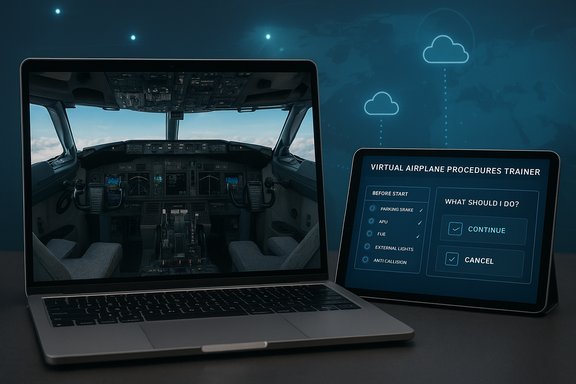
Boeing has formally launched the Virtual Airplane Procedures Trainer (VAPT), a cloud‑first pilot training platform built on Microsoft Azure and powered by Microsoft Flight Simulator, aimed at letting pilots rehearse cockpit procedures on laptops and iPads — starting with the Boeing 737 MAX and positioned explicitly as a pre‑sim, procedural rehearsal tool rather than a replacement for certified full‑flight simulators.
Boeing introduced VAPT at the European Aviation Training Summit in Cascais on November 6, 2025, presenting it as the first application in a wider “Virtual Airplane” product family. The Procedures Trainer component delivers a photoreal, interactive 3D cockpit environment and pairs that client with a web‑based authoring and distribution system for training teams. The platform uses Microsoft Flight Simulator for visual rendering and world data while Azure hosts the cloud services — authentication, content delivery, telemetry ingestion and analytics. This announcement formalizes a trend already visible in the training and enthusiast communities: consumer‑grade and prosumer flight simulation engines have matured into visual and systems platforms that, when combined with enterprise cloud backends and OEM‑authored aircraft systems content, can be productized for operational training use. VAPT is being marketed to airlines and Approved Training Organizations (ATOs) through Boeing Global Services rather than as a retail product for flight‑sim hobbyists.
Boeing’s Virtual Airplane Procedures Trainer crystallizes a practical future for flight simulation where cloud scale, photoreal visuals and lightweight clients make high‑quality procedural rehearsal ubiquitous — but it also brings a new set of governance, validation and procurement responsibilities. For operators prepared to run disciplined pilots, insist on contractual clarity, and engage with regulators early, VAPT offers a credible way to modernize procedural training while reserving certified simulator hours for tasks that truly require them.
Source: TweakTown Latest Simulators News, Updates & Coverage
 Background / Overview
Boeing introduced VAPT at the European Aviation Training Summit in Cascais on November 6, 2025, presenting it as the first application in a wider “Virtual Airplane” product family. The Procedures Trainer component delivers a photoreal, interactive 3D cockpit environment and pairs that client with a web‑based authoring and distribution system for training teams. The platform uses Microsoft Flight Simulator for visual rendering and world data while Azure hosts the cloud services — authentication, content delivery, telemetry ingestion and analytics. This announcement formalizes a trend already visible in the training and enthusiast communities: consumer‑grade and prosumer flight simulation engines have matured into visual and systems platforms that, when combined with enterprise cloud backends and OEM‑authored aircraft systems content, can be productized for operational training use. VAPT is being marketed to airlines and Approved Training Organizations (ATOs) through Boeing Global Services rather than as a retail product for flight‑sim hobbyists. Why this matters now
The commercial pilot training ecosystem faces three persistent constraints that make a product like VAPT attractive:- Simulator scarcity and cost: Full‑flight simulators (FFSs) and high‑fidelity flight training devices (FTDs) are expensive to procure and run, creating bottlenecks in training schedules and capacity planning. Moving routine, checklist‑based rehearsal off those machines could free scarce device hours for tasks that truly require simulator fidelity.
- Operational agility: Airlines need to push SOP updates, temporary procedures, and rapid remedial lessons across distributed pilot populations; a cloud authoring and distribution tool gives training managers a way to do that quickly and measure completion.
- Device ubiquity: Modern laptops and tablets now have enough CPU/GPU headroom and network connectivity to deliver meaningful rehearsal experiences, especially when combined with cloud streaming, selective offloading, and local caching. Microsoft Flight Simulator’s global scenery and Azure’s CDN capabilities make this feasible at scale.
Technical architecture and how it works
Core components
VAPT, as described by Boeing, contains two tightly coupled components:- A Procedures Trainer client that runs on laptops and iPads, presenting an interactive 3D cockpit, clickable controls, checklists, and branching failure scenarios.
- A web‑based authoring and distribution platform used by training administrators to author lessons, tailor procedures to operator SOPs, push content to pilot cohorts, and collect telemetry for learning analytics.
Why Microsoft Flight Simulator + Azure?
Microsoft Flight Simulator supplies industry‑leading photogrammetry, live weather, and a mature rendering pipeline that produces high‑fidelity scenery and cockpit visuals at global scale. Azure brings enterprise cloud services (identity, storage, CDNs, telemetry pipelines) and compliance artifacts that large operators require. By standing on those shoulders, Boeing avoids rebuilding world‑scale rendering, streaming and CDN plumbing.How the client likely functions (hybrid model)
- Hybrid rendering: PCs can run local GPU‑accelerated rendering for richer visuals and local systems logic; iPad clients will lean on optimized rendering and selective cloud offload to stay within device constraints.
- Streaming and caching: Azure CDN and streaming deliver scenery and large assets; clients cache assets locally for offline or low‑bandwidth scenarios.
- Telemetry and analytics: Lesson starts/completions, time‑on‑task, and common error metrics are ingested into an analytics pipeline for training admins to measure efficacy.
Features and claimed benefits
Boeing and coverage by industry outlets outline the headline features and operational claims:- High‑fidelity 3D cockpit simulations accessible on laptops and iPad devices, initially enabled for the Boeing 737 MAX with other types promised later.
- An intuitive authoring tool that lets training operators create, customize and distribute lessons instantly across pilot cohorts.
- Cloud‑hosted content delivery and telemetry to support scalable distribution, auditing, and learning‑analytics reporting.
- The promise of reduced simulator familiarization time by enabling pilots to rehearse procedures ahead of booking costly FFS slots.
Regulatory reality — what VAPT can and cannot do
It is crucial to separate the product’s marketing from formal regulatory credit.- Certification bodies such as EASA and the FAA evaluate and qualify training devices under well‑defined frameworks (CS‑FSTD for EASA; 14 CFR Part 60 and Appendix A for the FAA). These frameworks require explicit device qualification and documented fidelity to be eligible for training, checking, or type‑rating credit. Consumer or desktop simulation engines are not, on their own, FSTD qualifications.
- Boeing’s public statements and independent reporting make clear that VAPT is being positioned as a non‑certified, preparatory tool — a procedural rehearsal and familiarization product — and not as a replacement for Level‑D FFS credit or formal regulatory training credits. This positioning aligns with how regulators treat different device categories: novel technologies can receive approval under special conditions, but that requires formal qualification steps and audits.
Data governance, privacy and enterprise controls
Boeing’s rollout includes enterprise‑grade features and privacy documentation intended for airline procurement and compliance stakeholders:- Account and identity services for pilot access, tied to organizational provisioning flows.
- Telemetry capture for lesson completion, timing, and interaction metrics to support learning analytics and compliance records.
- A privacy and data‑processing notice describing retention and handling of learner metrics, signaling Boeing recognizes enterprise and regional data‑residency concerns.
Strengths — where VAPT shines
- Pragmatic use of existing platforms: Leveraging Microsoft Flight Simulator and Azure lets Boeing move quickly and economically to deliver world‑scale visuals and enterprise cloud features without rebuilding the entire stack from scratch.
- Operationally relevant feature set: The mix of a lightweight client and a robust authoring/distribution platform addresses real pain points: SOP rollout speed, standardized content, and measurable completion tracking.
- Device reach and flexibility: Laptop and iPad support mean pilots can rehearse in hotels, layovers or at home, increasing effective practice time without disrupting simulator schedules.
- OEM‑authored procedural content: Boeing‑authored lessons and Boeing‑validated procedural flows reduce the variability and risk that comes from user‑generated content in hobbyist simulators. That OEM participation matters for airlines looking for defensible, consistent training content.
Risks and open questions
- Regulatory credit remains conditional. Without formal FSTD qualification or explicit regulator approval for crediting, airlines cannot assume VAPT hours will substitute for FFS time. Any operational savings on FFS hours must be validated with regulators and reflected in approved training programs.
- Unverified efficacy claims. Boeing and partners claim familiarization time reductions and improved readiness, but independent, peer‑reviewed validation — ideally from airline pilot training studies or third‑party evaluations — is required to quantify real‑world benefits. Until such studies are published, the magnitude of time or cost savings is speculative.
- Dependence on cloud availability and connectivity. A cloud‑first product introduces operational dependencies: Azure region outages, CDN congestion, and cross‑region data routing could impact availability for distributed crews. Buyers must insist on clear SLAs and contingency plans, including offline lesson packages and local caching.
- IP and software‑supply‑chain risks. Delivering airline‑specific checklists and procedural content raises questions about intellectual property, content ownership, and how operators can archive or export training records for regulatory audits.
- Device fidelity vs. critical tasks. Some training tasks — e.g., upset recovery, motion‑dependent maneuvers, low‑level handling — fundamentally require motion cues and validated aerodynamics that only certified FFS/FTD devices can deliver. Overreliance on desktop rehearsal risks under‑preparing pilots for these physical elements.
What airlines and training managers should evaluate in procurement
When assessing VAPT or similar cloud‑backed procedural trainers, training leads and procurement teams should insist on concrete artifacts and run a disciplined pilot program:- Request technical architecture documentation: Azure regions used, CDNs, expected bandwidth, local caching behavior and offline packaging.
- Demand a data flow diagram: where telemetry is stored, encryption key ownership, cross‑region replication and retention policies.
- Insist on measurable KPIs in a proof‑of‑value (PoV): targeted reductions in FFS familiarization minutes, completion rates, and pilot self‑assessment metrics.
- Request independent validation: testing by a third‑party training evaluator, or at minimum a controlled internal study comparing cohorts with and without VAPT familiarization.
- Negotiate contractual remediation and SLAs: uptime guarantees, incident response times and breach notification parameters.
How this fits into the broader simulator and training ecosystem
VAPT sits at the intersection of several industry trends:- The evolution of Microsoft Flight Simulator from an entertainment product to a robust rendering and world model used in professional contexts.
- The hyperscaler‑driven trend of moving heavy rendering and data services into the cloud to support thin clients and mobile devices.
- Regulatory openness to flexible device classification: EASA’s FCS/FSTD capability work and the FAA’s conditional approvals for novel VR FSTDs show regulators are adapting frameworks to new tech — but formal qualification remains a deliberate and evidence‑driven process.
Practical examples of likely usage patterns
- Rapid SOP rollouts: An airline adopts a new temporary procedure and pushes an update to all affected crews with a short, mandatory VAPT lesson, capturing completion timestamps and interaction logs for audit.
- New‑hire onboarding: Pilots joining from other fleets use VAPT to familiarize themselves with Boeing‑specific flows before booking expensive FFS time.
- Recurrent familiarization: Short refresher lessons for recurrent checks focusing on non‑handling tasks such as checklists, FMC/CDU flows, and emergency flows that do not require motion or full aerodynamic fidelity.
Independent verification and what’s still unproven
Boeing’s press materials and industry reports present a coherent narrative and technology stack; however, a few claims need independent verification before procurement decisions are made:- Quantified simulator hours saved per pilot per recurrent cycle (no independent study released by Boeing at announcement).
- Measured impact on check‑ride pass rates or on‑device learning transfer to FFS performance.
- Latency, offline behavior and asset sizes for global fleets operating in low‑bandwidth regions.
The strategy behind OEM‑led virtual training products
This move is consistent with a broader OEM strategy: capture recurring software and services revenue by packaging digital tools that complement hardware sales and training services. OEM control over procedural content carries commercial and safety advantages: standardized, up‑to‑date procedures authored by the aircraft manufacturer reduce content drift and misalignment in operator training programs. At the same time, airlines must preserve the ability to audit, export and lock down content for regulatory inspection.Final assessment — practical advice for WindowsForum readers in aviation IT
Boeing’s VAPT is a pragmatic, well‑engineered entry into the blended training market. It leverages mature platform capabilities (Microsoft Flight Simulator’s visuals, Azure’s cloud plumbing) and packages them with enterprise features training teams actually use. For airlines, ATOs and training managers, the product represents an opportunity to:- Standardize and scale procedural rehearsal across distributed fleets,
- Improve operational agility when SOPs change, and
- Potentially reduce non‑value simulator time — if validated by operator‑level PoVs and regulator engagement.
What to watch next
- Publication of operator PoVs or independent studies that quantify simulator hour savings and learning transfer.
- Regulatory guidance or formal approvals that would permit some classes of VAPT‑delivered training to count toward official credits.
- Boeing’s roadmap for additional aircraft types (737NG, 787, 777X) and any extensions of the Virtual Airplane suite into systems deep‑dives, crew coordination modules, or mission rehearsal.
Boeing’s Virtual Airplane Procedures Trainer crystallizes a practical future for flight simulation where cloud scale, photoreal visuals and lightweight clients make high‑quality procedural rehearsal ubiquitous — but it also brings a new set of governance, validation and procurement responsibilities. For operators prepared to run disciplined pilots, insist on contractual clarity, and engage with regulators early, VAPT offers a credible way to modernize procedural training while reserving certified simulator hours for tasks that truly require them.
Source: TweakTown Latest Simulators News, Updates & Coverage
