

Boeing’s new Virtual Airplane Procedures Trainer (VAPT) turns a familiar consumer franchise — Microsoft Flight Simulator — into an enterprise-grade, cloud-powered tool for procedural pilot training, promising faster familiarization, broader access, and airline‑level content control while stopping short of replacing certified full‑flight simulators.
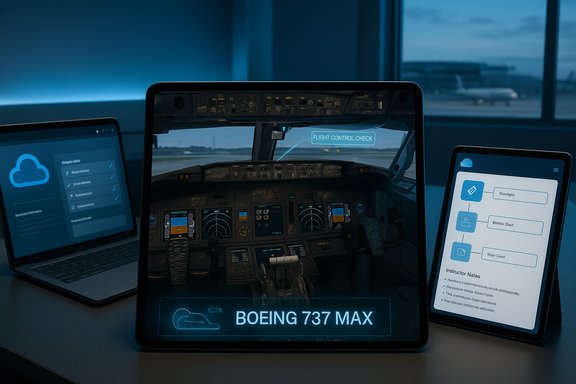
Boeing announced VAPT at the European Aviation Training Summit as the first application in a larger Virtual Airplane product suite. The platform is built on Microsoft Azure and integrates technology from Microsoft Flight Simulator to deliver a 3D cockpit environment that runs on lightweight devices such as PCs and iPads. Boeing positions VAPT as a way to practice both standard and non‑standard procedures outside of traditional simulator schedules, and it includes an authoring tool that lets training teams create, edit and distribute scenario content directly to crews. The initial shipped configuration supports the Boeing 737 MAX, with Boeing stating plans to extend the platform to additional aircraft families. Boeing Global Services CEO Chris Raymond framed the launch as a milestone in the company’s digital transformation for training, stressing flexibility and accessibility. At the same time, the wider Flight Simulator ecosystem has scale: Microsoft’s Flight Simulator (the 2020 release developed by Asobo Studio) has been a commercial and critical success, accumulating millions of users and a long history of world‑scale simulation that Boeing and Microsoft are tapping into for fidelity and situational realism. The franchise’s 2020 title holds a Metacritic score in the low 90s and is available on PC and Xbox Series.
Source: hi-Tech.ua Boeing trains pilots in Microsoft Flight Simulator
 Background
Boeing announced VAPT at the European Aviation Training Summit as the first application in a larger Virtual Airplane product suite. The platform is built on Microsoft Azure and integrates technology from Microsoft Flight Simulator to deliver a 3D cockpit environment that runs on lightweight devices such as PCs and iPads. Boeing positions VAPT as a way to practice both standard and non‑standard procedures outside of traditional simulator schedules, and it includes an authoring tool that lets training teams create, edit and distribute scenario content directly to crews. The initial shipped configuration supports the Boeing 737 MAX, with Boeing stating plans to extend the platform to additional aircraft families. Boeing Global Services CEO Chris Raymond framed the launch as a milestone in the company’s digital transformation for training, stressing flexibility and accessibility. At the same time, the wider Flight Simulator ecosystem has scale: Microsoft’s Flight Simulator (the 2020 release developed by Asobo Studio) has been a commercial and critical success, accumulating millions of users and a long history of world‑scale simulation that Boeing and Microsoft are tapping into for fidelity and situational realism. The franchise’s 2020 title holds a Metacritic score in the low 90s and is available on PC and Xbox Series. What VAPT actually is — the product breakdown
What Boeing says VAPT does
- Provides a high‑fidelity 3D cockpit for procedure practice on lightweight devices.
- Reduces simulator familiarization time before students move to full‑size Flight Training Devices (FTDs) or Full Flight Simulators (FFSs).
- Ships with a self‑service authoring tool so airlines can write company‑specific lessons, add procedural notes, and push updates to crews rapidly.
- Runs on Microsoft Azure and leverages Microsoft Flight Simulator technology for world and systems modeling.
- Initial aircraft support: Boeing 737 MAX; multiplatform access via PCs and iPads; roadmap to additional types.
How it differs from certified simulators
VAPT is explicitly presented as a procedures trainer and not a replacement for qualified Flight Simulation Training Devices (FSTDs). It is optimized for procedural drills, checklists, flows, and scenario rehearsal rather than for validated aerodynamic fidelity or for logging official training credit that regulators require from qualified simulators. Boeing’s messaging emphasizes readiness and familiarization rather than regulatory substitution.Why Boeing + Microsoft makes technical sense
Microsoft Flight Simulator’s engine and cloud services bring three immediate technical advantages to a product like VAPT:- Global data and scenery: Azure‑backed photogrammetry and mapping deliver realistic airports, terrain and visual cues that help pilots rehearse tasks in a geographically correct environment.
- Scalable cloud delivery: Azure enables central content distribution, telemetry capture and orchestration of updates, making it feasible to deliver tailored lessons to thousands of devices worldwide.
- A large existing user base and developer ecosystem: Microsoft Flight Simulator’s runway of community add‑ons, third‑party aircraft, and developer tools lowers the incremental cost of building realistic panels, avionics and systems models. The underlying sim has been iterated for years by Asobo Studio and partners, which shortens time‑to‑market for airline‑grade scenario building.
Verifiable scale and context from Microsoft Flight Simulator
The decision to build VAPT on Flight Simulator comes at a time when the franchise boasts meaningful scale and credibility:- Microsoft Flight Simulator (the 2020 title by Asobo Studio) was released for PC in August 2020 and later to Xbox Series in 2021; its developer is Asobo Studio.
- The franchise earned high critical marks on Metacritic and has been commercially significant within its niche.
- Industry announcements around FlightSim events have cited aggregate usage milestones — the 2020 generation has been reported to have reached roughly 15 million pilots and over 1 billion flights since launch, figures that underline the platform’s reach and the size of the available data/experience pool that VAPT can leverage. These figures were communicated by the Flight Simulator team at community events and echoed widely in the trade press.
Practical benefits for airlines and training organizations
Boeing’s VAPT promises concrete operational advantages when used as part of a blended training approach:- Increased logistics flexibility: trainees can rehearse procedures anywhere — at home or in crew rooms — reducing FFS scheduling bottlenecks.
- Cost efficiency: running short procedure lessons on tablets and laptops is orders of magnitude cheaper than booking time on a Level‑C or Level‑D full flight simulator.
- Faster adaptation for type‑conversions: pilots transitioning to a new series (initially the 737 MAX) can get up to speed on flows, checklists and non‑normals before stepping into a device that replicates motion and aerodynamic behavior.
- Rapid content control: the embedded authoring tool lets airlines inject company SOPs, new safety bulletins, or regulatory briefings and push them live to crews without vendor intervention.
Regulatory reality: what VAPT can and cannot provide
A vital, evidence‑based distinction separates procedural familiarization from regulatory training credit.- In the U.S., FAA rules and guidance require that simulators and training devices used for official credit be approved FSTDs and meet the qualification standards (e.g., 14 CFR Part 60 and related rules). Training equipment that replicates aircraft equipment must be approved if used to meet approved training program obligations.
- In Europe, EASA’s certification specifications define FSTD categories and the scope of qualifying devices; procedural trainers and basic instrument training devices (BITDs) have their own definitions and qualification criteria. Screen‑based devices can provide procedural training, but the regulator must accept them within an operator’s approved training program.
Safety, fidelity and learning‑science considerations
Strengths
- Procedural rehearsal reduces human memory load and helps crews internalize flows before dealing with real cockpit distractions.
- Short, frequent practice sessions (micro‑learning) align with adult learning research: distributed practice improves retention for procedures and emergency flows.
- Visual fidelity and accurate airport/environment modeling help pilots rehearse route‑specific flows (taxiway peculiarities, gate configurations) that would be costly to replicate in FFS time.
Limitations and technical risks
- Aerodynamic and control‑response fidelity: VAPT’s underlying platform is optimized for visual and systems fidelity, not necessarily for the detailed aerodynamics or motion cues of a qualified FFS. That matters when training for stall recovery, upset recovery, or handling characteristics that require motion or force‑feedback replication.
- Non‑normals and failures that depend on physical sensations or cockpit force requirements may not translate well in a tablet‑based environment.
- Instructor‑led evaluation: procedural rehearsal alone cannot replace instructor judgment. If operators allow self‑paced lessons to substitute instructor‑proctored sessions, there is a risk of incomplete skill assessment.
Data, cloud and cybersecurity issues
VAPT relies on Azure for content delivery, telemetry, and scenario management. That architecture brings benefits — centralized updates, analytics and scalability — but it also introduces business and security considerations:- Data residency and privacy: airlines operating across jurisdictions will need control over where crew training data and completion logs are stored to meet regulatory and corporate privacy policies.
- Cybersecurity and integrity: any cloud‑connected training device must guarantee content integrity and protection from tampering — especially for authoring tools that can push SOP changes. A compromised authoring environment could propagate incorrect procedures at scale.
- Vendor lock‑in: deep integration with Microsoft and Boeing services creates dependency. Operators should assess exportability of content, local offline modes, and contractual exit strategies.
Commercial and competitive implications
VAPT enters a market long dominated by specialist training‑device manufacturers and training organizations such as CAE, FlightSafety, L3Harris/Tru Simulation & Training and others. Those companies supply certified FSTDs and long‑established training syllabi. Boeing’s offering is not a direct one‑for‑one competitor to high‑fidelity Level‑D simulators; rather, it is a complementary product intended to widen the pipeline of ready students and reduce overall training costs per pilot. Potential market impacts:- Training centers may see reduced demand for short familiarization blocks, while full‑flight simulator demand for validated hours (type‑rating maneuvers, emergency handling) should remain stable.
- Boeing could bundle VAPT into broader digital services sold to operators, creating an additional recurring revenue stream for Boeing Global Services.
- Partnerships with Microsoft and the Flight Simulator ecosystem may accelerate third‑party tool creation (airline‑specific models, airport fidelity add‑ons), enriching the VAPT content library but also raising IP and certification questions.
Operational checklist: how airlines should approach VAPT adoption
- Evaluate objectives: Define whether VAPT is for readiness, recurrent refresher work, or to be pursued for regulatory credit.
- Engage regulators early: If credit is desired, start conversations with the FAA/EASA now and prepare equivalence demonstrations.
- Pilot a controlled roll‑out: Run VAPT in parallel with existing training to measure time savings, knowledge retention and instructor assessment alignment.
- Validate content: Use Boeing’s authoring tool to encode company SOPs, then validate them in instructor‑led sessions before wide release.
- Harden data controls: Ensure Azure tenancy, data residency, encryption and logging meet corporate and regulatory requirements.
- Maintain human oversight: Keep instructor‑led assessment and sign‑off as a gate before granting line privileges or simulator credit.
Risks and open questions that should concern operators
- Certification pathway: Will regulators accept a Flight Simulator–backed device for partial training credit? That depends on formal demonstration of equivalence and may vary by jurisdiction.
- Liability and safety: If crews train on VAPT and then fail to respond correctly in real incidents, who bears operational risk? Airlines will need robust QA and documentation practices.
- Technical updates: Rapid updates and cloud patches may introduce variability; configuration control is essential to ensure a consistent training baseline.
- Equity of access: Pilots without access to modern tablets or PCs may be disadvantaged unless airlines provide hardware.
- Long‑term support and upgrade path: Flight Simulator and Azure are commercial products with their own roadmaps; operators must assess long‑term stability and backward compatibility for training records.
The bigger picture: what this means for flight training
VAPT signals a maturation of the consumer‑to‑enterprise pipeline: technologies born and polished in entertainment markets are being hardened for regulated industries. This particular cross‑pollination makes sense for procedural practice — a domain where visual context, avionics interaction and checklist discipline matter most.- It democratizes access to practice time and could raise baseline procedural proficiency across fleets.
- It forces training organizations to modernize content‑delivery and measurement systems.
- It redefines the economics of the early stages of type conversion and recurrent training.
Final assessment
Boeing’s Virtual Airplane Procedures Trainer is a pragmatic and timely product that leverages proven consumer‑grade simulation technology to solve logistical bottlenecks in pilot training. The platform’s reliance on Microsoft Flight Simulator and Azure brings real technical strengths: world‑scale visuals, a mature content ecosystem, and cloud delivery. For operators, the immediate value is in procedural rehearsal, localized SOP distribution and reduced simulator familiarization time — benefits that are both measurable and operationally relevant. However, the most important boundaries are regulatory and pedagogical. Unless and until sovereign regulators accept VAPT or comparable screen‑based tools for training credit, the product’s primary role will remain preparatory rather than certificatory. Organizations adopting VAPT should proceed with clearly defined scopes, robust instructor oversight, secure data governance and a plan for regulatory engagement. In short: VAPT is a powerful new tool for the training toolbox, not a drop‑in replacement for the instruments of certification. Its success will depend on careful integration into verified training programs, transparent evidence of learning outcomes, and durable operational controls that preserve safety above all.Source: hi-Tech.ua Boeing trains pilots in Microsoft Flight Simulator
