

Microsoft’s move to resell Box as a first‑class option on Azure — and to fold Box’s content platform into Azure’s machine learning and cognitive services — signals a pragmatic pivot in the enterprise cloud market: strategic partnerships between platform providers and independent content platforms are now a primary battleground for winning enterprise workloads and developer mindshare.
Box and Microsoft announced an expanded partnership in mid‑2017 that formalized “Box on Azure” as a purchase option for enterprise customers and opened the door for Box to consume Azure’s AI and machine learning services to add intelligence to Box’s cloud content management platform. This arrangement was promoted by both companies as a way to give enterprises the choice of storing Box content on Microsoft’s global Azure infrastructure while enabling new, intelligent content services powered by Azure cognitive APIs. Later in 2017 Box introduced Box Skills, a framework explicitly designed to let Box customers apply third‑party machine learning — including Azure Cognitive Services — to content stored in Box for tasks such as audio transcription, video indexing, object recognition in images, and automated metadata extraction. Box framed Skills as part of a broader strategy to transform content into searchable, actionable data and to enable a developer ecosystem around content intelligence. Aaron Levie and other Box executives positioned this as an essential step toward turning content into intelligence for enterprise workflows.
The openness to multiple ML providers (Azure, IBM, Google) is important: it prevents vendor lock‑in at the intelligence layer while still enabling Box to centralize governance and access control.
Cautionary note: automated metadata generation can create compliance traps if retention, access control, and anonymization are not re‑evaluated for the new, machine‑readable metadata layer.
For Microsoft, enabling Box on Azure is a pragmatic approach to capture enterprise content workloads without erasing an established player. For Box, the deal improves their enterprise reach while keeping their platform independent and ecosystem‑friendly. The broader market signal is that enterprises will increasingly choose hybrid models — combining best‑of‑breed SaaS with hyperscaler compute — rather than monolithic single‑vendor stacks.
For enterprise architects and IT leaders, the lesson is clear: these partnerships can accelerate capability adoption, but they must be approached with careful pilots, explicit governance, and measured expectations. When content becomes intelligence, organizations must upgrade not just technology, but policy, process, and oversight — otherwise the promised productivity gains will be uneven and the risks materialize in regulatory, privacy, or operational domains.
Source: BetaNews Microsoft to sell Box storage to Azure customers
 Background
Box and Microsoft announced an expanded partnership in mid‑2017 that formalized “Box on Azure” as a purchase option for enterprise customers and opened the door for Box to consume Azure’s AI and machine learning services to add intelligence to Box’s cloud content management platform. This arrangement was promoted by both companies as a way to give enterprises the choice of storing Box content on Microsoft’s global Azure infrastructure while enabling new, intelligent content services powered by Azure cognitive APIs. Later in 2017 Box introduced Box Skills, a framework explicitly designed to let Box customers apply third‑party machine learning — including Azure Cognitive Services — to content stored in Box for tasks such as audio transcription, video indexing, object recognition in images, and automated metadata extraction. Box framed Skills as part of a broader strategy to transform content into searchable, actionable data and to enable a developer ecosystem around content intelligence. Aaron Levie and other Box executives positioned this as an essential step toward turning content into intelligence for enterprise workflows. What exactly did the deal do?
The offering: Box on Azure
- Microsoft and Box agreed that Box’s cloud content management platform would be offered to enterprise customers with the option to have Box content stored on Azure infrastructure, marketed as Box on Azure or “Box using Azure” in various press briefings. The objective was to provide enterprises a familiar Box experience while meeting regional data residency, compliance, and technical requirements via Azure’s global footprint.
- The arrangement included commercial co‑selling incentives: Microsoft sales teams would be able to sell Box on Azure packages and receive credit for those deals — a pragmatic sales tactic to accelerate enterprise adoption. This is typical in software partnerships where channel incentives drive go‑to‑market alignment.
The technology tie‑ins: Azure cognitive services + Box Skills
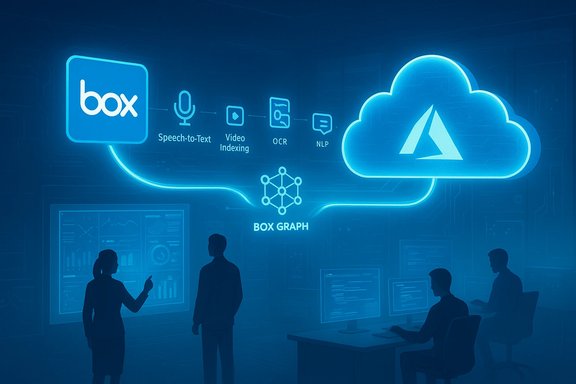
- Box announced Box Skills, an extensible framework that lets developers and partners connect external cognitive services (speech‑to‑text, computer vision, NLP, and video indexing) to content that lives in Box. At BoxWorks 2017 Box demoed Skills using IBM Watson, Google Cloud, and Microsoft Azure services as backend engines for those skills. The partnership allowed Box to call Azure’s AI stack to perform content processing workflows such as transcription and topic detection.
- The integration plan included using Azure services to automate metadata creation at scale (OCR, label extraction, transcript generation), enabling enhanced search, discovery, and content recommendation scenarios inside Box. Box also positioned “Box Graph” — a metadata and relationship layer — as the substrate for surfacing intelligence across user workspaces.
Timeline and availability
- Public communications around these initiatives clustered in mid‑2017 (announcement of the Azure strategic platform relationship) and October 2017 (Box Skills reveal), with a stated general availability for Box on Azure starting November 1st, 2017. These dates were part of vendor messaging used to coordinate product readiness and the partner go‑to‑market schedule.
Why this mattered then — and why it still matters now
For enterprise IT: choice plus intelligence
Enterprises historically wrestled with three competing priorities: security & compliance, cloud economics, and platform innovation. This partnership promised to address all three simultaneously by giving IT:- Choice of datacenter and regional control (store Box content in Azure regions where data residency matters).
- Access to advanced AI and ML (speech, vision, NLP) without building or operating bespoke models.
- Integrated workflows with productivity ecosystems (Box’s long‑standing Office integrations paired with Azure’s enterprise services).
For platform and cloud vendors: win without acquisition
For Microsoft, the deal represented a pragmatic path to increase Azure enterprise usage without acquiring Box or building a complete content management replacement. For Box, the relationship preserved brand independence and offered a route to scale via Microsoft’s global enterprise reach and AI investments. It’s a modern example of “coopetition” — cooperating where customer benefit is clear while still competing in other areas (OneDrive/SharePoint vs Box).Technical analysis: what Box on Azure really enabled
Data flow and architecture (high level)
- Box continues to operate its content platform and access controls.
- Box can choose to persist content storage on Azure storage services in select regions.
- Box Skills framework orchestrates calls to cognitive services (Azure Cognitive Services, Google Vision, IBM Watson) to extract metadata and intelligence.
- Extracted metadata is stored in Box Graph and indexed for search, discovery, and downstream workflows.
Capabilities enabled by Azure AI
- Audio & Video Transcription: Automated speech‑to‑text for media assets makes large repositories searchable by content, not just filename or manual tags.
- Video Indexing & Object Detection: Topic detection and face/scene recognition enable time‑indexed search within video files.
- OCR & Image Tagging: OCR for scanned documents and auto‑tagging reduces manual metadata labor and speeds document discovery.
- Automated Metadata Population: Extracted metadata can be used for policy enforcement, DLP classification, and workflow automation.
Developer model and extensibility
Box Skills is fundamentally an API‑driven model: developers write connectors (skills) that accept a file payload, call an external cognitive service, and return structured metadata and annotations to Box. This model encourages an ecosystem of specialized skills (e.g., medical imaging models, legal contract extractors) and enables enterprises to incorporate proprietary models where necessary.The openness to multiple ML providers (Azure, IBM, Google) is important: it prevents vendor lock‑in at the intelligence layer while still enabling Box to centralize governance and access control.
Business and competitive implications
For customers choosing a cloud provider
Enterprises evaluating cloud strategies often face regional constraints, procurement politics, and long sales cycles. Box on Azure reduced friction for Azure‑centric customers who wanted Box’s collaboration model with Azure’s backing for storage and compute. The partnership essentially made Box a first‑class citizen in the Azure ecosystem for enterprises that prioritize a single cloud strategy.For Box’s multi‑cloud posture
Box historically positioned itself as cloud‑provider agnostic, offering storage across different clouds for geographic and compliance reasons. The Azure tie‑up did not eliminate that strategy — Box continued integrations with AWS and Google Cloud — but it did create a high‑profile, deeply integrated option for Microsoft customers. This is an important nuance: the partnership increased Box’s addressable market while preserving its multi‑cloud narrative.Sales incentives and channel effects
By allowing Microsoft sales teams to receive credit for Box on Azure deals, the partnership used Microsoft’s enterprise sales engine to accelerate Box adoption. That kind of co‑selling incentive materially affects enterprise procurement patterns and is a practical example of how cloud providers can influence software selection without a direct acquisition.Strengths: what this partnership gets right
- Fast path to AI for content: Box customers gain access to mature cognitive services instead of building in‑house ML pipelines. This is especially valuable where organizations need production‑grade speech and vision services quickly.
- Data residency and compliance control: Storing content on Azure’s global infrastructure gives customers more options to satisfy data residency and regulatory demands. That’s a practical advantage for multinational firms.
- Ecosystem flexibility: Box Skills’ support for multiple cloud ML vendors provides flexibility for enterprises that either already have ML investments or want best‑of‑breed models.
- Sales and distribution lift: Microsoft’s enterprise sales channels create a distribution advantage that Box could not easily replicate alone.
Risks and downsides to watch
1. Data governance and privacy complexity
Automating metadata extraction and transcribing audio/video changes the nature of stored data. Sensitive information that previously lived only in raw files becomes structured and searchable. Without strict governance, organizations risk increasing their attack surface and exposure of regulated data.Cautionary note: automated metadata generation can create compliance traps if retention, access control, and anonymization are not re‑evaluated for the new, machine‑readable metadata layer.
2. Vendor lock‑in and commercial dependency
While Box keeps an agnostic Skills framework, deep platform integration with Azure raises questions about long‑term commercial dependence. Enterprises should evaluate contract terms, data egress costs, and operational dependencies, particularly where Azure‑hosted processing becomes critical to core business workflows.3. ML quality, bias, and explainability
Using off‑the‑shelf cognitive services introduces the typical caveats of ML: model drift, bias in visual recognition, and the need for explainability in regulated industries. Enterprises that adopt these features for decisions affecting people, contracts, or compliance must build validation and human review into pipelines. The mere availability of transcription or auto‑tagging is not a substitute for governance.4. Security surface area
Integrating third‑party cognitive APIs and moving content across storage layers increases the number of interfaces that must be secured. Enterprises must ensure that API keys, service principals, and data transport channels are managed consistently and that Box’s permissions model aligns with any Azure IAM constructs used by the Skills.5. Unverifiable or speculative claims
Vendor and press commentary often projects ideal use cases (for example, “voice control” or automated recommendations across all content types). While Box demonstrated specific capabilities (transcription, video indexing), broad claims about future features or cross‑domain recommendations depend on product roadmaps, model performance, and customer integration work — and should be treated as aspirational until proven in customer deployments. These forward‑looking statements require validation in real customers at scale.Practical guidance for IT and architects
If an organization is evaluating Box on Azure or similar content + AI pairings, follow these steps:- Define the business value: Identify specific use cases (e.g., legal search, media asset discovery, compliance indexing) and measurable success criteria.
- Run a controlled pilot: Ingest a representative corpus and measure transcription accuracy, tag quality, and search improvements.
- Validate governance: Map the impact of extracted metadata on retention policies, access controls, and audit processes.
- Test egress and performance: Benchmark latency, cost, and throughput for both storage and cognitive processing paths.
- Plan for model governance: Implement human‑in‑the‑loop checks, model validation, and monitoring for drift and bias.
Use cases that make sense today
- Media & Entertainment: Time‑indexed video transcription and scene detection improve asset retrieval and enable automated highlight creation for distribution workflows. Azure’s video indexing and speech services are a practical fit here.
- Legal & Compliance: Automated OCR and transcript search accelerate discovery and compliance monitoring, but require careful chain‑of‑custody and retention controls.
- Customer Service & Call Centers: Audio intelligence to extract topics and sentiment from call recordings can be integrated into Box Workflows for faster triage. Again, human oversight is recommended for critical decisions.
- Enterprise Knowledge Management: Auto‑tagging and cross‑content recommendation can surface related content to employees, improving productivity but also demanding robust permission checks.
The competitive landscape and market signal
This partnership is emblematic of larger market dynamics: cloud hyperscalers increasingly seek to host and monetize enterprise workloads and the adjacent ecosystems that ride on them. Software vendors, in turn, leverage hyperscaler scale while preserving their product identity and user experience.For Microsoft, enabling Box on Azure is a pragmatic approach to capture enterprise content workloads without erasing an established player. For Box, the deal improves their enterprise reach while keeping their platform independent and ecosystem‑friendly. The broader market signal is that enterprises will increasingly choose hybrid models — combining best‑of‑breed SaaS with hyperscaler compute — rather than monolithic single‑vendor stacks.
What to watch next
- Real customer case studies that quantify the ROI of Box Skills on Azure (search, time‑to‑insight, cost savings).
- How Box and Microsoft manage regulatory and compliance demands in sensitive industries (healthcare, finance).
- The evolution of Box Skills into a mature developer marketplace of third‑party and customer‑built skills.
- Pricing dynamics around storage, cognitive processing, and data egress — these economics determine long‑term TCO.
Conclusion
The Box–Microsoft tie‑up that produced Box on Azure and the Box Skills framework was a pragmatic move to marry enterprise content management with hyperscaler AI capabilities. It offered immediate, practical advantages — data residency choice, rapid access to mature cognitive services, and an appealing commercial model leveraging Microsoft’s enterprise salesforce. Those strengths are balanced by real risks: data governance complexity, the need for robust ML validation, and the commercial entanglement that accompanies deep platform partnerships.For enterprise architects and IT leaders, the lesson is clear: these partnerships can accelerate capability adoption, but they must be approached with careful pilots, explicit governance, and measured expectations. When content becomes intelligence, organizations must upgrade not just technology, but policy, process, and oversight — otherwise the promised productivity gains will be uneven and the risks materialize in regulatory, privacy, or operational domains.
Source: BetaNews Microsoft to sell Box storage to Azure customers
