

Banco Bradesco has sharply accelerated customer service and internal operations by building Bridge — a custom, multi‑agent generative AI platform developed with Microsoft and Avanade that runs on Azure technologies including Azure AI Foundry and Azure Red Hat OpenShift, while exposing low‑code interfaces to business teams through Microsoft Power Platform.
Brazil’s banking market is complex: heavy regulation, rising fraud and cyberthreats, and a customer base that expects instant, cross‑channel experiences. Large incumbents face the twin pressure of modernizing legacy stacks and delivering seamless interactions across phone, chat, web and high‑use messaging apps like WhatsApp. Bradesco’s Bridge initiative responds to these pressures by turning generative AI into a governed, production‑grade platform that sits across customer channels and internal workflows. Bridge reflects a broader enterprise trend: enterprises want agents that do real work — not only answer questions — and they want those agents to operate under corporate governance, traceability and robust security controls. Microsoft’s Azure AI Foundry and related agent runtimes were explicitly designed to support that pattern, providing model catalogs, orchestration, safety tooling and developer accelerators that enterprises can use to compose agentic solutions.
What Foundry brings to an architecture like Bridge:
Source: Microsoft Banco Bradesco streamlines customer service with Azure AI Foundry, apps, and databases | Microsoft Customer Stories
 Background
Brazil’s banking market is complex: heavy regulation, rising fraud and cyberthreats, and a customer base that expects instant, cross‑channel experiences. Large incumbents face the twin pressure of modernizing legacy stacks and delivering seamless interactions across phone, chat, web and high‑use messaging apps like WhatsApp. Bradesco’s Bridge initiative responds to these pressures by turning generative AI into a governed, production‑grade platform that sits across customer channels and internal workflows. Bridge reflects a broader enterprise trend: enterprises want agents that do real work — not only answer questions — and they want those agents to operate under corporate governance, traceability and robust security controls. Microsoft’s Azure AI Foundry and related agent runtimes were explicitly designed to support that pattern, providing model catalogs, orchestration, safety tooling and developer accelerators that enterprises can use to compose agentic solutions.Overview: What Bradesco built
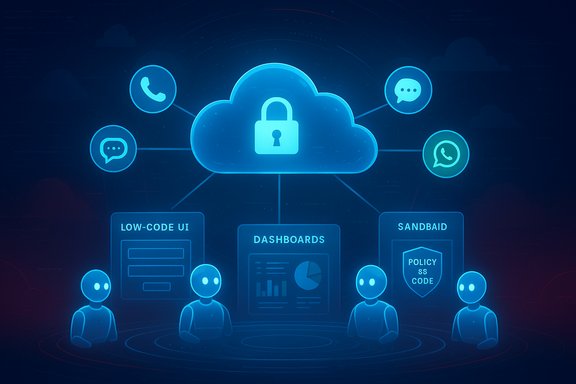
Bridge is a purpose‑built, generative‑AI layer that connects to Bradesco’s existing channels and systems and provides:- A multi‑agent orchestration layer for conversational assistants, document processors and workflow bots.
- Integration with contact channels (phone, chat, WhatsApp) and backend systems for account lookup, case handling and approvals.
- An operational governance plane built on Azure Red Hat OpenShift, enforcing policy, observability and cluster‑wide security.
- Democratized app building via Microsoft Power Platform and intuitive UIs so non‑technical teams can assemble and manage agents.
The Bridge user experience
Bridge exposes capabilities to two audiences:- Frontline customers receive faster, more consistent answers through virtual assistants (BIA) embedded in channels customers already use.
- Business users and domain teams get low‑code tools and visual agent builders to create, tune and manage specialized agents without needing to write infrastructure code. This shifts the speed of innovation from IT backlogs to product teams.
Technical architecture and key components
Azure AI Foundry and Azure OpenAI in Foundry Models
At the core of Bridge’s reasoning layer are Azure OpenAI capabilities hosted within Azure AI Foundry. Foundry provides a managed catalog for model selection, hosted inference, and agent orchestration; it also surfaces developer SDKs, templates and observability tools so organizations can run models with enterprise SLAs and safety checks. Bradesco used these features to create agents that can perform tasks, call APIs, extract data from documents and synthesize responses tailored to banking processes.What Foundry brings to an architecture like Bridge:
- A model catalog and routing plane so workloads can be directed to the most appropriate model for latency, cost and reasoning requirements.
- Agent runtimes to author multi‑step flows that call tools and persist state.
- Operational controls such as telemetry, throttling, and role‑based access for production governance.
Azure Red Hat OpenShift for security, scale and governance
Bradesco standardized cluster management and governance on Azure Red Hat OpenShift, using it as the control plane for containerized agent services and for enforcing compliance at scale. The bank implemented policy‑as‑code and centralized observability to ensure consistent configuration across clusters — a necessary step when agent fleets touch regulated customer data and must be auditable. Red Hat’s own case coverage highlights Bradesco’s use of Advanced Cluster Management to enforce policies, centralize Prometheus metrics into Azure Blob Storage and visualize operations with Grafana.Integration and data flow
Bridge’s design is pragmatic and integration‑first:- Retrieval‑augmented generation (RAG) patterns are used to ground model outputs on internal documents, customer records and knowledge bases so agents give evidence‑backed answers rather than unaudited hallucinations.
- APIs and connectors link agents to core banking systems for secure reads/writes, subject to role‑based access and strict audit trails.
- Low‑code interfaces (Power Platform and Power Automate) let business teams compose automations that call underlying agents, minimizing the need for specialist engineering for every use case.
Business impact and measurable outcomes
Bradesco’s public statements and independent reporting show several concrete benefits already realized after Bridge’s rollout:- Wide operational rollout: Bridge has supported hundreds of initiatives across functions and is used by millions of customers through Bradesco’s virtual assistant (BIA), affecting both customer‑facing and internal processes.
- Higher first‑contact resolution: The assistant achieved a high resolution rate in early deployments, with some reports citing figures around 90% for routine inquiries routed through the platform.
- Productivity gains: Automation of repetitive document processing, approvals and triage tasks has freed employees to focus on higher‑value decisions — a typical outcome when RAG and agent orchestration reduce manual search and routing.
Security, compliance and governance — how Bradesco manages risk
Large banks cannot treat generative AI as an experimental add‑on. Bradesco built layered controls into Bridge:- Platform governance: policy as code and cluster‑level enforcement via Azure Red Hat OpenShift and Advanced Cluster Management — this standardizes configuration and compliance across environments.
- AI governance framework: content safety filters, prompt management, and agent intent classification prevent sensitive data leaks and reduce harmful or inaccurate outputs.
- Data controls: options for bring‑your‑own‑storage (BYOS), private networking and on‑behalf‑of authentication reduce exfiltration risk by keeping sensitive data within controlled environments.
- Observability and audit: OpenTelemetry‑style tracing and centralized metrics ensure actions taken by agents can be reconstructed for audit and regulatory review.
Strengths: why the approach works
- Business alignment: Bridge was designed around Bradesco’s existing channels and approval processes rather than forcing teams to adapt to an off‑the‑shelf bot. This reduced change friction and improved adoption.
- Platform thinking: Treating generative AI as a shared infrastructure (platform + governance + low‑code UI) scales far better than point solutions. It reduces duplication and creates reusable agent components.
- Enterprise‑grade controls: Using Azure Red Hat OpenShift plus Foundry’s governance primitives gives a balance of agility and compliance — especially relevant for banks that must comply with national regulators and data residency rules.
- Democratization: Power Platform and visual agent builders mean product owners can iterate without waiting for engineering sprints, accelerating time‑to‑value while preserving guardrails.
Risks, gaps and areas that still demand attention
While Bridge represents a mature and pragmatic implementation, several material risks remain for Bradesco and for any bank following the same path:- Model hallucinations and implied liability: Even with RAG, there remains a non‑zero risk of models producing incorrect or misleading responses. Banks must define accountability for agent outputs and provide explicit human‑in‑the‑loop checkpoints for high‑risk decisions.
- Data residency and cross‑border governance: Multi‑cloud and hybrid footprints improve resilience but complicate data residency compliance; regulatory requirements in Brazil and other jurisdictions demand strict mapping of where data and model inference occur. Public reporting indicates Bradesco is operating a multicloud architecture that integrates Azure, ServiceNow and other systems — this must be continuously validated against evolving local regulations.
- Agent sprawl and lifecycle management: As more teams create agents, without firm lifecycle, cost and ownership controls organizations risk ungoverned agent sprawl. Treating agents as first‑class identities and enforcing cost centers and runbooks is essential.
- Vendor and operational dependencies: Reliance on managed model catalogs and agent runtime services is a trade‑off: it accelerates delivery but creates operational dependency on cloud providers and partners. Banks must negotiate resilience SLAs and define migration plans if required.
- Security posture complexity: Combining BYOS, private networking and multi‑tenant model hosting increases the attack surface. Continuous red‑team testing, vulnerability scanning and strict secrets management are non‑negotiable.
Lessons and a pragmatic checklist for other banks
Bradesco’s experience provides transferable lessons. For banks planning similar projects, prioritize the following sequence:- Establish a clear business problem and prioritize use cases with measurable outcomes (call volume reduction, time to resolution, cost per case).
- Build a secure platform foundation (kubernetes/openShift or equivalent) and implement policy‑as‑code for cluster configuration and compliance.
- Adopt retrieval‑augmented generation (RAG) to ground model outputs on authoritative sources and maintain evidence‑backed answers.
- Democratize safely: provide low‑code/no‑code UIs for domain teams, but enforce role‑based access and approval workflows for agent promotion.
- Instrument and govern: require observability, cost controls and owner assignment for every agent. Treat agents like production services with SLOs and runbooks.
Practical mitigation strategies for the top risks
- To reduce hallucination risk, require a confidence and provenance layer that always returns the sources used to construct an answer and flags outputs below a confidence threshold for human review.
- For data residency, adopt regionalized inference and BYOS storage where regulated data never leaves customer jurisdiction.
- To prevent sprawl, implement an agent registry with lifecycle states (draft, test, approved, deprecated) and enforce cost attribution and owner responsibility.
- For resilience, negotiate cross‑region failover, hardened SLAs and an exit plan for models or services so critical flows can continue if a provider region degrades.
Where Bradesco should focus next
Bradesco’s Bridge is already a platform success story, but to move from native automation to strategic differentiation, the bank would gain by:- Expanding auditable, human‑in‑the‑loop workflows for all high‑risk agent actions (credit decisions, dispute resolutions).
- Investing more in synthetic testing and red‑team cycles for agent logic and data flows to surface edge‑case failures before customer impact.
- Establishing standardized model evaluation metrics (precision, recall, factuality, latency, cost) and publishing internal model cards for key use cases to maintain transparency.
- Creating a formal agent reliability engineering (ARE) discipline to manage agent SLOs, incident response and continuous improvement.
Conclusion
Bradesco’s Bridge shows how a major bank can responsibly and rapidly convert generative AI into operational value by combining a governed platform architecture, enterprise Kubernetes (Azure Red Hat OpenShift), managed model hosting (Azure AI Foundry), and democratized tooling (Power Platform). The platform approach — rather than scattered point projects — is central to scaling AI across departments while keeping compliance, security and auditability front and center. Independent reporting and vendor coverage corroborate Bradesco’s trajectory: a multicloud, policy‑driven implementation that already affects customer interactions and internal productivity. The remaining challenge for Bradesco — and for any regulated institution adopting generative AI — is operational: maintain tight governance while enabling business teams to iterate quickly, and institutionalize risk management so agent‑driven automation becomes a durable competitive advantage rather than a compliance liability. With Bridge, Bradesco has laid a practical blueprint that other banks will study closely as the industry moves from pilot projects to production‑scale agentive AI.Source: Microsoft Banco Bradesco streamlines customer service with Azure AI Foundry, apps, and databases | Microsoft Customer Stories
