

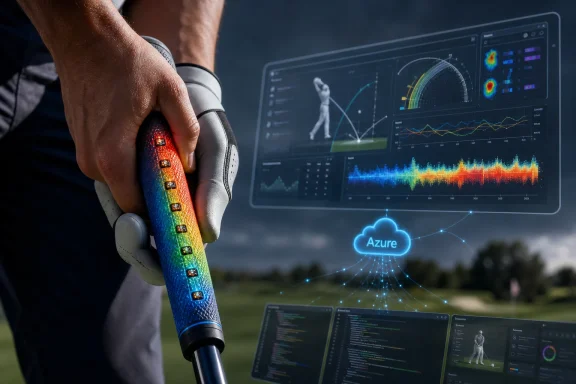
Bryson DeChambeau worked with Microsoft and Seattle-area sensor startup Sensoria in late 2016 to build a prototype golf grip that measured hand pressure through eight embedded sensors and sent swing data to Microsoft Azure for real-time visualization and future machine-learning analysis. The project was not a retail product launch so much as a small, revealing experiment in how Microsoft wanted Azure, Surface, Visual Studio, and sports data to meet. It also captured something essential about DeChambeau before he became one of golf’s most polarizing major champions: he was already trying to turn “feel” into a dataset. For Microsoft watchers, the smart grip was less about golf equipment than about the company’s larger bid to make the cloud the invisible nervous system of professional sport.
The smart grip arrived at a moment when Microsoft was aggressively trying to prove that Azure was not merely a place to rent compute. It was trying to sell the cloud as a live analytics platform: collect data at the edge, move it into Azure, render it on devices people already understood, and eventually train models that could convert raw telemetry into coaching, prediction, or automation.
A golf grip was an oddly perfect demo object. It was familiar, physical, and emotionally loaded. Every golfer has been told at some point that grip pressure matters, but almost nobody can quantify it beyond folk wisdom: hold the club like a bird, squeeze it like a tube of toothpaste, keep it relaxed, don’t let it slip.
That ambiguity is exactly what made the project interesting. DeChambeau’s question was not whether he could swing harder or whether Microsoft could make a prettier dashboard. It was whether a player could measure an invisible variable that had traditionally lived in the realm of touch, memory, and coaching shorthand.
Microsoft and Sensoria embedded sensors into DeChambeau’s existing JumboMax-style grips and used Sensoria Core electronics to gather the data. The readings were pushed through Microsoft’s cloud stack and rendered visually on a Surface, reportedly with a Windows app built using Microsoft development tools. In miniature, it was the full Microsoft pitch: sensors, Azure, Windows hardware, developer software, analytics, and a professional user with a high-stakes workflow.
The result was not a consumer gadget that changed golf overnight. It was a case study with a club attached. But that is precisely why it deserves a second look nearly a decade later.
By 2016, DeChambeau had become famous for his single-length irons, physics degree, analytical vocabulary, and willingness to treat golf less like inherited craft and more like a lab problem. He had won the NCAA Championship and U.S. Amateur in 2015, then turned professional into a sport that both loves and distrusts tinkerers.
That made him a perfect collaborator for a pressure-sensing grip. A normal player might have used the system to confirm a lesson. DeChambeau wanted to interrogate a variable: how much pressure he applied, where he applied it, whether that pressure changed by club, and whether consistency in the hands could lead to consistency in the ball flight.
This is where the project became more than a novelty. Grip pressure is not a secondary detail in golf. It affects face control, tempo, release, speed, and touch. Yet it is also one of the most difficult aspects of the swing to teach because the coach cannot see it directly and the player’s self-report is unreliable.
The smart grip promised to drag that hidden relationship into view. The eight-sensor layout could show where pressure was distributed across the hands, while the motion sensors could provide context about the club’s movement. In theory, the system could connect a player’s felt grip with the measured pattern that preceded a good or bad shot.
DeChambeau’s value to Microsoft was that he would not be satisfied with a blinking gadget. He wanted a measuring instrument. For a cloud company trying to sell intelligence rather than infrastructure, that distinction mattered.
The software story was more consequential. The data moved into Azure, where it could be stored, processed, visualized, and eventually fed into machine-learning workflows. Microsoft’s own telling of the project emphasized that the data gathered from DeChambeau over time could be analyzed to build new golf-data streams around club usage, rhythm, plane, swing speed, and related mechanics.
That phrasing sounds ordinary now because every product manager in 2026 talks about intelligent systems, telemetry, and AI feedback loops. In 2016, the sports-tech world was still moving from isolated devices toward cloud-connected ecosystems. A sensor was no longer just a sensor. It was the first mile of a data pipeline.
The Surface rendering mattered too. Microsoft had spent years trying to make Surface credible as a professional tool rather than a Windows tablet curiosity. In sports partnerships, Surface could be shown not as a consumer device but as the front end for high-value analysis: on the sideline, in the booth, in the training room, or in this case, around a golfer trying to decode his swing.
Visual Studio and XAML were not glamorous parts of the story, but they placed the project firmly in Microsoft’s developer universe. This was not merely Azure as a backend. It was Microsoft’s full-stack argument: build the application, collect the data, store it, analyze it, and display it, all inside the company’s ecosystem.
That is why the golf grip still reads like a Microsoft artifact. It was a sports prototype, yes, but it was also a brochure for the company’s post-Windows identity.
Golf was attractive because it generates structured events. Every shot has a player, club, lie, distance, location, outcome, and context. The PGA Tour’s ShotLink system had already turned tournament golf into one of the more data-rich sports products, even if much of that data was historically packaged for broadcasts and scoring rather than player biomechanics.
The DeChambeau grip operated at a different layer. ShotLink tells the world what happened to the ball. A pressure-sensing grip tries to explain what happened in the player’s hands before the ball moved. That difference is crucial.
For broadcasters and fans, shot tracking is enough to make the viewing experience richer. For players, coaches, equipment fitters, and training facilities, the more valuable frontier is cause, not result. Why did the face close? Why did the tempo change? Why did the wedge fly five yards farther than expected? Why does a pressure pattern break down under stress?
Microsoft’s sports ambitions sat between those worlds. The company wanted to be useful to leagues, broadcasters, teams, athletes, and developers. Golf gave it a stage where precision mattered and where a cloud platform could plausibly turn data exhaust into decision support.
The smart grip was therefore not an isolated gimmick. It was a small example of a broader strategic bet: professional sport would increasingly be instrumented, and the companies that owned the analytics platforms would sit close to the money.
Both camps have a point. Golf is not a spreadsheet. A player cannot stand over a six-foot putt with a dashboard in mind and expect to perform freely. The sport still requires imagination, nerve, adaptation, and the ability to execute without turning every swing thought into a committee meeting.
But the romantic critique can be lazy. Golf has never been pure. Club design, agronomy, ball construction, fitness training, yardage books, green-reading systems, and launch monitors have all changed what elite players know and how they prepare. The question is not whether technology belongs in golf. It is whether a specific technology improves judgment or merely adds noise.
A pressure-sensing grip has a stronger case than many gadgets because it measures something coaches already discuss. It does not invent a new obsession out of thin air. It attempts to quantify a known variable that was previously difficult to observe.
The danger is that players may confuse measurement with meaning. A heat map of hand pressure is not a swing philosophy. It becomes useful only when connected to ball flight, intent, club selection, lie, fatigue, and the player’s own tendencies. Without that context, the system risks becoming another colorful interface that tells golfers what they cannot act on.
This is where Microsoft’s machine-learning language was both exciting and premature. Data collected over time might reveal patterns a player cannot feel. But turning those patterns into trusted advice is harder than building the sensor. The grip could measure pressure; the real challenge was deciding which pressure pattern actually mattered.
Modern training products increasingly follow the same template. A device captures motion or biometric data. A cloud service stores and compares it. A model finds patterns. An app translates those patterns into recommendations. The human coach, athlete, or consumer then decides whether the feedback is useful or unbearable.
That template is everywhere: smart watches, cycling platforms, running shoes, baseball bat sensors, force plates, sleep trackers, and connected gym equipment. The golf version is especially crowded, with launch monitors, simulator software, putting systems, wearable trackers, and swing-analysis apps competing to become the trusted interpreter of practice.
The DeChambeau project anticipated a key issue in all of them. The future is not just more data; it is better translation. A golfer does not need a thousand pressure readings. A golfer needs to know that his lead-hand pressure spikes during transition when he tries to hit a draw under pressure, or that his trail hand takes over on partial wedges, or that a pattern associated with good drives disappears late in a round.
That is the difference between telemetry and coaching. Microsoft’s promise was that Azure and machine learning might eventually build those connections. The prototype did not need to solve the whole problem to show where the industry was heading.
There is also a lesson here for Windows and Azure developers. The application layer is where trust is won or lost. Sensors can be accurate, databases can scale, and models can classify patterns, but if the feedback arrives in a form the user cannot understand at the right moment, the system fails as a product.
A pressure-sensing grip has to be more than technically correct. It has to respect the psychology of the player.
That is why DeChambeau’s involvement mattered. He was not asking Microsoft to define the golf swing for humanity. He was asking for a way to understand his own repeatability.
This is a subtle but important distinction for any connected-device project. The consumer-tech industry often overreaches by trying to convert individual measurement into universal advice. Golf resists that because the game is full of functional weirdness. Great players do not all swing alike, grip alike, aim alike, or think alike.
A smart grip that tried to enforce one ideal pressure model would likely be useless. A smart grip that helped a player identify his own best pattern could be valuable. The difference is personalization, and personalization is where cloud analytics and machine learning can become more than marketing language.
It also raises thorny questions. Who owns the data from a professional athlete’s hands? The player, the device maker, the sponsor, the Tour, the coach, or the cloud provider? If pressure signatures correlate with injury, stress, fatigue, or competitive weakness, they become sensitive performance information.
In 2016, those concerns sat mostly in the background. In 2026, they are unavoidable. The more intimate sports data becomes, the more it resembles health data, labor data, and proprietary tradecraft. A golfer’s grip pressure may sound harmless until it reveals when he is compensating for pain or losing control under pressure.
Microsoft’s enterprise instincts could be an advantage here. The company understands identity, permissions, compliance, and data governance better than most gadget startups. But the sports-tech sector as a whole has often moved faster than its privacy vocabulary.
Technology companies often use elite athletes as stress tests for concepts that may later appear in more ordinary forms. Formula 1 improves road cars indirectly. Military and aerospace research filters into commercial systems over time. Professional sports can play the same role for sensors, data visualization, and human-performance analytics.
The DeChambeau grip was not a mass-market gadget because mass-market golf training aids have to solve a brutal combination of problems. They must be durable, legal for practice contexts, easy to install, light enough not to affect feel, cheap enough for amateurs, accurate enough for coaches, and simple enough that a mid-handicapper does not abandon the app after two sessions.
That is a much harder business than building a prototype for one unusually motivated player. The gap between “this can be measured” and “this should be sold to everyone” is enormous.
Still, the project mattered because it clarified a direction. Golf’s next wave of improvement tools would not only watch the club from the outside. They would move into the handle, the shoe, the glove, the shirt, and the ground. They would measure the body-club relationship directly.
That future is now familiar. The prototype may not have become a consumer standard, but its assumptions did. Training is increasingly sensorized. Practice is increasingly recorded. Coaching is increasingly comparative. Even golfers who reject the most extreme versions of analytics now live in a world shaped by launch-monitor numbers and simulator feedback.
DeChambeau did not make that world alone. But he became one of its most visible avatars.
Sports partnerships helped make that shift visible to ordinary people. Azure can be abstract. A golf club that shows hand pressure is not. A Surface displaying live swing data is not. A Tour data platform that powers broadcasts and analysis is not.
This kind of demonstration matters because cloud computing often suffers from invisibility. Users see the app, the device, or the broadcast graphic; they do not see the ingestion pipeline, storage architecture, analytics service, or model training environment behind it. Microsoft needed stories that made the invisible legible.
The smart grip did that. It made Azure feel less like corporate infrastructure and more like an engine for translating the physical world. The hand squeezes the club. The sensor detects the force. The data moves to the cloud. The app renders a pattern. The athlete learns something, or at least asks a better question.
That is the modern Microsoft story in miniature. The company does not need to manufacture the golf club, own the tournament, or coach the athlete. It wants to provide the platform through which the data becomes useful.
The same logic extends far beyond golf. Factory floors, hospitals, logistics fleets, retail shelves, smart buildings, and energy grids all face versions of the same problem. Instrument the physical process, collect the signal, analyze it, and feed the result back into human or automated decisions.
A pressure-sensing grip was a charmingly niche example. It was also a clean metaphor for industrial IoT.
The skeptics were easy to mock, especially in hindsight, because DeChambeau went on to win major championships and become one of the defining players of the launch-monitor age. But the skepticism contained a useful warning.
Not every measurable variable deserves a place in the player’s head. The best performance systems hide complexity during execution and expose it during learning. A golfer can study pressure data after practice, but he probably should not be mentally debugging sensor output on the downswing.
That boundary is important for technology design. The best sports analytics tools are not the ones that produce the most charts. They are the ones that help athletes simplify action after analysis. If the device adds anxiety, it has failed.
The same principle applies to Windows software, enterprise dashboards, and AI copilots. A system that surfaces every metric is not intelligent; it is noisy. Intelligence means filtering, prioritizing, and timing the intervention.
The smart grip was therefore a reminder that Microsoft’s challenge was never only technical. The company could move data into Azure and render it on a screen. The harder job was turning that data into advice that a human being could trust without becoming dependent on the machine.
That remains the central design problem of AI.
Years later, the experiment looks less eccentric. DeChambeau bulked up, chased ball speed, won the 2020 U.S. Open, became a central figure in golf’s distance debate, moved into the LIV Golf era, rebuilt parts of his game, and won the 2024 U.S. Open with a short-game performance that complicated the caricature of him as merely a human launch monitor.
That arc matters because it shows the limit of the “robot golfer” critique. DeChambeau’s career has been data-heavy, but it has not been data-only. His best golf has required creativity, touch, and competitive resilience. The analytics did not replace feel; they gave him another way to search for it.
The pressure-sensing grip fits that pattern. It was not an attempt to delete intuition. It was an attempt to calibrate it. A player who can match a felt sensation to a measured pattern may become more intuitive, not less, because he knows what his best feel actually corresponds to.
That is the paradox of good measurement. It can make the invisible visible long enough for the athlete to internalize it again. The goal is not to stare at the dashboard forever. The goal is to practice until the dashboard becomes unnecessary.
This is the version of sports technology that deserves to survive: not gadgets that turn athletes into operators, but systems that help athletes understand themselves more precisely.
Golf will keep arguing about feel versus data because the argument is part of the game’s identity. But the better framing is not opposition; it is translation. DeChambeau and Microsoft’s smart grip tried to translate pressure into information, information into patterns, and patterns into better decisions. The prototype may have remained a prototype, but the idea behind it is now everywhere: the future of performance will belong to the systems that can measure the body without drowning the athlete, and to the players smart enough to know when to listen.
 Microsoft Found a Golf Club That Could Explain Azure
The smart grip arrived at a moment when Microsoft was aggressively trying to prove that Azure was not merely a place to rent compute. It was trying to sell the cloud as a live analytics platform: collect data at the edge, move it into Azure, render it on devices people already understood, and eventually train models that could convert raw telemetry into coaching, prediction, or automation.A golf grip was an oddly perfect demo object. It was familiar, physical, and emotionally loaded. Every golfer has been told at some point that grip pressure matters, but almost nobody can quantify it beyond folk wisdom: hold the club like a bird, squeeze it like a tube of toothpaste, keep it relaxed, don’t let it slip.
That ambiguity is exactly what made the project interesting. DeChambeau’s question was not whether he could swing harder or whether Microsoft could make a prettier dashboard. It was whether a player could measure an invisible variable that had traditionally lived in the realm of touch, memory, and coaching shorthand.
Microsoft and Sensoria embedded sensors into DeChambeau’s existing JumboMax-style grips and used Sensoria Core electronics to gather the data. The readings were pushed through Microsoft’s cloud stack and rendered visually on a Surface, reportedly with a Windows app built using Microsoft development tools. In miniature, it was the full Microsoft pitch: sensors, Azure, Windows hardware, developer software, analytics, and a professional user with a high-stakes workflow.
The result was not a consumer gadget that changed golf overnight. It was a case study with a club attached. But that is precisely why it deserves a second look nearly a decade later.
DeChambeau Was the Right Kind of Difficult User
Bryson DeChambeau was not chosen because he was a generic PGA Tour pro with a sponsorship slot to fill. He was chosen because he was already a walking counterargument to golf’s sentimental resistance to measurement.By 2016, DeChambeau had become famous for his single-length irons, physics degree, analytical vocabulary, and willingness to treat golf less like inherited craft and more like a lab problem. He had won the NCAA Championship and U.S. Amateur in 2015, then turned professional into a sport that both loves and distrusts tinkerers.
That made him a perfect collaborator for a pressure-sensing grip. A normal player might have used the system to confirm a lesson. DeChambeau wanted to interrogate a variable: how much pressure he applied, where he applied it, whether that pressure changed by club, and whether consistency in the hands could lead to consistency in the ball flight.
This is where the project became more than a novelty. Grip pressure is not a secondary detail in golf. It affects face control, tempo, release, speed, and touch. Yet it is also one of the most difficult aspects of the swing to teach because the coach cannot see it directly and the player’s self-report is unreliable.
The smart grip promised to drag that hidden relationship into view. The eight-sensor layout could show where pressure was distributed across the hands, while the motion sensors could provide context about the club’s movement. In theory, the system could connect a player’s felt grip with the measured pattern that preceded a good or bad shot.
DeChambeau’s value to Microsoft was that he would not be satisfied with a blinking gadget. He wanted a measuring instrument. For a cloud company trying to sell intelligence rather than infrastructure, that distinction mattered.
The Grip Was a Small Device With a Large Architecture Behind It
The hardware story was simple enough to understand. Sensoria had experience with smart garments and connected textiles, including pressure sensors in footwear and athletic wear. For the golf project, the company’s electronics were small enough to fit into a grip without turning the club into a science-fair prop.The software story was more consequential. The data moved into Azure, where it could be stored, processed, visualized, and eventually fed into machine-learning workflows. Microsoft’s own telling of the project emphasized that the data gathered from DeChambeau over time could be analyzed to build new golf-data streams around club usage, rhythm, plane, swing speed, and related mechanics.
That phrasing sounds ordinary now because every product manager in 2026 talks about intelligent systems, telemetry, and AI feedback loops. In 2016, the sports-tech world was still moving from isolated devices toward cloud-connected ecosystems. A sensor was no longer just a sensor. It was the first mile of a data pipeline.
The Surface rendering mattered too. Microsoft had spent years trying to make Surface credible as a professional tool rather than a Windows tablet curiosity. In sports partnerships, Surface could be shown not as a consumer device but as the front end for high-value analysis: on the sideline, in the booth, in the training room, or in this case, around a golfer trying to decode his swing.
Visual Studio and XAML were not glamorous parts of the story, but they placed the project firmly in Microsoft’s developer universe. This was not merely Azure as a backend. It was Microsoft’s full-stack argument: build the application, collect the data, store it, analyze it, and display it, all inside the company’s ecosystem.
That is why the golf grip still reads like a Microsoft artifact. It was a sports prototype, yes, but it was also a brochure for the company’s post-Windows identity.
The PGA Tour Partnership Gave Microsoft a Fairway Into Sports Data
The smart grip also made sense because Microsoft had already moved into golf through its PGA Tour relationship. In 2015, Microsoft and the PGA Tour announced a multiyear partnership that included Windows, Surface, Azure, and the Tour’s data operations. The company was not just dabbling in golf because an executive liked tee times.Golf was attractive because it generates structured events. Every shot has a player, club, lie, distance, location, outcome, and context. The PGA Tour’s ShotLink system had already turned tournament golf into one of the more data-rich sports products, even if much of that data was historically packaged for broadcasts and scoring rather than player biomechanics.
The DeChambeau grip operated at a different layer. ShotLink tells the world what happened to the ball. A pressure-sensing grip tries to explain what happened in the player’s hands before the ball moved. That difference is crucial.
For broadcasters and fans, shot tracking is enough to make the viewing experience richer. For players, coaches, equipment fitters, and training facilities, the more valuable frontier is cause, not result. Why did the face close? Why did the tempo change? Why did the wedge fly five yards farther than expected? Why does a pressure pattern break down under stress?
Microsoft’s sports ambitions sat between those worlds. The company wanted to be useful to leagues, broadcasters, teams, athletes, and developers. Golf gave it a stage where precision mattered and where a cloud platform could plausibly turn data exhaust into decision support.
The smart grip was therefore not an isolated gimmick. It was a small example of a broader strategic bet: professional sport would increasingly be instrumented, and the companies that owned the analytics platforms would sit close to the money.
Golf’s Oldest Argument Met the Cloud
The reaction to the pressure-sensing grip was predictable because golf has always argued with itself about technology. One side sees tools like this as progress: high-speed cameras, launch monitors, force plates, wearable sensors, and now AI-assisted coaching. The other side sees them as evidence that the game is being smothered by numbers.Both camps have a point. Golf is not a spreadsheet. A player cannot stand over a six-foot putt with a dashboard in mind and expect to perform freely. The sport still requires imagination, nerve, adaptation, and the ability to execute without turning every swing thought into a committee meeting.
But the romantic critique can be lazy. Golf has never been pure. Club design, agronomy, ball construction, fitness training, yardage books, green-reading systems, and launch monitors have all changed what elite players know and how they prepare. The question is not whether technology belongs in golf. It is whether a specific technology improves judgment or merely adds noise.
A pressure-sensing grip has a stronger case than many gadgets because it measures something coaches already discuss. It does not invent a new obsession out of thin air. It attempts to quantify a known variable that was previously difficult to observe.
The danger is that players may confuse measurement with meaning. A heat map of hand pressure is not a swing philosophy. It becomes useful only when connected to ball flight, intent, club selection, lie, fatigue, and the player’s own tendencies. Without that context, the system risks becoming another colorful interface that tells golfers what they cannot act on.
This is where Microsoft’s machine-learning language was both exciting and premature. Data collected over time might reveal patterns a player cannot feel. But turning those patterns into trusted advice is harder than building the sensor. The grip could measure pressure; the real challenge was deciding which pressure pattern actually mattered.
The Smart Grip Foreshadowed the AI Coaching Boom
The smart grip looks more prescient in 2026 than it did in 2016. At the time, the story could be filed under “quirky Bryson does quirky Bryson thing.” Now it reads like an early sketch of the AI coaching stack that has spread across sports, fitness, health, and consumer devices.Modern training products increasingly follow the same template. A device captures motion or biometric data. A cloud service stores and compares it. A model finds patterns. An app translates those patterns into recommendations. The human coach, athlete, or consumer then decides whether the feedback is useful or unbearable.
That template is everywhere: smart watches, cycling platforms, running shoes, baseball bat sensors, force plates, sleep trackers, and connected gym equipment. The golf version is especially crowded, with launch monitors, simulator software, putting systems, wearable trackers, and swing-analysis apps competing to become the trusted interpreter of practice.
The DeChambeau project anticipated a key issue in all of them. The future is not just more data; it is better translation. A golfer does not need a thousand pressure readings. A golfer needs to know that his lead-hand pressure spikes during transition when he tries to hit a draw under pressure, or that his trail hand takes over on partial wedges, or that a pattern associated with good drives disappears late in a round.
That is the difference between telemetry and coaching. Microsoft’s promise was that Azure and machine learning might eventually build those connections. The prototype did not need to solve the whole problem to show where the industry was heading.
There is also a lesson here for Windows and Azure developers. The application layer is where trust is won or lost. Sensors can be accurate, databases can scale, and models can classify patterns, but if the feedback arrives in a form the user cannot understand at the right moment, the system fails as a product.
A pressure-sensing grip has to be more than technically correct. It has to respect the psychology of the player.
The Data Was Valuable Because It Was Personal
Sports analytics often sounds objective, but the most useful data is frequently personal rather than universal. There may not be one perfect grip-pressure pattern for every golfer. There may be a DeChambeau pattern, a Rory McIlroy pattern, a junior-player pattern, a nervous-amateur pattern, and a good-shot-under-fatigue pattern.That is why DeChambeau’s involvement mattered. He was not asking Microsoft to define the golf swing for humanity. He was asking for a way to understand his own repeatability.
This is a subtle but important distinction for any connected-device project. The consumer-tech industry often overreaches by trying to convert individual measurement into universal advice. Golf resists that because the game is full of functional weirdness. Great players do not all swing alike, grip alike, aim alike, or think alike.
A smart grip that tried to enforce one ideal pressure model would likely be useless. A smart grip that helped a player identify his own best pattern could be valuable. The difference is personalization, and personalization is where cloud analytics and machine learning can become more than marketing language.
It also raises thorny questions. Who owns the data from a professional athlete’s hands? The player, the device maker, the sponsor, the Tour, the coach, or the cloud provider? If pressure signatures correlate with injury, stress, fatigue, or competitive weakness, they become sensitive performance information.
In 2016, those concerns sat mostly in the background. In 2026, they are unavoidable. The more intimate sports data becomes, the more it resembles health data, labor data, and proprietary tradecraft. A golfer’s grip pressure may sound harmless until it reveals when he is compensating for pain or losing control under pressure.
Microsoft’s enterprise instincts could be an advantage here. The company understands identity, permissions, compliance, and data governance better than most gadget startups. But the sports-tech sector as a whole has often moved faster than its privacy vocabulary.
The Product Never Had to Ship to Matter
One of the easiest ways to misunderstand the smart grip is to ask why it did not become a mainstream retail product. That question assumes the prototype’s value depended on a box appearing at a golf shop. It did not.Technology companies often use elite athletes as stress tests for concepts that may later appear in more ordinary forms. Formula 1 improves road cars indirectly. Military and aerospace research filters into commercial systems over time. Professional sports can play the same role for sensors, data visualization, and human-performance analytics.
The DeChambeau grip was not a mass-market gadget because mass-market golf training aids have to solve a brutal combination of problems. They must be durable, legal for practice contexts, easy to install, light enough not to affect feel, cheap enough for amateurs, accurate enough for coaches, and simple enough that a mid-handicapper does not abandon the app after two sessions.
That is a much harder business than building a prototype for one unusually motivated player. The gap between “this can be measured” and “this should be sold to everyone” is enormous.
Still, the project mattered because it clarified a direction. Golf’s next wave of improvement tools would not only watch the club from the outside. They would move into the handle, the shoe, the glove, the shirt, and the ground. They would measure the body-club relationship directly.
That future is now familiar. The prototype may not have become a consumer standard, but its assumptions did. Training is increasingly sensorized. Practice is increasingly recorded. Coaching is increasingly comparative. Even golfers who reject the most extreme versions of analytics now live in a world shaped by launch-monitor numbers and simulator feedback.
DeChambeau did not make that world alone. But he became one of its most visible avatars.
Microsoft’s Real Win Was Showing the Cloud Could Touch the Physical World
The smart grip also belongs to a specific chapter in Microsoft’s reinvention. Under Satya Nadella, the company was repositioning itself around cloud services, cross-platform software, developer tools, and enterprise intelligence. Windows still mattered, but Microsoft’s center of gravity had shifted.Sports partnerships helped make that shift visible to ordinary people. Azure can be abstract. A golf club that shows hand pressure is not. A Surface displaying live swing data is not. A Tour data platform that powers broadcasts and analysis is not.
This kind of demonstration matters because cloud computing often suffers from invisibility. Users see the app, the device, or the broadcast graphic; they do not see the ingestion pipeline, storage architecture, analytics service, or model training environment behind it. Microsoft needed stories that made the invisible legible.
The smart grip did that. It made Azure feel less like corporate infrastructure and more like an engine for translating the physical world. The hand squeezes the club. The sensor detects the force. The data moves to the cloud. The app renders a pattern. The athlete learns something, or at least asks a better question.
That is the modern Microsoft story in miniature. The company does not need to manufacture the golf club, own the tournament, or coach the athlete. It wants to provide the platform through which the data becomes useful.
The same logic extends far beyond golf. Factory floors, hospitals, logistics fleets, retail shelves, smart buildings, and energy grids all face versions of the same problem. Instrument the physical process, collect the signal, analyze it, and feed the result back into human or automated decisions.
A pressure-sensing grip was a charmingly niche example. It was also a clean metaphor for industrial IoT.
The Forum Skeptic Was Not Entirely Wrong
The GolfWRX commentariat did what online golf forums do best: it turned a small technology story into a referendum on civilization. Some readers saw the grip as the future. Others saw it as information overload, technological vanity, or the latest proof that golfers were forgetting how to play by feel.The skeptics were easy to mock, especially in hindsight, because DeChambeau went on to win major championships and become one of the defining players of the launch-monitor age. But the skepticism contained a useful warning.
Not every measurable variable deserves a place in the player’s head. The best performance systems hide complexity during execution and expose it during learning. A golfer can study pressure data after practice, but he probably should not be mentally debugging sensor output on the downswing.
That boundary is important for technology design. The best sports analytics tools are not the ones that produce the most charts. They are the ones that help athletes simplify action after analysis. If the device adds anxiety, it has failed.
The same principle applies to Windows software, enterprise dashboards, and AI copilots. A system that surfaces every metric is not intelligent; it is noisy. Intelligence means filtering, prioritizing, and timing the intervention.
The smart grip was therefore a reminder that Microsoft’s challenge was never only technical. The company could move data into Azure and render it on a screen. The harder job was turning that data into advice that a human being could trust without becoming dependent on the machine.
That remains the central design problem of AI.
The DeChambeau Arc Made the Prototype Look Less Weird
When the smart grip story appeared in 2016, DeChambeau was still more concept than proof at the professional level. He was the physics major with the single-length irons, the oversized grips, and the confidence to talk about golf in terms that made traditionalists roll their eyes.Years later, the experiment looks less eccentric. DeChambeau bulked up, chased ball speed, won the 2020 U.S. Open, became a central figure in golf’s distance debate, moved into the LIV Golf era, rebuilt parts of his game, and won the 2024 U.S. Open with a short-game performance that complicated the caricature of him as merely a human launch monitor.
That arc matters because it shows the limit of the “robot golfer” critique. DeChambeau’s career has been data-heavy, but it has not been data-only. His best golf has required creativity, touch, and competitive resilience. The analytics did not replace feel; they gave him another way to search for it.
The pressure-sensing grip fits that pattern. It was not an attempt to delete intuition. It was an attempt to calibrate it. A player who can match a felt sensation to a measured pattern may become more intuitive, not less, because he knows what his best feel actually corresponds to.
That is the paradox of good measurement. It can make the invisible visible long enough for the athlete to internalize it again. The goal is not to stare at the dashboard forever. The goal is to practice until the dashboard becomes unnecessary.
This is the version of sports technology that deserves to survive: not gadgets that turn athletes into operators, but systems that help athletes understand themselves more precisely.
The Grip Was Small, but the Signal Was Large
The pressure-sensing grip was a prototype, not a product category that swept pro shops. Its long-term importance lies in what it revealed about Microsoft, DeChambeau, and the direction of performance technology.- The project showed Microsoft using golf as a practical demonstration of Azure-connected sensors, Windows development tools, Surface visualization, and future machine-learning workflows.
- The grip attempted to measure a real coaching variable — hand pressure — rather than inventing a gimmick unrelated to how golfers already think about performance.
- DeChambeau was an unusually suitable test subject because his career was already built around converting golf assumptions into experiments.
- The prototype foreshadowed today’s AI coaching economy, where raw motion and biometric data are only as valuable as the recommendations built on top of them.
- The biggest unanswered questions were not about whether the sensors could collect data, but whether the system could produce trustworthy, timely, and psychologically useful feedback.
- The project also anticipated modern concerns about athlete data ownership, privacy, and the competitive sensitivity of intimate performance metrics.
Golf will keep arguing about feel versus data because the argument is part of the game’s identity. But the better framing is not opposition; it is translation. DeChambeau and Microsoft’s smart grip tried to translate pressure into information, information into patterns, and patterns into better decisions. The prototype may have remained a prototype, but the idea behind it is now everywhere: the future of performance will belong to the systems that can measure the body without drowning the athlete, and to the players smart enough to know when to listen.
References
- Primary source: GolfWRX
Published: 2026-05-25T16:30:09.550573
Bryson DeChambeau, Microsoft develop pressure-sensing grip
Bryson DeChambeau, in a very Bryson DeChambeau move, joined forces with Microsoft and Seattle-startup Sensoria to work on a prototype “smart grip.” The grip is designed to analyze pressure applied throughout the swing. The grip’s eight embedded sensors return real-time pressure data. It’s... www.golfwrx.com
- Related coverage: geekwire.com
Microsoft and Sensoria partner with PGA pro Bryson DeChambeau to create 'smart' golf grip – GeekWire
Embed from Getty Images The golf grip is getting geeky. PGA Tour golfer Bryson DeChambeau worked with Microsoft and Seattle-area startup Sensoria over thewww.geekwire.com - Related coverage: mygolfway.com
Golf y Tecnología – Microsoft se une a DeChambeau y Sensoria para crear un grip inteligente - MyGolfWay - Plataforma Online del Sector del Golf - Online Platform of Golf Industry
24 Noviembre 2016 – El peculiar golfista profesional del PGA Tour Bryson DeChambeau ha trabajado durante ocho semanas con Microsoft y la startup Sensoria para crear un prototipo de ‘Smart Grip’, o grip inteligente, que analiza cuánta presión aplica el jugador sobre el palo de golf a través del... www.mygolfway.com
- Related coverage: golfdigest.com
Could this Microsoft smart grip be the solution to your swing problems? | Golf News and Tour Information | Golf Digest
Could this Microsoft smart grip -- tested by Bryson DeChambeau -- be the solution to your swing problems? www.golfdigest.com
- Related coverage: globenewswire.com
Sensoria to Showcase Microsoft Azure Connected “Smart
Smart Footwear and Garments Will Help Scouts and Coaches Select High Potential Players by Monitoring Acceleration, Deceleration, Passing, Dribbling,...www.globenewswire.com - Related coverage: digitaltrends.com
Improve your swing with these smart golf grips from Microsoft - Digital Trends
Microsoft is teaming up with Sensoria and professional golfer Bryson DeChambeau to develop the Smart Grip for your golf club. The grip measures pressure levels and relays the data to a tablet or computer.www.digitaltrends.com
- Official source: microsoft.com
Touch-Sensing Input Devices - Microsoft Research
We can touch things, and our senses tell us when our hands are touching something. But most computer input devices cannot detect when the user touches or releases the device or some portion of the device. Thus, adding touch sensors to input devices offers many possibilities for novel interaction...www.microsoft.com - Related coverage: marketscreener.com
Sensoria to Showcase Microsoft Azure Connected “Smart Garments” That Track and Analyze Soccer Player Movements at CES 2016 in Las Vegas
LAS VEGAS, Jan. 06, 2016 -- Sensoria Inc., a world leader in the development of IoT enabled garments, is proud to announce a new collaboration with Microsoft Corp. to develop a Microsoft Azure... -January 06, 2016 at 11:00 am EST - MarketScreenerwww.marketscreener.com
