

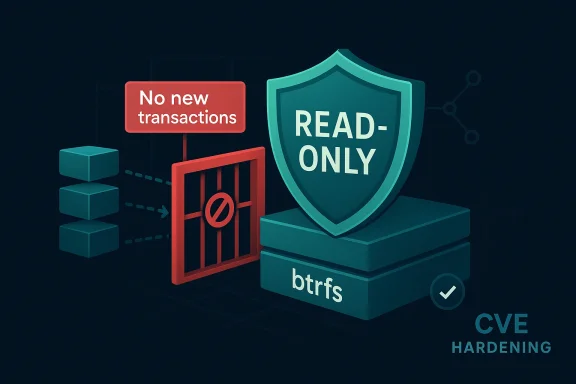
The Linux kernel’s Btrfs filesystem has always lived at an interesting intersection of flexibility and fragility: it is a copy-on-write filesystem built for snapshots, checksumming, and online recovery, yet it must also behave sensibly when the filesystem is damaged, mounted read-only, or being dismantled during shutdown. CVE-2026-23214 is a good example of how a seemingly narrow edge case can expose a broader hardening gap. Microsoft’s Security Update Guide points to a Linux kernel issue in Btrfs, and the kernel-side description now makes the bug clear: when the filesystem is mounted with Btrfs rescue options that make it fully read-only, the kernel should not start new transactions, but it currently can under some paths. (msrc.microsoft.com)
Background — full context
Btrfs is not a conventional filesystem in the “simple metadata plus data blocks” sense. It is a copy-on-write design that tracks data and metadata with checksums, supports writable snapshots, subvolumes, send/receive, and multiple device layouts, and it is explicitly built around transactions. That transactional model is one of the reasons Btrfs can make powerful guarantees about consistency, but it also means that “read-only” is not a single, trivial state. The filesystem can be read-only for different reasons, with different recovery assumptions attached. (kernel.org)Linux documentation for Btrfs and fs-verity helps frame the technical backdrop. Btrfs supports read/write metadata verification, and since Linux v5.15 it also supports fs-verity, a mechanism that makes individual files read-only and cryptographically verified after a Merkle tree is attached. In that model, the filesystem may still be mounted read-write overall even though some files become immutable after being sealed. That is very different from a “fully read-only” rescue mount where the administrator is trying to recover data from a damaged filesystem and does not want the kernel to perform operations that could mutate state. (kernel.org)
The kernel bug underlying CVE-2026-23214 is described as a mismatch between these two concepts. Btrfs intentionally allows new transactions even on read-only mounts in some situations because it needs that flexibility for log replay, in the same general way ext4 and XFS do. But when the filesystem is mounted with rescue options that make it fully read-only, the kernel should treat that state as hard stop territory. The bug report cited in the CVE shows that inode eviction during unmount could still trigger a transaction, which then emitted warnings such as “Transaction aborted (error -22)” on a heavily corrupted filesystem. (nvd.nist.gov)
That distinction matters because rescue modes are not about convenience; they are about containment. Once an administrator has resorted to rescue mount options, they are often trying to extract data from a damaged disk image or a suspect block device without making things worse. If the filesystem code starts optimistic write-like housekeeping during teardown, the promise of “read-only” becomes less reliable. The fix, therefore, is not merely cosmetic. It is a guardrail that tells the transaction machinery to stop trying to be helpful when the administrator has explicitly chosen a non-mutating recovery path. (nvd.nist.gov)
This also explains why the issue has a dual personality: it is both a correctness bug and a hardening bug. On one level it produces ugly warnings and aborted transactions during unmount. On another, it violates the intent of rescue mode and creates an unnecessary opportunity for kernel-side activity in a path that should have been quiescent. The CVSS record published by NVD places the issue in the local, low-privilege, availability-impact category, which is consistent with a filesystem hardening flaw rather than a remote code execution problem. (nvd.nist.gov)
What the CVE actually says
The CVE record is unusually informative because it includes the kernel maintainer’s own summary of the bug. In plain terms, the kernel is permitted to create transactions on a read-only Btrfs mount because some read-only states still need log replay. But rescue mount options are different: they make the filesystem fully read-only and incompatible with remounting read-write. That means the existing “allow transactions on read-only mounts” behavior is too permissive for rescue mode, and the fix is to make rescue-mounted filesystems behave as if they are in an error state for this purpose. (nvd.nist.gov)The trigger path
The path that exposes the bug is not glamorous; it is housekeeping. During unmount, the VFS tears down dentries and inodes. On Btrfs, inode eviction can call into logic that reserves extents, allocates tree blocks, and otherwise performs work that expects a transaction to exist. On a normal read-write filesystem that is fine. On a read-only-but-replay-capable mount, that can still be acceptable. On a rescue mount, however, it becomes the wrong thing to do. (nvd.nist.gov)Why warnings mattered
The immediate symptom in the report is a kernel warning and transaction abort. That may sound benign, but warnings on a corrupted filesystem are not just noise. They indicate that code has entered a state that the recovery mode was meant to avoid. In operational terms, warnings can complicate troubleshooting, extend outage time, and make postmortem work harder because they obscure the boundary between pre-existing damage and damage induced by the recovery process itself. (nvd.nist.gov)Why the issue is not “just” a mount option bug
It would be easy to dismiss this as an oddity of rescue options. But the real lesson is broader: kernel subsystems must distinguish between “read-only because I might still need to replay metadata” and “read-only because nothing should be mutated.” That distinction appears in multiple filesystems and recovery paths, and the Btrfs fix is a reminder that transaction semantics need to be gated by the precise flavor of read-only state, not by a blanket assumption. (nvd.nist.gov)The filesystem model behind the bug
Transaction-driven metadata
Btrfs uses transactions as a central coordination point for metadata updates. That design provides strong structural advantages, but it also means that many internal operations are written with the assumption that a transaction can be started whenever a metadata path needs it. That assumption is safe only when the mount state is compatible with metadata changes or replay. (kernel.org)Read-only is not one thing
A normal read-only mount, a read-only mount that still allows replay, and a rescue mount that forbids any further mutations are not equivalent. The kernel’s Btrfs code recognized the first two well enough to keep replay working, but the CVE demonstrates that the rescue path needed one more constraint. In other words, the bug was not “Btrfs forgot what read-only means.” It was “Btrfs failed to apply the right meaning in the right branch.” (nvd.nist.gov)Rescue modes as a last resort
The existence of rescue mount options signals a filesystem is already in distress. The purpose is to maximize read access and diagnostic reach while minimizing side effects. That is why the documentation and mailing-list history around Btrfs rescue options matter: rescue is intended to help administrators get data out, not to give the filesystem another chance to reorganize itself during teardown. (lwn.net)Anatomy of the fix
The core change
The fix described by the CVE is straightforward: if the filesystem has rescue mount options that make it fully read-only, Btrfs should treat the filesystem as being in an error state so no new transaction can be started. That is a relatively small condition check, but conceptually it is doing a lot of work. It converts a “maybe we can still do housekeeping” posture into an explicit “no more transactions” posture. (nvd.nist.gov)Why that approach is appropriate
This is the kind of fix kernel developers often prefer for hardening problems: narrow, local, and semantic. Instead of reworking inode eviction or the transaction subsystem wholesale, the code inserts the right gate at the boundary where policy matters. That reduces the risk of collateral regressions while ensuring the recovery path behaves the way users expect. (nvd.nist.gov)The compatibility tradeoff
A hardening change like this always raises a compatibility question: could the stricter behavior break some legitimate cleanup path? In this case, the kernel team has apparently judged that rescue mode is already a special-case recovery path where preventing transactions is the correct contract. The CVE text explicitly says there should be no new transaction triggered once rescue options mark the filesystem fully read-only. (nvd.nist.gov)What the patch is not
This is not an attempt to make Btrfs “more read-only” in all contexts, and it is not the same as disabling log replay universally. The fix is scoped to the rescue-mode case where remounting read-write is not an option. That scope matters because Btrfs and other filesystems often rely on replay to preserve consistency after an unclean shutdown. (nvd.nist.gov)How to interpret the security impact
Availability, not confidentiality
The NVD page classifies the issue with a CVSS vector that lands in the availability bucket, not the confidentiality or integrity buckets. That fits the bug report: the observed outcome is aborts and warnings during unmount, not arbitrary code execution or direct data leakage. (nvd.nist.gov)Local access and low privileges
The score also reflects a local attack surface. The scenario assumes the attacker can arrange for a crafted or heavily corrupted filesystem image to be mounted and then influence the teardown path. That is not the same as a remote network exploit; it is a local, environment-dependent problem. (nvd.nist.gov)Why low-severity bugs still matter
Filesystem hardening bugs are easy to underestimate because they often do not look dramatic. But they matter in the exact environments where reliability and recovery are most important: boot failures, crash recovery, forensic analysis, and operations on damaged storage. A warning in those settings can be the difference between a clean recovery and a confusing chain of follow-on failures. (nvd.nist.gov)Btrfs, ext4, and XFS: the comparison that explains the behavior
Why read-only mounts may still replay metadata
The CVE description specifically says Btrfs allows new transactions on read-only mounts because it wants to permit log replay, “just like what ext4/xfs do.” That is a common filesystem pattern: read-only does not always mean “absolutely no internal state changes,” especially if replay is needed to restore consistency after a crash. (nvd.nist.gov)The rescue-mode exception
The vulnerability exists because rescue-mode read-only is a more stringent state than ordinary read-only. The system is not just temporarily mounted that way; it is supposed to stay that way and avoid any recovery-side mutation that could disturb an already damaged filesystem. The fix ensures rescue mode is not lumped together with ordinary replay-capable read-only behavior. (nvd.nist.gov)The broader filesystem lesson
This is a classic “policy leak” problem. Internal mechanisms that are correct for one mounting context become wrong in another. Filesystems with recovery features are especially vulnerable to this kind of bug because they intentionally blur the line between passive reading and limited repair-like action. (kernel.org)What the kernel logs tell us
Transaction aborts are signals, not just noise
The sample stack trace in the CVE record shows the failure happening through extent reservation, tree block allocation, copy-on-write block handling, and inode eviction. That path is informative because it demonstrates that even teardown can still pass through allocation-oriented code. That is precisely why the transaction gate matters. (nvd.nist.gov)Unmount is a busy moment
Many people imagine unmount as a passive “flush and stop” operation. In reality, unmount can trigger deep internal cleanup, dentry eviction, inode teardown, and metadata finalization. If the filesystem is in a complicated state, those operations may still try to use normal transaction flows unless the code explicitly stops them. (nvd.nist.gov)Why corrupted filesystems expose edge cases
The bug surfaced on a heavily fuzzed filesystem. That is not surprising. Fuzzing tends to find paths where hidden assumptions about state validity break down, and a rescue mount on top of corrupted metadata is almost the perfect environment for those assumptions to fail. (nvd.nist.gov)Practical implications for administrators
When rescue mounts are used
Rescue options are usually used when a filesystem is already sick, perhaps after a crash, an unclean shutdown, a bad block event, or an interrupted disk migration. The goal is to extract usable data or inspect state without making things worse. That makes predictable non-mutating behavior especially important. (lwn.net)What operators should expect after the fix
After the patch, inode eviction paths on rescue-mounted filesystems should stop trying to start new transactions. In practice, that should mean fewer aborted-transaction warnings on unmount and a more faithful implementation of “fully read-only.” (nvd.nist.gov)Best operational habits
- Treat rescue mounts as a recovery-only path, not a maintenance path.
- Avoid assuming “read-only” implies identical behavior across filesystems or mount modes.
- Validate kernel versions before using rescue procedures on critical storage.
- Keep a copy of the exact recovery command used, especially in incident response.
- Prefer a staged recovery workflow: mount, copy data off, then analyze offline.
- Watch for kernel warnings during teardown as signs that the recovery mode is not as inert as expected.
- Remember that clean unmount behavior can be just as important as clean mount behavior.
A note on troubleshooting
If a rescue mount produces transaction warnings during unmount, that is not necessarily evidence of a new catastrophic failure. It may simply indicate that the kernel is walking an edge case that the hardening patch now addresses. The important point is to distinguish between a warning triggered by the bug and the underlying corruption that caused rescue mode to be necessary in the first place. (nvd.nist.gov)Strengths and Opportunities
Stronger state separation
The biggest strength of the fix is conceptual clarity. It sharpens the boundary between recoverable read-only operation and strict read-only rescue mode. That is exactly the kind of state distinction mature kernel code needs. (nvd.nist.gov)Minimal surface area
A narrow conditional change has lower regression risk than a broad rewrite. For a filesystem with complex transaction logic, that is a major advantage. Small corrections at the policy boundary often age better than large architectural shifts. (nvd.nist.gov)Better operator trust
When rescue options are used, operators want predictability. The fix increases trust in the recovery workflow by ensuring the filesystem does not surprise administrators with late-stage transaction attempts during unmount. (nvd.nist.gov)Alignment with hardening trends
The patch fits a larger Linux hardening pattern: make exceptional states explicit, narrow what is allowed in recovery mode, and avoid “helpful” behavior that can turn into unwanted side effects. That trend shows up across kernel subsystems, not only filesystems. (docs.kernel.org)Risks and Concerns
Edge-case regressions
Any time a kernel path is made stricter, there is a risk that some legitimate but obscure cleanup flow loses functionality. The most likely concern here is whether any remaining read-only replay or teardown path was depending on the old behavior. The fix appears intentionally scoped to rescue-mode full read-only, which should reduce that risk. (nvd.nist.gov)Confusion around “read-only”
The term “read-only” is overloaded in filesystem work. Operators, incident responders, and even developers can misread it as a single universal mode. Bugs like this remind us that mount semantics need to be documented and understood precisely, especially when rescue options are involved. (nvd.nist.gov)Recovery-path complexity
Recovery features are inherently brittle because they must operate on damaged state. The more features a filesystem exposes for rescue, replay, and partial mountability, the more important it becomes to keep those pathways sharply separated. That complexity is the cost of powerful recovery tooling. (kernel.org)Visibility gaps
The CVE record is helpful, but the wider ecosystem still tends to learn about filesystem issues through scattered references: NVD, kernel commit messages, distro advisories, and downstream trackers. That fragmentation can make it harder for administrators to understand which exact build they need and whether the issue affects their recovery procedures. (nvd.nist.gov)What to Watch Next
Stable backports
The key practical question is how quickly the fix lands in downstream stable and vendor kernels. The CVE record already references multiple kernel patch links and shows affected versions spanning several release lines, so administrators should expect backports to matter more than the upstream commit alone. (nvd.nist.gov)Distro advisories
Linux distributions often package filesystem hardening fixes into their own kernel maintenance streams. That means the same CVE can arrive under different kernel package versions and release cadences. Tracking distro errata is still essential even when the upstream fix is known. (nvd.nist.gov)Related Btrfs hardening work
Btrfs has seen repeated hardening and recovery-focused refinements over time, including rescue-mount improvements and mount-option handling. This CVE likely fits into that broader effort rather than standing alone as an isolated defect. Watching the Btrfs maintenance stream for adjacent fixes is a good way to understand whether more read-only state checks are being tightened elsewhere. (lwn.net)Administrative playbooks
The final thing to watch is how this affects operational guidance. If a filesystem rescue path is expected to be completely inert, playbooks and internal runbooks should say so explicitly and assume that kernel behavior will respect that contract on patched systems. (nvd.nist.gov)The broader significance of a small fix
At first glance, CVE-2026-23214 looks like the sort of issue only filesystem maintainers and recovery engineers would notice. But it is actually a pretty elegant example of why hardening matters. The kernel was not wildly wrong; it was almost right in a state that is easy to misclassify. In ordinary read-only operation, transactions may still be useful for replay. In rescue mode, they are not. The fix is to make that distinction explicit and enforce it at the moment the transaction machinery would otherwise wake up. (nvd.nist.gov)That is also why the issue deserves attention beyond the immediate warning messages. It shows how security, reliability, and recoverability overlap in modern Linux storage stacks. A bug that only manifests during unmount on a damaged filesystem is still worth fixing because those are exactly the moments when systems are under stress and administrators need the kernel to behave predictably. The better the recovery semantics, the less likely a bad day becomes a worse one. (nvd.nist.gov)
In the end, the likely CVE fix is less about making Btrfs “safer” in some abstract sense than about restoring the promise of rescue mode itself. A rescue mount should be a promise that the kernel will help you inspect and extract, not surprise you with new transactions at the edge of teardown. CVE-2026-23214 closes that gap, and that makes it a small but meaningful hardening win for one of Linux’s most sophisticated filesystems.
Source: msrc.microsoft.com Security Update Guide - Microsoft Security Response Center
Last edited:
