

Microsoft used Build 2026 in San Francisco on June 2–3 to push Windows, Microsoft Fabric, Foundry, Microsoft 365, and Azure databases toward a single governed platform for enterprise AI agents. The company’s message was not that it has the biggest model, but that it wants to own the place where agents get context, identity, permissions, memory, runtime, and audit trails. That is a more consequential ambition than another chatbot demo. It is Microsoft’s bid to make agentic AI boring enough for enterprises to actually deploy.
For the last two years, the enterprise AI pitch has been framed around assistants: a Copilot in Word, a Copilot in Teams, a Copilot in the browser, a Copilot in the IDE. That phase mattered because it normalized generative AI inside business software, but it also exposed the ceiling of the model. Summarizing a meeting, drafting an email, or querying a document is useful; it is not the same thing as reorganizing how work gets done.
Build 2026 marked the moment Microsoft publicly moved the center of gravity from chat with your software to software that acts within governed boundaries. That distinction sounds like marketing until you follow it through the stack. An assistant can be wrong and annoying. An agent with credentials, files, tools, APIs, and the ability to trigger workflows can be wrong and expensive, or wrong and dangerous.
Microsoft’s answer is not simply to make the agent smarter. It is to surround the agent with infrastructure: context layers, semantic models, sandboxed execution, identity, policy, observability, and database backends designed for AI-heavy workloads. This is the dull machinery that enterprises have been asking for while vendors showed them increasingly theatrical demos.
The company is also implicitly acknowledging a problem with the first wave of Copilot deployments. Many organizations bought seats before they had redesigned workflows, cleaned up permissions, labeled data, mapped processes, or decided which tasks should be automated at all. The result has often been a mismatch between premium software pricing and ordinary productivity gains. Microsoft’s Build 2026 platform story is an attempt to shift the conversation from individual productivity to organizational execution.
That is the right pivot, but it is also a risky one. The more Microsoft makes agents into an enterprise substrate, the more it must prove that Windows, Azure, Microsoft 365, Fabric, Foundry, Entra, Purview, and Defender can behave like one coherent system rather than a collection of branded control panels stitched together by licensing diagrams.
That problem is especially severe outside office work. In manufacturing, energy, logistics, healthcare, finance, and government, operational reality lives across documents, emails, asset registries, telemetry streams, tickets, CAD files, compliance archives, databases, and the tribal knowledge of people who have been fixing systems for twenty years. A general-purpose model cannot infer that context from a prompt. It has to be grounded in systems that know what a pump is, who owns it, what line it belongs to, when it last failed, which technician touched it, and whether an action is permitted during a production run.
Microsoft IQ is the umbrella for that grounding strategy. Work IQ captures the collaborative graph of Microsoft 365: people, meetings, files, messages, and the relationships among them. Fabric IQ provides a semantic foundation over structured business data. Foundry IQ ties agent knowledge, retrieval, planning, and orchestration into Microsoft’s developer platform. Web IQ gives agents a way to ground themselves in external information without every developer bolting on a separate search stack.
The shape of this matters. Microsoft is not merely saying that agents need data. It is saying that agents need meaning. A table of maintenance events is less useful than a semantic model that knows those events relate to a production cell, a quality excursion, a spare-parts constraint, and a service-level commitment. A folder full of documents is less useful than a permission-aware knowledge layer that knows which document is current, who approved it, and whether the agent is allowed to act on it.
This is where Microsoft’s advantage is obvious. The company already sits inside the work graph of many enterprises. It hosts the email, the meetings, the documents, the identity provider, the endpoint manager, the security tooling, the developer environment, and often the cloud data platform. If agentic AI is a context game, Microsoft begins with a formidable home-field advantage.
But that advantage is not absolute. Enterprises have spent years trying to avoid turning one vendor’s productivity suite into the de facto nervous system of the company. Microsoft IQ will be attractive because it reduces integration pain. It will be concerning for the same reason.
Rayfin is particularly revealing. Microsoft describes it as an SDK and command-line path for building production-ready application backends on Fabric. In plain English, that means Microsoft sees a future in which developers — and coding agents — generate applications whose storage, identity, messaging, and operational data hooks are managed through the Fabric estate rather than assembled from scratch.
That is a practical answer to a real problem. Agent demos are easy when the agent writes code in a sandbox and the user applauds. Production software is harder because it needs authentication, authorization, state, storage, schema discipline, deployment paths, monitoring, rollback, and compliance. Rayfin is Microsoft’s way of saying that the agentic development pipeline needs a managed backend, not just a better autocomplete engine.
Azure HorizonDB fits the same thesis. By introducing a PostgreSQL-compatible database aimed at AI-powered applications, Microsoft is acknowledging that agentic systems stress databases differently from conventional web apps. They need transactional reliability, vector-aware retrieval, low-latency access, and integration with broader analytics and lakehouse systems. The database is not an accessory to the agent stack; it is one of the places where memory, state, and business truth collide.
For IT leaders, this raises the central architectural question: do you want Microsoft to make the agent stack coherent by pulling more of your estate into its fabric, or do you want to preserve a looser, more portable architecture at the cost of integration work? There is no free answer. The first path reduces friction and may accelerate deployment. The second protects optionality and reduces the blast radius of vendor lock-in.
Industrial firms will feel that tension sharply. Their data is not just business exhaust. It is plant history, process knowledge, asset context, quality data, engineering intellectual property, and operational risk. Once that context is modeled inside a vendor’s semantic layer, switching costs are no longer measured in license migration. They are measured in institutional memory.
The announcement of Microsoft Execution Containers, or MXC, is the most concrete expression of that shift. MXC is a policy-driven execution layer that lets developers declare what an agent can access — files, network resources, runtime capabilities — and have those containment rules enforced at runtime. The point is to make agent execution a first-class operating-system concern rather than an improvised mixture of application permissions, scripts, and hope.
This is not a cosmetic feature. If agents are going to operate on workstations, engineering machines, industrial PCs, and managed endpoints, they need boundaries that are legible to administrators. An agent that can read a folder, call a local tool, inspect logs, or interact with a browser is useful. An agent that can wander through network shares, exfiltrate data, trigger uncontrolled API calls, or mutate files outside its intended scope is a governance failure waiting to happen.
Windows has always been strongest when it turns messy application behavior into manageable enterprise policy. Group Policy, Active Directory, endpoint management, Defender, and application control were not glamorous, but they made Windows deployable at scale. MXC is Microsoft trying to do something similar for agents: take a new class of software behavior and make it governable by default.
That is why the industrial framing is so important. In operational technology environments, the difference between software that suggests and software that acts is enormous. A scheduling agent that proposes maintenance is one thing. An agent that touches a control workflow, modifies a configuration, or triggers a service action is another. Even when agents are not directly controlling physical systems, their decisions can affect uptime, safety, inventory, and compliance.
Microsoft is not claiming that MXC alone solves industrial autonomy. It cannot. Safety-critical environments still require deterministic controls, validation, segmentation, vendor-specific certification, and human accountability. But MXC points toward the kind of system boundary enterprises will need before they allow agents to move from office productivity into operational execution.
The danger is not that one rogue agent becomes science fiction. The danger is that hundreds of narrowly useful agents emerge across departments with inconsistent permissions, overlapping responsibilities, unclear ownership, and no shared audit model. One agent updates a ticket. Another reopens it. A third emails a supplier. A fourth changes a forecast. A fifth decides the anomaly is not worth escalating because its context is stale.
This is the enterprise version of a distributed systems problem disguised as productivity software. Agents need identity, lifecycle management, logging, permissioning, discovery, and retirement. They need to be visible to the security team and understandable to the business owner. They need to be constrained not only by what they technically can do, but by what they are organizationally allowed to do.
That is where Agent 365, Entra, Purview, Defender, Microsoft 365, and Foundry all become part of the same story. Microsoft wants to be the control plane for agents whether they operate in cloud apps, productivity workflows, developer tools, or managed Windows environments. The company is trying to extend familiar enterprise governance concepts — identity, compliance, data loss prevention, audit, threat detection — into the agent layer.
This is also where Microsoft’s platform story becomes both compelling and self-serving. A unified control plane is exactly what enterprises need. It is also exactly the kind of thing that lets Microsoft deepen its hold over the customer estate. If the agent, the data, the identity, the runtime, the workflow surface, and the audit trail all live in Microsoft’s ecosystem, the customer gets coherence. Microsoft gets gravity.
Agents are token-hungry. They iterate, plan, retrieve, call tools, inspect results, revise steps, and often run multiple model calls for a single business outcome. That behavior is very different from a user asking a chatbot to summarize a document. In a cloud-only model, every loop has a cost, and every cost becomes visible once deployments scale.
This is why local execution matters. If enterprises can develop, test, and run some agentic workloads on local hardware, they can reduce latency, contain sensitive data, and avoid sending every reasoning loop through a metered cloud service. That does not eliminate cloud AI. It changes the balance. The cloud remains essential for frontier models, large-scale orchestration, centralized governance, and burst capacity. The edge becomes the place where repetitive, sensitive, latency-bound, or cost-sensitive workloads can run closer to the work.
Microsoft’s partnership with NVIDIA around RTX Spark-class hardware and Windows support for AI developer machines fits this pattern. The company is not abandoning Azure. It is making Windows a credible endpoint in a hybrid AI architecture. That is a defensive move against cloud cost anxiety, data sovereignty demands, and competition from other AI infrastructure providers.
For developers, the appeal is immediate. A local machine tuned for AI workloads, Windows development, WSL, PowerShell, Visual Studio Code, GitHub Copilot, and agent testing reduces setup friction. For enterprises, the appeal is more strategic. They can experiment with agentic systems without immediately turning every prototype into a cloud spending debate.
The catch is that local hardware does not magically solve governance. A powerful local AI workstation can be an asset or a liability depending on how it is managed. If it participates in the same identity, policy, logging, and containment model as the rest of the estate, it becomes part of the platform. If it becomes a skunkworks box under someone’s desk running untracked models against copied production data, it becomes another shadow system.
That is a smarter strategy. Industrial automation is full of specialized knowledge, entrenched systems, certification burdens, safety requirements, and customer relationships that cannot be wished away by a hyperscaler. A generic enterprise agent does not understand a production line simply because it has access to a manual. The last mile of industrial AI still depends on domain models, engineering data, control systems, asset hierarchies, and vendor-specific expertise.
Microsoft’s role is to provide the foundry underneath. Azure OpenAI, Microsoft Foundry, Fabric, GitHub, Windows, and Microsoft 365 give automation vendors a platform on which to build copilots and agents without each provider having to recreate the full AI stack. That lets Microsoft capture infrastructure value even when the customer-facing brand belongs to an OT incumbent.
This is also why the context layer matters so much. Industrial AI does not fail only because models hallucinate. It fails because data is fragmented, semantics are inconsistent, permissions are unclear, and operational workflows are poorly represented in software. If Microsoft can make Fabric IQ, Work IQ, Foundry IQ, and related tooling useful to industrial partners, it becomes harder to separate the AI application from Microsoft’s substrate.
Procurement teams should therefore look beneath the product names. The badge on the industrial copilot matters less than the cloud service, model provider, identity layer, data architecture, and governance plane behind it. Two products from different automation vendors may be more similar under the hood than their marketing suggests. Conversely, two Microsoft-backed solutions may still differ dramatically in domain competence and operational safety.
The risk for customers is assuming that a hyperscaler-backed agent inherits industrial reliability by association. It does not. A governed enterprise platform is necessary, but not sufficient. Industrial deployment still requires process knowledge, validation, change management, cybersecurity review, and a brutal understanding of what should never be automated.
This is why Model Context Protocol support and other interoperability moves matter. MCP has quickly become a practical grammar for connecting agents to tools and data sources. If enterprises can expose tools and context through open or widely adopted interfaces, they preserve some ability to change models, runtimes, and orchestration layers over time.
But standards are not magic either. A protocol can define how an agent calls a tool without making the underlying business semantics portable. A semantic model can be exported without preserving all the governance, lineage, performance, and operational assumptions around it. A vector index can move without carrying the full meaning of the processes it was built to support.
Industrial organizations should therefore insist on data decoupling at several layers. Asset models, process definitions, telemetry histories, maintenance taxonomies, safety constraints, and engineering records should not be trapped inside any one application’s private representation. The goal is not to avoid Microsoft, AWS, Google, NVIDIA, Siemens, Rockwell, or anyone else. The goal is to avoid making the enterprise’s operating knowledge inseparable from a vendor’s current product packaging.
This is especially important because the AI infrastructure market is still unstable. Model capabilities are changing quickly. Pricing models are changing quickly. Data residency rules are changing quickly. Hardware economics are changing quickly. A decision that looks efficient in 2026 could look restrictive in 2028 if the organization has fused its operational context too tightly to one vendor’s agent framework.
Microsoft’s Build 2026 strategy is credible precisely because it offers integration across so many layers. That is also why customers must negotiate architecture, not just discounts.
The valuable worker in this new architecture is the person who understands the process well enough to define goals, constraints, exceptions, escalation paths, and success criteria. In a factory, that might be a reliability engineer who knows which alarms matter and which are noise. In finance, it might be a controller who understands approval thresholds and audit exposure. In healthcare, it might be an operations leader who knows when automation improves throughput and when it creates clinical risk.
The ARC framing of “context engineers” and augmented workers points in the right direction, even if the terminology may not survive. Enterprises will need people who can translate messy operational reality into semantic models, knowledge graphs, policies, and agent instructions. They will need people who can audit agent behavior and recognize when the system is optimizing the wrong thing.
That is not merely a technical role. It is organizational design. If an agent executes a workflow across sales, finance, legal, and operations, who owns the result? If it makes a recommendation based on stale context, who updates the semantic layer? If it saves time in one department by creating risk in another, who adjudicates the tradeoff?
Microsoft’s platform can supply tooling, but it cannot supply accountability. The companies that benefit from agentic AI will not be the ones that scatter agents across workflows and wait for productivity to appear. They will be the ones that redesign work around explicit decision rights, measurable outcomes, and clear boundaries between automation and human judgment.
This is where Microsoft’s agent platform strategy becomes more defensible. The company is trying to move beyond feature adoption metrics and toward systems that can participate in end-to-end work. That is the only place the economics can work at scale. A $30-per-user productivity add-on has to fight for justification one employee at a time. An agent that reduces cycle time in a claims process, improves maintenance planning, or prevents duplicated engineering work can be evaluated against operational outcomes.
But the bar is higher. Once Microsoft moves from assistant features to agentic execution, customers will demand more than clever demos. They will want reliability, explainability, security boundaries, audit logs, cost controls, admin visibility, and graceful failure modes. They will also want proof that agents can operate across messy enterprise environments without requiring a full migration into Microsoft’s preferred architecture.
That is the hard part. Microsoft is strongest when the customer is already deep in Microsoft 365, Entra, Defender, Azure, GitHub, and Fabric. The broader and more heterogeneous the environment, the more the company has to prove that its agent stack is open enough to govern reality rather than merely govern Microsoft-shaped reality.
The opportunity is large because the need is real. Enterprises do not want a thousand disconnected AI toys. They want a manageable execution layer. Build 2026 was Microsoft’s clearest attempt yet to offer one.
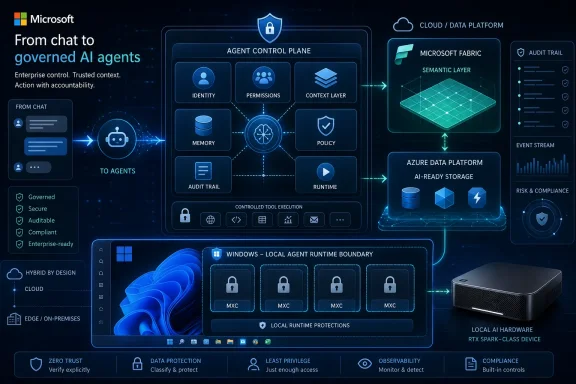 Microsoft Has Stopped Selling the Copilot Button and Started Selling the Control Plane
For the last two years, the enterprise AI pitch has been framed around assistants: a Copilot in Word, a Copilot in Teams, a Copilot in the browser, a Copilot in the IDE. That phase mattered because it normalized generative AI inside business software, but it also exposed the ceiling of the model. Summarizing a meeting, drafting an email, or querying a document is useful; it is not the same thing as reorganizing how work gets done.Build 2026 marked the moment Microsoft publicly moved the center of gravity from chat with your software to software that acts within governed boundaries. That distinction sounds like marketing until you follow it through the stack. An assistant can be wrong and annoying. An agent with credentials, files, tools, APIs, and the ability to trigger workflows can be wrong and expensive, or wrong and dangerous.
Microsoft’s answer is not simply to make the agent smarter. It is to surround the agent with infrastructure: context layers, semantic models, sandboxed execution, identity, policy, observability, and database backends designed for AI-heavy workloads. This is the dull machinery that enterprises have been asking for while vendors showed them increasingly theatrical demos.
The company is also implicitly acknowledging a problem with the first wave of Copilot deployments. Many organizations bought seats before they had redesigned workflows, cleaned up permissions, labeled data, mapped processes, or decided which tasks should be automated at all. The result has often been a mismatch between premium software pricing and ordinary productivity gains. Microsoft’s Build 2026 platform story is an attempt to shift the conversation from individual productivity to organizational execution.
That is the right pivot, but it is also a risky one. The more Microsoft makes agents into an enterprise substrate, the more it must prove that Windows, Azure, Microsoft 365, Fabric, Foundry, Entra, Purview, and Defender can behave like one coherent system rather than a collection of branded control panels stitched together by licensing diagrams.
The Real Product Is Context, Not Conversation
The most important announcement was not a single app. It was Microsoft IQ, the company’s shared intelligence layer for the agent era. Microsoft is trying to solve the problem every enterprise AI project eventually hits: models do not understand the business unless the business has been rendered into usable, permission-aware context.That problem is especially severe outside office work. In manufacturing, energy, logistics, healthcare, finance, and government, operational reality lives across documents, emails, asset registries, telemetry streams, tickets, CAD files, compliance archives, databases, and the tribal knowledge of people who have been fixing systems for twenty years. A general-purpose model cannot infer that context from a prompt. It has to be grounded in systems that know what a pump is, who owns it, what line it belongs to, when it last failed, which technician touched it, and whether an action is permitted during a production run.
Microsoft IQ is the umbrella for that grounding strategy. Work IQ captures the collaborative graph of Microsoft 365: people, meetings, files, messages, and the relationships among them. Fabric IQ provides a semantic foundation over structured business data. Foundry IQ ties agent knowledge, retrieval, planning, and orchestration into Microsoft’s developer platform. Web IQ gives agents a way to ground themselves in external information without every developer bolting on a separate search stack.
The shape of this matters. Microsoft is not merely saying that agents need data. It is saying that agents need meaning. A table of maintenance events is less useful than a semantic model that knows those events relate to a production cell, a quality excursion, a spare-parts constraint, and a service-level commitment. A folder full of documents is less useful than a permission-aware knowledge layer that knows which document is current, who approved it, and whether the agent is allowed to act on it.
This is where Microsoft’s advantage is obvious. The company already sits inside the work graph of many enterprises. It hosts the email, the meetings, the documents, the identity provider, the endpoint manager, the security tooling, the developer environment, and often the cloud data platform. If agentic AI is a context game, Microsoft begins with a formidable home-field advantage.
But that advantage is not absolute. Enterprises have spent years trying to avoid turning one vendor’s productivity suite into the de facto nervous system of the company. Microsoft IQ will be attractive because it reduces integration pain. It will be concerning for the same reason.
Fabric Becomes the Place Where Data Must Behave
The Build 2026 Fabric story is Microsoft’s attempt to turn semantic consistency into a product feature. Fabric has already been positioned as the unified data platform around OneLake, analytics, real-time intelligence, and Power BI-style business semantics. With Fabric IQ and Rayfin, Microsoft is pushing Fabric beyond analytics and into the application backend for agent-built software.Rayfin is particularly revealing. Microsoft describes it as an SDK and command-line path for building production-ready application backends on Fabric. In plain English, that means Microsoft sees a future in which developers — and coding agents — generate applications whose storage, identity, messaging, and operational data hooks are managed through the Fabric estate rather than assembled from scratch.
That is a practical answer to a real problem. Agent demos are easy when the agent writes code in a sandbox and the user applauds. Production software is harder because it needs authentication, authorization, state, storage, schema discipline, deployment paths, monitoring, rollback, and compliance. Rayfin is Microsoft’s way of saying that the agentic development pipeline needs a managed backend, not just a better autocomplete engine.
Azure HorizonDB fits the same thesis. By introducing a PostgreSQL-compatible database aimed at AI-powered applications, Microsoft is acknowledging that agentic systems stress databases differently from conventional web apps. They need transactional reliability, vector-aware retrieval, low-latency access, and integration with broader analytics and lakehouse systems. The database is not an accessory to the agent stack; it is one of the places where memory, state, and business truth collide.
For IT leaders, this raises the central architectural question: do you want Microsoft to make the agent stack coherent by pulling more of your estate into its fabric, or do you want to preserve a looser, more portable architecture at the cost of integration work? There is no free answer. The first path reduces friction and may accelerate deployment. The second protects optionality and reduces the blast radius of vendor lock-in.
Industrial firms will feel that tension sharply. Their data is not just business exhaust. It is plant history, process knowledge, asset context, quality data, engineering intellectual property, and operational risk. Once that context is modeled inside a vendor’s semantic layer, switching costs are no longer measured in license migration. They are measured in institutional memory.
Windows Is Being Recast as the Local Runtime for Agents
Build 2026 also made clear that Microsoft sees Windows as more than the place where users click on AI features. It wants Windows to become a local runtime for governed agents. That is a major shift in how the operating system is being positioned.The announcement of Microsoft Execution Containers, or MXC, is the most concrete expression of that shift. MXC is a policy-driven execution layer that lets developers declare what an agent can access — files, network resources, runtime capabilities — and have those containment rules enforced at runtime. The point is to make agent execution a first-class operating-system concern rather than an improvised mixture of application permissions, scripts, and hope.
This is not a cosmetic feature. If agents are going to operate on workstations, engineering machines, industrial PCs, and managed endpoints, they need boundaries that are legible to administrators. An agent that can read a folder, call a local tool, inspect logs, or interact with a browser is useful. An agent that can wander through network shares, exfiltrate data, trigger uncontrolled API calls, or mutate files outside its intended scope is a governance failure waiting to happen.
Windows has always been strongest when it turns messy application behavior into manageable enterprise policy. Group Policy, Active Directory, endpoint management, Defender, and application control were not glamorous, but they made Windows deployable at scale. MXC is Microsoft trying to do something similar for agents: take a new class of software behavior and make it governable by default.
That is why the industrial framing is so important. In operational technology environments, the difference between software that suggests and software that acts is enormous. A scheduling agent that proposes maintenance is one thing. An agent that touches a control workflow, modifies a configuration, or triggers a service action is another. Even when agents are not directly controlling physical systems, their decisions can affect uptime, safety, inventory, and compliance.
Microsoft is not claiming that MXC alone solves industrial autonomy. It cannot. Safety-critical environments still require deterministic controls, validation, segmentation, vendor-specific certification, and human accountability. But MXC points toward the kind of system boundary enterprises will need before they allow agents to move from office productivity into operational execution.
The Agent Swamp Is the Failure Mode Microsoft Is Trying to Preempt
The phrase “agent swamp” may sound dramatic, but it captures a real risk. Enterprises are already struggling with shadow SaaS, shadow data pipelines, ungoverned scripts, personal automation tools, and poorly documented integrations. Agents could multiply that problem because they make it easier for teams to create software actors that retrieve information, invoke tools, and perform tasks without going through traditional development channels.The danger is not that one rogue agent becomes science fiction. The danger is that hundreds of narrowly useful agents emerge across departments with inconsistent permissions, overlapping responsibilities, unclear ownership, and no shared audit model. One agent updates a ticket. Another reopens it. A third emails a supplier. A fourth changes a forecast. A fifth decides the anomaly is not worth escalating because its context is stale.
This is the enterprise version of a distributed systems problem disguised as productivity software. Agents need identity, lifecycle management, logging, permissioning, discovery, and retirement. They need to be visible to the security team and understandable to the business owner. They need to be constrained not only by what they technically can do, but by what they are organizationally allowed to do.
That is where Agent 365, Entra, Purview, Defender, Microsoft 365, and Foundry all become part of the same story. Microsoft wants to be the control plane for agents whether they operate in cloud apps, productivity workflows, developer tools, or managed Windows environments. The company is trying to extend familiar enterprise governance concepts — identity, compliance, data loss prevention, audit, threat detection — into the agent layer.
This is also where Microsoft’s platform story becomes both compelling and self-serving. A unified control plane is exactly what enterprises need. It is also exactly the kind of thing that lets Microsoft deepen its hold over the customer estate. If the agent, the data, the identity, the runtime, the workflow surface, and the audit trail all live in Microsoft’s ecosystem, the customer gets coherence. Microsoft gets gravity.
Local AI Hardware Is a Cost Argument in Disguise
The Surface RTX Spark Dev Box was one of the flashier Build 2026 announcements, but its strategic significance is not that Microsoft has discovered developer workstations. It is that local AI hardware gives Microsoft a credible answer to the economics of agentic computing.Agents are token-hungry. They iterate, plan, retrieve, call tools, inspect results, revise steps, and often run multiple model calls for a single business outcome. That behavior is very different from a user asking a chatbot to summarize a document. In a cloud-only model, every loop has a cost, and every cost becomes visible once deployments scale.
This is why local execution matters. If enterprises can develop, test, and run some agentic workloads on local hardware, they can reduce latency, contain sensitive data, and avoid sending every reasoning loop through a metered cloud service. That does not eliminate cloud AI. It changes the balance. The cloud remains essential for frontier models, large-scale orchestration, centralized governance, and burst capacity. The edge becomes the place where repetitive, sensitive, latency-bound, or cost-sensitive workloads can run closer to the work.
Microsoft’s partnership with NVIDIA around RTX Spark-class hardware and Windows support for AI developer machines fits this pattern. The company is not abandoning Azure. It is making Windows a credible endpoint in a hybrid AI architecture. That is a defensive move against cloud cost anxiety, data sovereignty demands, and competition from other AI infrastructure providers.
For developers, the appeal is immediate. A local machine tuned for AI workloads, Windows development, WSL, PowerShell, Visual Studio Code, GitHub Copilot, and agent testing reduces setup friction. For enterprises, the appeal is more strategic. They can experiment with agentic systems without immediately turning every prototype into a cloud spending debate.
The catch is that local hardware does not magically solve governance. A powerful local AI workstation can be an asset or a liability depending on how it is managed. If it participates in the same identity, policy, logging, and containment model as the rest of the estate, it becomes part of the platform. If it becomes a skunkworks box under someone’s desk running untracked models against copied production data, it becomes another shadow system.
Microsoft’s Industrial Play Is to Power the Incumbents, Not Replace Them
The industrial sector should read Microsoft’s Build 2026 announcements with a clear eye. Microsoft is not trying to become Siemens, Rockwell, Schneider Electric, ABB, Honeywell, or every other domain-specific automation vendor. It is trying to become the AI, data, identity, and runtime layer those vendors use to modernize their portfolios.That is a smarter strategy. Industrial automation is full of specialized knowledge, entrenched systems, certification burdens, safety requirements, and customer relationships that cannot be wished away by a hyperscaler. A generic enterprise agent does not understand a production line simply because it has access to a manual. The last mile of industrial AI still depends on domain models, engineering data, control systems, asset hierarchies, and vendor-specific expertise.
Microsoft’s role is to provide the foundry underneath. Azure OpenAI, Microsoft Foundry, Fabric, GitHub, Windows, and Microsoft 365 give automation vendors a platform on which to build copilots and agents without each provider having to recreate the full AI stack. That lets Microsoft capture infrastructure value even when the customer-facing brand belongs to an OT incumbent.
This is also why the context layer matters so much. Industrial AI does not fail only because models hallucinate. It fails because data is fragmented, semantics are inconsistent, permissions are unclear, and operational workflows are poorly represented in software. If Microsoft can make Fabric IQ, Work IQ, Foundry IQ, and related tooling useful to industrial partners, it becomes harder to separate the AI application from Microsoft’s substrate.
Procurement teams should therefore look beneath the product names. The badge on the industrial copilot matters less than the cloud service, model provider, identity layer, data architecture, and governance plane behind it. Two products from different automation vendors may be more similar under the hood than their marketing suggests. Conversely, two Microsoft-backed solutions may still differ dramatically in domain competence and operational safety.
The risk for customers is assuming that a hyperscaler-backed agent inherits industrial reliability by association. It does not. A governed enterprise platform is necessary, but not sufficient. Industrial deployment still requires process knowledge, validation, change management, cybersecurity review, and a brutal understanding of what should never be automated.
The Open Standards Story Is Where Buyers Need to Press Hardest
Microsoft talked extensively about agents, context, and platform integration, but customers should pay equal attention to portability. The more agentic systems depend on semantic layers, tool registries, memory stores, workflow definitions, and identity-bound execution policies, the harder they become to move. Lock-in no longer looks like a proprietary file format. It looks like a business process that only runs because six platform services understand each other.This is why Model Context Protocol support and other interoperability moves matter. MCP has quickly become a practical grammar for connecting agents to tools and data sources. If enterprises can expose tools and context through open or widely adopted interfaces, they preserve some ability to change models, runtimes, and orchestration layers over time.
But standards are not magic either. A protocol can define how an agent calls a tool without making the underlying business semantics portable. A semantic model can be exported without preserving all the governance, lineage, performance, and operational assumptions around it. A vector index can move without carrying the full meaning of the processes it was built to support.
Industrial organizations should therefore insist on data decoupling at several layers. Asset models, process definitions, telemetry histories, maintenance taxonomies, safety constraints, and engineering records should not be trapped inside any one application’s private representation. The goal is not to avoid Microsoft, AWS, Google, NVIDIA, Siemens, Rockwell, or anyone else. The goal is to avoid making the enterprise’s operating knowledge inseparable from a vendor’s current product packaging.
This is especially important because the AI infrastructure market is still unstable. Model capabilities are changing quickly. Pricing models are changing quickly. Data residency rules are changing quickly. Hardware economics are changing quickly. A decision that looks efficient in 2026 could look restrictive in 2028 if the organization has fused its operational context too tightly to one vendor’s agent framework.
Microsoft’s Build 2026 strategy is credible precisely because it offers integration across so many layers. That is also why customers must negotiate architecture, not just discounts.
The Workforce Story Is Less About Prompt Engineers Than Process Owners
The most inflated job title of the first generative AI wave may have been prompt engineer. The work was real, but the label often implied that the primary human skill was learning how to coax a model into producing a better answer. Agentic enterprise systems shift the premium elsewhere.The valuable worker in this new architecture is the person who understands the process well enough to define goals, constraints, exceptions, escalation paths, and success criteria. In a factory, that might be a reliability engineer who knows which alarms matter and which are noise. In finance, it might be a controller who understands approval thresholds and audit exposure. In healthcare, it might be an operations leader who knows when automation improves throughput and when it creates clinical risk.
The ARC framing of “context engineers” and augmented workers points in the right direction, even if the terminology may not survive. Enterprises will need people who can translate messy operational reality into semantic models, knowledge graphs, policies, and agent instructions. They will need people who can audit agent behavior and recognize when the system is optimizing the wrong thing.
That is not merely a technical role. It is organizational design. If an agent executes a workflow across sales, finance, legal, and operations, who owns the result? If it makes a recommendation based on stale context, who updates the semantic layer? If it saves time in one department by creating risk in another, who adjudicates the tradeoff?
Microsoft’s platform can supply tooling, but it cannot supply accountability. The companies that benefit from agentic AI will not be the ones that scatter agents across workflows and wait for productivity to appear. They will be the ones that redesign work around explicit decision rights, measurable outcomes, and clear boundaries between automation and human judgment.
Copilot’s Early Friction Was a Warning, Not a Verdict
It is tempting to read mixed Copilot adoption stories as evidence that enterprise AI has been overhyped. A better reading is that the first wave exposed how little value can be captured when AI is layered onto unreformed workflows. If the workflow is broken, adding a model often makes the broken workflow faster, noisier, and more expensive.This is where Microsoft’s agent platform strategy becomes more defensible. The company is trying to move beyond feature adoption metrics and toward systems that can participate in end-to-end work. That is the only place the economics can work at scale. A $30-per-user productivity add-on has to fight for justification one employee at a time. An agent that reduces cycle time in a claims process, improves maintenance planning, or prevents duplicated engineering work can be evaluated against operational outcomes.
But the bar is higher. Once Microsoft moves from assistant features to agentic execution, customers will demand more than clever demos. They will want reliability, explainability, security boundaries, audit logs, cost controls, admin visibility, and graceful failure modes. They will also want proof that agents can operate across messy enterprise environments without requiring a full migration into Microsoft’s preferred architecture.
That is the hard part. Microsoft is strongest when the customer is already deep in Microsoft 365, Entra, Defender, Azure, GitHub, and Fabric. The broader and more heterogeneous the environment, the more the company has to prove that its agent stack is open enough to govern reality rather than merely govern Microsoft-shaped reality.
The opportunity is large because the need is real. Enterprises do not want a thousand disconnected AI toys. They want a manageable execution layer. Build 2026 was Microsoft’s clearest attempt yet to offer one.
The Build 2026 Bet Comes Down to Boundaries
The practical lesson from Build 2026 is that Microsoft is trying to make autonomy acceptable by making it governable. That means the most important questions for buyers are less glamorous than model benchmarks. They are questions about context, containment, cost, and control.- Enterprises should treat Microsoft IQ as a serious attempt to turn organizational context into agent infrastructure, not as another branding layer for search.
- Windows is being repositioned as a governed local runtime for agents, with Microsoft Execution Containers pointing toward OS-level boundaries for autonomous software.
- Fabric, Rayfin, and HorizonDB show that Microsoft wants agent-built applications to land on its data and backend estate, not just call Azure models from somewhere else.
- Local AI hardware is becoming part of the enterprise cost and sovereignty argument, especially for iterative agent workloads that cannot justify endless cloud inference loops.
- Industrial customers should welcome Microsoft’s governance push while resisting any architecture that traps asset context, process semantics, or operational history in a single vendor’s application layer.
- The human work shifts from prompting models to designing, constraining, validating, and auditing the processes those models are allowed to execute.
References
- Primary source: arcweb.com
Published: 2026-06-10T12:30:08.124690

The Enterprise Agent Canvas: Microsoft Re-Architects the Operating System and Cloud Infrastructure for Governed Autonomy (BUILD 2026)
Microsoft’s BUILD 2026 announcements highlight a broader shift from chat-based assistants toward governed enterprise agents, combining semantic data layers, cloud infrastructure, Windows-based execution boundaries, and edge AI hardware.www.arcweb.com
- Related coverage: windowscentral.com
Build 2026 only makes sense if you remember Build 2025: a look back at the groundwork of the "age of AI agents" | Windows Central
Microsoft’s latest announcements build directly on the architecture it introduced a year ago.www.windowscentral.com - Official source: blogs.microsoft.com
Microsoft Build 2026: Be yourself at work - The Official Microsoft Blog
Platforms shift when developers build. We explore, choose tools, dream, create. This platform shift comes with more information than ever, ready at your fingertips. This shift, it’s about building fast AND THEN: it’s about building, operating, optimizing and observing. Securing your...blogs.microsoft.com - Official source: devblogs.microsoft.com

What's new in Microsoft Foundry | Build Edition | Microsoft Foundry Blog
Microsoft Build 2026 brings a major set of Microsoft Foundry updates for developers building agents: hosted runtimes, Toolboxes, memory, Voice Live, Foundry IQ, new models, managed compute, and trust, evaluation, and observability tools. devblogs.microsoft.com
- Official source: azure.microsoft.com
Microsoft Build 2026: Building agentic apps with Microsoft Fabric and Microsoft Databases | Microsoft Azure Blog
Microsoft Build 2026 highlights advancements in app development with Microsoft Fabric and Microsoft Databases, emphasizing a unified data and AI platform. azure.microsoft.com
- Official source: news.microsoft.com

Microsoft Build 2026: Be yourself at work - Source Asia
Build 2026: Tools, models, and AI agents to build securely with intelligence you own. news.microsoft.com
- Official source: blogs.windows.com
Build 2026: Furthering Windows as the trusted platform for development
Build is one of our favorite moments each year - a chance to connect with the global developer community and share what we’ve been building. Over the past year, we have connected with many developers pushing the boundaries of what’s possible on blogs.windows.com
- Official source: partner.microsoft.com
Microsoft Build 2026: Turning innovation into partner growth
Microsoft Build 2026 highlights AI, agents, and platform updates that create new opportunities for partners to build, scale, and deliver customer solutions.partner.microsoft.com
- Related coverage: tomsguide.com
Biggest Microsoft Build 2026 announcements — agentic AI, RTX Spark Dev Box, GitHub Copilot app, new MAI models, and more | Tom's Guide
All the big news from Microsoft's AI-focused eventwww.tomsguide.com - Related coverage: meteoraweb.com
- Related coverage: constellationr.com

Microsoft Build 2026: Windows, Rayfin, Fabric IQ and more | Constellation Research
Microsoft at Build 2026 aimed to position itself as an end-to-end platform for building and operating agentic AI systems with a set of announcements on infrastructure, models, tools, security and observability. The upshot from a series of Microsoft product announcements is that the company is...www.constellationr.com
- Related coverage: techradar.com

Microsoft Build 2026 — all the news and updates as it happened
Everything we saw at Microsoft Build 2026www.techradar.com
- Official source: adoption.microsoft.com
- Official source: cdn-dynmedia-1.microsoft.com
- Related coverage: isg.sitefinity.cloud
MSFT Blueprint 2026
Business people join puzzle pieces in office. Concept of teamwork and partnership. double exposure with light effectsisg.sitefinity.cloud
- Official source: download.microsoft.com
Assessing ‘sovereignty’ requirements and solutions with Microsoft Azure
PDF documentdownload.microsoft.com
- Related coverage: msthesource.thesourcemediaassets.com
06012026_Nadella_TRANSCRIPT_Build Dress Rehearsal
Microsoft Build 2026msthesource.thesourcemediaassets.com
