

Bozhidar Bozhanov, a senior opposition figure and former minister for electronic governance, has publicly warned that a recent Council of Ministers decision to authorise a central public procurement for Microsoft products could lock Bulgaria’s state administration into long‑term technical, fiscal and geopolitical dependencies — risks that go beyond licence renewal and touch the country’s digital sovereignty.
Bulgaria’s Council of Ministers has reportedly tasked the Minister of Electronic Governance with launching a public procurement procedure that would cover Microsoft server products, productivity subscriptions and associated support for the state administration. The procurement language, as reported, includes the phrase “or equivalent,” a formulation that opponents say could be interpreted so narrowly in practice as to favour Microsoft’s integrated stack unless procurement rules are tightly specified. The opposition’s critique is led by Bozhidar Bozhanov (also known as Bojidar/Bozhidar in some English-language reports), who has direct institutional memory of these decisions from his time in government. He acknowledges the operational reasons why a government would centralise licensing — standardisation, vendor support, and predictable updates — but argues the decision must be treated as a strategic policy choice that balances day‑to‑day efficiency against longer‑term sovereignty and contingency planning.
A separate, technical analysis prepared in civil‑tech and IT community channels mirrors the political critique: renewing or centralising licensing for a dominant vendor creates strong switching costs, concentrates critical identity and collaboration infrastructure, and can produce an outsized single point of failure unless the contract embeds rigorous portability, key‑control and auditability guarantees.
If the Bulgarian Council of Ministers and the Ministry of Electronic Governance proceed with a Microsoft‑centred framework, the state must convert product capabilities into enforceable, auditable contract obligations: customer‑managed keys, independent audits, tested exit paths, and transparent evaluation criteria. Without those guardrails, a centralised licence agreement risks creating a durable external dependency that will be costly — technically, fiscally and politically — to unwind. The choice is not binary; a well‑engineered procurement can capture the benefits of mature vendor technology while protecting strategic autonomy. The difference lies in the detail of the contract and the political will to insist on verifiable protections.
Source: БТА https://www.bta.bg/en/news/bulgaria...ned-microsoft-contract-for-state-administrat]
 Background
Bulgaria’s Council of Ministers has reportedly tasked the Minister of Electronic Governance with launching a public procurement procedure that would cover Microsoft server products, productivity subscriptions and associated support for the state administration. The procurement language, as reported, includes the phrase “or equivalent,” a formulation that opponents say could be interpreted so narrowly in practice as to favour Microsoft’s integrated stack unless procurement rules are tightly specified. The opposition’s critique is led by Bozhidar Bozhanov (also known as Bojidar/Bozhidar in some English-language reports), who has direct institutional memory of these decisions from his time in government. He acknowledges the operational reasons why a government would centralise licensing — standardisation, vendor support, and predictable updates — but argues the decision must be treated as a strategic policy choice that balances day‑to‑day efficiency against longer‑term sovereignty and contingency planning. A separate, technical analysis prepared in civil‑tech and IT community channels mirrors the political critique: renewing or centralising licensing for a dominant vendor creates strong switching costs, concentrates critical identity and collaboration infrastructure, and can produce an outsized single point of failure unless the contract embeds rigorous portability, key‑control and auditability guarantees.
What the procurement would likely cover (and why it matters)
Public statements and parliamentary materials indicate the scope under discussion includes:- Windows Server and associated server licences that host back‑end registries and critical line‑of‑business systems.
- SQL Server and other database platform licences used by publosoft 365 (Office 365) subscriptions for productivity, mail and collaboration.
- Azure Active Directory / Microsoft Entra for identity and access management.
- Azure, hybrid hosting and managed platform services where agencies move workloads into cloud or hybrid models.
Technical mitigations vendors offer — what they mean in practice
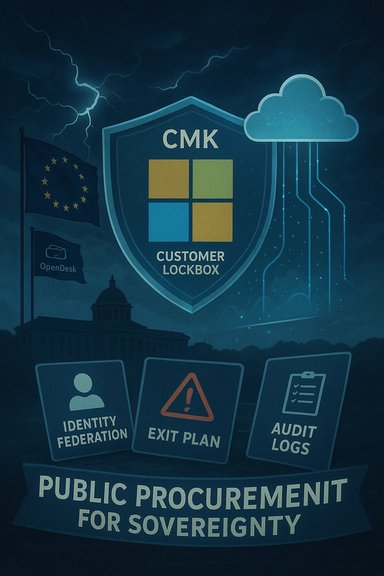
Microsoft has added a suite of public‑sector features intended to address sovereignty concerns: Azure Government offerings, Customer Lockbox, Customer‑Managed Keys (CMK) / Bring‑Your‑Own‑Key (BYOK) for encryption, and confidential computing options. These features giveal* mechanisms to limit provider access or keep keys under customer control in many workloads. Microsoft’s documentation and product pages outline how CMK and Key Vault integration work across many Azure services. However, two practical truths matter:- Not every managed service or workload supports CMK/BYOK in the same way. The presence of a technical capability in marketing materials does not automatically mean a given workload, tenant configuration or subscription will deliver the same legal or operational guarantees without specific contractual commitments and implementation validation.
- Features such as Customer Lockbox reduce but do not eliminate risk: where they apply, they require active configuration, licence tiers and operational discipline by the customer to be effective. They also rely on robust lls and audit processes to be credible.
Key risks: digital sovereignty, lock‑in and geopolitical exposure
- Identity consolidation and administrative control. Centralising identities into Azure AD/Entra provides strong SSO and conditional access benefits, but it also turns the vendor’s control plane into the administrative heartbeat of public services. ant‑hosted, recovery and mass migration are non‑trivial. Switching away from a cloud identity provider is far more complicated than repointing email or moving file storage; it often involves procedural re‑authentication, federation reconfiguration and weeks or months of application rework.
- Key ss. Customer‑managed keys are a powerful mitigation, but they are not universal across all services. Absent a clearly specified contractual guarantee that CMK will be used, regularly audited and that the vendor will cooperate in migration exercises, governments can be left with the illusion of control. The difference between “capability exists” and “capability is enforceable in contract, tested and audited” is fundamental.
- Concentration of failure and cascade risk. Centralised management, single‑tenant misconfiguration, or an outage affecting a widely used tenancy could cascade across multiple agencies simultaneously. Concentration reduces redundancy and increases systemic operational risk.
- Geopolitical and legal exposure. The ICC incident and subsequent European reactions crystallised a broader concern: actions by or pressures on U.S. authorities can, in some situations, translate into operational effects for tenants of U.S. cloud providers. The ICC has publicly moved to reduce dependence on Microsoft 365 and adopt a European open‑source stack (OpenDesk/OpenDesk‑style projects managed by Germany’s ZenDiS), a high‑profile example used by crie practical dimensions of political risk. Reporting on that migration is corroborated across multiple independent outlets. At the same time, Microsoft has denied deliberate suspension of services; the facts around any single incident are often complex and disputed, so these episodes must be treated cautiously and verified.
- Hidden migration and long‑tail costs. Replatforming legacy services away from a Microsoft server ecosystem — databases, code that targets Windows Server APIs, or custom integrations reliant on Active Directory semantics — can be a multi‑year, multi‑million‑euro effort that is rarely captured by simple licence comparators. Procurement must account for the full TCO, migration runbooks and vendor cooperation in exit scenarios.
The ICC precedent and Europe’s sovereignty push
The International Criminal Court’s decision to adopt an EU‑centric open‑source stack — reported by TechRadar, Cybernews and others — has become a symbolic and prnt for European institutions considering exposure to U.S. cloud providers. The ICC case shows how a politically sensitive organisation reacted to an episode that raised fears of a “kill switch” or sanction‑related interruption, and chose to migrate to a European, state‑backed open alternative. That decision is now frequently cited in procurement debates as an example of operational autonomy taking precedence over convenience. European states and institutions are increasing attention to digital sovereignty through a variety of measures: sovereign cloud initiatives, procurement rules that prioritise portability and auditability, and new EU regulatory frameworks that emphasise interoperability and contestability. Those broader political dynamics are relevant because they shape the non‑technical constraints that accompany large, multi‑year public contracts.What a robust public‑sector procurement should require
The technical mitigations and political context point to a clear procurement checklist. The following measures convert abstract protections into enforceable obligations:- *vendor‑named) requirements.** Define measurable requirements for identity, mail, collaboration, encryption, and availability — avoid brand‑locking language that effectively mandates a specific vendor unless a transparent equivalence test is used.
- Mandatory Customer‑Managed Keys l proof. Require CMK for every workload containing sensitive or classified data; mandate HSM backing where relevant and require proof of key rotation, separation of duties, and audit logs accessible to independent auditors. Specify which services must accept CMK and require testings first year.
- Binding exit and migration terms (and escrowed artifacts). Insist on tested exit‑for‑fee‑free migration clauses, clea, escrow of manifests and deployment playbooks, and contractual cooperation clauses that require the vendor to support a staged migration. Include penalties for obstructive behaviour.
- Independent audit and transparency. Require quarterly, independently audited compliance reports covering access requests, internal support‑engineer access (Customer Lockbox logs), and encryption key events. Publish high‑level summaries to parliament and oversight authorities.
- Staged adoption and pilot programmes. Start with pilot domains (non‑sensitive) and test portability, identity federation and incident exercise scenarios before committing large tranches of staff to cloud‑first services. Include rollback triggers tied to SLA and audit ‑vendor and hybrid architecture postures.** Where possible, require modular service design that allows critical workloads to run on state‑controlled infrastructure or alternative EU‑based providers; require documentation and interoperability tests for key APIs.
A realistic, operational procurement clause example (high level)
- Require CMK for all mailboxes, document stores and databases designated as “sensitive” or higher.
- Vendor must submit a migration plan and complete a portability proof‑of‑concept within 12 months that demonstrates full export and re‑import of 10 representative agency workloads.
- All support‑engineer accessomer tenant must be subject to Customer Lockbox, logged and auditable for a minimum of five years.
- The vendor must escrow deployment manifests and automation scripts in a neutral escrow with certified auditors, with access conditions that allow an independent third party to operate the service if the vendor fails to cooperate.
Fiscpolitics of centralised licensing
Centralised purchasing can and often does reduce short‑term licence costs and administrative duplication. A single framework agreement can produce volume discounts, unified support channels, and lower procurement overhead. But the fiscal analysis must include:- Cost of enforced CMK and associated HSMs.
- Costs for migration runbooks, third‑party audits and escrow services.
- Hardware refresh or re‑certification costs for Windows 11 readiness and compatibility with other platform changes.
- Contingency budgets for emergency migration, legal disputes or compliance remediation.
Red flags and unverifiable elements to watch for
- Procurement wording vs. operational outcome. Phrases such as “or equivalent” can be interpreted in many ways; the real test is the scoring matrix, evaluation criteria and the technical annexes that define equivalence. The public press summaries do not always include those annexes, so procurement reviewers must examine original tender documents carefully.
- Assertions about previous incidents. Reports that US authorities compelled a vendor to suspend ICC access are disputed and partially contested by vendor statements. Treat single‑incident narratives as illustrative but verify the chain of facts independently before extrapolating policy. The ICC’s migration is widely reported, but the causal attribution of service changes to government pressure remains contested in public statements. Flag these elements as politically sensitive and verify with contractual or audit evidence where possible.
- Vendor feature coverage. Marketing claims that “all services support CMK” must be validated at the workload level. Request a certified list of services, regions and configurations where CMK, Customer Lockbox, and confidential computing are available and legally enforceable.
Practical checklist for Bulgarian policymakers and CIOs
- Publish the draft procurement scoring matrix and technical annexes for public scrutiny before tender launch.
- Require independent, third‑party technical attestation that any “customer‑managed key” or “no‑access” claim is verifiably implemented and auditable.
- Fund a multi‑year migration and exit contingency line in the budget and require migration exercises within contract year one.
- Implement a hybrid identity posture as default: federated or on‑premises AD for privileged accounts and a staged approach to cloud identity for general staff.
- Insist on contractual cooperation in incident response: local forensic access, runbooks, and a joint incident escalation board with vendor representatives.
- Pilot open‑source or EU‑based alternatives for a subset of non‑mission‑critical services to preserve real options and stimulate local suppliers.
Conclusion
The procurement now under discussion in Sofia is not a narrow commercial transaction; it is a strategic infrastructure choice that will shape how Bulgarian public services operate for years to come. Microsoft’s products deliver real operational benefits: mature security tooling, a large partner ecosystem, and predictable support for many legacy systems. Those benefits explain why governments often default to the path of least resistance. But the balance of benefits and risks depends entirely on procurement design.If the Bulgarian Council of Ministers and the Ministry of Electronic Governance proceed with a Microsoft‑centred framework, the state must convert product capabilities into enforceable, auditable contract obligations: customer‑managed keys, independent audits, tested exit paths, and transparent evaluation criteria. Without those guardrails, a centralised licence agreement risks creating a durable external dependency that will be costly — technically, fiscally and politically — to unwind. The choice is not binary; a well‑engineered procurement can capture the benefits of mature vendor technology while protecting strategic autonomy. The difference lies in the detail of the contract and the political will to insist on verifiable protections.
Source: БТА https://www.bta.bg/en/news/bulgaria...ned-microsoft-contract-for-state-administrat]
