

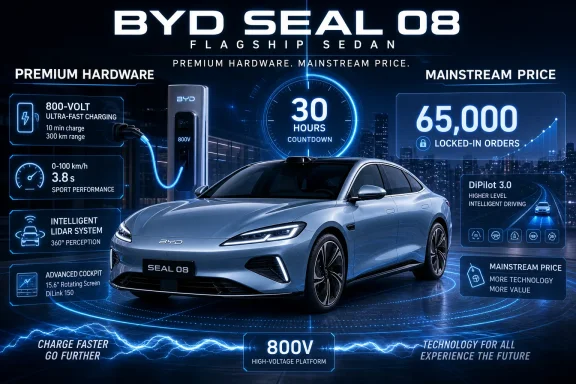
BYD Turns The Flagship Sedan Into A Volume Weapon
The Seal 08 is being sold as a flagship, but BYD has priced it like a provocation. CnEVPost and CarNewsChina reported that the sedan starts at 196,900 yuan, roughly $29,000, with both battery-electric and plug-in hybrid variants offered from the same headline entry price. That puts a 5.15-meter luxury-oriented sedan, slightly larger than a Tesla Model S by basic dimensions, into a price bracket many Western buyers associate with compact crossovers.
This is the BYD pattern in its most threatening form. The company does not merely introduce a premium feature, wait three model cycles, and then trickle it down. It industrializes the feature, packages it aggressively, and uses China’s ferociously competitive domestic market to test whether buyers will reward the bet.
The reported 65,000 locked-in orders should still be handled with care. Locked-in orders are not deliveries, and Chinese-market pre-order metrics often include deposits, blind reservations, and configurations that can change before final handover. But the scale matters even with those caveats, because this is not a $9,000 Seagull-style city car producing a viral headline. This is a large flagship sedan generating mass-market-style early demand.
The detail that should worry rivals most is the order mix. According to data attributed to Xueqiu BYD researcher Andy Ding and reported by CarNewsChina and Electrek, more than 65 percent of early orders were for the pure-electric model, with buyers favoring the all-wheel-drive version. In other words, the early crowd was not simply hunting for the cheapest BYD badge; it was gravitating toward the performance-heavy EV configuration.
The Price Is The Product
Automakers love to talk about platforms, brands, and lifestyle. BYD is talking, more bluntly, about arithmetic. A sedan with claimed 800-volt architecture, second-generation Blade Battery technology, lidar-equipped driver assistance, fast charging, rear-wheel steering on higher trims, and luxury cabin hardware lands below $30,000 before translation into other markets.
That is the strategic punchline. BYD is collapsing the distance between “aspirational” and “attainable,” especially in China, where EV consumers have become increasingly difficult to impress. A large touchscreen and a quick 0–100 km/h time are no longer enough; buyers expect advanced driver assistance, long range, fast charging, and cabin comfort as table stakes.
The Seal 08’s spec sheet reads like a deliberate attempt to erase the old segmentation map. The dual-motor all-wheel-drive version is reported at about 510 kW, or roughly 683 to 694 horsepower depending on source conversion, with a claimed 0–100 km/h time of 3.3 seconds. The longest-range EV variant is listed at up to 905 km on China’s CLTC cycle, while the AWD flagship comes in lower, at around 785 km CLTC.
Those numbers should not be confused with EPA range, and U.S. buyers in particular should resist treating CLTC figures as directly comparable to American window stickers. But the marketing effect inside China is unmistakable. BYD is selling a vehicle that says: you do not need to pay exotic money for exotic acceleration, and you do not need to pay German-luxury money for flagship equipment.
This is where the “power of a million-dollar vehicle” claim becomes more than hype. BYD is borrowing the emotional vocabulary of supercars and applying it to a sedan priced close to a well-optioned Toyota Camry in the U.S. market. The result is not just a car launch; it is an attack on the pricing logic that has protected premium automakers for decades.
Flash Charging Is BYD’s Real Infrastructure Bet
The most important Seal 08 claim may not be horsepower. It may be charging. CnEVPost reported that the Seal 08 is BYD’s first model to make flash charging standard across both battery-electric and plug-in hybrid versions, which is a subtle but important escalation from treating ultra-fast charging as a halo feature.
BYD claims the EV version can add about 400 km of range in five minutes under ideal conditions. That figure depends on compatible infrastructure, battery temperature, charging curve behavior, and local grid capacity, so it should be read as a best-case demonstration rather than a universal owner experience. Still, the strategic message is powerful: BYD wants charging time to stop being the psychological tax on EV ownership.
This is also where the auto industry starts to look familiar to the WindowsForum crowd. Fast charging is not just a battery chemistry story; it is an ecosystem story. It involves power electronics, thermal management, station deployment, standards, software negotiation, billing systems, uptime monitoring, and load management. The car is only the endpoint.
For years, Tesla’s Supercharger network was the industry’s cleanest example of vertically integrated EV infrastructure as competitive moat. BYD is attempting a different version of that play, one rooted in manufacturing scale and aggressive hardware deployment. If the company can make very fast charging feel ordinary across a broader slice of its lineup, it changes what consumers expect from every EV brand.
The PHEV angle is especially interesting. Plug-in hybrids often escape the charging-speed conversation because owners can lean on gasoline, but BYD appears to be treating electrified drivetrains as a continuum rather than a set of separate tribes. Making flash charging standard on both EV and PHEV versions tells buyers that the charging ecosystem is not an elite EV-owner perk; it is part of the whole vehicle architecture.
The Seal 08 Is A Computer With A Very Competitive Chassis
Windows enthusiasts and IT pros should resist the temptation to see the Seal 08 story as only an automotive pricing story. Modern EVs are rolling compute platforms, and China’s automakers have been unusually aggressive in bundling driver assistance, cockpit software, over-the-air update capability, and sensor arrays into mainstream vehicles. The Seal 08 continues that trend.
Reports from CarNewsChina and Electrek say all versions include lidar and BYD’s God’s Eye B driver-assistance system, with city and highway navigation-on-autopilot features and automatic remote parking. That matters because lidar and urban assisted-driving features were recently treated as premium differentiators. BYD is pushing them down into a price band where they become expected equipment.
There is a catch, of course. Advanced driver assistance is only as good as its software validation, sensor calibration, mapping support, human-machine interface, and fail-safe behavior. The hardware bill of materials can impress buyers on launch day, but the long-term trust curve is built through millions of mundane interventions: lane merges, construction zones, bad weather, confusing signage, and inattentive drivers.
Still, the direction is plain. The automobile is becoming another managed endpoint, albeit one that weighs two tons and moves at highway speed. Fleet managers will increasingly care about update cadence, telemetry, vulnerability response, data residency, and vendor accountability. That is familiar territory for IT, even if the consequences are more kinetic than a failed laptop patch.
The Seal 08 also shows how quickly expectations migrate. Once a buyer has seen lidar, fast charging, long range, luxury seating, and high-performance motors in a sub-$30,000 Chinese-market sedan, it becomes harder for rival brands to charge separately for each feature. Software-defined vehicles were supposed to create recurring revenue. BYD’s version starts by making the hardware feel cheap.
Tesla Is Not The Only Target
It is tempting to frame every Chinese EV launch as a Tesla problem, and the Seal 08 certainly invites the comparison. Its size edges into Model S territory, its acceleration claims are dramatic, and its technology stack is designed to look comprehensive. But BYD’s more immediate competitive blast radius may include Chinese rivals such as Xiaomi, Geely, Changan, Nio, Xpeng, and SAIC, along with the joint ventures still trying to defend sedan share.
The Chinese EV market is no longer a simple story of disruptors versus incumbents. It is a knife fight among companies that understand software, batteries, consumer electronics, financing, and manufacturing at scale. Xiaomi’s SU7 proved that a tech company could turn a car into a device launch with wheels. BYD’s response is to remind everyone that manufacturing depth still matters.
That manufacturing depth is BYD’s unfair-looking advantage. The company builds batteries, power electronics, electric drivetrains, and vehicles at vast scale. Vertical integration does not guarantee good products, but it gives BYD more room to move on price while still deciding where to preserve margin, where to absorb cost, and where to use a vehicle as a strategic wedge.
Legacy automakers face a harder equation. They must fund EV platforms, maintain combustion-engine lines, negotiate with dealers, protect brand hierarchies, and satisfy investors who do not enjoy margin compression. BYD can make the premium sedan segment look overpriced because it does not need to defend the same old ladder.
This is why the Seal 08’s early order count matters even if some reservations never become deliveries. A launch can change expectations before it changes market share. Rivals now have to answer why similar performance and technology cost so much more elsewhere.
China’s EV Market Is Becoming The World’s Harshest Product Lab
The Seal 08 could only emerge from a market as competitive as China’s. Domestic EV buyers have been trained by constant launches, rapid refreshes, and price cuts to expect startling improvements at startling speed. A vehicle that would be treated as a multi-year flagship elsewhere can feel like part of a quarterly cadence in China.
That pace has consequences. It creates consumer excitement, but it can also punish resale values, stress suppliers, and make last year’s car feel prematurely obsolete. Owners may gain better technology faster, yet they also live inside a market where depreciation and feature churn become part of the ownership experience.
For automakers, the same market is both laboratory and battlefield. A company that can survive China’s EV price war exits with battle-tested supply chains, faster engineering loops, and a more disciplined view of what consumers actually pay for. A company that cannot survive it may discover that brand heritage is a thin shield against a competitor with better batteries and lower costs.
Western markets often discuss Chinese EVs through the lens of tariffs, subsidies, and trade barriers, and those questions are real. But trade policy should not obscure the product lesson. BYD and its peers are learning how to ship advanced electrified vehicles at volumes and prices that make many global product plans look slow.
That does not mean the Seal 08 will arrive unchanged in the U.S. or Europe, or even that it will arrive at all in some markets. Regulatory requirements, tariffs, safety testing, charging standards, software localization, data rules, and brand perception all matter. But products do not need to cross borders physically to influence expectations. Specs, prices, and YouTube walkarounds travel instantly.
Range Claims Are Marketing, But Battery Scale Is Real
The Seal 08’s 905 km CLTC figure will grab headlines, and it should also trigger skepticism. China’s CLTC test cycle is generally more generous than the EPA methodology used in the United States, so the real-world number will be lower, especially at sustained highway speeds, in cold weather, or under aggressive driving. Buyers and analysts should not treat 905 km as a universal promise.
But dismissing the range figure entirely would miss the point. BYD’s second-generation Blade Battery branding, high-voltage architecture, and fast-charging claims show a company trying to turn battery competence into a brand pillar. In an industry where many automakers still buy cells, outsource software layers, or depend on supplier roadmaps, BYD is building the core technology closer to home.
The Blade Battery has long been central to BYD’s safety and packaging pitch. With the Seal 08, the company is tying that battery story to charging speed and premium performance. That is a more complete argument than simply saying “our car has a big pack.”
Battery strategy is also where cost matters most. If BYD can produce long-range packs at scale while keeping vehicle prices low, rivals must either accept lower margins or explain why their cars cost more. Some will point to brand, service networks, safety validation, or driving refinement. Those arguments may work for some buyers, but they grow harder as the spec gap narrows.
The real test will come after launch fever fades. Fast charging must remain reliable. Battery degradation must be acceptable. Thermal systems must hold up. Service networks must handle the new technology. A spec sheet wins attention; durability wins repeat buyers.
The Plug-In Hybrid Version Is Not A Side Story
The pure-electric Seal 08 captured most early reported orders, but the plug-in hybrid version may be just as strategically important. CarNewsChina reported PHEV variants with very long combined CLTC range claims, including figures around 1,660 km depending on configuration. Again, cycle-based range claims require skepticism, but the positioning is unmistakable: BYD wants to erase range anxiety without forcing every buyer into a pure EV.
This matters because the global EV transition is not moving in a straight line. In many markets, charging infrastructure is uneven, electricity prices fluctuate, and consumers remain nervous about long-distance travel. Plug-in hybrids offer a bridge, though only when owners actually charge them and when the vehicles deliver meaningful electric range rather than token compliance numbers.
BYD has been especially strong in plug-in hybrids because it treats them as serious electrified products, not regulatory loopholes. A PHEV sedan with fast charging, a large electric range, and premium equipment can appeal to buyers who want the EV experience most days and gasoline backup when needed. That is a pragmatic pitch in markets where charging remains inconsistent.
For rivals, this creates a two-front problem. Competing with BYD on EVs is hard enough. Competing with BYD on EVs and PHEVs simultaneously is harder, because it forces product planners to defend multiple transition paths at once.
The Seal 08 launch also suggests BYD is not interested in ideological purity. It wants volume, and it will use whichever electrified drivetrain captures the buyer. That flexibility may prove more useful globally than a single-minded bet on battery-electric adoption curves.
Premium Is Being Rewritten From Below
The phrase “flagship sedan” used to imply scarcity. It meant low volume, high margin, brand theater, and a showroom halo. BYD is turning the category into something closer to an aggressively equipped mainstream device.
That shift should make luxury automakers uneasy. If features like zero-gravity seats, augmented-reality head-up displays, lidar, advanced parking assistance, air suspension, and extreme acceleration become available at Chinese-market prices below $35,000, premium brands must defend themselves with more than badges. They need design, service, refinement, software reliability, and trust.
Some will survive that test. There is still value in build quality, crash performance, dealer support, warranty experience, noise isolation, materials, and brand identity. But the burden of proof is moving. The old assumption that high-end technology must begin at high-end prices is weakening.
This is the same pattern the consumer electronics industry has seen repeatedly. Features that once justified premium pricing migrate downward, then become invisible expectations. Fingerprint sensors, OLED screens, high-refresh displays, and multi-camera systems all followed that path. BYD is applying the same logic to cars, only with batteries and motors instead of phone screens.
The danger for incumbents is not that every buyer immediately switches to BYD. It is that BYD changes the comparison set. Once consumers believe a flagship-level sedan can cost mainstream money, every automaker above that price has to explain the delta.
Washington And Brussels Can Slow The Car, Not The Benchmark
Trade barriers can shape where the Seal 08 is sold, but they cannot make the product disappear from the global conversation. The U.S. has already taken an aggressively protective stance toward Chinese EVs, and Europe has wrestled with its own tariff and subsidy disputes. Those policies may prevent direct price shock in some markets, but they do not eliminate competitive learning.
Automakers outside China still have to benchmark the Seal 08. Engineers will study the battery pack, thermal system, software stack, suspension packaging, cost structure, and manufacturing choices. Product planners will study the price ladder. Executives will study the order book and ask whether their own flagship sedans are solving the right problems.
This is how industrial competition works now. Even if a vehicle never appears in a local showroom, its existence changes investor questions and consumer expectations. A U.S. buyer may not be able to buy a China-market Seal 08, but that buyer can still ask why a domestic EV with fewer features costs far more.
There is also a cybersecurity and data governance layer that will only grow more important. Connected vehicles collect location, driver behavior, camera, sensor, and diagnostic data. Governments will increasingly treat cars as data platforms, not just transportation goods. That will complicate the global expansion of Chinese EVs, and it will complicate the expansion of all connected vehicles.
For IT professionals, this should feel familiar. Hardware globalization, software supply chains, telemetry, update channels, and regulatory trust all collided in PCs and cloud services long before they reached the garage. The car industry is now entering the same argument, but with national security, industrial policy, and consumer mobility tied together.
The Early Order Frenzy Leaves Rivals With Fewer Excuses
The Seal 08’s reported order surge does not prove BYD has built the perfect car. It does prove that buyers are willing to respond when premium EV hardware is priced like a mainstream product. That distinction matters.
There are still unknowns. We do not yet have independent long-term tests, verified real-world charging curves, large-scale owner reliability data, or a full picture of how quickly BYD can deliver those locked-in orders. The difference between a hot launch and a durable hit is production execution.
But the launch gives rivals fewer places to hide. If a company says advanced driver assistance is too expensive to include broadly, BYD has an answer. If a company says very fast charging belongs only on top trims, BYD has an answer. If a company says premium sedans must be priced far above the mass market, BYD has a very loud answer.
The risk for competitors is not merely that BYD undercuts them. It is that BYD normalizes a faster innovation cadence. Consumers begin expecting major battery, charging, and software improvements every year, not every platform generation. That is exhilarating for buyers and brutal for companies with slow development cycles.
This is the auto industry’s version of the PC clone wars and the smartphone spec race compressed into one product category. Margins get squeezed, features spread, and the companies with the best supply chains gain leverage. The Seal 08 may be a car, but the competitive script is pure technology industry.
The Sedan That Makes The Spec Sheet A Price War Document
The concrete lesson from the Seal 08 launch is not that every claim should be accepted at face value. It is that BYD has built a product whose claims are strong enough, and whose price is low enough, to force a new conversation.
- BYD reportedly reached about 65,000 locked-in Seal 08 orders within just over 30 hours after the China launch, including earlier blind bookings.
- The Seal 08 starts at 196,900 yuan in China, putting a large flagship sedan below roughly $30,000 at current exchange-rate framing.
- The pure-electric version reportedly accounted for more than 65 percent of early orders, with buyers favoring the all-wheel-drive configuration.
- The sedan combines claimed 800-volt architecture, second-generation Blade Battery technology, flash charging, lidar-equipped driver assistance, and luxury cabin features at unusually aggressive pricing.
- The headline charging and range figures are based on ideal conditions and Chinese test cycles, so real-world results will need independent validation.
- The larger threat to rivals is expectation reset: BYD is making premium EV hardware look less like a luxury option and more like a mass-market baseline.
The Seal 08 is not just another fast Chinese EV with a giant order number attached. It is a demonstration of how quickly the center of gravity in the car business is moving toward companies that can integrate batteries, software, manufacturing, and pricing into one ruthless package. Whether or not this exact sedan ever appears in American driveways, it will appear in the planning documents of every automaker that still hopes to charge premium prices for features BYD is trying to make ordinary.